Animals and humans have a long-intertwined histories. The “domestication and socialization of animals” is described as “an interactive process of cooperation and coevolution based on a shared need for shelter, food and protection [8]. This interdependent relationship is sometimes described as human-animal interaction or human-animal bond depending on the species of the animal and the key role/function they play in people’s lives e.g. supporting livelihoods, companion or service animal, farm animal, etc.
Just like humans, animals are sentient beings with feelings and welfare needs that need to be met. The nature of the interdependent relationship and associated human-animal bond shapes and determines how humans treat their animals and how animals experience their surroundings. Thus, animals’ welfare depends on their owners, carers, and users and the animal-human bond and interactions between them, and their compassionate handling, management, and use. The stronger the animal-human bond, the more animal owners or carers are likely to invest in positive animal welfare practices, for example when animals are considered family members [9].
Exploring the following key points can support people in understanding the importance of investing in their animals’ welfare and help increase their motivation to take action to improve it:
The role animals play in people’s lives and associated benefits people experience because of their animals, and how adopting improved animal husbandry and management practices can create mutual benefits for both humans and animals.
People’s beliefs and understanding about their animals’ as sentient beings, including their feelings and needs.
Understanding animal welfare in terms of the five animal welfare domains.
How people’s attitude and behaviours influences their animals’ welfare including their handling and husbandry practices.
The following sections focus on understanding animal welfare in terms of the nature of the human-animal relationship vis-à-vis the roles that humans and animals’ play in each other’s lives.
1.1 Understanding the Importance of Animals to People
People derive benefits from their animals depending on the role that animals play in their lives, whether it be by making peoples’ lives easier by relieving their physical labour burdens, supporting livelihoods, or through contributing to people’s emotional wellbeing as companions.
It is therefore our responsibility to ensure animals live a life worth living rather than just survive.
Understanding how individuals, households, and communities’ benefit from animals is important to effectively framing communications to help motivate people to take action to improve the welfare of their animals.
The following section outlines animals’ potential benefits to people in terms of livelihood assets and well-being which you may identify through discussion and observations with communities you work with.
Figure 15: (from left to right) Illustrating how ensuring working and production animals’ welfare helps support people in meeting their livelihood needs, including firewood collection, transport of goods for people and animals, and income generation helpful to paying school fees.
Financial Capital: Animals may improve people’s opportunities for income generation, wealth accumulation, and related improvements in material living standards. Animals engage in many types of income generating activities which support people’s livelihoods and working animals may contribute to savings from hiring labour or transport. Animals may also be purchased as an investment, used to facilitate access to credit as a guarantee against a loan, and/or serve as a safety net for unexpected expenses.
Social Capital: Animals contribute to strengthening social networks and building trust and reciprocity. For example, people may lend their animals to others in need (e.g. free transport services, helping plough fields, supporting ceremonial activities), which may later see a return of support to animals’ owners in their times of need. This mutual support can contribute to enhanced resilience through strengthened social networks, and enhanced trust and reciprocity. Working animals can help women or other disadvantaged groups to carry out social responsibilities, which may increase their level of respect and status within their community. Alternatively, animal ownership, care or use can be linked to social stigmas (e.g. low socio-economic status, uncleanliness). Such stigmas can negatively affect people’s attitudes and beliefs about themselves and their animals, which can further affect how they treat their animals. It is therefore important to understand the nature of people’s relationship with their animals and related attitudes and beliefs which may be motivating or hindering them from taking action to improve the welfare of their animals.
Human Capital: animals support people’s health, attainment of skills and knowledge, and ability to work. For example, animals can act as transport providing access to healthcare services schools, and markets. They can also provide sources of nutrition’s either directly through meat and dairy products, or through farming inputs, which can promote good health. In this way, animals can support people’s attainment of knowledge and skills, as well as free up time and energy by reducing physical work burden which in turn may increase the availability of time and labour for investing in other pursuits.
Physical Capital: working animals can be a vital transport asset for goods and people, as well as provide essential sources of draught power which support agricultural production and other industries value chains’ (construction, infrastructure), which can be critical to supporting people’s livelihoods.
Natural Capital: animals themselves are natural resources natural resources from which further resources and services can be developed to support people’s livelihoods. Working animals can be also an important asset for enhancing access to natural resources such as fuel and firewood, food, feed, and water, as well through supporting agricultural inputs and outputs. Animal owners and users may also benefit from access to communal lands, water, and forest resources, or alternatively experience increased conflict over resources as a result their animal keeping.
Reducing Vulnerability: working animals and livestock can be valuable assets which contribute to communities’ resilience to natural shocks and disasters. For example, donkeys help transport water long distances to drought affected areas, help families move when natural disasters strike, and support pastoralist communities during migration.
Figure 16: Donkey’s supporting migration of Pastoralist communities in Turkana
Psychological, emotional, and spiritual well-being: animals can contribute for humans “well-being, connectedness, and resilience”, particularly in the case of domestic pets, companion animals, and service animals, by providing pleasure, relaxation, affection, loyalty, joy, and comfort [8]. In addition, animals can play a role in providing people with a sense of security through their contributions to income and food production, thereby reducing people’s exposure to unexpected shocks, and their ability to withstand shocks they may encounter. Leisure activities involving animals can also contribute to people’s sense of joy, freedom, and/or personal achievement (e.g. horseback riding, animal agility or show competitions).
Cultural and Spiritual Significance: Animals have had important cultural and spiritual significance attached to them throughout human history and are often well treated when they hold significance in cultural and religious teachings or practices [8]. Perceived cultural benefits may be derived when animals are used during cultural ceremonies like celebrations, memorials, and/or important sporting events. People may also derive cultural benefits if there is a significant cultural or group identity attached to being an animal owning community, for example cattle pastoralists’ sense of identity can be strongly linked with their keeping of animals or size of herd. In addition, understanding how animal species are depicted and characterized within cultural stories, literature, and within day-to-day sayings, as well people’s cultural values and beliefs about their animals and their identity, can provide useful insights into what drives people’s behaviours, and how to effectively communicate to motivate the adoption of improved animal welfare practices.
Figure 17: Horses supporting cultural and social activities in Ethiopia.
Horses supporting cultural and social activities in India.
Case Study Improving Animal Welfare Benefits People
In the Helwan region near Cairo, a huge collection of brick kilns produces 200 million red bricks every month in 2010, relying on over 1500 donkeys and 324 mules to pull brick carts.
Brick kiln donkeys have many welfare problems, including dehydration, poor body condition, foot problems and wounds from saddles and from beating. Due to the harsh conditions in which they live and work, their mortality rate is high, and many donkeys die young.
The Brooke Hospital for Animals supported an equine welfare improvement project to address equid welfare issues in Brik Kilns and facilitated meetings and trainings with brick kiln and animal owners to build their capacity to provide for their working animals’ welfare. Monitoring results indicated the age of working animals in brick kilns was increasing over the course of the project. Factory owners recognized that the turnover of working animals had sharply decreased, and that workers’ animals seemed to be living longer and able to be more productive and generate more income. A factory owner cited this being the result of improved donkey feeding practices during the peak working season. Another brick kiln worker and owner of several donkeys explained that water was a problem in the peak season and causing his donkeys to suffer. His solution to this issue was moving the water source inside the stable to give the animals more opportunities to drink. He noted that his animals’ health seemed to improve and that they felt so happy.
Over the years these very small adjustments have made a real difference to the welfare of the donkeys, reducing mortality rates, and prolonging their lives at the brick kilns.
Source: Mohamed Hammad, Ahmed El Sharkawy and Amro Hassan, Brooke Egypt, January 2010
There are many ways in which animals create value in our lives; however, animals’ provision of benefits to people, or lack thereof, is not the sole justification for people to address animal welfare issues. Rather understanding these benefits when they exist, along with people’s attitudes and beliefs about their animals and their treatment, can inform how best to engage people to motivate them to improve their animals’ welfare. Animals’ intrinsic value as sentient beings is sufficient reason for people to promote positive animal welfare states; however, may still require changes in social norms and values to support increased compassion for animals.
1.2 How Animal's Welfare Depends on People
The welfare of animals varies depending on a complex range of factors influencing their lives, many of which are dependent or determined by humans. Unlike wild animals, domesticated animals depend on humans for their welfare, and may not have the freedom to express their natural behaviour and depend on people to meet their needs. Working and production animals often have a very restricted and unnatural life, deprived of their freedom of movement and ability to express natural behaviours. Regardless of animal species, people who choose to keep animals are ultimately responsible for their animals’ life experiences, as these animals are dependent on people for meeting their needs.
The figure below illustrates the variety of determinants influencing animal welfare. The central, middle circle represents the animal factors which influence animal welfare, whereas the second, third and fourth layers are examples of the determinants of welfare which are dependent on humans, highlighting how much a domesticated animal’s welfare depends on people and is beyond the control of the animal them self. In the second layer, you can see direct influences on animals’ welfare related to their immediate living and/or working conditions, such as housing, nutrition, workload, handling, disease prevention and treatment, all of which are dictated by people. This could be considered in line with the five domains of welfare discussed in previous sections.
Figure 18: Determinants of Animals' Welfare (Adapted from [10])
The third layer shows the factors which influence the animal’s living and working conditions and therefore determines their welfare indirectly. These are similarly human determinants and may include the knowledge and capacity of the people who interact with the animal, the services available (including animal health services), the resources available in the locality and, among those, the specific resources that owners choose to provide, depending on what they can afford. This layer also contains the belief systems and traditions of the people dealing with the animal, the influence of their peers and social network, their social status, and their income level.
The outer layer represents more general socio-economic and environmental factors which influence the third layer. These may include social structures, income opportunities or wages, droughts and floods, mobility patterns, urbanisation, fuel prices and changes in policies. Together the third and fourth level can be considered determinants of human behaviour related to people’s capability, opportunity, and motivation for ensuring their animals’ animal welfare. Within this diagram, the human factors, or determinants of animal welfare influence each other within each layer and between one layer and the next. To be successful in sustainably improving welfare, several determinants will likely need to be addressed at the same time amongst the people regularly interacting with the animal and the systems in which animals and people live and/or work. Some factors influencing animal welfare are within the owner’s control, such as whether they are beaten, or what time of day they are fed. However, many factors cannot be influenced by individual animal owners because they are part of a wider living and working system, or socio-economic system. Thus, for people to be able to meet the needs of their animals and improve their welfare, a holistic and systems-based approach is recommended to understand and address the variety of factors influencing the behaviours of animal owning communities.
It is also important to note that animals’ welfare needs are not static. Just as the human circumstance affects peoples’ needs and related ability to meet them, animals’ needs and feelings may similarly change with the changing circumstances of their owners, and in response to changing circumstances they experience over the course of each day, season, or lifetime. The points below highlight general circumstances in which an animal’s needs may change, and which may require the people they depend on to adapt their husbandry and management practices to enable them to continue to thrive and experience positive welfare states.
Changes in the local context/environment: Animals’ welfare needs change depending on the circumstances and context as well. Sometimes when the community environmental context or circumstances change (e.g. in times of crisis or emergency), animals’ roles can change which can further result in changes in animals’ needs and related welfare (e.g. equids during humanitarian crisis, or search and rescue dogs). Changes in animals’ roles can require changes in care and management practices to meet the resultant changing needs of animals.
Animals’ welfare needs change depending on their age during their lifetime: Just like people, animals experience mental and physical changes and challenges during their lifetime. The needs and feelings of animals are likely to change as they reach middle and older age. There are many reasons for this, such as changes in nutritional needs, working ability and the amount of rest or care needed by the animal and provided by their owner.
Animals’ welfare needs change when seasons change: Within a single year, people and their working animals will experience many changes and challenges according to the climate, workload, food availability, income and other livelihood and environmental factors. In different countries and regions there will be different seasons or times of change within a livelihood system in one year and these will affect the welfare of animals.
Animals’ welfare needs change during a single day: Within a single day, working animals will experience changes and challenges to their welfare. These will be influenced by their living, working and resting conditions and their health status. They will also depend on the opportunities to experience positive feelings that are provided by their environment and the people and other animals around them.
As circumstances affecting animals’ needs change, people’s animal husbandry and management practices may need to adjust to provide for their animals’ welfare and ensure their animals continue to experience positive welfare states to the extent feasible.
The five domains framework is helpful for understanding how animals’ positive life experiences can be improved even within the contextual constraints people may face which are out of their control, since it doesn’t seek to ensure the animal is free from all issues which may not be possible.
Small changes can make a big difference to an animal’s overall welfare, with each little bit is contributing to the mental state and small gains in the animals’ overall welfare.
Look after your animals and they will look after you.
Figure 19: Woman in India checking and cleaning her working horse’s hooves to promote hoof health and prevent lameness.
1.3 Linking Human Behaviours to Positive Animal Welfare States
People have control over the lives of animals, and determine when their animals eat, drink, sleep, what they can do, where they can go, and what other animals they can meet. People are responsible for their animals’ well-being because they choose to keep animals and derive benefits from them. It is therefore important to understand who is responsible for the animals’ welfare state, and what behaviour should be targeted to improve it, as well as whether they have adequate knowledge and skills and access to sufficient resources and services to change. However, it is also essential to see things from the animal’s point of view, so not only are we asking, ‘Is the owner providing inputs or resources,’ but also: ‘Is the animal really getting what they need?’
Think about the animals in the communities where you will work, and how they spend their day. What activities comprise their day, how much time are they being active or resting? Describe who the animals depend upon to stay in a good, healthy state? Who feeds them and gives them water? Who cleans the area where they are kept? What care do people who own the animals believe they need, and who is responsible for providing that care?
It is not usually practical or realistic to give an animal absolutely everything they need to keep them feeling good all the time, every day, every season, throughout their life. However, the more animal needs that can be met, and the better their feelings are understood, the better their welfare can be. Incremental improvements in management practices and access to resources and service and decreases in poor husbandry and management practices and use of poor-quality resources and services can make a difference to animal welfare. Some changes will make an immediate, short-term difference, while others will make a sustainable, long-term difference. All of them are valuable and small steps are better than no action at all.
As animals are fully contributing members of our communities that are sentient and can feel pain, fear, and stress as well as a wide range of positive emotions, an animal can have both good and bad experiences throughout their life. Animal owning communities can therefore proactively promote good overall welfare by preventing negative experiences and promoting positive experiences. Considering and providing for the animal’s needs and feelings as much as possible, using the five domains for reference, is also important to preventing welfare problems from developing. Preventing welfare problems before they happen tends to be easier than successfully treating them when they arise and is in the best interest of animals and communities who own them. “Without good care, animals can become sick, weak, unhappy, and unproductive. For example, a working animal in a poor welfare state cannot thrive and provide a family with income in the way that a fit and healthy animal does. In contrast, if welfare problems are prevented and the needs of animals are met, animals are more likely to be in good physical condition and have fewer episodes of disease or injury and are more likely to experience greater positive emotions and less negative emotional experiences.
While understanding what animals need is a useful first step when working with animal owning communities, this understanding needs to be linked to what communities can do to meet those needs to promote behavioural change for animal welfare improvement. To do this, you can use the five domains framework to craft a similar framework linking the human behaviours communities can undertake to promote positive welfare states. A general non-species-specific example is provided in the figure below.
Figure 20: Examples of human behaviour supporting the five domains
Mapping human behaviours within the five domains is recommended when working with communities as it helps to reframe the welfare issues into actionable human behaviours that promote positive welfare states and supports animal owners to identify alternative actions for improving their animals’ quality of life, even when external constraints may impede their ability to address some welfare issues (e.g. insufficient financial resources of access to animal related services).
In addition, animals and people being dependent on one another for their well-being, their well-being is also dependent on the health of the environment, and the frameworks of One Health and One Welfare can help us to understand the interconnectedness between the realms of the health and welfare of animals, people, and the environment.
This section introduces these frameworks and their utility in understanding and addressing the “inextricable and mutually reinforcing connections between problems” amongst these three realms [11]. The two different yet complimentary concepts of One Health and One Welfare were developed to help different disciplines work together to advance solutions to common threats to the interconnected health and well-being of humans, animals and their various environments which are mutually beneficial and ensure that improvements in any one realm are not achieved at the expense of another.
Figure 21: Visualizing the concept of One Health [12]
WHAT IS ONE HEALTH?
The World Health Organization (WHO) defines One Health as an approach to designing and implementing programmes, polices and legislation and research in which multiple sectors (human health, animal health and the environment) communicate and work together to achieve better public health outcomes.
The aim of the One Health approach according to the One Health Global Network is “to improve health and wellbeing through the prevention of risks and the mitigation of effects of crises that originate at the interface between humans, animals, and their various environments [13].”
Originating to better tackle zoonotic diseases (diseases that transfer between animals and humans), One Health has since evolved its focus beyond communicable disease to include any issue that affect health outcomes (e.g. urbanization, climate change, land use, demographic changes). Taking a One Health approach will therefore seek to understand and consider the inextricable links between human, animal, and environmental health and to achieve sustainable change and optimal health in any of these areas [12].
One Health Case Study
Building veterinary paraprofessional competencies through Animal Health Mentoring Framework
Across Africa and Asia large proportion of primary animal healthcare is delivered by veterinary paraprofessionals (VPPs). However, VPPs receive varying level of training and their profession is unregulated. Their training can range from 2 weeks to 2 years and is often lecture-based (which does not teach practical skills).
As a result, we see Paravets with low confidence and competence. This leads to poor handling, low clinical skills, inappropriate treatment choice (the inappropriate use of antimicrobials), spread of disease and incorrect diagnosis. This in turn contributes to Antimicrobial Resistance (AMR) and poses a risk to the health of humans and animals alike, as well as a threat to the environment (contamination of water or soil).
Brooke has developed the Animal Health Mentoring Framework (AHMF) whereby trained mentors (usually an experienced vet or Paravets) accompany VPPs while they are attending to real life cases, providing support, and coaching as the work is carried out. This allows VPPs to develop practical skills and allows for assessment on gaps and to identify priority areas for improvement.
Improvements in VPP training and regulation are critical to OH. Well trained paraprofessional improves food safety, help reduce AMR and prevent diseases transferring from animals to humans (zoonosis). It is important to note that the AHMF applies to all species of livestock, not just equines, and as such can be easily adopted by other organizations.
Since 2013, the AHMF has been successfully used to mentor over 4,000 animal health professionals in India, Pakistan, Kenya, Senegal, Ethiopia, Afghanistan, and Nepal. As a result of the mentoring, 37% of practitioners moved from an unsatisfactory competency level to satisfactory within one year.
WHAT IS ONE WELFARE?
One Welfare is a complementary approach akin to One Health, with One Welfare similarly recognizing the interconnections between animal welfare, human wellbeing and the environment and seeks to promote multi (cross sectoral) collaborations to better optimize desired welfare/well-being benefits for animals, people, and the environment [12].
The difference in the two concepts is primarily related to their origins and fields of application, with historically One Health focused more on disease prevention and treatment within the human health sector. One welfare simply promotes a slightly broader, more all-encompassing understanding of welfare inclusive of the welfare of animals as well as people and the environment. However, as the World Health Organizations defines health as “a state of complete physical, mental and social well-being and not merely the absence of disease or infirmity” One Health and One Welfare are in fact mutually inclusive given the inclusion of physical, mental, and social well-being in the definition of health. However, whereas One Health is a more established and evidenced approach in practice that is championed by leading international organizations, One Welfare is a newer concept whose practical applications for tackling the common threats to human, animal and environmental welfare are still being explored and evidenced.
3.2 Relevance of One Health and One Welfare to Working with Communities to Improve Animal Welfare
The advantage of using a One Health/One Welfare approach when working with communities to improve animal welfare, especially in communities where animal welfare may not be a priority issue considering human and environmental issues they may be facing, is that these approaches are more likely to result in solutions that create benefits that are of interest to all, which can generate greater buy-in and motivation to change amongst communities.
The OH/OW frameworks can help explore the inter-relationships between humans, animals, and the environment realms in the following three ways:
Understanding Causal Relationships between Realms: OH/OW frameworks can help to understand how the situation or issues affecting the health and well-being of any one realm may be causing the health and well-being issues in another realm (e.g. lack of regulation of glyphosate-based herbicide use in the agricultural sector negatively impacts the health of humans and animals) [14].
Understanding/Identifying Root Causes of Issues within and Between Realms: help to understand the relationships between human, animal and/or environmental health and wellbeing in terms of shared or interlinked root causes. This may be in terms of how root causes of issues impacting health and well-being within any one realm originate from one of the other realms, as well as how issues in human, animal and environmental health and wellbeing may share root causes e.g. lack of knowledge of antibiotics and understanding of antimicrobial resistance causes their misuse and overuse which make infections harder to treat and increases the spread of disease in humans and animals [15, 16].
Shared External Threats or Risks: they can help to understand potential threats or risks to health and welfare shared by humans, animals, and the environment e.g. climate change.
Prior to developing solutions to animal welfare issues, it is helpful to first consider potential linkages between the health and well-being of animals, people, and the environment in terms of the above, and seek multidisciplinary collaborations that can better inform this understanding and support implementation of solutions which can better optimize benefits for all whenever feasible.
One Welfare | Case Study 1 Brick Kilns
In South Asia building material for the growing megacities is produced in around 152,700 active brick kilns. These kilns employ over 16 million people and 500,000 animals, mainly horses, donkeys, and mules, and produce 86% of the world’s bricks.
Workers in the kilns must endure extreme heat, dusty and polluted air, tough terrains, long hours, and hard physical labour. Many of them are women and children. In the brick kilns we have surveyed, 60% of workers lived below the poverty line, 80% had no running water and 60% had no latrine facilities. Restricted access to healthcare results in high rates of self-medication or use of unqualified doctors. Mental health is affected with 80% workers in one kiln reporting lack of pride in their work and 60% feeling no control over their lives.
Equines carry heavy loads in extreme heat, with limited access to water, food, shade, and rest. Common health issues in animals working in the kilns are hoof problems (50%), wounds (30%), abnormal gait (52%) and fear of human interaction (30%). Brick kilns are a huge contributor to pollution across the continent. According to the World Bank, the brickmaking sector is responsible for up to 91% of total particulate matter emissions (solid airborne particles) in some South Asian cities.
It was with a One Health solution in mind that Brooke has formed a coalition of organisations dedicated to improving labour conditions, animal health and welfare, child labour, and quality of the natural environment in brick kilns across South Asia: the International Labour Organisation (ILO), the South Asia Initiative to End Violence Against Children (SAIEVAC), the Donkey Sanctuary, the International Centre for Integrated Mountain Development (ICIMOD), World Wildlife Fund (WWF), ActionAid Nepal, International Union For Conservation of Nature (IUCN) and Global Fairness Initiative.
One of the interventions led by a coalition partner is the ‘Green Bricks’ initiative, which is tackling harmful kiln emissions through the implementation of new ‘clean air’ technology. ICIMOD is working with the Climate and Clean Air Coalition (CCAC) in South Asia to train brick entrepreneurs and raise awareness of new, increasingly cost effective and scalable, kiln technologies and improvements in the brick production process. One of these technologies, called zigzag, reduces coal consumption by 20% and produces up to 70% lower levels of pollution than the existing technology. Other interventions have included the introduction of human and animal first aid kits into kilns, health, and safety training, linking workers to social care and health care schemes.
One Welfare | Case Study 2 Equine welfare in the production of organic cocoa in Nicaragua
In the north side of Nicaragua, the grass-root organization ADDAC (Association for Diversification and Development of Agricultural Communities) leader in agro-ecological activities and located in Waslala, is implementing a local project to increase the access of 1,000 organic cocoa producers to fair trade markets.
This region is recognized since 1961 for its contribution of 50% of the national cocoa bean production, and almost 70% of organic cocoa production is concentrated in areas with deficient road access. The families that depend on this crop to meet their basic needs, traditionally rest on equines for key tasks of the stages of production, harvesting, primary transformation (fermented and dried) and commercialization of cocoa beans. Horses and mules participate in the preparation of the soil for sowing and fertilization, the transfer and transplantation of genetic varieties, irrigation, surveillance activities for the maintenance, health and rehabilitation of cocoa plantations, and forest regeneration. They also represent the unique means of transportation of the cocoa fruits to be transformed and placed for domestic consumption and export markets. Moreover, working equids provide raw material to produce organic fertilizer to contribute to good soil conditions for cocoa growth, and the use of animal traction, lessens the pressure on carbon emissions, which add to environmental sustainability.
Through the experience of ADDAC, in collaboration with Brooke, this organization was introduced for the first time to the Equine Welfare, and has reflected on the link between the three realms of welfare: from the perspective of cocoa producers´ wellbeing, by improving the welfare of their equids, they perceived benefits to household’s incomes since the transportation of the cocoa grains on time to crops collection centre, encourage engagement through negotiations among merchants, and families are able to cope their prioritized needs. Additionally, the dynamics of cocoa-producing families are influenced by their equines as they converge in negotiation or trade centres, fairs, and traditional events, where the bonds between people and community roots and attachment is strengthened.
These has also benefited equines since cocoa producer are more aware of equines needs and have adopted positive animal welfare practices such as: the use of proportionate loads, appropriate hooves’ care, better feeding, preventive veterinary care; the appropriate use of the equid´s services in the post-harvest activities, and the reduction of the loss of production caused by accidents suffered by working equids in poor condition. These practices have helped families to report savings of approximately $1,645 per household per year that can be invested in improvements of the quality of the cocoa production, equid welfare. In addition, cocoa qualifies for commercial certifications to acquire a better market price, which represents USD 0.45 more per sold kilogram.
In their accumulated experience, ADDAC express that they have reached a more comprehensive understanding of the agro-ecological approach under the One Welfare Umbrella, which extends beyond the use of agricultural technology for the restoration of the productive capacity of the soils, but refers to the demand of the farmer production model, involving aspects of community organization and participation, capacity for commercialization and rescue of values for the management of the environmental and animal welfare, since there is a relationship of coexistence and co-dependency.
“Animal welfare leads communities to explore the One Welfare and One Health approach, strengthening the conceptual and practical framework of work, and ADDAC to better understands the relationship between animal welfare, productivity, the environment and human development.”
Luis Rosales, Animal Welfare Technician, ADDAC
3.3 Key Considerations for Using a One Health or One Welfare Approach
Potential Benefits of Using OH/OW Approaches:
Promotes more holistic systems thinking which leads to more strategic and sustainable solutions. This can improve understanding and solutions for addressing root causes, exploring cause and effect relationships, or interdependencies that can have a spill over effect from one realm to another.
Can be a useful framework for tailoring communications in terms which speak to what stakeholders’ value and find relevant e.g. framing outreach messages to communities, donors, collaborators, or policy makers to ensure it speaks to their human or environment oriented interests rather being focused on animal welfare.
It can promote greater collaboration and interest in strategic partnerships by harnessing interest, expertise, and resources across sectors to address cross cutting issues resulting in greater efficiency in resource use and more sustainable solutions and benefits for all e.g. helps identify potential collaborators experienced in addressing human and environmental issues identified as root causes of animal welfare issues.
The One Health approach encourages a greater focus on prevention, which is justifiable due to being more cost effective, and can therefore be particularly appealing and make generating support amongst policy makers and leaders easier e.g. Using a OH approach can helps prevent pandemics like COVID 19 (Delia Grace, The business case of One Health – printed material.
Potential Limitations of Using OH/OW Approaches:
Designing every project as OH/OW project can limit the scope of issues addressed. While beneficial to utilize one health and one welfare frameworks when appropriate, projects should not feel beholden to using it, or require linkages to human or environmental health and welfare for every project. Animal welfare issues may not have linkages to human or environmental wellbeing, but that doesn’t make them any less important to address. It could potentially be more challenging to address them if communities or other stakeholders with whom you may wish to engage do not share the same animal welfare improvement priorities. In such cases, using the science of human behaviour change and best practices in participatory community engagement and development is recommended to inform project design and improve the effectiveness of implementation and attainment of desired results.
It can be challenging to collaborate and coordinate work across disciplines and different stakeholders e.g. identifying and establishing collaborations can be time consuming, there may be differences in ways of working or availability of resources that need to be resolved.
While these challenges should not be ignored, it is clear the potential benefits of collaborating in terms of the health and well-being of animals, people, and the environment, as well in terms shared resource investments in such projects, make them worthwhile when feasible.
A seasonal calendar is used to plot changes over the annual cycle. This tool provides a visual representation of seasonally varying phenomenon, such as production activities, illness and disease, migration patterns and much more [48]. This is a useful exercise to carry out with a community as part of a needs assessment and shared vision, which identifies mitigating action. This tool enables people to analyse changes across seasons in the lives of animals as well as their owners, users and/or carers, as well as how these changes may be linked to each other.
Tool purpose:
Time needed:
• To identify periods of availability and scarcity (water, food, income) to target programme activities • To identify periods of lowest and highest risk (disease, poor health, poor body condition) to target programme activities • To identify potential linkages or causal factors related to the livelihoods of animals’ owners, users and carers
1.5 - 2 hours
Materials needed:
Chart paper and markers or sticks, stones, straw, leaves, beans, seeds, pulses, coloured sand or chalk powder and/or any other locally available materials to represent each aspect in the chart
Keyword Search Tags
Project Phase: Initiation Phase
Approaches for Working With Communities: Community Development Approach, Community Engagement Approach
Behavioural Drivers (COM-B): Opportunity
Project Support: Participatory Learning and Action Tools, Needs Assessment
Specific Topics: Animal Health and Services; Livelihoods; Vulnerability/Resilience, Animal Welfare, Feelings, and Needs
Seasonal calendar of the lives of animals, their owners, users and carers
The seasonal calendar can include many aspects of life. For example, it may highlight changes in animal welfare according to seasonal variations in workloads or availability of feed, which may also be associated with changes in household income and/or expenditure. It can help the community to decide actions to improve animal welfare and plan ahead to prevent welfare from getting worse in difficult seasons, as well plan alternative livelihood strategies for times when their working animals will not be required, required less or for different purposes. Each important aspect is identified and defined by the community.
Different criteria is agreed by the community to illustrate seasonal variations in:
festivals, religious ceremonies, important local events
household income
household expenditures
consumption of animal feed and fodder, grazing or other resources
seasonal prevalence or incidence of animal diseases
general health status of people in animal-owning households
the general body condition or welfare status of animals
availability of water and/or other important natural resources
availability of work or employment and other livelihood related activities
work load of animals and humans e.g. periods of heavy work or periods of relative ease
migration patterns of animal-owning families
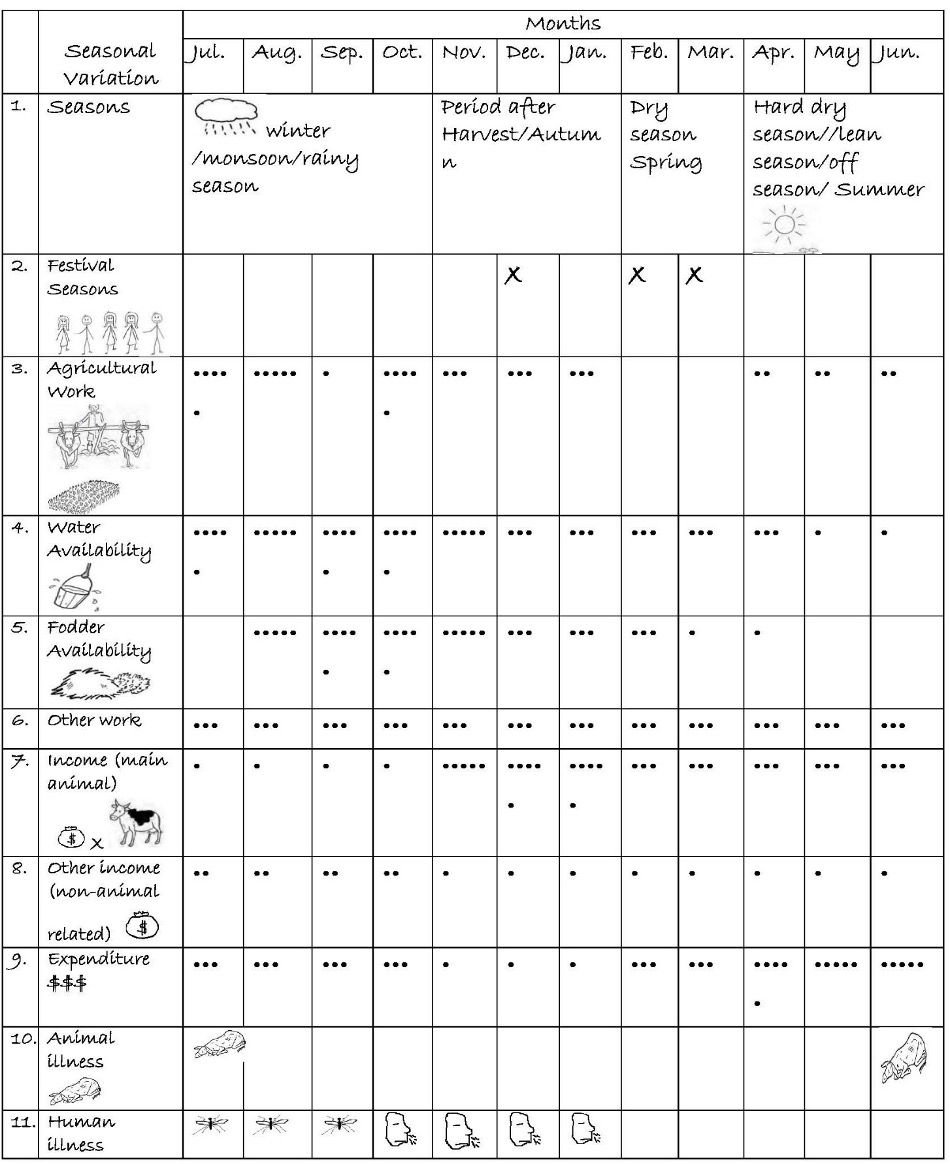
Figure T6 Seasonal calendar created by a group of animal owners in Thies, Senegal
The example above was conducted with a community, whose livelihoods depend on animals, especially during periods of agricultural harvest. Men and women primarily rely on animals to support their livelihoods, but have additional sources of income throughout the year. From this calendar, we come to understand:
There are four seasons: Winter/Rainy or Monsoon season, Autumn/Harvest time, Spring/Dry Season, and Summer/Lean Season (1st row)
Two major festivals take place (2nd row) in December and January/February
Water (4th row), harvesting (3rd row) and fodder availability (5th row) are extremely low or non-existent during the dry season (Aug-Sept) and highest during the rainy season (Oct-Dec).
Animal-related (7th row) and non-animal related (8th row) income varies between men and women, with women bringing in more non-animal-related income (8th row) throughout the year and men bringing in more animal-related income (7th row) generally.
Both income (7th & 8th rows) and household expenditure (9th row) go up during festival months.
There appears to be a relationship between animal body condition (10th row), availability of feed/fodder (5th row) and disease prevalence in animals (9th row):
Animal body condition is worse and disease prevalence (9th row) higher during summer season (Jun - July), when there is low water availability, no fodder.
Human health is also worse during the winter months (July-Sept). The issue of diseases (11th row), discussions focused on the most disease prone periods. For more details, during this exercise the communities indicated that from July to January, there is usually an outbreak of seasonal diseases like Malaria, during the rainy season (July-August-September), and; seasonal flu from October to January. Communities indicated that the fatigue accumulated during the harvesting season (3rd row) and water availability (4th row) are some of the aggravating factors.
As far as expenses (9th row) are concerned, there are fewer expenses related to household care just after the harvests. In fact, during this period consumption is mainly derived from the harvest, and expenditure concerns other aspects such as education and health. Sometime afterwards, expenditure increases due to the reduction in food stocks and the need to prepare for the next season (seeds, inputs, etc.). Taking care of the animals during this period also requires expenditure due to the scarcity of grasses.
Seasonal Calendar of the Lives of Animals and Communities
Step 1
a) Start a discussion by asking participants about the local calendar and seasonal landmarks, for example dry or rainy seasons, before or after festival periods or religious ceremonies. b) Ask the helper to draw a matrix on the ground or large piece of chart paper and list the identified seasons on the horizontal (top) axis including the months in which they fall. c) On the first line of the vertical axis, add the identified seasonal landmarks (1a). Instead of words, the group may identify unique characteristics of each season and depict these using a symbol or drawing.
Step 2
a) Move on to a discussion about the present season and their main work during this season. Add the work to the vertical axis. Then ask about: b) Other work during the year c) Income generated from the main work d) Income generated from the other work e) general house expenditures throughout the year f) Big issues related to animals and humans, such as: • Animal illness/disease • Human illness/disease • Availability of water/feed/fodder, etc.
Step 3
Decide with the group how they will display the situation. Encourage participants depict seasonal changes using locally available materials. You may also use symbols or simply write words on cards.
For example:
• Higher income levels can be shown by placing a lot of seeds/money on the month in which this occurs, while a decrease in income the next month is shown with just a few seeds. - Figure T6 used dots, or you can use dollar signs ($) for income, whereby five dots or $$$$$ = high income and a single dot or $ = low income (Rows 7, 8, 9)
• On the same note, you can use the dots to represent abundance or scarcity. Abundance can be represented by 5 dots whereas a single 1 dot represents scarcity; and those in between can show relative references to abundance or scarcity. - Figure T6 used 5 dots for periods of high-water availability, 3 dots for average water availability and 1 dot for periods of water scarcity (Row 4).
• You can also use by shading Dark colours to represent periods of abundance and light colours periods of scarcity.
Step 4
Explore the relationships between different seasonal events, activities and problems for animals and humans, especially those that show changes at the same time. The availability of resources either in the form of fodder or water availability or income or spending shows you what kind of physical opportunities are available to create an enabling environment for people to change their behaviour towards their animal’s welfare.
Also discuss any similarities between the well-being of animals and humans throughout the seasons. Once the calendar is complete, discuss the results of the activity with the group.
Step 5
Record the community’s analysis and responses in your project action tracker. Leave the seasonal calendar with the community and take a copy/picture for your records. Follow up with the community later when you start action planning together.
Facilitation Notes
In exceptional cases, where there are more than 20 people in the group, consider dividing participants into smaller groups to compare the seasonal changes amongst different groups of people. Encourage people to arrange themselves into the smaller groups with those they feel share greatest similarities (e.g. men / women, owners / users).
It may be helpful to have more than one facilitator to support/facilitate small group work and discussions, especially if there are many participants.
Before starting this exercise, discuss the calendar focus areas (which specific aspects will be examined) and how it will be used to analyse how the welfare of working animals and their related livelihoods and well-being change in different seasons. Also, how certain changes may be linked or cause challenges in their capacity to care for their animals.
Be clear that the aim of the activity is to discuss how seasonality affects animal welfare and people’s livelihoods and identify challenging seasons. In this way, participants’ expectations can best be managed, and potential frustrations or perceptions that facilitators are more interested in animals’ well-being than people, can be mitigated. This is particularly important given that some changes in livelihoods and well-being may be identified, but it may be beyond the capacity of the project to address them.
New facilitators might look into historical weather and food security reports (FEWS NET) to gain an understanding of seasonal challenges that the community might be facing before meeting with the group, which will help with identifying dry/lean, rainy/fruitful seasons and historical water shortages.
Next Steps
Seasonal calendars during the rapport building stage might accompany or be created alongside one or more of the following tools:
T3 Venn Diagram (T3a Resources and Services Venn Diagram) to understand identify animal-related resource and service providers animal-owning communities rely on most and their level of satisfaction with each one
T4 Daily Activity Schedule to understand how people and animals in animal-owning communities spend their time
QUICK LINKS T2 Mobility Map Resources and Services T2 Location of Services and Resources T2 Facilitator's NOTES T2 NEXT STEPS
T7: Historical Timeline Resources and Services
The historical timeline is an excellent tool to start building rapport with a community. This activity can provide both the facilitator and participants with insight into how participants perceive their past and which events they perceive as most important. It generates discussions and understanding of how past events have contributed to shaping, either positively or negatively, conditions in the present. This tool has been adapted to the context of animal welfare [50], and can be used to create a timeline of animals’ history in the community, including events such as their introduction to the community, changes in the way they are used, disease outbreaks, and external factors or events that affect their lives and the community members who depend on them. This tool works well when carried out with community elders.
The value of this exercise lies in the discussions that take place during the process of developing the timeline, rather than recalling or remembering every event. Discussions can highlight important issues in the lives of animals and their owners, help identify critical drivers of change and root causes of the current situation. Discussions can uncover patterns of reoccurring events and their perceived impacts. Finally, the historical timeline can act as a retrospective learning activity to bring participants’ attention to significant events, occurrences or changes that happened, and promote awareness and commitment to sustained change.
Tool purpose:
Time needed:
• Generate understanding of major past events community members perceive to be significant to the lives of animals and people. • To understand changes over time regarding working animals, their use, the livelihoods of community members who depend on them, and/or recurrent shocks or trends which influence the vulnerability of communities and their animal • Can identify key policy focus areas, or key government stakeholders or potential project partners helpful to addressing issues of shared interest.
2-3 hours
Materials needed:
Cards, pens/markers
Keyword Search Tags
Project Phase: Initiation Phase
Approaches for Working With Communities: Community Development Approach
Specific Topics: Animal Husbandry and Management; Livelihoods, Vulnerability/Resilience
Historical Timeline
The historical timeline (figure T7) begins in 1950 when the first Community Leader was elected. The first animal (ox) was purchased by Omar in 1969 and the second animals (donkeys) were purchased by Asim in 1980. This exercise was done as part of the initial interaction with the community during the rapport building phase and generated an interesting discussion on animal ownership and use in the village.
Historical Timeline
Step 1
Draw a line on the ground and show that one end represents the beginning point in lifetime of the eldest participant and the other end represents the present. Ask what is current and what is past, letting participants define the past.
Begin the discussion by asking participants to identify significant events in their community and write them on cards. They should identify whatever they feel is significant without any constraints at this stage.
Step 2
Ask participants to identify which of the significant events are important to their lives and the lives of their animals. Which events that have shaped the lives of working animals, their use of them, or the related benefits they obtain from them?
Have participants organise all identified events in chronological order. Start with the earliest event at the top, gradually adding all later events until they reach the present at the end line.
Please note: Recalling specific dates and times can be challenging. It is more important to have the events in chronological order. Encourage participants to think about the events in relation to each other or in relation to other well-known local or national events. This will enable them to work out the sequencing of events along the timeline, without wasting time agreeing on precise dates.
Then identify significant milestones or events to add to timeline (both positive and negative) related to the history of working animals in their community.
Consider using the following to guide the discussions:
• When were the first working animals introduced? • Environmental catastrophes e.g. earthquake, hurricane, tsunami, and/or floods • Introduction or occurrence of disease epidemics/outbreaks, human or animal (e.g. cholera) • Availability of services and/or resources within the community e.g. water point construction, health centre construction, animal health service providers • Introduction of new technologies e.g. animal traction, animal cart/harness design, mechanized transport, or machinery (e.g. tractors, ploughs) • Introduction of new practices e.g. building household or communal animal shelters, soil or water conservation practices, improved farming practices, food/feed storage • Introduction of new income generating activities e.g. construction jobs, renting animals, selling goods/services, sale of home-grown food production • Major seasonal changes (e.g. longer dry/rainy season) • Hard times when animal owners had to sell animals or other assets to survive • Periods of political change, major conflicts, civil unrest, war
Consider asking:
• Which actors or stakeholders were involved in the major developments or events? • Are there any other key milestones or turning points which, you feel shaped these events, either positively or negatively?
Place added events within the timeline in relation to the first event (or beginning of the timeline). Give participants time to respond individually.
Step 3
Once all events have been identified, ask participants to confirm that everything has been captured. Make necessary adjustments until participants are satisfied that the timeline represents the perceived history of their lives and lives of their animals.
Step 4
Discuss events that participants are interested in and inquire about events that you are particularly interested in better understanding.
If this activity was conducted separately with men and women, rather than collectively, bring the groups back together to compare the two timelines as appropriate to local context.
Use the following questions to help guide the discussion:
• Did any of these events lead to or cause another? • Which of these events were major obstacles or opportunities to improving the lives of working animals and people who depend on them? • How were the obstacles overcome? • Are any obstacles, issues, or challenges recurring? • Are there any other noticeable recurrent patterns of events?
If comparing the timelines between two groups (e.g. men and women), ask participants whether there any similarities and differences in events on each timeline or perceived significance of events similarities? If yes, why? You may do this together if contextually appropriate. If done collectively between men and women, you might ask which events are most significant for men and women.
Alternatively, you can compare the two results yourself and follow up with men and women participants independent of the group scenario to gain a deeper understanding of significant differences.
Step 5
As a final step, ask participants what activities and events, if any, are planned to enhance their lives or the lives of their animals?
Step 6
Once the timeline is complete, take a photo or record of the chart on a piece of paper, ensuring the community has a copy for their records. A copy is retained by the facilitator for future reference or planning. Add any notes or interesting points to your project action tracker.
Facilitation Notes
Aim to include a broad cross-section of animal-owning household members from the community, across multiple generations.
If it is not possible or locally appropriate to do the exercise collectively with both sexes, consider conducting the exercise separately with men and women. Each may recall different events due to the impacts these events had on their lives.
If possible, invite 10-20 people to participant in this exercise.
Do not lead participants into identifying events that are not important to them. While asking probing questions, emphasize including only events that they perceive to be important. Events should not be included simply because you inquired about them.
Encourage participants not to spend too much time engaged in a discussion about the exact date of events, or precisely defining timeline intervals. Make it clear that discussion on the order of events is more important.
The timeline tool can be challenging to facilitate. Maintain the focus and get broad participation. Carefully manage controversy and mitigate arguments should they arise.
Participants may find it difficult to relay events in a chronological order. People often use a local time frame that may be different from a traditional calendar year. Use your judgement to enable them to articulate time in a way in which you can both relate.
Disagreements may arise through discussions on controversial past events. Try to:
Mitigate potential disagreements and blame by keeping participants focused on facts; who did what and when they occurred.
Not to force a conclusion, as there may be different interpretations.
Have participants add their differing interpretations to the timeline.
Ask participants to explain the event from their perspective.
Include multiple timelines to reflect differing views of a single event/actor. Views can be further reflected on in subsequent discussions at the end of the exercise.
Next Steps
In order to better understand the lives and context of the animal owning community during the initiation phase, consider using the following tools in addition to the historical timeline:
T1 Mapping to understand the community’s perceived welfare issues.
T11 Change Analysis (T11a Changing Trend Analysis)to know how change happened from past to present
T4 Daily Activity Schedule to know when best to meet with men and women or children; to understand differing roles.
T6 Seasonal Calendar to identify periods of scarcity, highest risk and when animal body condition and/or resources supporting animal health and welfare are the best/worst.
This PLA may be conducted to assess change in a variety of contexts, and this tool includes guidance for two different versions, including: a) changing trends analysis, and b) before and now change analysis.
T11a: Changing Trend Analysis
A changing trend analysis helps the community to identify changing trends over time, for example over generations. Here, a ‘generation’ refers to people born and living around the same time e.g. ‘grandparents generation’, ‘parents generation’, ‘present generation’ etc. Through discussion of present and past situations, this tool enables participants to identify the significant changes that have occurred over time, promoting a greater understanding of the current situation.
Tool purpose:
Time needed:
• To reflect on changes to the lives of animals and animal-owning households within a community over time: - animal populations - reliance and use of animals - animal husbandry and management practices - disease patterns - availability and use of health services and resources - climate or other environmental factors • To generate discussion about significant changes over time and reasons for any perceived negative changes that have occurred
2 - 3 hours
Materials needed:
Cards, pens, markers, coloured powder, chalk, sticks, tree leaves, coloured cards or other locally available materials.
Keyword Search Tags
Project Phase: Initiation Phase
Approaches for Working With Communities: Community Development Approach, Community Engagement Approach
Project Support: Participatory Learning and Action Tools
Specific Topics: Animal Husbandry and Management; Animal Welfare, Feelings and Needs; Animal Health and Services; Livelihoods; Vulnerability / Resilience
Changing trend analysis
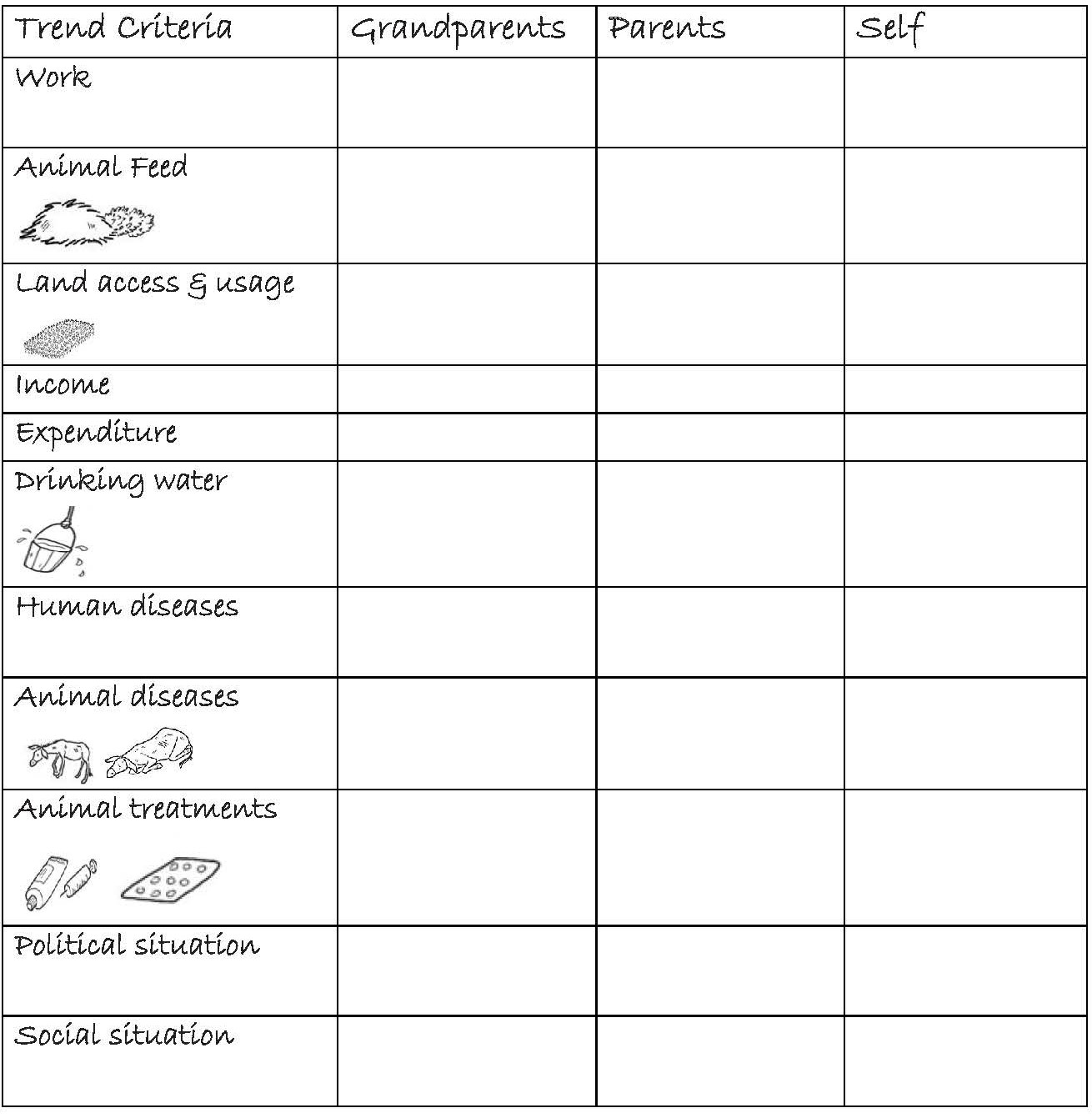
Figure T11A-1 Changing trend analysis matrix (analysis criteria on vertical axis, generations on horizontal axis)
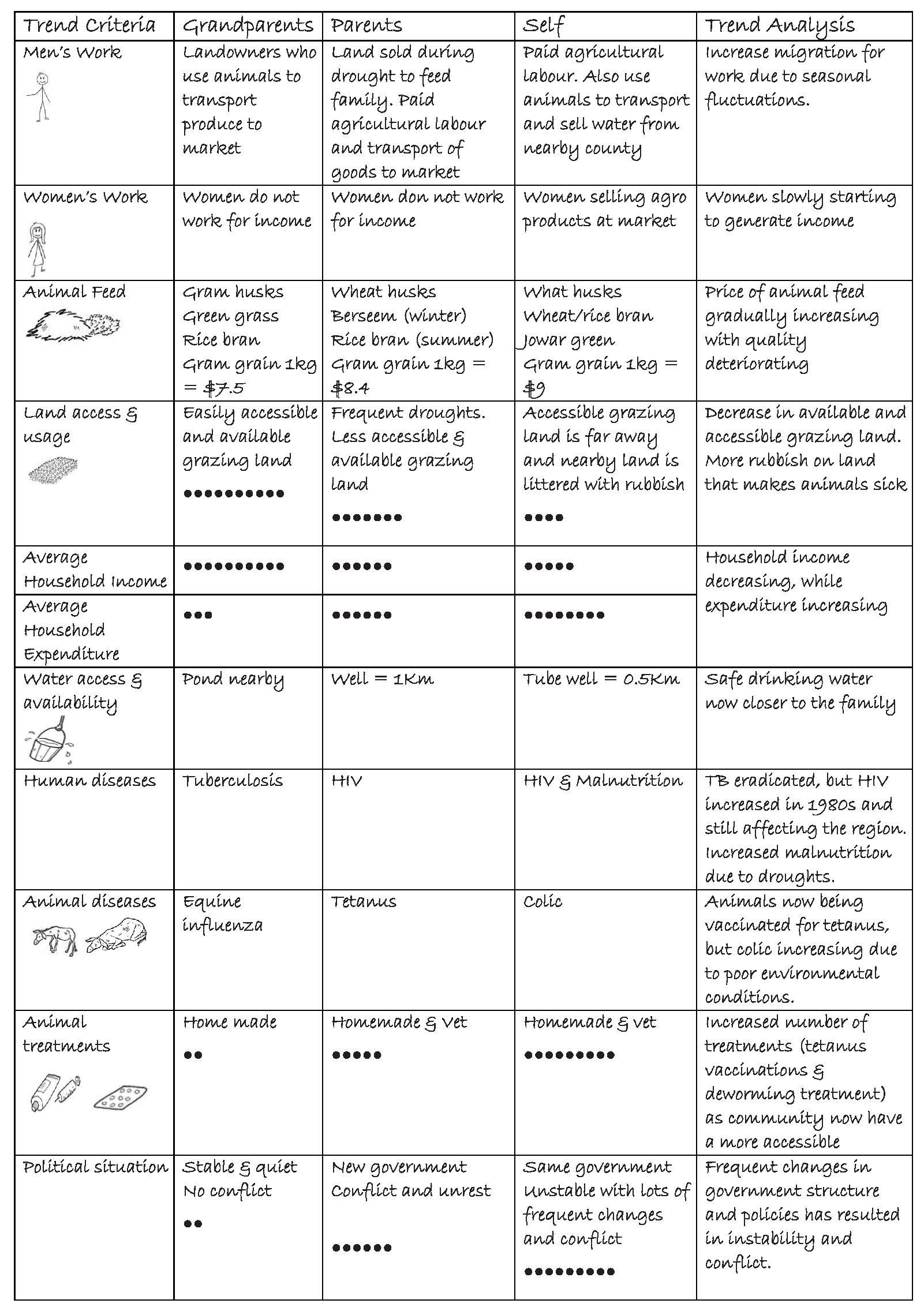
Figure T11A-2 Changing trend analysis of changes affecting potters and their working animals over four generations
The completed matrix above is the result of a changing trend analysis carried out with a group of animal-owning farmers. It was used as part of a community needs assessment and shared vision. It shows changes in work type and land ownership, quantity, type and cost of animal feed and fodder, grazing land accessibility and availability, average household income and expenditure, availability of and distance to travel for water, human and animal disease prevalence and treatment options, and changing political situation. As a result of this exercise, farmers were able to identify opportunities to mitigate the trends they identified as negatively impacting their lives and the related welfare of their animals.
Changing Trend Analysis
Step 1
Start by explaining that the purpose of the exercise is to understand how the situation in the community has changed over time, and that the group will start with the present and then look at the past. Then ask the group what changes they have experienced in their lives as compared to the past?
Examples:
• Income-generating activities for men and women (separately) • Household income • Household expenditure
Other human aspects, such as food consumption, health and illness, education, and social groups, such as religious groups, self-help & savings/loaning groups, women’s groups. Access & availability of natural resources, such as water, wood, soil, land, etc.
Then ask about changes they have experienced related to their animals.
Examples include:
• Types of animals • Animal work types • Feed practices • Health/illness • Treatment
Ask the community helper to write all identified changes on cards using words or drawings. Make sure that each criterion is specific, for example if participants say ‘water’ clarity if they mean ‘access and availability of water’. Once all changes have been identified, ask participants to select the cards representing the changes which are most important to them. It is the facilitator’s job to ensure that the ones most important to the project are included.
Step 2
Then ask participants to define a timescale for their analysis. It may be based on generations, such as ‘in our grandparents’ time’, ‘in our parents’ time’ and ‘in our time’, or other important activities, events, or years.
Ask the community helper to draw a matrix on the ground and show the chosen time scale on the horizontal axis along the top of the matrix and place the cards with the trend criteria identified in step 1 down the vertical axis (figure T11A-1).
Step 3
Next, explain to the group that they will complete the matrix and decide with the group how they wish to display the situation for each trend criteria. For example, by scoring criteria that can be measured using seeds or stones (0 to 10 for income/expenditure), and/or drawings, symbols, or words for lists of objects etc. As the group defines the scenario for each trend criteria, ask the helper to represent the situation on cards using the chosen means of display.
Step 4
Once the matrix is complete, record the trend analysis by adding a column labelled ‘analyses to the matrix.
Use the following guiding questions to facilitate a discussion about changes over time:
• What are the significant trends or changes that have occurred over time? • Are these trends/changes positive or negative? • What caused these trends/changes to occur?
In the ‘analysis’ column, write whether the change has been positive or negative and have participants expand on the negative changes. Explore the possibility and interest in taking action to address the identified negative changes.
Step 5
The matrix produced should be left with the community. Take a picture or copy and add it to your project action tracker for future reference and to assist with intervention planning.
Facilitator’s Notes: Changing trend analysis
Include a broad cross-section of animal-owning household members of all ages. Invite 10-20 people to participate in this exercise (e.g. youth, adults, elders).
If it is not possible or locally appropriate to do the exercise collectively with both sexes, conduct the exercise separately with men and women. Each may recall different events and changes due to the impacts that resulted in their lives.
Do not lead participants into identifying changes that are not important to them. While asking probing questions, emphasize identifying changes that they perceive to be important. Events or perceived changes should not be included simply because the facilitator inquiries about them.
Clarify any doubts to understand people’s perceptions about changes over time by reaching consensus amongst participants.
Next Steps
As part of a community needs assessment and shared vision, this activity might accompany one or more of the following tools to get a full picture of community dynamics and needs for project planning:
T1 Mapping to understand which resources and services are important to the community.
T2 Mobility Map to understand where people spend most of their time and how long it takes to get places.
T3 Venn Diagram(T3b Social Networking Venn diagram) to identify key individuals, groups and actors perceived to be most important to people and their animals.
T12 Dependency Analysisto understand animal-owning households’ level of dependency on external actors and their implications on resources and services important to ensuring animals’ welfare.
T11b: Before and Now Analysis Changing Trend
The before and now analysis helps the community to identify changes from the beginning to the end of an animal welfare improvement project. This tool may be used to analyse many different aspects of peoples’ lives and the lives of their animals, including changes in people’s reliance/use of animals, animal care practices, animal disease patterns and related impacts on people, availability and use of animal-related health services and resources, climate or other environmental factors affecting animals and people.
Tool purpose:
Time needed:
• To reflect on perceived changes in the lives of animals and animal owning households within the project period • As a learning and reflection tool to assess perceived changes in animal welfare and people’s behaviours as a result of community/project activities • To determine if there are remaining areas of improvement that can be addressed
2 hours
Materials needed:
Cards, pens, markers, coloured powder, chalk, sticks, tree leaves, coloured cards or other locally available materials.
Keyword Search Tags
Project Phase: Exit & Evaluation Phase
Approaches for Working With Communities: Community Development Approach, Community Engagement Approach, Societal Outreach and Campaigns Approach
Behavioural Drivers (COM-B): Motivation
Stages of Behaviour Change: Maintenance Stage
Project Support: Participatory Learning and Action Tools, Monitoring and Evaluation
Specific Topics: Animal Husbandry and Management; Livelihoods; Vulnerability/Resilience
Owners know what to look for when animals being treated by LSP
7
LSP access
Previously free services
Availability better – now have LSP phone numbers
7
Beating
Everyone used to beat their animals
No more beating
6
Figure T11B Before and now results from a group of animal owners in Faisalabad, Pakistan
The matrix in figure 11B was produced by a group of animal-owners at the end of a five year project as part of the community’s self-evaluation. They wanted to determine whether the human and animal welfare changes within their community could be sustained over time without the intervention team. The group compared the situation before the intervention to the present state, analysed what the differences meant and whether they thought that they had the skills, knowledge and tools needed to continue to improve on their own.
The group identified six key areas where change has been observed since the beginning of the animal welfare improvement project: food provision (dietary diversity), water provision (daily increase), local service providers’ skills (improvement), owners’ knowledge of good animal welfare, access to local service providers (LSPs) and beating of animals. After scoring the extent to which the majority of the community had made positive change, the group determined that more work was needed to improve LSP skills, owners’ knowledge of animal welfare, access to LSPs and beating of animals. They added the actions that they would take to the community action plan and set a date for the next meeting to focus on beating, which scored the lowest amongst the positive changes.
Before and Now Analysis
Step 1
Start by explaining to the group that they will be reflecting on changes in the lives of animals and their own community members within the project period, comparing how things were before the project to now.
Step 2
Ask the group about the present situation relating to animals’ care, use and their own livelihood status. Have the group compare the present situation to the past.
Ask:
• What are some of the changes that have resulted since project/community action plan activities were implemented? • How have things changed since the beginning of the project?
As the community comes up with the present situation, have the community helper write the changes with words or symbols on cards.
Examples of change categories might include:
• Men’s/women’s work types • Animals’ usage • Household income, expenditure, credit (group formation) • Land access & usage • Animal and human diseases and treatments • Community dynamics (more cohesion amongst group) • Climate change situation (water/feed storage) • Political situation (changes to laws, by-laws) • Environmental change (infrastructure improvements, increased availability of resources)
Please note: If the community comes up with more than 10 changes, ask participants to select the cards representing the 8-10 changes which are most important to them.
Step 3
Ask the community helper to draw a matrix on the ground or large sheet of chart paper. Label three columns ‘change in project’, ‘before’ and ‘now’. Have the helper place the cards representing the most important changes down the first column under ‘change in project’.
Then, facilitate a discussion on how the present situation has changed since the project started. The past and present situations will be defined by the community through this discussion. As each situation is defined for each of the changes, have the community helper write the results on cards and place the past scenario in the ‘before’ column and the present situation in the ‘now’ column.
Step 4
Have the community helper add a fourth column and label it ‘score’. Ask the community to score out of 10 the proportion of the community who meets the ‘now’ criteria. For example, a score of 10 = everyone has changed; 0 = no change.
Step 5
Once the matrix is complete, discuss the results of the activity with the group.
Follow the discussion by asking:
• Does everyone agree with the results? If yes, why? If no, why not? • What needs to change for everyone to achieve the desired result? - Can you achieve the desired results without our intervention? - If yes, do you feel that you have skills, knowledge, and resources to continue without the intervention team?
If the group determines that not all the project objectives have been met and wish to continue with the project, have the community helper add any identified priorities to the community action plan for later discussion and further planning.
Step 6
The matrix should be documented through photos or recreated on paper. Copies should be made and distributed to the group for their records, future reference and/or action planning. Add a copy to your project action tracker.
Facilitator’s Notes: Before and now analysis
If possible, invite 10-15 people to participate in this exercise.
If it is not possible or locally appropriate to do the exercise collectively with both sexes, consider conducting the exercise separately with men and women. Each may recall different change criteria due to the impacts that resulted in their lives.
Do not lead participants into identifying changes that are not important to them. While asking probing questions, emphasize identifying changes that they perceive to be important. Perceived changes should not be included simply because the facilitator inquiries about them.
Have the community’s original shared vision available for reference during the final discussion.
Next Steps
If the community determines it is satisfied with the changes it has achieved:
Consider using T28 Group Sustainability Mapping tool to help participants in planning to sustain their welfare improvements independently once support from the facilitating organization has ceased.
The facilitating organization may use the qualitative before and now findings of project successes to support project reporting or future funding proposals.
If participants indicate the project activities have not achieved the desired changes, update the community action plan and project action tracker with any new agreed actions. Re-evaluate persistent issues using any or all of the following tools:
T21 Animal Welfare Practice Gap Analysis to identify actions people can take, either individually or collectively, to address gaps in animal husbandry and management to improve animal welfare
A credit analysis examines existing sources of income, expenditure and credit. This motivational tool is primarily used during planning to generate interest in establishing a self-help or savings group to promote collective action. If group savings is not appropriate or part of the local culture, this tool is great for promoting the benefits of collective action to reduce common expenditures, such as animal feed or veterinary treatments.
Tool purpose:
Time needed:
• To generate interest in establishing a self-help group through collective regular savings and loaning activities. • To identify the coping strategies undertaken to meet household and animal needs. • To understand the advantages and disadvantages of credit sources and their impacts on animal welfare and people’s livelihoods. • To identify opportunities for collective action to reduce common community-wide expenditures. • To support a gender analysis during a participatory needs assessment to identify perceived differences in income, expenditure and credit between men and women.
1.5 - 2 hours
Materials needed:
Chart paper, cards & pens, or coloured chalk and other local resources that represent each source of income, expenditure and credit.
Specific Topics: Livelihoods, Group Formation / Strengthening
Income, expenditure & credit analysis
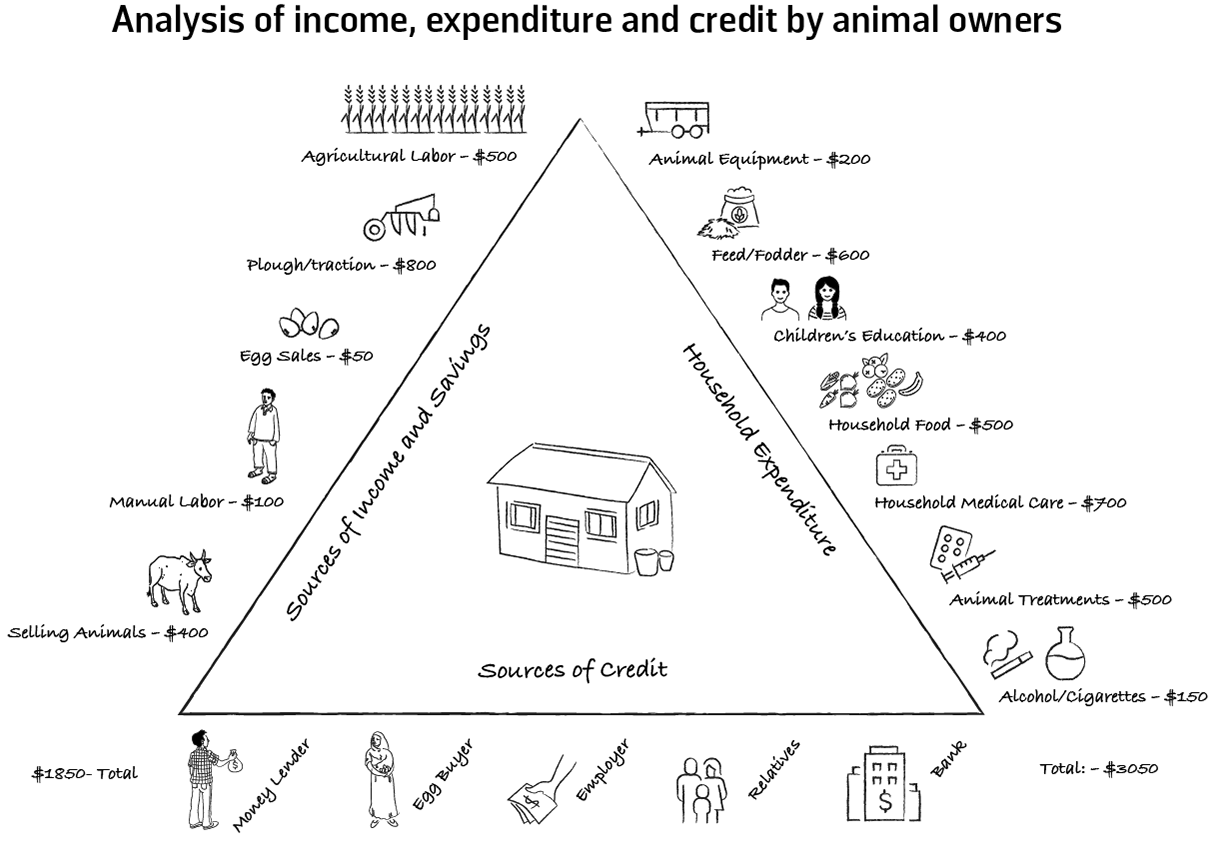
Figure T13 Analysis of income, expenditure and credit by animal owners
The figure above (T13) shows an income, expenditure and credit analysis carried out by members of animal-owning households in a community. In this example, participants were asked to allocate an estimated annual amount per household for each source of income and expenditure. They also identified where they were able to find credit when income is less than expenditure.
The diagram illustrates:
Most animal owners earn their main income through work with their animals using plough and traction ($800).
Additional income comes from agricultural labour ($500), selling animals ($400), manual labour ($100) and selling eggs ($50).
The major household expenditures are household medical treatment and health care ($700), animal feed and fodder ($600), human food ($500) and animal health treatments ($500).
Other household expenses include children’s education ($400), and animal’s equipment ($200) and alcohol and cigarettes ($150).
Many animal owners are dependent on credit from employers, the local money lender, relatives or the egg buyer.
The discussion during this exercise led the group to start their own savings fund in order to support their animal-related and household needs and reduce their dependency on high interest loans from money lenders.
Income, Expenditure and Credit Analysis
Step 1
Start by explaining the purpose of the activity and ask a community helper to draw a large triangle, either on the ground or on a large piece of chart paper. Label the left side ‘income’ and the right side ‘expenditure’. Draw arrows facing into the triangle for income and out of the triangle for expenditure (see figure T13).
Step 2
Ask participants about their various sources of annual household income. Encourage them to describe all the types, not only cash, but payments in kind (such as food, handmade goods, or other resources). Urge participants to recall both regular (daily, weekly, monthly) and seasonal income. If this activity is conducted by men and women separately, make sure that they include income from all family members. Have the helper write each source of income on individual cards using words or symbols and have participants align the cards along the outer left-hand side of the triangle.
Step 3
Have the group discuss and agree on their common major household expenditures, including animal-related expenditures. Remind them to include big items that might not be regular expenditures, such as household construction and renovations, gifts for family members and wedding expenses. Have the community helper write each source of expenditure on individual cards using words or symbols and ask participants to place the cards along the right-hand side of the triangle.
Step 4
Ask the participants to provide an estimated average annual amount for each source of income and have the helper add the amount to each card. Then, ask the group to provide an estimated average annual amount for each household expenditure and have the helper add the amount to each card.
Step 5
Total the average annual income with the participants and have the helper write it on the triangle in the bottom left-hand corner (below all the income source cards).
Total the average annual expenditure with the participants and have the helper write it on the triangle in the bottom right-hand corner (below all the expenditure cards) (see figure T13).
Step 6
Once income and expenditure have been totalled, compare the total average income with total average expenditure. If expenditures appear to be more than income, ask the participants what they do to cover the costs of expenditures that income does not cover. What do you do during a period of emergency or when unexpected costs arise (health care, gifts, ceremonies, etc.) to meet the needs of your households and animals? (Coping strategies)
Step 7
Ask participants to describe and list their various sources of credit. Have the helper write the credit sources on cards and place them along the bottom of the triangle (see figure T13).
Participants may identify reasons for selecting specific sources of credit, such as:
• ease of access • interest payments • loan repayment terms • threats and pressure (from family/friends) • the need for a guarantor • collateral and mortgage terms
Step 8
Once the triangle is complete, ask the group:
• How can you reduce common expenditures? • What are some potential collective action activities? • Why do you prefer one source of credit over another? • What are the negative implications of continuous borrowing on your own lives and your animals’? • Are there alternative options that would have less consequences or impacts?
Step 9
Record any actions the group agrees (e.g. establishing a self-help group, starting their own savings group, opportunities to take collective action to reduce expenditures) to the community action plan. For those interested in setting up a savings and/or self-help group, set a date and time to meet soon to ensure that interest is not lost.
Record actions to be taken by the team in your project action tracker and support the community by linking them to any necessary stakeholders.
Facilitator’s notes: Income, expenditure and credit analysis
The primary purpose of this tool is to generate interest in group formation. If you know that a savings/self-help group already exists, it might be more appropriate to use another tool such as T9 Matrix Ranking and Scoring (T9c credit matrix ranking and scoring) for group strengthening or T15 cost-benefit analysisto initiate collective action.
For some groups this might be a sensitive discussion. Trust is important between community members before they will have an open discussion on income, expenditure and credit, thus, it is essential to have a good understanding of the trust between participants before conducting this activity.
Decide the group dynamics ahead of time and whether it would be best carried out with men and women (or other subgroups) separately or in a mixed group. This will depend on your rapport with the community, culture and local gender dynamics.
If conducted separately between men and women, consider bringing the two groups back together at the end of the activity to review the results of each chart and resolve any differences if time allows.
If it is not appropriate to conduct this activity with men and women together in the local context, or if it could prohibit participation and freedom of discussion, consider conducting this activity separately.
This tool may support gender analysis when conducted separately with men and women, by enabling communities to identify and compare differences in perceptions of sources of income, expenditure and credit, total estimated amounts of each and the advantages and disadvantages of each source of credit. The facilitator job is to help participants explore whythese differences exist, how they help or hinder them from meeting their own and their animals’ needs and identify actions to address the differences.
Next Steps
This tool is predominantly used for action planning. Consider following this activity up with another credit analysis tool, such as T9 Matrix Ranking and Scoring (T9c credit matrix ranking and scoring) for group strengthening or T15 Cost-Benefit Analysisto initiate collective action.
Once the group has identified potential for alternative credit options, follow up with them to see if they any require further support. This might include linking the group to other programmes, or guiding them to the appropriate organisations, agencies, schemes etc.
If the group has shown interest in forming a self-help or savings group for collective action, follow this activity up with a session on forming and sustaining a group. Do not let much time pass between this activity and the next meeting or else the community might lose the momentum and enthusiasm for forming a group.
If the community has only come up with sources of income, this might be an opportunity to explore other income generation activities with the group if there is interest.
This activity provides a visual representation of a savings and loaning groups’ overall status, including the reasons for lending or borrowing money between members of a savings and loaning group. The group’s savings fund or common contributions are lent (inter-loaned) for various purposes, such as buying animal feed, paying for service provision, equipment repair and maintenance, purchase of additional animals and other household needs. Reasons for taking loans may have been identified previously through tools such as T13 income, expenditure and credit analysis and may be reviewed in their community action plan if necessary.
Tool purpose:
Time needed:
• To support a community savings group to understand their financial strength, status and potential for long-term sustainability of group savings and loaning activities. • To assess and/or monitor how group savings and loans are being used to improve animal welfare and the lives of animal-owning households. • To give an indication of loan repayments and promote accountability amongst members. • To identify opportunities for additional and/or collective income-generating activities. • To compare changes in how loans are being used (base line to end line).
2 hours
Materials needed:
Materials needed: Chart paper and markers, post-its, cards or any other local materials
Project Support: Participatory Learning and Action Tools, Monitoring and Evaluation
Specific Topics: Vulnerability / Resilience, Livelihoods, Group Formation / Strengthening
Group inter-loaning analysis
This exercise is used to assess the present status of group members’ loan repayments, thereby providing a social accountability mechanism which encourages group members to repay their loans to the group fund as originally agreed between group members.
Information gained from this activity can help participants decide where collective spending might save them money and therefore reduce their need to borrow from the fund. For example, if many group members are borrowing money to buy animal feed, a common fund could be used to buy animal feed in bulk. The group may wish to arrange vaccinations for all community animals at the same time for a reduced fee or buy resources together in bulk.
Figure T14a Group inter-loaning analysis (template)
Figure T14b Group inter-loaning analysis (sectioned)
Figure T14c Group inter-loaning analysis completed by a community
A savings group analysed the use of money lent from their common savings fund. All members of the group had taken a loan at some point. The circle rings represents:
Name of group members: Individual names of people who have an outstanding loan
Purpose of loan: The reason for taking the loan
Loan amount: Original loan amount and the repayment terms (months to repay)
Status: the amount still owing and number of months left to repay
In this savings group, most loans were taken by group members to buy animal feed. This exercise helped the group discuss where they could take action collectively for their animals, such as buying feed in bulk at a discounted price.
Group Inter-Loaning Analysis
Step 1
Take time at the beginning of the exercise to have an in-depth discussion on the group’s general activities and different projects that they work on together. This will act like an icebreaker and help participants feel more comfortable and willing to share freely before beginning any type of discussion on money or finances.
Slowly transition the discussion to focus on financial activities and on inter-loaning.
Step 2
Ask the community helper to draw a small centre in the middle of a piece of chart paper that will represent the group and label it with the group name. Then, have the helper draw four big circles around the centre circle (see figure T14a).
Ask the group generally for what purpose they take loans from the savings group.
Please note: From here, the conversation will move to the individual level, so ask the group if they feel comfortable with this and give consent to sharing individually. Assure them that the discussion will be kept confidential and that it is for the purpose group learning. Also, advise them that they are not obligated to participate if they do not feel comfortable. You can also mention that this tool has potential to be used to monitor individual progress over time, or to improve or strengthen group loaning activities.
Ask members with active loans who would like to volunteer to participate in the activity. Try to have between 6-10 participants. Remind them that this is not an individual analysis, but a group analysis. The facilitator should try to ensure that there is diversity amongst the loan purposes.
Step 3
Ask participants to write their names on separate cards or to identify themselves using different symbols. Put a card on the outside circle labelled ‘name’. Arrange the cards representing each person who has taken a loan around the outside edge of the circle. Then, have the community helper divide the circle into segments according to how many participant names are along the outer circle (e.g. 11 segments for 11 participants) (see figure T14b).
Ask participants about the purpose of their loan and have the helper write the purpose on a card. Put a card on the second outer ring labelled ‘purpose’. Add the card representing the purpose in line with the person’s name.
Ask participants about the loan amounts taken and repayment periods. Have participants write the amount and period (e.g. 2,000 / 24 months) on a card. Have the community helper put a post-it on the third outer circle labelled ‘amount & period’. Add the cards representing the amount & period in line with each participant’s segment.
Finally, ask participants about the loan balances and remaining repayment periods. Have participants write the loan balance and remaining repayment period (e.g. 500 / 2 months) on a card. Have the community helper place the card on the remaining circle labelled ‘loan statuses. Add the cards representing the loan status in line with each participant’s segment.
Step 4
Once the chart is complete, ask the group about their general observations of the final chart.
Depending on their responses, you might probe further into the terms and conditions or rules and regulations of the savings group.
Guiding questions might include:
• What are the criteria for a group member qualifying for loans? (rules & regulations governing group loans) • If defaulting has been identified, ask: what are the reasons for defaulting on loan payments? Ask for a few personal examples. • If defaulting has not been identified, ask participants whether any members have ever defaulted and why? • Are they comfortable with the rules and the terms? If no, what changes are possible? • Has there been a time when a group member needed a loan, and the group was unable to provide it? If yes, why? - What did they do about it individually or as a group? • What strategies are the group currently undertaking to increase their savings and loaning capacity? - What could they do to increase the amounts available for loaning as a group?
Step 5
At the end of the exercise, ask the group to summarise their findings:
• Highlight how animals have benefited from the group’s inter-loaning activities. For example, loans taken for: - Animal treatments and health care - Purchasing feed and fodder - Seeking health or welfare service - Materials to build a shelter
• How animals could benefit from inter-loaning activities. • How members have benefited from initiating income-generating activities individually or as a group.
After this discussion, ask participants what actions they can take from the analysis. Have the community helper record the actions and any specific activities in the community action plan. Make sure to include who will monitor it and a realistic timeline. Support the community by linking them to any necessary stakeholders. Add the outputs of this activity to your project action tracker and any action points to follow up on.
Facilitation Notes
This exercise is ideal for a community-based group of animal owners that has been operating for at least one year, with members making regular contributions to a common savings fund and accessing group loans.
Consider removing the individual names from the outside of the circle and replacing them with symbols or numbers to make those who volunteered feel more comfortable and willing to share during the analysis.
It is best to do this exercise without referring to the group’s register or ledger of savings and loans. If any queries arise, look at the register together at the end of the exercise and make changes to the chart then if needed.
Encourage each group member to tell you about their loan amounts themselves. Discourage one particular member or group leader from leading the exercise and talking about or for the other members.
Next Steps
Revisit the actions and activities in your project action tracker in the next meeting to monitor their progress and what further support is required.
Repeat the inter-loaning analysis annually to assess changes and promote accountability amongst members.
If conducted in the exit and evaluation phase and results of the activity have shown that the savings and loaning group is well-functioning, consider carrying out a sustainability mapping exercise to help the group determine whether they can continue without help from the facilitating organization.
This PLA may be conducted to explore the potential benefits, risks and affordability of different practices to enable participants to thoroughly examine the implications of their choices for more informed decision-making. This tool includes step-by-step guidance for three different versions, including:
This tool explores the potential benefits, risks, and affordability of adopting different animal welfare-related practices to both people and their animals, thereby enabling participants to thoroughly examine the implications of their choices for more informed decision making. By promoting understanding of the benefits of changing their behaviours or practices to improve animal welfare, along with the costs and effects of existing practices, this exercise promotes animal welfare improvements by generating motivation and commitment to change, and identifies opportunities for reducing costs through collective action.
Tool purpose:
Time needed:
• To promote understanding of the potential effects/costs and benefits of improving animal welfare practices for both animals and people. • To motivate participants to adopt new practices, either independently or collectively, to improve the welfare of their animals. • To identify ways to reduce costs of adopting new practices to improve animal welfare through collective group action.
2 hours
Materials needed:
Chart paper, index cards or sticky notes, pens/markers, chalk and/or locally available materials
Project Support: Participatory Learning and Action Tools
Specific Topics: Animal Husbandry and Management Practices, Livelihoods, Group Formation / Strengthening
Cost-benefit analysis of animal welfare practices
This exercise facilitates assessment of the costs and benefits of adopting different animal husbandry and management practices such as: feeding and watering, sheltering, humane handling, freedom of movement/no hobbling, allowing animals to socialize together, grooming, using welfare friendly equipment etc.
In the example below, animal-owning participants assessed the costs and benefits of adopting animal welfare practices that were previously identified as gaps during the T21 Animal Welfare Practice Gap Analysis.
T15a Cost-benefit analysis of improved animal welfare practices
The above example was produced by a group of animal-owners in a brick kiln community in Pakistan who identified lack of provision of balanced feed as an animal welfare practice gap.
Through discussions, the group identified the following as key learnings:
A balanced ration can be purchased by spending only Rs 50 more per day individually
Keeping the animal healthy is not only important for the health and wellbeing of the animal, but also for the family
Through discussions, the group identified the following possible solutions:
A few people decided that they would add maize to their regular feed ration
The group agreed to explore purchasing feed in bulk because it will save time and they can purchase it collectively at a reduced cost
Cost-benefit Analysis of Animal Welfare Practices
Step 1
Before undertaking this activity, identify key behaviours necessary for improving animal welfare that have been difficult to change amongst the community. For this exercise, have the community select only one hard to change behaviour for analysis at a time, where low motivation and/or high costs have been identified as hindering adoption.
Step 2
Start by drawing a matrix and write the difficult behaviour selected in step 1 in the top row. Ask a community helper to assist in creating the matrix if time and capacity permits.
Step 3
Start the discussion by asking the group to identify the perceived costs of adopting the practice, in terms of money, time and labour. Allow the community to identify the costs important to them without leading them and have the community helper write the costs on cards using words or symbols and place them in the matrix.
Step 4
Once the costs of adopting the new practice is identified, ask participants to specify the benefits to the animal. After the benefits to the animal are identified, ask participants to identify the benefits to the household and have the community helper write the benefits on cards using words or symbols and place them in the matrix.
Step 5
Once the matrix is complete for adopting the new practice, ask participants to identify the effects/costs on the animal if the new practice is not adopted. After these effects/costs to the animal are identified, ask them to identify any effects/costs on the household. Have the community helper write the effects/costs on cards using words or symbols and place them in the matrix.
Step 6
Once the matrix is complete, review it with participants to assess the costs and benefits of adopting the new practice. The following guiding questions may be used to facilitate the discussion:
• What have you learned from this exercise? • What are possible solutions to reduce the negative impacts to animal welfare and your household, while also mitigating the potential costs to your household of adopting the new practice? (Either at household or group level) • Who needs to do what differently and how often?
Have the community helper document the key learnings and possible solutions from the discussions. Based on the discussion, prompt the group to decide on what actions they wish to take, any support needed and who will monitor. Add them to the community action plan.
Step 7
The matrix should be left with the community. A copy should be made for reference for future discussions and action planning. Add a copy to your project action tracker along with any identified needs for support or actions that need to be taken by the project. Make sure to add identified gaps in knowledge or understanding to your action tracker, as well as any plans to further sensitize animal-owning households in these areas.
Facilitator’s notes: Cost-benefit analysis of animal welfare practices
This tool is best conducted with participants who have already been introduced to concepts of animal welfare, understand animals’ needs and best practices. Consider using any or all of the following tools before undertaking a cost-benefit analysis. T19, T21, and T22 are particularly recommended, as reviewing their findings prior to this activity can help to identify the hard to change behaviours.
Make sure that participants consider more than just the financial costs when deciding whether to adopt any new practices.
It may be useful for professionals, such as vets or community animal health workers, to be present for this activity to advise on the animal welfare implications of any identified solutions. This will promote understanding of costs and benefits to animals and resolve any misconceptions about animal welfare issues and best practices.
Consider using any combination of writing, drawings, symbols or number scoring and/or locally available materials to represent costs and benefits identified to enable participants to understand and discuss the matrix once finalized.
When participants’ are considering the effects on the animal, encourage them to think about the physical, behavioural, mental/emotional state of the animal.
In contexts where male and female household members have different animal-related roles and responsibilities (e.g. ownership, care, use, financial decision making), conduct this activity with all household members who have key roles and responsibilities associated with the specific animal welfare practices being assessed and for which change is desired.
When new practices or behaviours are relatively easy to adopt with little risk or cost (e.g. grooming), it may be possible to assess more than a few behaviours in one session without overwhelming participants.
As changes in existing practices are achieved, and/or new priorities emerge, consider conducting this activity again to generate motivation for change in other animal welfare and management practices.
Next Steps
The following tools are recommended for use as a reflective learning exercise to understand whether any of the originally perceived costs and benefits were realized as a result of changes adopted to practices:
Participants may monitor animal-based welfare indicators to assess changes in animal welfare resulting from their changes in practice. Consider using animal-based welfare indicators developed in the following exercises:
T15b: Cost-Benefit Analysis - Prevention and Treatment of Animal Health Issues
This tool explores the potential benefits, risks, and affordability of preventing and treating animal health issues to both the animal and their owners, users and carers thereby enabling participants to thoroughly examine the implications of their choices for more informed decision making. By promoting understanding of the benefits of changing their behaviours or practices to improve animal welfare, along with the costs of inaction, this exercise can support animal welfare improvements by generating motivation and commitment to change, and identify opportunities for reducing costs through collective action.
Tool purpose:
Time needed:
• Promote understanding of the potential costs and benefits of preventing and/or treating animal health issues and effects of inaction for both animals and people. • To motivate participants to take action, either independently or collectively, to improve the health their animals. • Identify ways to reduce costs of adopting new practices to improve animal health through collective group action.
2-3 hours
Materials needed:
Chart paper, index cards or sticky notes, pens/markers, chalk, stones, pebbles, local materials (leaves, seeds, etc.)
Stages of Behaviour Change: Contemplation, Preparation Stage
Project Support: Participatory Learning and Action Tools
Specific Topics: Animal Health and Services, Livelihoods, Group Formation / Strengthening
Cost-benefit analysis of prevention and treatment of animal health issues
This version of the cost-benefit analysis promotes prevention and treatment of animal diseases or illnesses by assessing the costs and benefits of each to humans and animals, and potential effects if no action is taken. This activity can identify opportunities for collective action to reduce the costs associated with preventing and treating some animal health issues e.g. reduced rate group vaccinations.
In the example below, a cost-benefit analysis was conducted with an animal-owning group when prevention and treatment of animal illnesses were identified as a gaps in their welfare practices using the T21 animal welfare practice gap analysisexercise. The costs and benefits of prevention and treatment were assessed for the two highest priority illnesses previously identified by the community using the T8 pairwise ranking and scoring.
T15b Cost-benefit analysis of preventing and treating tetanus and colic
Cost-benefit analysis of prevention and treatment of animal health issues
Step 1
Before undertaking this activity, identify a priority disease or illness which has been difficult to encourage the community to adopt prevention or treatment measure. Consider reviewing findings from T1c Mapping - disease, T8 pairwise ranking and scoring or T9 matrix ranking and scoring to identify priority illnesses or diseases to analyse with the group. For this exercise, select only one disease to analyse at a time.
Step 2
Start by asking the community helper to draw a matrix and list ‘prevention’ and ‘treatment’ along top of the matrix.
Step 3
Ask participants about the main factors they consider when weighing the costs and benefits of preventing or treating the animal disease/illness being assessed. The group may add as many factors as they feel necessary.
The facilitator may probe the participants to consider the following factors if not initially identified, however factors should only be included which the participants use to inform their decision making:
• Cost of treatment/prevention • Disease/illness frequency • Severity • Prevention/treatment cost • Effectiveness • Loss of work/income due to animal illness (for working animals)
Ask the community helper to list identified factors in the first column of the matrix.
As a facilitator, ensure that the benefits to both animals and people are well represented by adding ‘benefits/effects on animal’ and ‘benefits/effects on household’ to the matrix once participants have identified the factors they consider when deciding whether to take preventative measures for illness/disease being assessed. Facilitate the group to fill in the matrix.
Step 4
Once the matrix is complete, review with participants.
Use the following guiding questions to facilitate the discussion:
• What have you learned from this exercise? • What are the benefits to both animal and household of taking preventative measures rather than seeking treatment? • What are possible solutions for reducing this disease/illness that reduce the costs for households? • Are there opportunities to take collective action to reduce the costs? • What steps would you take to put these solutions into practice?
Based on the discussion, prompt the group to decide on what actions they wish to take, any support needed, responsible parties and add them to the community action plan.
Step 5
The matrix should be documented, either through photos or recreated on paper. Copies should be made and distributed to the group for their records and for reference for future discussions and action planning. Add a copy to your project action tracker along with any identified needs for support or actions that need to be taken by the project.
Facilitator’s Notes: Cost-benefit analysis
As this exercise may take some time to complete, limit the number of assessed diseases/illnesses to the main 2-3 priorities. More can be added as time permits or the activity can be conducted again in the future to assess other illnesses/diseases. This is important to reducing the likelihood that participants’ become overwhelmed and/or demotivated to change as a result of the number of changes they are being asked to consider.
As changes in existing practices are achieved and/or new priorities emerge, consider conducting this activity again to generate motivation for change in other animal welfare and management practices.
This tool is best conducted with participants’ who have already been introduced to concepts of animal welfare, understand animals’ needs and best practices. Consider using any or all of the following tools before undertaking a cost benefit analysis:
In contexts where male and female household members have different animal-related roles and responsibilities (e.g. ownership, care, use, financial decision making), conduct this activity with all household members who have key roles and responsibilities associated with the specific animal welfare practices being assessed, and for which change is desired.
If literacy amongst participants is low, consider filling in the matrix using symbols, drawings, or number scoring rather than written text to represent general concepts (e.g. +/-, ?/?/☹). The facilitator is responsible for asking questions and facilitating discussions about representations in the matrix to promote understanding and engagement of all participants. See example in animal feed cost-benefit analysis.
It is common for participants to start by analysing the financial costs and benefits of alternative animal welfare practices and naturally seek out the cheapest options. Your role as a facilitator is to ensure that animal welfare costs and benefits are included in the discussions, along with their related implications on animal-owning households.
Next Steps
Address any misconceptions or gaps in knowledge or understanding that were added to your project action tracker (plans for additional outreach, trainings, or experiential learning activities to further sensitize animal-owning households within their own action plan).
The following tools are recommended for use as a reflective learning exercise to understand whether any of the originally perceived costs and benefits of action were realized as a result of changes adopted to practices.
Participants may monitor animal-based welfare indicators to assess changes in animal welfare resulting from their changes in practice. Consider using animal-based welfare indicators developed in the following exercises:
This tool explores the potential benefits, risks and affordability of adopting different animal feeding practices to both the animal and their owners, users and carers thereby enabling participants to thoroughly examine the implications of their choices for more informed decision making. By promoting understanding of the benefits of changing their current feeding practices to improve animal welfare, along with the costs of maintaining the current situation, this exercise can support animal welfare improvements by generating motivation and commitment to change, and identify opportunities for reducing costs through collective action.
Tool purpose:
Time needed:
• To promote understanding of the potential costs and benefits of improving animal feeding practices and effects of inaction for both animals and people • To motivate participants to take action, either independently or collectively, to improve the welfare their animals • To identify ways to reduce costs of adopting new feeding practices to improve animal welfare through collective group action.
2-3 hours
Materials needed:
Chart paper, index cards or sticky notes, pens/markers, chalk, stones, pebbles, local materials (leaves, seeds, etc.)
Stages of Behaviour Change: Contemplation, Preparation Stage
Project Support: Participatory Learning and Action Tools
Specific Topics: Animal Husbandry and Management, Group Formation / Strengthening
Feeding practice analysis
In our experience, many working animals are thin and community groups identify feeding as one of their main concerns. Root cause analyses often highlight difficulties in finding enough good quality food of high nutritional value and the high cost is often considered a barrier. The feeding practice analysis explores whether changes in animal feeding practices will lead to better animal welfare outcomes whilst remaining affordable. It can assess current feeding practices, the nutritional content of different feeds and/or general effect on the animal, and the best formulation of feed at low cost. Finally, this tool can identify opportunities to improve the affordability of feeds through collective action.
T15c Cost-benefit analysis of animal feeding practices in Halaba, Ethiopia
Cost-benefit Analysis of Feeding Practices
Step 1
Start by asking participants to discuss different types of feed available throughout the year, not just those which are currently available. Ask the community helper to draw a matrix on the ground or a large piece of chart paper, list the difference types of feed down the first column using words, symbols, pictures, or locally available materials to represent the different feed types.
Step 2
Ask participants to list the factors they consider when weighing the costs and benefits of using the different feeds. The group may add as many factors as they feel necessary.
The facilitator may probe the participants to consider the following factors if not initially identified, however factors should only be included which the participants use to inform their decision making:
• Cost • Availability (seasonal/annual) • Access (ease of obtaining) • Nutritional value for promoting animal health and productivity • Discounts for buying in bulk
Ask the community helper to list identified factors along the top row of the matrix.
Please note: As a facilitator, ensure that the nutritional value for promoting animal health and productivity is included in the matrix if not already identified by participants so that the assessment of costs and benefits of different feed types do not solely consider factors important to households.
Step 3
Facilitate the group to fill in the matrix. Consider using any combination of writing, drawings, symbols, number scoring (e.g. 🙂/😐/☹️, +/-) and/or locally available materials to complete the matrix so participants can understand and discuss it.
Step 4
Review the matrix with participants to assess the costs and benefits associated with changing feeding practices to improve animal welfare.
Use the following guiding questions to facilitate the discussion:
• Which of these feeds do you currently use? • What is the cost of the feed currently being provided (allow participants to specify in terms that are relevant to them e.g. daily/weekly cost)? • Do you think it would be better to use a different formulation of feed than you currently use given each type of feed has a different potential benefit for your animals? • What feeds/formulations would have the highest nutritional content and greatest benefit for animals at lowest cost for households? • Are there opportunities to adopt these improved formulations of feed through collective action/purchase to get a reduced group rate? • What steps would you take to put these solutions into practice?
Based on the discussion, prompt the group to decide on what actions they wish to take, any support needed, and responsible parties, and add them to the community action plan.
Step 5
The matrix should be documented, either through photos or recreated on paper. Copies should be made and distributed to the group for their records and for reference for future discussions and action planning. Add a copy to your project action tracker, along with any identified needs for support or actions that need to be taken by the project.
Step 6
The diagram should be documented through photos or recreated on paper. Copies should be made and distributed to the group for their records, future reference and/or action planning. Add a copy to your project action tracker and note preferred resource and service providers.
Facilitator’s Notes: Cost-benefit analysis
Participants should be sensitized to the nutritional value of different feed types available in their locality and the benefits to promoting animal welfare using easily understood local language. Ideally, this would happen shortly before this activity is conducted.
It is useful for professionals, such as vets or community animal health workers, to be present for this activity to advise on the nutritional content of different feeds to promote understanding and accurate accounting of potential costs and benefits to animals of different feeds and support development of a locally appropriate feeding plan.
Make sure that participants consider more than just the financial costs when deciding whether to change feeding practices. Ensure that planned changes do not reduce household costs at the expense of animal welfare.
This tool is best conducted with participants’ who have already been introduced to concepts of animal welfare, understand animals’ needs and best practices. Consider using any or all of the following tools before undertaking a cost benefit analysis:
In contexts where male and female household members have different animal-related roles and responsibilities (e.g. ownership, care, use, financial decision making), conduct this activity with all household members who have key roles and responsibilities associated with the specific animal welfare practices being assessed, and for which change is desired.
If literacy amongst participants is low, consider filling in the matrix using symbols, drawings, or number scoring rather than written text to represent general concepts (e.g. 🙂/😐/☹️, +/-). The facilitator is responsible for asking questions and facilitating discussions about representations in the matrix to promote understanding and engagement of all participants. See example in animal feed cost-benefit analysis.
It is common for participants to start by analyzing the financial costs and benefits of alternative animal welfare practices and naturally seek out the cheapest options. Your role as a facilitator is to ensure that animal welfare costs and benefits are included in the discussions, along with their related implications on animal-owning households.
Focus on assessing only a few top priority animal welfare practices at a time to reduce the likelihood that participants’ become overwhelmed and/or demotivated to change as a result of the number of changes they are being asked to consider. This is important if the changes are perceived as challenging or high risk to adopt. However, when new practices or behaviours are relatively easy to adopt with little risk or cost (e.g. grooming), it may be possible to assess more than a few without overwhelming participants.
As changes in existing practices are achieved and/or new priorities emerge, consider repeating this activity with other animal welfare and management practices.
Next Steps
Add identified misconceptions or gaps in knowledge/understanding to your project action tracker, along with any of the community’s plans for outreach, trainings or experiential sensitization/learning activities.
Use the following tools as reflective learning exercises to understand whether any of the originally perceived costs and benefits were realized as a result of adopted changes:
Participants may monitor animal-based welfare indicators to assess changes in animal welfare resulting from their changes in practice. Consider using animal-based welfare indicators developed in the following exercises:
‘If I were an animal’ is a tool specifically designed to put the animal and its welfare at the centre of community analysis and discussion and is very popular in animal-owning communities. It enables people to experience the point of view of the working animal by asking them to reflect on the question: ‘If I were an animal, what would I expect from my owner or carer?’ This tool is a good follow up to animal body mapping (T20) and animal feeling analysis (T19).
Tool purpose:
Time needed:
• To raise awareness of animals’ needs and promoting positive welfare states • To understand the effects on animals and humans when animals’ needs are not met • To identify the perceived extent animals’ needs are being met within the community • Can support identification of indicators related to animals’ body and behaviours, husbandry and management practices, and effects of animal’s welfare on people’s lives • To identify perceived animal welfare issues and gaps in knowledge to support intervention planning
1.5 - 2 hours
Materials needed:
Sticks, coloured powder or chart paper, cards, markers, stones, beans, seeds or other locally available materials. Picture of an animal if one is available.
Approaches for Working With Communities: Community Development Approach, Community Engagement Approach, Societal Outreach and Campaigns Approach
Behavioural Drivers (COM-B): Behaviour Change Diagnosis and Planning, Capability, Motivation
Stages of Behaviour Change: Pre-contemplation Stage, Contemplation Stage
Project Support: Participatory Learning and Action Tools, Needs Assessment, Monitoring and Evaluation
Specific Topics: Animal Husbandry and Management; Animal Handling; Animal Welfare, Feelings and Needs; Livelihoods; Compassion / Empathy, Community Change Agents / Resilience
If I were an animal…’
Figure T17 shows the completed ’If I were an animal’ diagram developed by a group of animal owners as one of the first steps in a participatory welfare needs assessment. They identified five expectations that their animals have of them as owners in order to survive and thrive: humane handling (no beating), no over-loading, timely treatment, sufficient feed/fodder and sufficient water. In the second circle they scored their present practices out of ten: they scored lowest on humane handling (no beating) and highest on sufficient food/fodder. Through discussion, the group identified the effects of not meeting their animals’ expectations on the animal, including fear, lameness, weakness and wounds, including where they would look for the specific behavioural and physical signs resulting from not meeting their animals’ expectation. Finally, they identified the effects on the human owners, including loss of income and aggressive/scared animals that are more difficult to handle. These effects were recorded and used by the group to assess their animals during an Animal welfare transect walk (T22).
'If I were an animal'
Step 1
Start by encouraging participants to see the world from their animals’ point of view. Ask what expectations their animals have of them to have a happy and healthy life. If they are struggling with this concept, ask them what they need as humans to be happy and healthy, then extend the question to their animals. At this point, the group should start identifying expectations animals have of their owners. Ask the community helper to write the expectations on cards for everyone to see or use representative drawings.
When participants have finished identifying their animals’ expectations of them, it is the facilitator’s responsibility to ensure that all welfare components have been considered. Use the following guiding questions as needed to facilitate participants to identify their animals’ expectations of them in terms of any of the following domains of welfare which they have not yet considered:
• Health - What do animals need/expect of owners to be healthy? (Disease prevention, timely treatment, proper fitting equipment) • Nutrition - What do animals need/expect of owners for good nutrition? (feeding & watering) • Environment - What do animals need/expect of owners in their environment? (Comfort, rest, temperature, shelter) • Behaviour - What do animals need/expect of owners to express their natural behaviours? (Freedom of movement, social interaction with other animals)
Please note: The facilitator should group/organise similar expectations into one category and explain the reason for the grouping (only if the anticipated effects of the expectation not being met are the same). For example, if the community identified ‘free access to water’ and ‘clean water’, consider consolidating the two examples into one ‘free access to clean water’ category.
Once the list is complete, ask the community helper to record the group-identified expectations on cards using words, symbols, or local materials.
Step 2
Next, ask the community helper to draw a big circle on the ground or on paper and place an animal in the centre. If you carry drawings or models of animals with you, such as the one used for animal body mapping (T20), put one of these in the centre of the circle to represent the animal instead.
Step 3
Once all cards have been placed, ask participants which of the actors support their animals specifically. Mark the card with coloured dot or sticker representative of the animal. The more the dots or sticker representing the animal are placed on an actor, the more support the actor provides.
Step 4
Ask participants to identify which relationships are accessible by men, women, or both, by placing a different indicative mark on the card (either using pens or stickers, or bean types). If the relationship is accessible to both men and women, ask whether accessibility is equal for both sexes. You may wish to place a > / = / < in between the representative marks or objects to indicate which sex has greater access. If it is just one group (e.g. only men) then this step is not necessary.
Step 5
Once the social Venn diagram is complete, encourage participants to discuss what it shows (if not already identified through previous discussions).
Consider using the following questions as a guide:
• Why are some relationships perceived to be more or less important? • Why are certain actors more important for men or women? (If identified) • Are there differences between men, women and/or children within the household? • Why are some actors positively or negatively affecting people and their animals? • What changes in this network could improve yours and/or your animals’ lives? • What can you as an individual or group do to improve your relationships with these actors? • What have you learned because of participating in this activity?
Initiation Phase:
Step 6
The diagram should be documented through photos or recreated on paper. Copies should be made and distributed to the group for their records, future reference and/or action planning. Add a copy to your project action tracker.
Planning Phase:
Step 7
Have the community helper record any actions the group agrees to the community action plan. Record the community’s agreed actions and activities in your project action tracker and support the community by following up with any identified key stakeholders.
Facilitator’s Notes: ‘If I were an animal’
Consider conducting an animal feeling analysis (T19) in a prior session to assess the positive and negative factors that influence how animals feel and behave.
Ideally, this exercise should be carried out with 15-20 participants in order have everyone input into the discussion. If the group is large, consider having a second facilitator and break the group into two.
Encourage everyone to express their own views and avoid using only one person’s examples or contributions for the diagram. Allow enough time to discuss participants’ own beliefs and traditional animal management practices.
It can be helpful to have pictures/diagrams on hand that represent the possible effects on animals when their expectations are not met, which may be used instead of hand writing. This can support sensitization and be used in situations where literacy is low.
Next Steps
Follow up with the T22 Animal welfare transect walk to support the assessment and monitoring of animals’ welfare and identification of common welfare problems to inform action planning.
As a first step, the facilitator should prepare a list of the observable indicators derived from identified expectations and effects which reflect animal-based indicators (body and behavioural related indicators), resources, and management practices. In addition, animal-based welfare indicators identified through T19 ‘Animal feeling analysis’, and/or T20 ‘Animal body mapping’ exercises can be used to inform indicator selection for the transect walk. This list of indicators can then be presented back to the community to agree on the criteria which defines each in terms of good, moderate, bad condition/state (green, yellow, red).
Consider using the ‘effects on humans’ identified in step six to inform human indicator selection if part of the project.
Address any identified gaps in knowledge through sensitization or training sessions. It is recommended to conduct this prior to undertaking any community-based action planning.
Any identified gaps can be examined in more detail using the following tools, especially prior to undertaking any community-based action planning:
T21 Animal welfare practice gap analysisto promote understanding of the drivers of gaps in animal welfare practices, such as lack of motivation, resources, or knowledge that can be used to develop targeted behavioural change strategies.
T25 Problem animal to identify the root causes of the different animal welfare issues observed on the body of the animal and inform action planning to address them.
T26 Animal welfare cause effect analysis to explore the root causes of specific animal welfare issues and promote understanding of the effects of the issue on animals and people as a means to generate improved motivation to take action and inform action planning.
The animal welfare cause and effect analysis is sometimes called a problem tree, in which causes are depicted as roots of the tree and effects as branches. This adapted version of the tool provides a visual representation of the relationship between the causes of specific priority animal welfare issues, and the effects of the issues on both people and animals [48]. This tool has proven to be one of the most important and effective participatory tools in this toolkit, as the improved understanding and awareness that results from discussions and outputs of this activity have effectively motivated participants to take action to prevent animal welfare issues, as well as respond to them when they do occur. In particular, the effect analysis portion of this tool can be a key motivator of behaviour change. Consider conducting a pairwise ranking (T8) or matrix ranking and scoring (T9)prior to this one to identify the priority welfare issues.
Tool purpose:
Time needed:
• To identify and promote participant understanding of the root causes of a specific priority animal welfare issue and their implications for humans and animals. • To generate participants’ motivation to take action or change their behaviour, either collectively or individually, to prevent or respond to animal welfare issues • To identify root causes of animal welfare issues and potential implications on the livelihoods and well-being of animal-owning households.
1.5 - 2 hours
Materials needed:
Cards, pens, markers, coloured powder, chalk, sticks, tree leaves, coloured cards or other locally available materials
Specific Topics: Animal Welfare, Feelings, and Needs; Livelihoods; Compassion / Empathy
Animal welfare cause and effect analysis (or problem tree)
The animal welfare cause and effect analysis is used to analyze an animal welfare issue or problem by identifying the complex contributing factors and any relationships between the factors, as well as their effects on animal-owning households and animals alike. In the context of working animals, this tool has been used to help identify the causes of priority welfare problems such as wounds and overloading, and to discuss the effects of these welfare issues on animals and the people who depend on them. For example, discussing the causes of wounds on specific parts of a working animal’s body may highlight causal factors such as the size and structure a harness or saddle, or the design of a cart or carriage. Effects on the animal could include pain, weight loss and reduced working capacity. Effects of the animal’s wounds on the owner could include less income (from reduced work and increased expenditure on treatment) or lower status in the community.
T26a Animal Welfare Cause and Effect Analysis diagram for an Animal-Owning Community
The above animal welfare cause and effect analysis was produced by a group of working animal owners in a rural community. They were particularly concerned about reducing and preventing wounds on their animals’ backs. Four major causes were initially identified: whipping by users, beating by children, bad road conditions and improper harness fitting. These causes were then continuously analysed to better understand why they were happening, until the underlying root causes were identified. The effects of back wounds on the animals were then discussed and identified as decreased energy, low appetite, pain and increased risk of infection. The resulting effects on the household were decreased income, increased expenditure on treatment and always feeling stressed and worried about where money would come from and whether the animal would recover.
This activity motivated the group to take action on the root causes that were within their influence.
This included:
Petitioning the local government for road repairs between nearby communities and major transport routes
Promoting more humane handling amongst members of their household to prevent wounds from whipping and beating
Making their own welfare-friendly harnesses from recycled materials
Animal Welfare Cause & Effect Analysis
Step 1
Ask participants to identify the animal welfare issues they feel are a priority and select one issue to explore in depth with this exercise. Consider referring to animal welfare issues and priorities previously identified using T25 Problem Animal,T8 Pairwise Ranking or T9 Matrix Ranking and Scoring, if available. Make sure that the issue is not broad, such as ‘wounds’ generally.
Step 2
Have the community helper draw a circle on the ground or on a large piece of paper and ask him/her to draw or write the priority welfare issue in the middle of the circle using a symbol, picture, or word.
Step 3
Begin the discussion by asking the group what they perceive to be the major factors that cause this problem. As main causes are identified, each cause is added below the priority issue, using symbols, pictures, or words, and connected to the problem with arrows.
Step 4
Once all initial causal factors have been identified, start with one causal factor, and have participants identify the sub-causal factors by asking them why that causal factor happens? Show this sub-cause below the major cause it is associated with, connecting it with an arrow (see Figure T26). Continue asking why each sub-cause happens and continue adding sub-causes - spreading out like the roots of tree - until the group reaches a stage where no further sub-causes can be found. As a rule, these probing using “why” questions may need to be asked 3-5 times per cause, before the root cause is finally identified.
Please note: It is common for participants to discuss, and debate causes. These discussions often create shared learning opportunities, whereby participants learn from one another as they discuss and seek agreement on the true causal factors. As a facilitator, you should allow and encourage this discussion without inserting your ideas. However, you may need to ask probing questions or take the time to teach participants about the real causal factors if they get stuck or their lack of understanding prevents them from identifying true root causes. You may also need to intervene if they struggle to resolve their differences in beliefs themselves.
Step 5
Once all the root causes of the welfare issue have been identified, facilitate the same process to analyse the effects of the welfare issue on the animal and the animal-owning household. Start by having the helper add two circles above the welfare issue: one representing the animal and the other representing the animal-owning household.
Step 6
Ask participants to identify the effect of the welfare problem on the animal. As effects on the animal are identified, linkages to the animal-owning household will naturally emerge and the discussion can quickly turn to effects on the household.
Please note: The facilitator should allow the discussion to flow naturally, ensuring full exploration of effects on the animal AND household. It is common for participants to identify only a few main effects on the animal, especially in contexts where animals are not viewed as sentient beings. Here, the facilitator’s role is to ask probing questions to promote discussion around the animal’s feelings and experience of the welfare issue. It may be helpful to frame questions in terms of, “If you had this issue, how would you feel?”
Please note: When discussing the effects on the animal-owning household, encourage participants to consider potential effects on all household members, including men, women, and children. Ask: do the identified household effects effect all household members equally? Make sure effects on different household members are accounted for on the diagram.
Step 7
When the diagram is complete, ask participants to reflect on what they have discussed and mapped. Some discussion questions may include: Support the community to identify possible solutions if needed, either in this session or in a follow up session as time and resources permit.
Step 8
Once complete, take a photo or record the outputs on a piece of paper. Ensure that the community has a copy for their records and facilitator has a copy for future reference or planning.
Finally, have the community record any root causes and activities to address the causes in the community action plan. Make sure to include any resources/materials needed to achieve this, including who will monitor it and a realistic timeline. Record the actions, activities, and proposed linkages into your project action tracker, and support the community by linking them to any necessary stakeholders.
Facilitation Notes
The facilitator should have a good knowledge of animal welfare and be able to recommend solutions to address issues, including community-based collective action ideas. Participants may ask for advice on actions to address root causes.
Decide the group dynamics ahead of time and whether it would be best carried out with men and women (or other subgroups) separately or in a mixed group. This will depend on your rapport with the community, culture and local gender dynamics. This is important when their roles and responsibilities related to animals differ, and/or they use/depend on animals differently, as their perceptions and concerns may differ.
If conducted separately between men and women, consider bringing the two groups back together at the end of the activity to review the results of each chart and resolve any discrepancies if time allows and culturally appropriate.
If it is not appropriate to conduct this activity with men and women together in the local context, or if it could prohibit participation and freedom of discussion, consider conducting this activity separately.
This exercise can take considerable time, so discuss this in advance with the group and agree a suitable time to set aside for doing it.
Avoid using your own examples; encourage everyone to express their individual views.
This exercise requires patience from the facilitator in order for deepest causal factors to emerge from the discussion. Allow time for participants to discuss their experiences.
Next Steps
The cause and effect analysis is useful for action planning, especially when combined with:
Animal welfare transect walk (T22) to monitor changes resulting from actions related to animal body issues, resources and environment, and management practices
If the group is struggling to understand that animals have feelings and identify them as sentient beings, consider conducting the T19 Animal feeling analysis again.
If monitoring identifies that the solutions to root causes are unable to be adopted or behaviours go unchanged, conduct a T15 Cost benefit analysis to explore the cost of continuing negative behaviours or practices and benefits of positive behaviour change.
Follow up with resource or service providers needed to help the group carry out their activities. Revisit the activities in the next meeting to monitor progress and if further support is required.
Results may also be useful to informing inform project planning and/or identify potential for partnerships to support:
Identification of community capacity building support to address the root causes of priority animal welfare issues
Addressing priority root causes which may be external to communities’ e.g. changes in policy
Identification of potential livelihood or human wellbeing indicators which could be used in monitoring to assess changes in people’s lives as a result of actions taken to improve animal welfare.
Livelihood’s vulnerability analysis is a method of assessing the impact of hazards on community livelihood resources. The tools help with planning for improving community resources.
Tool purpose:
Time needed:
• Identifying the hazards that have the most serious impact on important livelihood resources. • Determining which livelihood resources are most vulnerable. • Identifying current coping strategies and beginning to identify opportunities for adaptation. • Informing an understanding of local values of ecosystem services in relation to livelihoods and well-being and how these may change because of the threat of hazards.
1.5 hours
Materials needed:
Chart paper, note cards, markers, or other locally available resources, like sticks, stones, straw, beans, seeds, coloured powders or saw dust, etc.
Specific Topics: Livelihoods; Vulnerability / Resilience; Group Formation / Strengthening
The figure below shows an example of a community vulnerability map showing the different livelihood resources/assets and what makes them vulnerable. The process enables the community to understand how their resources can be vulnerable and put in place a plan to address the vulnerabilities to reduce the negative impact they would have on the resources they depend on.
Figure T31: An example of a livelihood’s vulnerability matrix
Livelihood’s vulnerability analysis
Step 1
Ask participants to brainstorm and identify the most important livelihoods resources for them. It may help to organise the livelihood resources or to have a checklist based on the 5 livelihood assets (or resource) classes commonly used in Sustainable Livelihoods frameworks (human, social, physical, natural, and financial) The definitions provided below are from the Brookes Livelihood Position Statement and Guidance notes.
i. NATURAL CAPITAL refers to natural resources, which includes land, soils, air, water, and all living organisms. EXAMPLE: equids, water, soil conservation for feed/fodder production, agriculture production/feed/fodder
ii. FINANCIAL CAPITAL income, savings, loans and/or other economic resources needed to meet their needs. EXAMPLE: access and availability of savings, credit/loans, livestock insurance schemes
iii. PHYSICAL CAPITAL tangible, man-made goods that support the creation of a product or service EXAMPLE: cart, harness, roads, ploughs, market shelters/resource centres, water points, boreholes
iv. SOCIAL CAPITAL is defined as what we share with others, such us our family, friends, and community as values, norms, and trust, that enable us to move developed as individuals and collectively such being in as savings groups. EXAMPLE: self-help groups facilitate working together towards collective action to produce/buy feed and at reduced cost, advocate for needs and accountability of service providers, as well as amongst community members themselves regarding their treatment of animals.
v. HUMAN CAPITAL refers to the skills, knowledge, and experience possessed by an individual or population. EXAMPLE: knowledge and skills to address the equid welfare issues identified as impacting communities’ livelihoods i.e., knowledge and skills to keep animals healthy and prevent/treat disease and death, building competencies of animal health practitioners
As this is likely to create a long list of resources, ask participants to then identify up to six resources that they consider to be MOST important in meeting their animal’s welfare needs.
Create a matrix by first listing these priority resources down the left side column of the matrix, using words, symbols, or graphics to represent the resources for all to understand.
Step 2
Next ask participants to identify the greatest hazards to their livelihoods. Hazards may be natural or man-made. It is important to be specific in the hazards, and to ensure that the issues identified are hazards. Participants may identify conditions such as “food insecurity” as hazards. Ask the group to break down these conditions to determine if they are caused by hazards (e.g., food insecurity may be the result of a drought, which is a hazard). Similarly, some groups may identify scarcity of resources, such as “lack of money”, as a hazard. In this case, it should be determined whether the lack of a resource is the result of a hazard, or in some cases, whether the resource should be added to the list of priority resources identified in the previous step.
Step 3
Once completed, ask participants to identify up to six hazards they consider to be the MOST The five most important hazards should be listed horizontally across the top of the matrix, again using symbols if necessary.
Step 4
Participants should then decide on a scoring system for assessing how vulnerable their animal dependent livelihoods are because of their livelihood resources being impacted by each hazard, identifying significant, medium/moderate, low and no impact from hazards. It is vital that all participants understand the scoring system. An example is provided below for reference:
3 = hazard significantly impacts the resource 2 = hazard moderately impacts the resource1 = hazard has a low impact on the resource 0 = hazard has no impact on the resource
Stones, symbols, or different colours of markers (e.g., red = significant risk to resource, orange = medium risk, green = low risk, blue = no risk) could also be used.
Step 5
Consider each resource in turn, support participants in discussing and agreeing the degree of impact that each of the hazards has on each of the resources. Any inconsistencies or differences of opinion should be discussed and resolved, if possible (either through discussion or by exploring the reasons for these differences and preparing more than one table if necessary).
Step 6
Discuss and analyse the results, noting different perspectives from different participants. An example is provided in the table T31.
The following questions can be used to guide the discussion but should be adopted and adapted according to the focus of the exercise.
• Are there any trends in the impact of hazards on livelihood resources? • Which resources are most affected and why? • Are there any resources that are more resistant to hazard? • What coping strategies are currently used to deal with the hazards identified? Are they working? • Are there different strategies that you would like to adopt which would reduce the impact of hazards on your livelihoods? • What resources do you have that would help you to adopt these new strategies? • What are the constraints to adopting these new strategies?
Step 7
Once complete, take a photo or record the outputs on a piece of paper. Ensure that the community has a copy for their records and facilitator has a copy for future reference or planning.
Record the actions, activities, and proposed linkages into your project action tracker, and support the community by linking them to any necessary stakeholders.
Facilitator's Notes
It can take time for people to understand the concepts and thus good facilitation will be needed to engage them.
There is need for the facilitator to be well versed with the five domain of animal welfare sufficiently prior to conducting this exercise as this is necessary to enable them to help the community identify resources important to meeting their animals' welfare needs.
Be aware that sensitive issues may not be discussed or clear to an outsider.
Local participants should be encouraged to build as much of the diagram as possible without interruption and to suggest anything else that should be recorded.
Consider having different groups based on gender, social status (re marginalized groups) when conducting the discussions.


![Figure 21: Visualizing the concept of One Health [12]](http://communitiesforanimals.thebrooke.org/wp-content/uploads/2021/04/A12-OneHealth-Complete-400x374.png)