The initiation phase is about building rapport within the target community, understanding the local context, animal welfare issues and community interests and dynamics, as well as gauging interest and motivation in engaging with your animal welfare intervention project.
Purpose:
The purpose of this to provide the practitioners with the direction in terms of the information needed for the initiation phase; and where to collect the information. Including the tools that can assist with collecting the information.
Keyword Search Tags
Project Phase: Initiation Phase
Approaches for Working With Communities: Community Development Approach, Community Engagement Approach, Societal Outreach and Campaigns Approach
Behavioural Drivers (COM-B): Behaviour Change Diagnosis and Planning
10a. Overview of Useful Information to Collect During Initiation Phase
The initiation phase is about building rapport within the target community, understanding the local context, animal welfare issues and community interests and dynamics, as well as gauging interest and motivation in engaging with your animal welfare intervention project. The following table provides an overview of key understandings you should seek through activities implemented during the initiation phase, as well as potential sources for obtaining relevant information.
Useful Information
Why Important
Sources of Information
Demographic Features: gender, age, literacy, income, social status, religion, population density
People’s circumstances can shape their behaviours, as well as inform which strategies may be most effective for engaging them.
Information collected during initial scoping phase
Daily Routines: where and when most animal owners, carers, and users (of working animals) spend their time during the days
How people spend their time can provide insights on what influences their behaviour and the welfare of their animals, as well as indicate their availability for engagement.
Observations, key Informant interviews, focus group discussions (FGD), survey
Common Desires/Priority Motivations: What are men and women’s common desires for their lives and the lives of their animals/what motivates them? Are there key concerns or issues which preoccupy their thinking? e.g. good income, health, having good community status, been seen as good according to their religion, or ensuring children’s education, having productive animals? And what benefits do they feel their animals contribute to their lives?
This can help us understand people's value, or issues they face, as these are likely to influence people’s motivations and behaviours [72]. Understanding this is useful to framing communications in ways that motivate and support behavioural change to improve animal welfare.
Existing Behaviour: What are men and women’s existing animal use, care, and management practices and what do they like/dislike about them? What animal related resources and services do men and women rely on? What are their priority challenges or concerns related to their animals, and animal related services and resources?
Understanding people’s current animal related practices/behaviours can help us understand what may be leading to observed animal welfare issues and who may be responsible. It is also helpful to understand what people appreciate and don’t about their current practices, so we can gauge perceived benefits and potential barriers to change. This is helpful to understanding whether and how the desired behaviours the project may promote could be perceived as more beneficial and worth practicing by target groups and enable communications to be framed accordingly where possible. In addition, understanding their priority animal welfare concerns, can help you gauge issues people may be more highly motivated to address and indicate potential useful starting points.
Observations, key Informant interviews, in depth focus group discussions, surveys
Animal Related Resources and Service Providers: What animal related resource and services providers exist within the community and what are the available resources and services they can provide?
Understanding what animal related resource and service providers exist within the community can be useful to understanding who you can potentially work with, what resources and services are available, and enable you to understand which may be underutilized based on insights from communities about those which they rely on. Understanding what animal related resources and services are available may be helpful to understanding possible solutions to animal welfare issues
Observations, key Informant interviews, in depth focus group discussions, survey
Influential People/Groups: what people influence men and women’s animal husbandry and management practices? Whose opinions and knowledge do they value and are likely to listen to generally, as well as in relation to their animals?
Helpful to identifying potential partners, groups, and individuals influential within the community who the project can engage as respected leaders or messengers or modellers of change, and/or whose support can be harnessed to promote change. May also help you to understand whose opinions or influence may pose a challenge to people’s adoption of desired changes.
Community Dynamics: what aredifferent members of the animal owning community’s expected social roles, how do they interact and collaborate or don’t amongst and between groups, who is perceived to hold power, and which individual or groups experience discrimination and/or greater opportunities or hardships because of their social status or other demographic characteristics,
Communities are not homogeneous, and it’s important to understand different members of the animal owning community in terms of their expected social roles, how they interact and collaborate, or don’t, amongst and between groups, who is perceived to hold power, and which individual or groups experience discrimination and greater opportunities or hardships because of their social status or other demographic characteristics. This will enable you to better understandintersectionality, and plan and design your project in ways that seeks to promote equality and mitigate the potential of your project to engage in exploitative practices which reinforce discrimination, as well as which may elicit mistrust in the project. This will also help your project allocate appropriate resources (human, financial, etc.) for your project in a strategic way.
Observations, key Informant interviews with organizations operating in the area or other knowledgeable stakeholders/potential change agents.
10b. Example Focus Group Discussion Questions Supporting Initiation Phase Assessments
A focus group discussion (or FGD) is a qualitative research method in the social sciences that employs the use of semi-structured interview led by a skilled moderator to elicit responses and generate discussion among the participants about a subject of interest within a given time.
Focus group discussions should be used when you need to understand an issue at a deeper level than you can access with a survey. They are helpful for adding meaning and understanding to existing knowledge or getting at the “why” and “how” of a topic.
Important guide to follow when designing your FGD questions.
Keep the number of questions reasonable (under 10, if possible). This prevents the participants from getting confused or worn out by a long discussion.
Keep the questions simple and short. FGD participants won’t get the chance to see the questions like in a survey.
Ensure that the wording on questions is clear. Otherwise, participants will end up discussing the question itself, rather than what the question was trying to ask.
Be careful that questions about sensitive issues or topics are asked carefully. Otherwise, the FGD will stop just because people are too embarrassed to answer.
Make sure that questions are worded in a way that cannot be answered with a simple “Yes” or “No” answer. Using words like “Why” and “How” will help elicit better responses from participants.
Question Types
There should be three types of questions in a focus group discussion:
Probe questions: these introduce participants to the discussion topic and make them feel more comfortable sharing their opinion with the group.
Follow-up questions: delve further into the discussion topic and the participants’ opinions.
Exit question: check to ensure that you didn’t miss anything.
Example
Say that you run two different animal welfare programs and you’d like to know why programme A sees better attendance than Program B. You could use the following questions to explore this issue:
Probe Questions:
How familiar are you with our programs?
How often do you attend our programs?
What is your favourite program?
Follow-Up Questions:
What is your favourite and least favourite aspects of Program A?
What is your favourite and least favourite aspects of Program B?
What influences whether you attend a program?
What influences whether your friends attend a program?
If we were to close a program, which one should we close and why?
Exit Question:
Is there anything else you’d like to say about our programs?
This Behaviour Change/Com-B Diagnosis Community Question Guide is recommended to be used as a framework to understand the COM-B components sufficiently to enable community facilitators rely on their own critical thinking and effective facilitation skills to identify what community members need in order to enact a target behaviour in terms of capability,motivation, and opportunities (COM-B). Overly adhering to these examples questions is not recommended. Facilitators are encouraged create their own contextually appropriate questions to ask to diagnose what needs to change when conducting a COM-B diagnosis in discussion with community members. Select or adapt example questions from this resource only as needed to support your exploration of barriers to change in consultation with communities.
The example questions relevant to the six subcomponents of COM-B outlined in the table below reflect the different Theoretical Domains associated with each COM-B subcomponent. These are just example questions and are not all necessary to ask during a COM-B analysis, as this would prove too time consuming. Rather, they reflect examples of questions that may be helpful to determining what someone may need in order to enact a desired target behaviour (in terms of COM-B). They are not prescriptive or exhaustive, but rather are intended to provide community facilitators with a sense of what each COM-B component means.
When conducting a COM-B diagnosis with communities, it is common for responses to questions to be relevant to more than one COM-B subcomponent. It is therefore helpful to take some time to carefully review responses after discussions are held, and organize or code them in terms of their relevance to the different COM-B subcomponents. Responses can not only help identify the COM-B barriers to behaviour change, they can also identify factors that could potentially enable or motivate desired behaviour change which may useful for projects to consider in their behaviour change planning.
The COM-B diagnosis of what needs to change for a desired behaviour to be adopted can then be used to identify the type of interventions and behaviour change techniques most likely to be effective in addressing the identified COM-B barriers to behaviour change. Using the Behaviour Change Wheel is recommended to support this process as it provides an evidence-based framework for identifying the types of interventions and behaviour change techniques evidenced within behaviour change science to be most effective in addressing different COM-B barriers to change [21]. Refer to the facilitator resource 13. Guidance on Identifying Effective Behaviour Change Strategies Based on COM-B Diagnosis for further guidance.
Table of Example Questions Supporting COM-B Diagnosis
COM-B Drivers
Example Questions Supporting COM-B Diagnosis Associated with the Theoretical Domains
Capability: Physical
Physical Skills: (Domain Definition: an ability or proficiency acquired through practice; skills, skills development, ability, interpersonal skills, practice, skills assessment)
• What skills do you think are required to be able to do [specify desired behaviour]? • Do you know how to [specify desired behaviour]? • How competent do you feel in doing [specify target behaviour]? • Have you practiced the [specify the desired behaviour]? • Can you think of any ways in which your own skills for doing [specify desired behaviour] could be improved? • Given your existing skills and (physical) strength, how easy or difficult would you find doing [specify desired behaviour]? • How/where can you receive training learn how to [specify the desired behaviour]? (responses may relate to psychological capability, and/or physical or social opportunity) • Do you have the skills to work with others as needed to undertake [specify target behaviour]?
Capability: Psychological
Knowledge (Domain Definition: an awareness of the existence of something; including knowledge of condition/scientific rationale, procedural knowledge, knowledge of task environment):
• How do you know/are you able recognize when [specify targeted animal welfare issue] is distressing the animal/needs to be addressed? • Can you tell me about what causes [specify targeted animal welfare issue]? • What does your animal need for [specify targeted animal welfare issue] to be improved/resolved? • What do you think about [specify desired behaviour] being recommended to address [specify targeted animal welfare issue]/Do you know why [specify desired behaviour] is recommended? • What do you know about/ How familiar are you with [specify desired behaviour required]? Do you feel you need any more knowledge in order to be able to address [specify animal welfare issue] or to adopt/practice [specify desired behaviour]? PROBE: what has prevented you from becoming knowledgeable in the ways you feel would be needed? Are there adequate opportunities to practice [specify desired behaviour] so you feel confident and competent in doing it?
Memory, Attention, and Decision Processes (Domain Definition: ability to retain information, focus selectively on aspects of the environment and choose between two or more alternatives, memory, attention, attention control, decision making, cognitive overload/tiredness):
• Is doing [specify desired behaviour] in the [specify context and desired timing/frequency of desired behaviour as applicable] something you would normally do? If no, why not? If yes, what helped you decide to do it? • Is doing [specify target behaviour] something you think you would likely often forget? • If you are likely to forget doing [specify target behaviour], what do you think would help you to remember? • What do you think will help you to stop doing [specify undesired behaviour]? (responses may be relevant to other domains) • What would stop you from doing [specify desired behaviour] in the [specify context and desired timing/frequency of desired behaviour as applicable]? (responses may be relevant to other domains) • How much attention do you think you will need invest/pay to do [specify target behaviour]? /How much cognitive power is needed to do [specify target behaviour]…is it affected by tiredness or other factors (please explain)? • What could influence your decision to do [specify target behaviour]? If no, why not? (responses may be related to other domains)
Behavioural Regulation (Domain Definition: anything aimed at managing or changing behaviour e.g. self-monitoring; breaking habit; action planning):
• Will doing [specify target behaviour] require breaking any well-formed habits? Please explain any existing habits by telling me more about what triggers you to initiate the current habitual behaviour (e.g. internal or external cues), and what you do in response to those cues (e.g. physical, mental and/or emotional responses to cues), and what reward or benefit you experience as a result which keeps you doing this habitual practice (e.g. why this habit/way of doing things is worth it)? • Are there things that would help to prompt you to do [specify desired behaviour]? • What would need to happen for you to do this [specify desired behaviour] as recommended to address the [specify targeted animal welfare issue]? • Are there particular groups of people for whom doing [specify desired behaviour] is more difficult? Please explain your response, what makes it more difficult for these groups in comparison to others? • To what extent do you feel that self-monitoring of your behaviours would be needed to do [specify target behaviour]?
Opportunity: Physical
Environmental Context and Resources (Domain Definition: Any circumstance of a person’s situation or environment that discourages or encourages a behaviour; includes: environmental stressors, resources, enabling culture/climate, salient events/critical incidents, interaction between person and their environment, barriers and facilitators):
• What materials or services are needed for you to be able to practice [specify desired behaviour] in [specify context behaviour occurs] [specify desired timing/frequency of behaviour]? • What things make it easy for you to practice [specify desired behaviour] in [specify context behaviour occurs] [specify desired timing/frequency of behaviour]? • What things make it difficult for you to practice [specify desired behaviour] in [specify context behaviour occurs] [specify desired timing/frequency of behaviour]? Prompt as needed e.g. access and availability of resources, finances, time? • How difficult is it to get/obtain [list any known resources/services/support needed for practicing the desired behaviour]? • Are there competing tasks and time constraints which may affect your ability to do [specify target behaviour]? Please specify. • To what extent does access or availability of any resources/services affect your ability to [specify target behaviour]? • Is doing or not doing [specify target behaviour] associated with or interrupted by critical incidences or events? • Are there accessibility factors or environmental influences that change the likelihood of [specify target behaviour]? • Are there other barriers and facilitators to doing [specify target behaviour]? (responses may be related to other domains)
Opportunity: Social
Social Influences(Domain Definition: interpersonal processes that can cause individuals to change their thoughts, feelings, or behaviours; includes: social pressure; social/cultural norms; group conformity, social comparisons, social support; power; intergroup conflict; group identity, and/or modelling):
• What pressures do you face from others to do or not do [specify target behaviour]? • Is there anyone that would disapprove of you or make it challenging for you to do [specify target behaviour]? Please describe how they, or your relationship with them, would make it difficult? • How important/not important do the people important to you think it is to do [specify desired behaviour]/address [specify target animal welfare issue]? Please explain why they may think this. • How would the people that you live and socialise with help you do [specify desired behaviour] in [specify context behaviour occurs] [specify desired timing/frequency of behaviour]? Prompt as needed: family, peers, social groups. • How do the people that you live and socialise with make it difficult for you to do [specify desired behaviour]? Prompt as needed: family, peers, social groups • Who do you see people around you doing [specify desired behaviour]; and if yes, how does this influence you? • Are there any cultural, traditional, or community beliefs or values which would make [specify target behaviour] less socially acceptable or challenging to adopt? • Are there any power dynamics or social norms within your community or household which would affect whether you can do [specify target behaviour]?
Motivation: Automatic
Reinforcement (Domain Definition: Increasing the probability of a response by arranging a dependent relationship, or contingency between the response and a given stimulus; includes: rewards, incentives; punishment, consequences, reinforcement, contingents, sanctions etc. which increase the probability of a particular behaviour):
• How easy or difficult do you think it would be to remember to [specify target behaviour] in [specify context behaviour occurs] every time you need to do it/ [specify desired timing/frequency of behaviour]? e.g., very difficult, somewhat difficult, or not difficult at all? Please explain your answer/why you feel this way. • What are the incentives for you to change from current practice to [specify desired behaviour], and how likely do you feel these benefits rewards are? • What evidence do you have that doing [specify target behaviour] would be a good thing? • What are the costs or consequences of not doing [specify target behaviour]? (Responses may also be relevant to Reflective Motivation/Beliefs about Consequences Domain) • What punishments or sanctions may be experienced/imposed for doing [specify target behaviour]?
Emotion(Domain Definition: positive or negative feelings which can encourage or discourage a particular behaviour; includes: fear, anxiety, stress, depression, positive/negative affect):
• When you can care for your animal and meet its needs, how does it make you feel? • When thinking about changing your practices to [specify target behaviour], how does this make you feel? Is this likely to cause you any anxiety, stress, burn out, or other any other positive or negative emotions? Please explain why you would feel this way?
Motivation: Reflective
Social/Professional Role and Identity (Domain Definition: coherent set of behaviours and displayed personal qualities of an individual in a social or work setting; includes: personal, social and group identify, professional identify, roles boundaries, and confidence, leadership/management/business clients):
• Is doing [specify desired behaviour] compatible or in conflict with [specify professional identity/standard]? • What do you feel about the credibility of the source of the recommendation/guidance about doing [specify target behaviour] to improve [specify animal welfare issue]? • Do you feel [specify target behaviour] is aligned with what others in their social or professional group/network are going (e.g. other households, animal owners/carers, animal breeders/producers, animal cart drivers etc.)? • To what extent do leaders/managers/clientele facilitate people’s adoption of [specify desired behaviour]? • To what extent are leaders/managers/clients willing to listen problems associated with [specify animal welfare issue] and [specify target behaviour] recommended to address it? (select the subject of question as appropriate to context of behaviour)
Belief About Capabilities(Domain Definition: self-confidence; perceived competence or ability which can; includes: perceived competence, self-efficacy, perceived behavioural control, beliefs, self-esteem, empowerment, confidence)
• How confident do you feel in your ability to [specify desired action] in [specify context behaviour occurs] and [specify desired timing/frequency of behaviour]? PROBE: - if confidence low: what would make you feel more confident? Is there anything that would increase your confidence? - if not doing it: how confident are you that you could change to doing [specify desired behaviour]? - if already doing it: how confident are you in maintaining or enhancing your existing practice? • How well equipped are you to do make this change and do [specify desired behaviour]? • Have you had (or do you envision) any problems/experienced any challenges trying do [specify desired behaviour]? / What makes it/would make it difficult for you to [specify target behaviour]? Why does this/do these make it difficult? What would make it easier? • Do you think you could carry on doing the [specify desired behaviour] in [specify context behaviour occurs] [specify timing/frequency of behaviour] if you started? Why or why not?
Optimism (Domain Definition: confidence things will happen for the best or that desired goals will be attained; includes; optimism, pessimism, unrealistic optimism, identify)
• Are you optimistic or pessimistic about the outcome of [specify target behaviour]/resolving {specify welfare issue]? Please explain your rationale.
Intentions (Domain Definition: conscious decision to perform a behaviour/resolve to act; includes: stability/strength of intentions, stages of change)
• How much do you want to take action to resolve [specify targeted animal welfare issue] by adopting [specify desired behaviour]? • Do you intend to do {specify target behaviour] consistently over time? Please explain your rationale.
Goals(Domain Definition: Mental representations of outcomes an individual wants to achieve; includes: goals (distal/proximal), goal priority, goal/target setting. goals (autonomous/controlled), action planning implementation intention) • Are there goals set in the immediate or distant future related addressing [specify targeted animal welfare issue]? • How important are achieving goals associated with doing [specify target behaviour]/improving [specify target animal welfare issue]? • Are there other things that you want to achieve that could interfere with, or that you think are more important than doing the [specify desired behaviour]? • How much do you feel you need to do [specify target behaviour]? • Has a plan been put in action to do [specify target behaviour] to address [specify target animal welfare issue]?
Beliefs about Consequences (Domain Definition: beliefs; outcome expectancies; characteristics of outcome expectancies; anticipated regret; consequents; includes: beliefs, outcome expectancies, characteristics of outcome expectancies, anticipate regret, consequents)
• What do you think will happen if you do [specify desired behaviour] to address [specify targeted animal welfare issue]? • Do you believe doing [specify target behaviour] is useful? Please explain why or why not? (responses may be relevant to Automatic Motivation/Reinforcement Domain) • What do you think are the advantages or benefits of [specify desired behaviour] for a) you? and b) your animal? (responses may be relevant to Automatic Motivation/Reinforcement Domain) • What do you think are the costs or consequences of adopting [specify desired behaviour] for a) you and b) your animal? (responses may be relevant to Automatic Motivation/Reinforcement Domain) • In your opinion, do the benefits of adopting [specify target behaviour] outweigh the costs/consequences? (responses may be relevant to Automatic Motivation/Reinforcement Domain) Do you feel you may regret doing [specify target behaviour]? Please explain your rationale.
General
• Is there anything else that you would like to add about what may encourage or discourage someone from being able to do [specify desired behaviour]? • Are there any other factors that you think might be important to consider about [specify desired behaviour] or [specify animal welfare issue] that we haven’t covered?
Questions Examples Adapted from [108, 21, 109, 110]
Facilitation Notes
When developing/asking COM-B diagnosis questions, ensure you:
Frame questions to be open-ended (e.g. not yes/no)
Focus questions on the target behaviour;
Ask additional probing questions as needed to elicit details; and
Include questions on only the TDF domains that may be relevant to your target behaviour and project context.
It will be important to first ensure there is sufficient rapport with respondents before initiating in-depth questioning about the specific target behaviour. Discussions should begin with some general greetings and introduction, and/or initial engaging background questions rather than starting with the COM-B diagnosis questions.
The order/layout of the questions in the table above DO NOT represent the most logical order they should be asked but rather simply lay out examples of the types of questions which may be appropriate to ask to assess barriers and motivators to practicing the desired behaviour. It is the role of the facilitator to ensure questioning does not feel like an interrogation and gauge the order in which they should be asked which create a natural, and logical flow to the conversation. Facilitators are encouraged to lay out their selected questions in an order which they feel would be most natural and logical, and should remain flexible to adapting the order as responses when it makes sense to do so e.g. if certain questions would seem to be logical follow up questions to maintain the natural progression of the discussion.
It is essential facilitators do not solely follow a prescriptive line of pre-prepared questions, and are properly skilled to facilitate these discussions and ask follow up questions as needed to more deeply probe community members’ responses to gain clarity on the true nature of the barriers and motivators to the adoption of the desired target behaviour.
Not all domains and questions may be relevant to the target behaviour and context in which you are working. Adapt and create additional questions as needed to explore the general behavioural domains above as needed for the specific target behaviour. The questions you decide to ask/determine to be relevant to understanding what needs to change to support adoption of the target behaviour, and how you ask them, will depend on the desired target behaviour, who is being targeted to adopt it, your understanding of the local context and what is appropriate to ask and how best to frame the questions, as well as the nature of the welfare issue and characteristics of the target animal (e.g. species, age, size, use, activity level, and reproductive and health status)..
As there may be many identified domains of behaviour and associated questions to explore to understand barriers and motivators to behaviour change, you may need to schedule more than one session with targeted respondents before fully understanding the COM-B barriers and motivators to change.
While these questions are organized in terms of COM-B drivers and their associated theoretical domains, responses to questions associated with a particular driver/domain will often provide information relevant to other or multiple COM-B sub-components. It is the responsibility of the facilitator to assess the nature of responses and their intended meaning within a given context, and categorize it in accordance with the appropriate COM-B driver to them as you feel appropriate. For this reason,
It is recommended to use an audio recording device to record responses with the consent of participants, or to take detailed notes of discussions to enable you to refer to them for better understanding of participants’ insights.
Recording conversations enables you to focus on asking open ended questions, listening, and exploring different topics without having capture detailed responses in writing. Listening back to recordings helps ensure critical information is not missed from interviews and allows you take your time when organizing/coding responses in terms of their relevance to different COM-B subcomponents.
Consider creating a table or document template to help organize responses in terms of the six COM-B drivers pertinent barriers and motivators to change related to which can be used to identify what needs to change, and related intervention functions and behaviour change techniques using the Behaviour Change Wheel during behaviour change project planning.
When time and resources are constrained for conducting a COM-B diagnosis with communities, consider conducting the COM-B diagnosis with a few representative key informants or focus groups representative of target groups. Project teams can also use these questions to help ensure they have thought through the potential barriers to change when planning behaviour change interventions; however it always recommended that their assumptions be checked and any gaps in their knowledge explored in discussion with communities.
It is recommended to explore barriers and motivators to adoption of a desired behaviour through discussion with community members/groups targeted to adopt the desired behaviour, as well as with other key stakeholders with knowledge and experience of community members and their potential barriers and motivators to change e.g. service providers, change agents, spouses etc. This triangulation of data can be helpful to gaining a full understanding of the barriers to change, which may not necessarily become apparent from responses of only one group of people/perspective.
Depending on who is targeted to adopt a desired behaviour, consider conducting a COM-B diagnosis separately with different representative groups to ensure you understand potential differences in their perceived barriers to change e.g. men, women, urban vs. rural community members, marginalized groups. This is important because barriers to change may differ depending on the intersecting social characteristics and realities different groups face, and may require different interventions and behaviour change techniques be used to support different groups in adopting the same target behaviour.
While the example questions provided in this guide can be used to conduct a COM-B diagnosis, barriers and motivators to change informing COM-B diagnosis can also be identified through insights gathered through use of other participatory tools or community engagement activities.
‘If I were an animal’ is a tool specifically designed to put the animal and its welfare at the centre of community analysis and discussion and is very popular in animal-owning communities. It enables people to experience the point of view of the working animal by asking them to reflect on the question: ‘If I were an animal, what would I expect from my owner or carer?’ This tool is a good follow up to animal body mapping (T20) and animal feeling analysis (T19).
Tool purpose:
Time needed:
• To raise awareness of animals’ needs and promoting positive welfare states • To understand the effects on animals and humans when animals’ needs are not met • To identify the perceived extent animals’ needs are being met within the community • Can support identification of indicators related to animals’ body and behaviours, husbandry and management practices, and effects of animal’s welfare on people’s lives • To identify perceived animal welfare issues and gaps in knowledge to support intervention planning
1.5 - 2 hours
Materials needed:
Sticks, coloured powder or chart paper, cards, markers, stones, beans, seeds or other locally available materials. Picture of an animal if one is available.
Approaches for Working With Communities: Community Development Approach, Community Engagement Approach, Societal Outreach and Campaigns Approach
Behavioural Drivers (COM-B): Behaviour Change Diagnosis and Planning, Capability, Motivation
Stages of Behaviour Change: Pre-contemplation Stage, Contemplation Stage
Project Support: Participatory Learning and Action Tools, Needs Assessment, Monitoring and Evaluation
Specific Topics: Animal Husbandry and Management; Animal Handling; Animal Welfare, Feelings and Needs; Livelihoods; Compassion / Empathy, Community Change Agents / Resilience
If I were an animal…’
Figure T17 shows the completed ’If I were an animal’ diagram developed by a group of animal owners as one of the first steps in a participatory welfare needs assessment. They identified five expectations that their animals have of them as owners in order to survive and thrive: humane handling (no beating), no over-loading, timely treatment, sufficient feed/fodder and sufficient water. In the second circle they scored their present practices out of ten: they scored lowest on humane handling (no beating) and highest on sufficient food/fodder. Through discussion, the group identified the effects of not meeting their animals’ expectations on the animal, including fear, lameness, weakness and wounds, including where they would look for the specific behavioural and physical signs resulting from not meeting their animals’ expectation. Finally, they identified the effects on the human owners, including loss of income and aggressive/scared animals that are more difficult to handle. These effects were recorded and used by the group to assess their animals during an Animal welfare transect walk (T22).
'If I were an animal'
Step 1
Start by encouraging participants to see the world from their animals’ point of view. Ask what expectations their animals have of them to have a happy and healthy life. If they are struggling with this concept, ask them what they need as humans to be happy and healthy, then extend the question to their animals. At this point, the group should start identifying expectations animals have of their owners. Ask the community helper to write the expectations on cards for everyone to see or use representative drawings.
When participants have finished identifying their animals’ expectations of them, it is the facilitator’s responsibility to ensure that all welfare components have been considered. Use the following guiding questions as needed to facilitate participants to identify their animals’ expectations of them in terms of any of the following domains of welfare which they have not yet considered:
• Health - What do animals need/expect of owners to be healthy? (Disease prevention, timely treatment, proper fitting equipment) • Nutrition - What do animals need/expect of owners for good nutrition? (feeding & watering) • Environment - What do animals need/expect of owners in their environment? (Comfort, rest, temperature, shelter) • Behaviour - What do animals need/expect of owners to express their natural behaviours? (Freedom of movement, social interaction with other animals)
Please note: The facilitator should group/organise similar expectations into one category and explain the reason for the grouping (only if the anticipated effects of the expectation not being met are the same). For example, if the community identified ‘free access to water’ and ‘clean water’, consider consolidating the two examples into one ‘free access to clean water’ category.
Once the list is complete, ask the community helper to record the group-identified expectations on cards using words, symbols, or local materials.
Step 2
Next, ask the community helper to draw a big circle on the ground or on paper and place an animal in the centre. If you carry drawings or models of animals with you, such as the one used for animal body mapping (T20), put one of these in the centre of the circle to represent the animal instead.
Step 3
Once all cards have been placed, ask participants which of the actors support their animals specifically. Mark the card with coloured dot or sticker representative of the animal. The more the dots or sticker representing the animal are placed on an actor, the more support the actor provides.
Step 4
Ask participants to identify which relationships are accessible by men, women, or both, by placing a different indicative mark on the card (either using pens or stickers, or bean types). If the relationship is accessible to both men and women, ask whether accessibility is equal for both sexes. You may wish to place a > / = / < in between the representative marks or objects to indicate which sex has greater access. If it is just one group (e.g. only men) then this step is not necessary.
Step 5
Once the social Venn diagram is complete, encourage participants to discuss what it shows (if not already identified through previous discussions).
Consider using the following questions as a guide:
• Why are some relationships perceived to be more or less important? • Why are certain actors more important for men or women? (If identified) • Are there differences between men, women and/or children within the household? • Why are some actors positively or negatively affecting people and their animals? • What changes in this network could improve yours and/or your animals’ lives? • What can you as an individual or group do to improve your relationships with these actors? • What have you learned because of participating in this activity?
Initiation Phase:
Step 6
The diagram should be documented through photos or recreated on paper. Copies should be made and distributed to the group for their records, future reference and/or action planning. Add a copy to your project action tracker.
Planning Phase:
Step 7
Have the community helper record any actions the group agrees to the community action plan. Record the community’s agreed actions and activities in your project action tracker and support the community by following up with any identified key stakeholders.
Facilitator’s Notes: ‘If I were an animal’
Consider conducting an animal feeling analysis (T19) in a prior session to assess the positive and negative factors that influence how animals feel and behave.
Ideally, this exercise should be carried out with 15-20 participants in order have everyone input into the discussion. If the group is large, consider having a second facilitator and break the group into two.
Encourage everyone to express their own views and avoid using only one person’s examples or contributions for the diagram. Allow enough time to discuss participants’ own beliefs and traditional animal management practices.
It can be helpful to have pictures/diagrams on hand that represent the possible effects on animals when their expectations are not met, which may be used instead of hand writing. This can support sensitization and be used in situations where literacy is low.
Next Steps
Follow up with the T22 Animal welfare transect walk to support the assessment and monitoring of animals’ welfare and identification of common welfare problems to inform action planning.
As a first step, the facilitator should prepare a list of the observable indicators derived from identified expectations and effects which reflect animal-based indicators (body and behavioural related indicators), resources, and management practices. In addition, animal-based welfare indicators identified through T19 ‘Animal feeling analysis’, and/or T20 ‘Animal body mapping’ exercises can be used to inform indicator selection for the transect walk. This list of indicators can then be presented back to the community to agree on the criteria which defines each in terms of good, moderate, bad condition/state (green, yellow, red).
Consider using the ‘effects on humans’ identified in step six to inform human indicator selection if part of the project.
Address any identified gaps in knowledge through sensitization or training sessions. It is recommended to conduct this prior to undertaking any community-based action planning.
Any identified gaps can be examined in more detail using the following tools, especially prior to undertaking any community-based action planning:
T21 Animal welfare practice gap analysisto promote understanding of the drivers of gaps in animal welfare practices, such as lack of motivation, resources, or knowledge that can be used to develop targeted behavioural change strategies.
T25 Problem animal to identify the root causes of the different animal welfare issues observed on the body of the animal and inform action planning to address them.
T26 Animal welfare cause effect analysis to explore the root causes of specific animal welfare issues and promote understanding of the effects of the issue on animals and people as a means to generate improved motivation to take action and inform action planning.
The purpose of this phase is to understand the community better, gain trust in each other and create an atmosphere of shared interest in making animal welfare improvements. This phase is different and separate to the scoping assessments done when selecting areas to target for project work. Listen, observe, and demonstrate genuine interest in community members, their lives, values, and what is important to them both generally and in terms of their animals. Here is where relationships are built, understanding is gained about the community, its environment, the stakeholders, and resources; it is all about creating a two-way dialogue.
ATTENTION! During this stage, it is important that no intervention activities are conducted.
Why? • An intervention started without knowledge of local context, animal owning community, their behaviours and practices is likely to be poorly informed, and unlikely to be appropriate or result in desired animal welfare improvements. • An intervention started without genuine rapport with and understanding of the community is likely to be viewed with mistrust. • Use this period to gather baseline date, this will inform your work and ensure you are able to monitor how community development is progressing.
1.1.1 Understand community dynamics and the local context
As an initial scoping exercise, you will want to know who comprises the animal owning community, including their demographics, ages, literacy, religion, ethnicity, incomes, and types of work.
Get to know animal owning families, including women and children, everyone responsible who may be taking some part in the animal care regime. Here the use of Daily Activity Schedule (T4), Seasonal calendar (T6) and Gender Roles and Responsibilities (T5) tools may assist with understanding the routines of animal caring community members. Speak with local veterinary and animal health service providers, animal resource providers (e.g. feed sellers, equipment suppliers, groomers etc.), and anyone else who works with animals, directly or indirectly. Using the Mapping (T1) and Venn diagram (T3) tools will assist with this process.
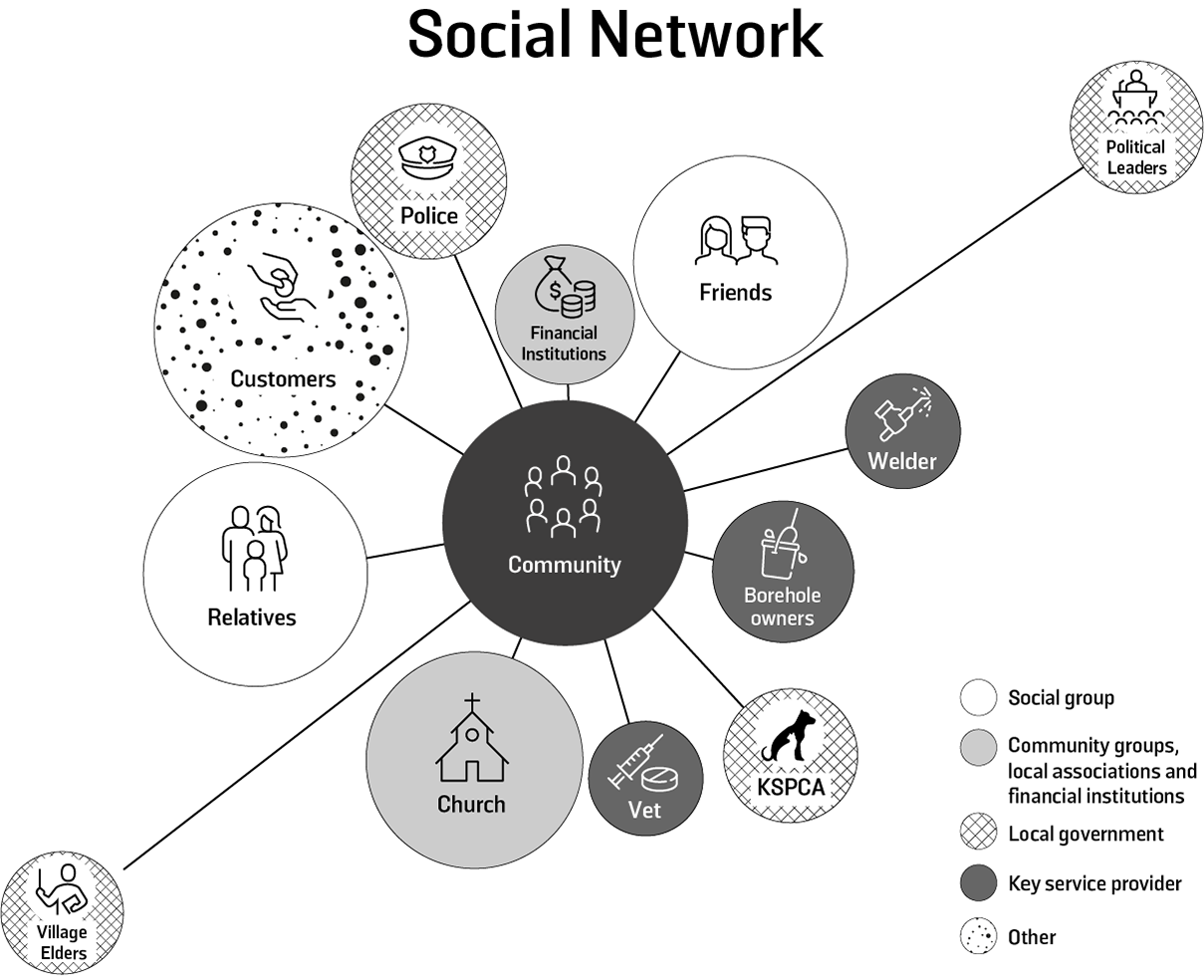
Figure 34: Example of a Social Network Venn diagram from Kenya
Arrange meetings and identify those interested in working with the project. Remember community members are not a homogenous group so, after an initial meeting with leaders and all interested stakeholders have break out meetings with more specific groups or individuals, such as men, women, and other potentially vulnerable groups to get their unique perspective using observation, key informant interviews (KII), focus group discussions (FGD). Encourage one of the stakeholder members to lead group discussions – this helps to encourage members to speak their minds rather than communicating what they think the facilitator wants to hear. However, a note of caution, sometimes if there are strong hierarchical relationships within a community the inclusion of a neutral facilitator can overcome barriers to expression; so, understand your community and its dynamics before deciding which route to take. Using tools such as Historical timeline (T7) and Changing trend analysis (T11a) can be a useful start to engage the community and generate discussions to investigate timelines around changing practices, resources, and animal welfare, and to identify some of the drivers for change and the root causes of the current situation.
Identify social groups that may be interested in animal welfare, the group may exist to serve a different purpose but may be willing to include an animal welfare element to their activities. Groups identified should show inclusive membership and leadership, be well organised and respected within the community. Ensure women, children and other potentially marginalised community members are included and that their voices are heard. Check 1. Gender mainstreaming checklist and refer to the Gender Equality diagram to assess what kind of gender relationships exist and how existing gender inequalities are dealt with by other programmes or organisations within the region. When identifying suitable groups, the use of a SWOT analysis (see Figure 35) can clarify whether there are any major gaps in the group’s organisation or positive opportunities for involvement; consider their financial management systems, their current or potential involvement in animal welfare related issues, their membership diversity and inclusivity. The following facilitator resources provide more information on group formation, challenges and dynamics: 14. Overview of Community Group Formation Process, and Common Challenges and Factors Influencing Group Success and 15. Templates Supporting Community Based Organisations Governance.
To undertake a SWOT analysis:
Gather a diverse team together to generate ideas
Get everyone to separately write their ideas for each of the four parts of the SWOT analysis: Strengths, Weaknesses, Opportunities and Threats. This ensures you hear all voices and get a wide diversity of ideas. Do this for 5-10 minutes and repeat for each of the four parts.
Rank the ideas
This process will clarify what a group has to offer, highlight any potential issues associated with working with them and will guide development of actions or tasks which may help overcome these issues or may guide you to decide not to work with the group.
Figure 35: SWOT analysis
1.1.2Build relationships with relevant community stakeholders
When you arrive at the community introduce yourself – explain that you are from an organization interested in supporting communities to work towards sustainable animal welfare improvements in their community. It is important to manage expectations, particularly in poor communities, as your presence cannot solve all the problems the community may be facing.
Different customs and other cultural habits may influence ease of dialogue and development decisions. Be aware many communities, particularly women, will not be used to airing their opinions or speaking freely about their needs. In most settings women can only approach other women to openly discuss. Ask women their preferences and what will make them comfortable before making any assumptions. Be patient, take time to listen.
Engage in conversations – anywhere! Go to speak with people while they are doing daily tasks, lend a hand, go to the local shop, or sit and converse in meeting places. Talk about their lives, their community, its culture, its history and working practices. Try to find out what issues they face, these may directly or indirectly affect animal welfare. Approach people in a culturally sensitive way as you might need to ask their permission to engage about the issues.
Attend important events at the invitation of the community - these occasions often highlight community dynamics and power relations, which are important to understand when deciding who and how to effectively engage when designing and implementing project activities. As you begin to get to know the community where you are working, community members will likely indicate who they feel might be good person/s to motivate other members and lead the development process. Social relationships are a key mechanism for encouraging participation and ultimately driving the process forward
ATTENTION! A supporting agency's 'mission', 'programme' or 'target' is not necessarily seen as important from a community perspective. All development must be guided by, and of priority to, the community members.
Tools and resources helpful to supporting this step include:
The animal welfare practice gap analysis is designed to explore current animal management practices and activities which contribute to animal welfare. This tool identifies gaps and reasons for the gaps in terms of the main drivers of behaviour change: capability, opportunity and motivation. It has been adapted from other tools specifically to put the animal at the centre of the analysis. The first steps are very similar to those in ‘If I were an animal’ (T17). Consider conducting this activity separately with owners, users and carers, including both men and women, or other relevant groups that are likely to have different priorities.
Tool purpose:
Time needed:
• To identify the gaps and causal factors contributing to people not meeting the welfare needs of their animals. • To identify actions people can take either individually or collectively to address gaps in animal husbandry and management practices to improve animal welfare. • To support gender analysis if conducted separately between men and women by identifying differences in factors contributing to gaps in practice. • To inform identification of community actions and/or behaviour change strategies to address the causes of people’s poor animal husbandry and management practices related to lack of capacity, resources and/or motivation. • When used repeatedly, results can inform monitoring by enabling assessment of perceived changes in participants’ animal welfare practices and underlying causal factors which constrain their adoption.
2 hours
Materials needed:
Chart paper, index cards or sticky notes, pens/markers, chalk, stones, pebbles, local materials (leaves, seeds, etc.)
Approaches for Working With Communities: Community Development Approach, Community Engagement Approach
Behavioural Drivers (COM-B): Behaviour Change Diagnosis and Planning, Motivation
Stages of Behaviour Change: Preparation Stage
Project Support: Participatory Learning and Action Tools, Needs Assessment, Gender Analysis, Monitoring and Evaluation
Specific Topics: Animal Husbandry and Management, Community Change Agents
Animal welfare practice gap analysis
Figure T21a Animal welfare practice gap analysis carried out by animal owners
A group of animal owners analysed their current animal management practices. They identified 10 practices that their animal would expect from them and scored the extent to which they currently carry out these practices. The highest ‘in practice’ scores were for timely veterinary treatment and free access to water. The group discussed the most common reasons for seeking veterinary treatment and how changes in current practices could reduce or eliminate the need for the treatment altogether. The lowest scores were for ‘shelter from the elements’ and ‘time to interact and play with other animals’. After a discussion, the group identified quick wins and collectively:
Purchased more nutritious and balanced feed by buying food in small groups instead of individually. This means spending less money, but also having better quality feed.
Identified a location to make a rolling-pit for the animals to use after work that was cleared so it was safe for the animals; it was also near a place where the users could have tea and socialise together.
Identified 5 new water points and cleaned abandoned tyres to use as water troughs.
The group agreed to make these good practices a daily habit and to monitor each other’s progress against their individual action plans.
Start by encouraging participants to see the world from their animals’ point of view. Ask what expectations their animals have of them to have a happy and healthy life and experience a positive mental state. If they are struggling with this concept, ask them what they need as humans to be happy and healthy, then extend the question to their animals. At this point, the group should start identifying expectations animals have of their owners. Ask the community helper to write the expectations on cards for everyone to see or use representative drawings.
When participants have finished identifying their animals’ expectations of them, it is the facilitator’s responsibility to ensure that all welfare components have been considered. Use the following guiding questions as needed to facilitate participants to identify their animals’ expectations of them in terms of any of the following domains of welfare [Five Domains] which they have not yet considered:
• Health - What do animals need/expect of owners to be healthy? (Disease prevention, timely treatment, proper fitting equipment) • Nutrition - What do animals need/expect of owners for good nutrition? (feeding & watering) • Environment - What do animals need/expect of owners in their environment? (Comfort, rest, temperature, shelter) • Behaviour - What do animals need/expect of owners to express their natural behaviours? (Freedom of movement, social interaction with other animals)
Please note: The facilitator should group/organise similar expectations into one category and explain the reason for the grouping (only if the anticipated effects of the expectation not being met are the same). For example, if the community identified ‘free access to water’ and ‘clean water’, consider consolidating the two examples into one ‘free access to clean water’ category.
Once the list is complete, ask the community helper to record the group-identified expectations on cards using words, symbols, or local materials.
Step 2
Next, ask the helper to draw a grid or matrix on the ground using coloured powder, chalk, or a stick, with at least 5 columns in the matrix to start. Place the group-identified practices (cards in step 1b) along the first column.
Label the second column ‘in practice’ (like the matrix in step 1a).
Step 3
Facilitate the group to fill in the second column of the matrix labelled ‘in practice’, by asking participants to what extent their animals’ expectations are fulfilled by each of the identified practices. Scoring from 0 to 10 (0 = not in practice, 10 = completely in practice).
Any remaining stones (out of ten) can be kept aside or in the first column, next to the identified practice.
Step 4
Ask the group to identify at least 4 of the most important factors contributing to gaps in their animals’ expectations and current practices. Have the helper write the factors on a card using words or symbols.
They may identify factors (causes) such as:
Place the cards with the factors as column headers along top of the matrix, adding more columns to the matrix if necessary.
Step 5
Ask participants to use the remaining stones (out of ten) to score the gap factors (causes). For example, if one of the expectations was ‘timely veterinary treatment’, five stones out of ten may have been used for ‘in practice’. The remaining five stones would need to be divided amongst the different causes of gaps in practice e.g. two stones for ‘lack of knowledge’ and three stones for ‘not a priority’.
Please note: Coming to an agreement on how the factors (causes) should be scored will raise a debate amongst the group. These discussions create shared learning opportunities, as participants learn from one another as they discuss and agree on final scores. As a facilitator, you should allow and encourage this discussion without inserting your ideas.
Step 6
Once all the causes of gaps in practice have been scored and the matrix is complete, ask a community member to help summarize the results with the group.
Use the following guiding questions to facilitate a discussion amongst participants:
• Where gaps in practices exist, what are the specific skills, knowledge and/or resources preventing participants from meeting their animals’ needs?
• What are the effects of the animal husbandry and management practice gaps on both animals and animal-owning households? If the group has already completed T17 ‘If I were an animal’, ask them to come up with some of the effects that they identified in this activity.
• Which practices do you perceive as most important to ensuring the welfare of your animals? Please note: This question can provide an opportunity to raise awareness of how practices often considered less important can still have significant impacts on animal’s welfare.
• What actions can participants take, either individually or collectively, to address these gaps and mitigate the negative effects on animals and animal-owning households?
• What technical support is required to support participants in acting?
Step 7
If participants have identified specific actions to address gaps, have the helper record the actions and specific activities in the community action plan. Make sure to include who will monitor it and a realistic timeline. Add any opportunities to capacity build or project plan into your project action tracker.
Facilitator’s notes: Animal welfare practice gap analysis
It is helpful for participants to have a general understanding of animal welfare and related animal husbandry and management best practices when undertaking this activity. Consider conducting one or more of the following activities as time permits to raise awareness of animal welfare needs prior to conducting this exercise:
T17 ‘If I were an animal’: raises awareness of what animals’ need and how they depend on people experience positive welfare states
T18 Thriving not surviving: promotes understanding of the five domains of animal welfare and how people can promote positive welfare states
T19: Animal feelings analysis: helps promote understanding of animal feelings and related physical expressions and behaviours indicative of those feelings.
T20 Animal body mapping: helps identify animal-based indicators of welfare status which can be used in the transect walk, and can serve as a useful sensitization exercise improve understanding of indicators of good and bad animal welfare.
If individual participants come up with a below standard practice (e.g. watering 2 x per day when free access is best practice), the facilitator can use this as an opportunity for them sensitize each other by reaching consensus.
This exercise can take considerable time, so discuss this in advance with the group. If the activity takes more than two hours, consider action planning in the next session.
Encourage everyone to express their own views and avoid bringing in your own examples while the matrix is being populated. Do not allow it to become a facilitator-driven exercise.
Consider having a designated note taker to document the insights (e.g. info on knowledge, skills, beliefs, resources) that emerge from participants’ discussions during this activity.
It is common for participants to identify only a few main effects on animals (step 6), especially when animals are not viewed as sentient beings. It is the facilitator’s role to use this as an opportunity to promote understanding of animals’ experience of these gaps.
T15 Cost benefit analysis when motivational factors have been identified as reasons for participants’ not meeting the expectations of their animals or when no consequences have been agreed by the community to address gaps
The facilitating organization may consider one or both of the following actions to address the identified gaps:
Capacity building trainings to promote knowledge and skills related to implementing animal husbandry and management practices that promote animal welfare:
Humane handling techniques
Proper feeding methods
Basic wound management
Benefits of grooming
Benefits of stable care
In-depth assessment or care practice research to identify:
Who needs to practice and who influences the desired behaviour
To identify main barriers to adoption of the promoted behaviour
Sustainable livelihood and/or community development-related projects to improve access and availability of resources important to animal welfare
1.2.1 Understand the lives of animals and communities who own them
To effectively work with communities to change their behaviours to improve animal welfare, it is essential to first understand the animal owning community’s existing knowledge, attitudes, beliefs, and behaviours. Community needs assessments give the facilitator and the community a snapshot of the livelihoods, resources, service provision, daily activities of humans and animals, husbandry techniques, diseases, and their treatment. Needs assessments help identify communities’ belief systems about what is good animal welfare, gaps in current provision, highlight what needs to be accomplished, support decision making and help tailor goals and objectives specifically for the community.
You will use the understanding you have already gleaned about the community, its beliefs, and attitudes towards animal welfare as a foundation for the steps that follow.
It is helpful to first understand the issues affecting communities which could potentially impact animal welfare, and the relative importance of these issues to animal owning communities. When viewed through a one welfare [69] perspective, this understanding, combined with understanding of animal welfare issues gained in later steps, can help identify potential areas of overlap between animal and human needs or issues, which if addressed, could potentially positively impact communities’ wellbeing and that of their animals. It will be easier to generate motivation to address issues important to communities, which if addressed, would benefit both community members and their animals. This is particularly the case in situations where there are competing or conflicting needs and feelings between animals and people. For example, when there are limited household resources to adequately meet both the needs of people and their animals, human needs are understandably more likely to be prioritized over those of their animals; or animals may be used to earn an income to meet human needs in ways which may not be best for the animal’s welfare.
Figure 36: Visualizing One Welfare - interconnected nature of human well-being, animal welfare, and the environment.
Analyse and identify issues within the community that might directly or indirectly influence animal welfare. Investigate these key areas with community members:
The lives of animals, including: - Daily activities of any animal/s including both at work and rest, and any seasonal variations, which can be supported by the Daily activity schedule - animals (T4b) and the Seasonal calendar (T6) tools, completed from the animal’s perspective. - Current husbandry and health practices: disease recognition and treatment, seasonal variations, and prevention, and cultural or traditional practices that could affect welfare. The Seasonal calendar (T6) and Mapping Animal Diseases (T1c) tools can assist with this process.
Animal-related service-providers and resources, using Mapping - Resources and Services (T1a) and Venn Diagram – resources and Services (T3a) can help this process: - Identify service providers that serve the animal owning community. - Identify animal related resources. - Understand the location of animal-related service providers including distance from the community, availability, affordability, quality, seasonal availability, and preferred providers.
1.2.2 Identify potential issues related to animal welfare, and animal-related services and resources, and related implications for communities
Help community members assess their situation and that of their animals to generate a sense of shared interest in improving animal welfare using Focus Group Discussion (FGD) and following the steps outlined below. To support informed analysis and discussion here, it can be helpful to socialize the concept of animal welfare as a first step, through general outreach or using the Animal welfare conversation tool (T32) as time and resources permit.
Identify which of these issues directly or indirectly affect their ability to care for their animal and meet its needs. Any animal welfare issues identified through the Mapping - animal welfare issues (T1b) or through observations may be useful to reflect on here.
Analyse these issues with discussions in member sub-groups such as animal owners, handlers, women, and children.
Present findings to the whole group for agreement on issues identified as important to the group. You may wish to use the Pairwise Ranking (T8) tool to support the group in coming to agreement on identified issues.
In a group, visit service providers and other stakeholders, visit sites, and investigate resources.
Discuss animal welfare issues with stakeholders either individually or in a workshop (using Focus group discussions (FGD) along with PLA tools such as Three Pile Sorting (T23) can be helpful). Follow-up with a group meeting to analyse gaps in service and resource provision and practices – how can they be improved?
Facilitate regular community group meetings until the analysis is completed. The number of visits, meetings and the tools required to identify and analyse all the issues are flexible – every community is different.
Pay attention to change talk in terms of how members of the community talk about any desires to change, ability to change, reasons to change, need to change and commitment to change. Refer to the facilitators resources 2. Essential Communication Skills for Promoting Behaviour Change, 3. Guidance on Listening for Change Talk to support your process during this step. In addition, take note of key findings and insights and any potential external barriers to communities’ improving animal welfare, consider using the 20. Project Action Tracker to support your documentation.
1.2.3. Identify shared interest for community and organization to work together on an animal welfare improvement project
Once you have built rapport with the animal owning community and understand the local context and their priority animal welfare needs and concerns, organize separate community meetings or focus group discussions with different groups within the animal owning community such as men, women, and other potentially vulnerable groups, including any existing social or interest groups previously identified as being interested in improving animal welfare during the rapport building step. During the meetings, share the identified community needs and issues related to improving animals’ welfare that were identified through the community discussions carried out in previous steps. This is an opportunity for you to learn about different groups’ interests and motivations in relation to improving their animals’ welfare, as well as gauge their general level of awareness of issues. This is also an opportunity for them to learn about your interest in collaborating with them to create community groups interested in improving animal welfare, and to introduce your ways of working [67]. Consider carrying out an Animal welfare transect walk (T22) with groups of community members at this stage to increase awareness of the welfare condition of animals in the community as needed to help generate motivation and interest in working with the project.
Facilitate the group/s to identify the key findings and concerns influencing animal welfare which they are interested in addressing, along with the specific individuals or groups interested in collaborating with the project and each other and note the best means for staying in contact with them.
In circumstances where improving the welfare of non-production working animals may be needed, but they are perceived as less valuable than production or income generating livestock whose needs are prioritized by communities, consider using the Increasing Perceived Importance of Animals (T27) tool. In such circumstances, this tool can be useful to improving communities’ awareness of the value of these working animals to the broader production system and the benefits they derive from it and help generate interest and motivation to address their welfare issues.
Tools and resources helpful to supporting this step include:
An adaptation of a traditional transect walk [48], this animal welfare transect walk can be used as part of a participatory animal welfare needs assessment of the welfare status of animals. It encourages participants to make direct observations of the animals themselves by looking at the animals, the resources in their environment and the owner’s, user’s, carer’s handling and management practices. This is a useful tool for exploring animal welfare conditions and the realities of resources available to animals within a community.
The findings from this exercise, coupled with analysis from the contributing root causes for any welfare problems (T21, T25and/or T26) can be used to prepare animal welfare improvement plans for individual or groups of animals. It can also be used to monitor changes in animal welfare over time if conducted at different points in time, and recorded observations compared to assess change.
Tool purpose:
Time needed:
• To identify which animals are in the best/worst condition and have the best/worst welfare. • To identify the most common animal welfare problems within the community • To understand which welfare issues owners, users, carers prioritize. • To inform community action planning and target capacity building activities to address community-identified priority welfare issues. • To identify which owners, users, carers may be good candidates to target as animal welfare champions in the community, when used in conjunction with the results from T1. Using these two tools together should identify individuals with the highest potential to be exemplary champions and potential mentors to others.
5-10 minutes for each animal in the walk + 1 hour for discussion
Materials needed:
Sheets of paper, pen, coloured markers (red, yellow, green)
Project Support: Participatory Learning and Action Tools, Needs Assessment, Monitoring and Evaluation
Specific Topics: Animal Welfare, Feelings, and Needs, Animal Husbandry and Management; Community Change Agentsnts / Resilience
Animal welfare transect walk
The animal welfare transect walk gives a more complete and detailed view of animal welfare because the animals are present for the group to examine, whereas the previousanimal welfare mapping exercise (T1) or body mapping exercise (T20), only gives an overall ‘bird’s-eye’ view of the animal conditions in a community, as described by their owners without the animals present. In this way, the transect walk can strengthen or triangulate the information from these mapping exercises.
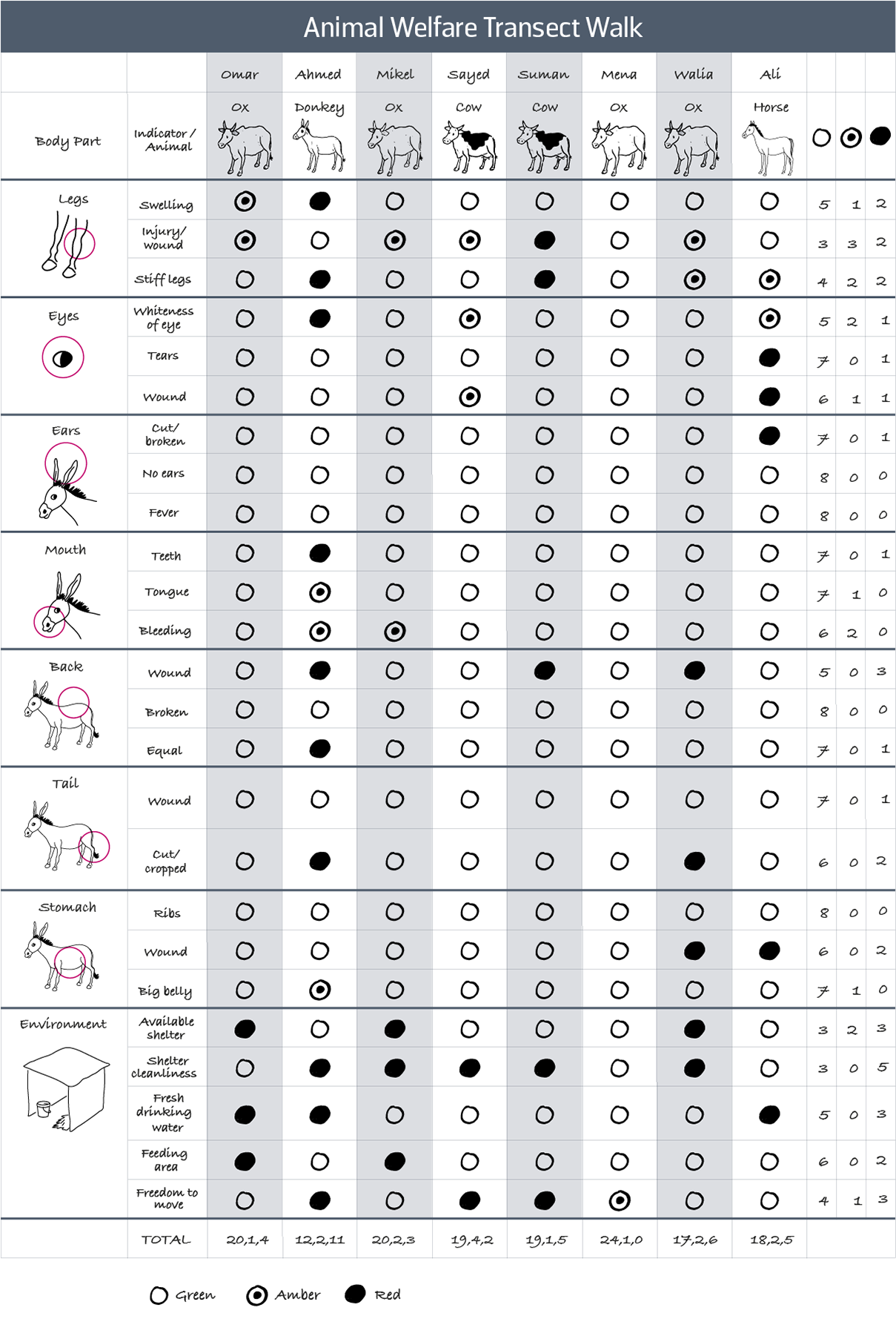
An animal-owning community carried out an animal welfare transect walk using a green, yellow, red traffic light system to score 25 animal welfare indicators that they had identified during their previous discussions and exercises, including 5 that directly relate to owner and carer behaviour (environmental factors). In this example, environmental factors were included because participants’ had a good understanding of animal welfare issues at the activity was carried out. However, it is also possible to modify this tool by using only animal condition indicators, which may be helpful in when participants have not yet gained a good understanding of factors contributing to good animal welfare.
Figure T22a Animal welfare transect walk recording sheet using traffic light signals
After the walk, the owners sat down together and analysed the score for each individual animal by summarizing the vertical columns on their recording sheet. In this example, Ahmad’s animal was found to be in the worst condition, with 11 red (‘bad’) and 2 amber (‘medium’) marks, followed by Walia’s animal which had 6 red and 2 amber welfare issues. After looking at all the individual animals, the group then summarized the horizontal rows to find out which welfare issues were most common in their village. Shelter cleanliness was the biggest issue in the community, with five of eight animals marked red. The group followed this exercise with a root cause analysis (consider using T25andT26) and inserted the results in the community action plan for action by individual owners and collectively.
Animal Welfare Transect Walk Using Traffic Light Signals
Step 1
Explain the purpose of the animal welfare transect walk to the group and involve all participants in the process of decision-making about which indicators of good and poor animal welfare are going to be observed. Create a safe learning environment at the start of this activity if this tool is being used as entry at Initiation phase to nurture positive motivation for further engagement.
To facilitate discussion and identification of observable animal welfare indicators, consider referring to the outputs of one or more of the following tools if already conducted:
Depending on participants’ understanding of animal welfare issues at the time this activity is carried out, it may be appropriate to focus only on indicators of animal body condition and consider adding indicators related to environmental/owner practices as the tool is used repeatedly and community participants’ understanding of animal welfare improves.
Alternatively, as the facilitator, you have an important role here: to check that the list represents all aspects of animal welfare as sometimes we find that the owners’ checklist only contains signs of physical welfare. If you notice this, it may be helpful to ask probing questions to encourage them to think about observable indicators of their animals’ welfare in terms of the five domains of animal welfare (e.g. nutrition, health, environment, behaviour, and mental state). After the group has finalized their list, sit together with them and check whether all aspects of welfare are covered.
Discuss the agreed animal welfare indicators thoroughly with all members of the group as well as the animal owners and carers from each household visited and agree a score for each one.
Step 2
Once the group has decided which observations to make, agree how the observations and discussions will be captured or recorded and who will take responsibility for this. Ask the community to decide what symbols will be used to record the result of each observation.
Examples include:
• Traffic light signals: good/best animal condition shown with green dot, moderate issues with animal condition with amber/yellow dot, worst condition with a red dot. Sometimes just red and green are used. • A tick/check mark might be used for good and a cross for bad. • Instead of a traffic light system, numerical scores might be assigned. For example: Red/cross = 0, Yellow/amber = 1, Green/tick/check = 2. If only red/green are used, then Red = 0 and Green = 1.
Step 3
Decide whose animals will be visited and the route of the transect walk. Fix a time when the group will go on the walk. It is essential that the owner and family of each animal visited are present when the group is visiting his or her animal and the surroundings.
Step 4
The community group should walk the route together, visiting all the households where animals are kept and the surrounding areas to look at each animal carefully. The group will often wish to make additions and alterations to the agreed observations. Any animal welfare issues which have emerged from other tools and exercises may also be discussed with the group during the walk.
Step 5
After returning from the walk, ask the group to summarize and analyse their record sheets:
• Have the participants add up the scores or numbers of red, yellow/amber, and green dots vertically to give a summary of the welfare problems of the animals. This can be used by the group to formulate individual action plans for owners. • Adding up the scores or dots horizontally will give a score for the whole community or group for that welfare parameter and add identified welfare issues to the “issues” column of the Community Action Plan. • Come to a consensus on the animal welfare successes and problems and discuss possible contributing factors. Discussion questions might include: - What welfare indicators are most in need of improvement and which are best performing? What are the reasons? - Why did some participants score higher than others? What are they doing differently than others who had lower scores? - What are the implications of these welfare issues on their animals’ physical and mental state, and on the lives of different household members? For example, do these welfare issues impact women, men, boys, or girls differently? - What could feasibly be done to improve their animals’ current welfare situation and replicate successes?
Record any identified ‘actions to be taken’ in the relevant column of the community action plan and have participants agree on a frequency to animal welfare transect walk activity to monitor progress (monthly, quarterly, etc.).
Facilitation Notes
If there are large numbers of animals, carry out the same exercise over several days so that all animals or a representative number of animals and households are covered.
This exercise can take considerable time, so discuss this in advance with the group and agree a suitable time to set aside for doing it.
If this exercise is planned to be undertaken in the project initiation phase or to support rapport building, it is imperative to create a safe and learning environment and build understanding about why scoring is part of the exercise.
It is helpful for participants to have a general understanding of animal welfare and related animal husbandry and management best practices prior to conducting this exercise. Consider conducting the following activities to raise awareness of animal welfare, feelings and needs, and help inform the identification of animal welfare related indicators to use during the transect walk:
T17 ‘If I were an animal’: raises awareness of what animals’ need and how they depend on people experience positive welfare states
T19 Animal feelings analysis: helps promote understanding of animal feelings and related physical expressions and behaviours indicative of those feelings.
T20 Animal body mapping: helps identify animal-based indicators of welfare status which can be used in the transect walk, and can serve as a useful sensitization exercise improve understanding of indicators of good and bad animal welfare.
Decide with the community in advance whose animals will be visited and the route of the transect walk. Fix a time when the group will go on the walk. It is essential that the owner and family of each animal visited are present when the group is visiting his or her animal and surroundings.
Animal welfare transect walks may be repeated at regular intervals and the results compared with previous walks. This enables participants to monitor and evaluate changes in the welfare status of individual animals, and changes management practices and availability of animal-related resources.
Next Steps
Once the participatory animal welfare needs assessment is complete, you can prioritize issues to address using one of the following tools:
Alternatively or in addition, you can explore the causes and effects of welfare issues by following the transect walk up with one of the following activities
Below is an overview of the community action planning process covered by steps within the planning phase of the community development approach:
Figure 37: Overview of the Community Action Planning Process
Beginning with a participatory welfare needs assessment (PWNA) helps put the animal itself to the centre of the group’s analysis by looking at the present welfare status of their animal/s. This process sensitizes owners to their animals’ needs and feelings and the ways in which these are expressed through an animal’s behaviour or body language.
Use the methods in this section to conduct and record data for a baseline assessment to determine:
The percentage of people who (do not) practice the promoted behaviours.
The existing pre-conditions (identified barriers/motivators) for practicing the desired behaviour (e.g. people’s knowledge, availability of resources).
Animal welfare indicators if an animal welfare assessment was not conducted at the start of the project initiation phase.
Having recorded a baseline of where animal welfare and associated husbandry and management practices are before any intervention enables assessment of the extent of behaviour change during monitoring and evaluation.
2.1.1 Analyse animal welfare needs and identify indicators for assessing the extent their needs are being met
The focus of this step is to support the group in building a common understanding of welfare based on the five domains. It will also enable them to recognize how aspects of good welfare and poor welfare are expressed by animals’ appearance and behaviour by facilitating the group’s analysis of how animals feel and what they need for their well-being.
In this section you will facilitate the group to:
Identify the needs of animals.
Analyse how far the animals’ needs are being met by everyone involved with their care regime.
Analyse the effects on animals when their basic needs are not fulfilled.
Identify the physical and behavioural signs of each need.
Organize a group meeting and facilitate the group to identify animal welfare needs and what it looks like when these needs are not met. To start the process of discussing animal needs, consider using Animal body mapping (T20) where the group identify welfare issues and their perceived causes on a drawing of their animals’ bodies and discuss what they perceive to be good and bad indicators of welfare. The Thriving not surviving (T18), and Animal feeling analysis (T19) tools can help to examine how the animal may experience life and how people can influence those emotions both positively and negatively. ‘If I were an animal’ (T17) may then help the community to determine to what extent animal needs are being met within the community and can support identification of welfare issues, indicators they can use and any knowledge gaps.
A list of an animal’s welfare needs will be developed by the group during these exercises and information to assist this process can also be found in the Animal Welfare and Communities Learning Module Part 1: Understanding animal welfare. These tools help to move people from looking at solely animal-related resources and services to observing the animal directly and seeing what animals can tell them about their own needs. They put the animal at the centre of analysis. Support group members in coming to common agreement on what they perceive to be good animal welfare and animal husbandry and management practices within their local context.
To support this process, consider populating a five domains framework with their animals’ needs and the equivalent human behaviours that would support meeting them, like the example provided in the facilitator resource 9. Example of Five Domains of Animal Welfare for Donkeys Linked with Human Behaviours. It is important to support the group in defining a list that represents all aspects of animal welfare not just those signs of physical welfare. Ask probing questions to encourage them to think about observable indicators of their animals’ welfare in terms of the five domains of animal welfare (e.g. nutrition, health, environment, behaviour, and mental state).
Next the group need to agree on how these animal- and resource or behaviour-based indicators will be scored to enable assessment of animal welfare and monitoring of changes. Participants write or draw the indicators as a list that can be used for assessing their own animals. The group then comes to a consensus on how each indicator will be scored and decide the exact definition for each score. Refer to the Animal Welfare Transect Walk (T22) instructions for determining scoring. The simplest scoring uses a traffic light system, over time communities will often shift to a more complex numerical system as the group builds experience and confidence assessing their animals’ welfare.
2.1.2 Conduct participatory welfare needs assessment to understand the welfare status of animals within the community
Facilitate the group to assess the welfare status of an animal, by looking at the physical condition of its body and observation of its behaviour. The Animal feeling analysis (T19) and Animal body mapping (T20) tools are helpful here. Identify things that may directly or indirectly affect the welfare of their animals (also refer to previous community needs assessment section 1.2). These include management practices, owner behaviour, resources, stakeholders and the environment, the Animal welfare practice gap analysis (T21) will assist here.
With the group, assess the level or severity of various welfare problems and their contributing factors. Conduct another Animal welfare transect walk (T22) now the community has greater awareness of how to assess animal welfare. This transect can be undertaken by men, women or both together, this process allows exploration of animal welfare conditions and assesses the realities of resources available within the community. The process of joint analysis leads to individual as well as collective action and increases understanding of the need for change and helps support people’s progress through the stages of change from pre-contemplation to the preparation stage.
Once completed, convene the group to sit together and summarise the findings on a chart to draw conclusions. If the walk has been carried out on more than one day, it is useful to hold a group discussion at the end of each day, with a final meeting on the last day of the exercise. The group summarizes the findings for each individual animal and for all the animals together. In particular, the group draws out the indicators that scored red (bad condition), for individual animals and for the village all together. This will generate a list of welfare issues for prioritizing during the next step of community action planning. As community members score themselves during the participatory welfare needs assessment, community facilitators can probe and listen for change talk to gauge different individual’s stages of change.
Tools and resources helpful to supporting this step include:
Three pile sorting, use cards to enable a member of an animal owning community to sort and discuss animal management and work practices according to whether they are seen as good, bad, or neutral for animal welfare.
Tool purpose:
Time needed:
• To explore participants’ understanding and perspectives on any animal welfare issue, care and management practices (including harmful practices) and to provide a starting point for problem analysis and action. • To analyse perceptions about animal diseases and their symptoms, causes and prevention.
1 hour 30 minutes
Materials needed:
Chart paper, note cards, markers or other locally available resources, and a set of cards showing animal welfare.
Approaches for Working With Communities: Community Development Approach, Community Engagement Approach, Societal Outreach and Campaigns Approach
Stages of Change: Pre-contemplation Stage, contemplation
Project Support: Participatory Learning and Action Tools, Needs Assessment
Specific Topics: Animal Husbandry and Management, Animal Handling
Three pile sorting
Step 1
For this exercise you need to prepare beforehand.
Make a set of cards showing animal welfare or management practices which can be interpreted as good, bad, or in-between (neutral). These should be based on problems previously identified by the community during exercises such as ‘If I were an animal’ (T17), Animal body mapping (T20) or Animal welfare practice gap analysis (T21). Common negative practices which could be illustrated on the cards include beating animals, overloading, not offering water, incorrect feeding, and lack of care for wounds
Step 2
Organize participants into groups of no more than seven and ask each group to form a circle. Give a set of cards to each circle and ask for two or three volunteers to sit in the centre of the circle and sort the cards together. They should place each card in one of three piles: representing good welfare or management practices, bad welfare, or management practices, and in-between or neutral practices (or practices where there is uncertainty or disagreement).
Step 3
After the cards have been sorted, ask the volunteers to arrange them so that each card is visible to the whole group (see figure T23 below- Place holder). Encourage debate between participants to challenge their choices and analyse all aspects of their decision. Enable participants to understand why a particular practice may be better or worse for animal welfare.
Step 4
Ask the group to identify which of the animal welfare issues or management practices are occurring in their own village, especially the ones they have identified as bad. This discussion can be used to enable participants to identify priority welfare problems and to propose potential solutions or action to be taken.
Step 5
Document the discussions and share back with the community.
Record the community’s analysis and responses in your project action tracker and follow up with the community later if/when you start action planning together.
Figure T23 a sample pile sorting process
Facilitation Notes
It is important that you enable the group to bring their own perceptions and use their local terms for management practices, diseases, pain, and animal suffering.
The game can also be played using photographs representing the existing situations in the village. This needs advance preparation.
Notice and document why certain practices are said to be harmful or are perceived as positive or neutral while they affect animal welfare. It is important to also note their misconceptions about the practices, diseases, etc. and their stages of change (pre-contemplation – being unaware or contemplation stages – struggling with their decisional balance to determine them as good, bad or neutral) with regard to the different care and management and animal diseases.
Another variation is to ask participants to sort cards according to different types of animal welfare issue they have experienced, such as i) issues directly related to animals ii) issues related to service providers and other stakeholders and iii) issues related to animal owners, users, and carers.
The problem animal tool supports identifying and exploring the underlying causes of perceived animal welfare issues through an in depth root cause analysis. This activity can be revisited when planned actions have resulted in desired welfare improvements to promote evaluation and reflection on unidentified or unaddressed root causes. Please note that the first step in this exercise is the same as that ofAnimal welfare body mapping (T20).
Tool purpose:
Time needed:
• To raise awareness of the root causes of welfare issues affecting different parts of an animal’s body and possible actions to be taken to address them, either collectively or individually • To inform organisational planning based on root cause analysis of animal welfare issues
2-3 hours
Materials needed:
Chart paper, cards, sticky notes, coloured markers, tape, and scissors
Keyword Search Tags
Project Phase: Planning Phase
Approaches for Working With Communities: Community Development Approach, Community Engagement Approach, Societal Outreach and Campaigns Approach
Behavioural Drivers (COM-B): Behaviour Change Diagnosis and Planning, Capability
Stages of Behaviour Change: Preparation Stage
Project Support: Participatory Learning and Action Tools, Needs Assessment
Specific Topics: Animal Welfare, Feelings and Needs
Problem Animal
Figure T25a Problem animal diagram
Exploring the complexities of need and demand for farriery service.
This diagram was made by a group of animal owners. First, the group discussed the problems affecting each part of the animal’s body, then they analysed the problems in depth to find their root causes. The group found that wounds on different parts of the body have different causes, but there are also causal factors (sub causes) which are common to more than one body area, such as bad road conditions and the way that ropes are tied. Wounds on the belly, breast and tail base were found to be inter-related. The group created a community action plan to address some of the root causes identified during this exercise.
Figure T25b Problem animal – causes of identified animal welfare problems
Animal body mapping PLEASE NOTE: Steps 1-3 are the same as in T20 Animal body mapping and should be completed prior to carrying out T25 Problem animal.
Animal body parts map
Step 1
If the broken animal jigsaw puzzle is available, start by playing the game. Then, ask participants to sketch the body of their animal on the ground or on paper and to identify the different body parts and the local names used for each body part.
Step 2
Once participants have identified all body parts, initiate a discussion on their perceptions of the role and function of each part. This discussion often creates an opportunity for facilitators to sensitize participants about which body parts are important to animals’ function, which is particularly relevant in relation to working animals.
Animal body issue map
Step 3
Follow step one above, then ask the group to identify issues they commonly perceive on the body of their animals. This may include wounds, symptoms of disease, or other problems with animal health or function which they observe. It is important to allow participants to identify what they perceive to be issues, rather than identify issues you as the facilitator perceive. Encourage participants to draw these issues on the body map or represent those using symbols next to the appropriate body part.
Problem animal
Step 4
Then, ask the community which 2 or 3 of the issues identified in step 3 are the biggest problems and focus on those for the rest of the activity. Start with those most common to everyone.
Have participants discuss the causes of the problems and draw or write the causes near the relevant part of the animal’s body. Analyse each welfare issue in depth by repeatedly asking ‘why?’ questions.
For example:
‘Why does the animal get that wound?’ – ‘Because of the leather belt on the harness’
‘Why does the leather belt cause the wound?’ – ‘Because it is not cleaned and oiled’
‘Why is the belt not cleaned and oiled?’ – ‘Because we don’t have the time’
‘Why don’t you have the time?’
…and so on, until the group reaches the deepest root causes of the welfare problem and cannot go any further.
When one welfare problem is complete, take up the next one and repeat the questions until root causes are drawn or written next to all the problems shown on the body of the animal. If time permits, add additional issues, and repeat the same process with participants.
Step 5
As the discussion progresses and all the causes are identified, analyse any links or relationships between different causes and show these using lines or arrows (see Figure T25).
Please note: It is common for participants to discuss, and debate causes. These discussions often create shared learning opportunities, whereby participants learn from one another as they discuss and seek agreement on the true causal factors. As a facilitator, you should allow and encourage this discussion without inserting your ideas. However, you may need to ask probing questions or take the time to guide participants to the real causal factors if they get stuck or their lack of understanding prevents them from identifying true root causes. You may also need to intervene if they struggle to resolve their differences in beliefs themselves.
Step 6
Ask participants to reflect on what they have discussed and mapped.
Discussion questions may include:
• What have they realized or learned because of doing this activity? • What are possible solutions for addressing the root causes of priority animal welfare issues? • Are there opportunities to take collective action to address the root causes the issues? • Referring to the identified root causes, what are the implications or consequences for owners or animal-owning households if not addressed?
Support the community to identify possible solutions if needed, either in this session or in a follow up session as time and resources permit.
Step 7
Have the community helper record the root causes and any specific actions and activities in the community action plan, including who will monitor, a realistic timeline and any help needed from external stakeholders. Record the root causes and actions to be taken by the team to your project action tracker and support the community by linking them to any necessary stakeholders
Facilitator’s notes: Problem animal
The facilitator should have a good knowledge of animal welfare and be able to recommend solutions to address issues, including community-based collective action ideas.
Men, women, owners, users and carers all have different roles and responsibilities related to their animals and may have different knowledge to contribute to understanding the root causes of welfare issues. Decide who best to include in this activity and whether to carry it out with men and women (or other subgroups) separately or in a mixed group. This will depend on group dynamics, your rapport with the community and the local context.
The in-depth problem analysis explores socially and traditionally induced inequality related issues as root causes from different people’s lived experiences depending on their position within a society e.g. gender inequality, caste systems, migratory status, race, etc. might uniquely affect owners/users/carers understanding in living within and dealing with root causes. Therefore, the importance of creating safe and enabling environment during such discussion is a high priority as part of a ground rule when leading such sensitive areas. It is also important to acknowledge people’s realties/lived experiences; rather than being dismissive.
This exercise needs a lot of patience and questioning in order to enable the deepest causal factors to come out of the discussion. Keep asking “why” until all root causes are identified.
Consider using cards or sticky notes to document the causes and sub-causes, as participants may change their mind about the causes and either move or remove them.
It is important for the facilitator to end such meetings on a positive note by doing Step 6 and 7 focusing on the potential solutions. Doing this helps with reflective motivation for people to be more motivated to continue to engage and work with us (rather than leaving them pondering about all the magnitude of the problems they have to tackle).
If the animal body mapping (T20)exercise was performed by the group in the recent past, it should not be necessary to repeat steps 1-3. In this case, review and summarize the issues identified with the group, then move to root cause identification in step 4.
T26 Animal welfare cause and effect analysis to explore the root causes of an individual welfare issue identified during this Problem Animal activity in greater depth along with the related effects on animals and people. This tool is great for fostering motivation to improve animal welfare, as it explores the consequences of inaction for both animal and humans.
T15 Cost benefit analysis to explore the risks and opportunities of action and inaction on both animals and humans, including potential solutions for reducing costs and increasing benefits to both. This tool is useful if previously agreed community actions are not being adopted due to lack of motivation or high perceived costs.
Undertaking the root causes analysis using T25 tool paves the way to do COM-B behavioural diagnosisto further support the kind of substantive intervention needed to address the desired behaviour change.
The animal welfare cause and effect analysis is sometimes called a problem tree, in which causes are depicted as roots of the tree and effects as branches. This adapted version of the tool provides a visual representation of the relationship between the causes of specific priority animal welfare issues, and the effects of the issues on both people and animals [48]. This tool has proven to be one of the most important and effective participatory tools in this toolkit, as the improved understanding and awareness that results from discussions and outputs of this activity have effectively motivated participants to take action to prevent animal welfare issues, as well as respond to them when they do occur. In particular, the effect analysis portion of this tool can be a key motivator of behaviour change. Consider conducting a pairwise ranking (T8) or matrix ranking and scoring (T9)prior to this one to identify the priority welfare issues.
Tool purpose:
Time needed:
• To identify and promote participant understanding of the root causes of a specific priority animal welfare issue and their implications for humans and animals. • To generate participants’ motivation to take action or change their behaviour, either collectively or individually, to prevent or respond to animal welfare issues • To identify root causes of animal welfare issues and potential implications on the livelihoods and well-being of animal-owning households.
1.5 - 2 hours
Materials needed:
Cards, pens, markers, coloured powder, chalk, sticks, tree leaves, coloured cards or other locally available materials
Specific Topics: Animal Welfare, Feelings, and Needs; Livelihoods; Compassion / Empathy
Animal welfare cause and effect analysis (or problem tree)
The animal welfare cause and effect analysis is used to analyze an animal welfare issue or problem by identifying the complex contributing factors and any relationships between the factors, as well as their effects on animal-owning households and animals alike. In the context of working animals, this tool has been used to help identify the causes of priority welfare problems such as wounds and overloading, and to discuss the effects of these welfare issues on animals and the people who depend on them. For example, discussing the causes of wounds on specific parts of a working animal’s body may highlight causal factors such as the size and structure a harness or saddle, or the design of a cart or carriage. Effects on the animal could include pain, weight loss and reduced working capacity. Effects of the animal’s wounds on the owner could include less income (from reduced work and increased expenditure on treatment) or lower status in the community.
T26a Animal Welfare Cause and Effect Analysis diagram for an Animal-Owning Community
The above animal welfare cause and effect analysis was produced by a group of working animal owners in a rural community. They were particularly concerned about reducing and preventing wounds on their animals’ backs. Four major causes were initially identified: whipping by users, beating by children, bad road conditions and improper harness fitting. These causes were then continuously analysed to better understand why they were happening, until the underlying root causes were identified. The effects of back wounds on the animals were then discussed and identified as decreased energy, low appetite, pain and increased risk of infection. The resulting effects on the household were decreased income, increased expenditure on treatment and always feeling stressed and worried about where money would come from and whether the animal would recover.
This activity motivated the group to take action on the root causes that were within their influence.
This included:
Petitioning the local government for road repairs between nearby communities and major transport routes
Promoting more humane handling amongst members of their household to prevent wounds from whipping and beating
Making their own welfare-friendly harnesses from recycled materials
Animal Welfare Cause & Effect Analysis
Step 1
Ask participants to identify the animal welfare issues they feel are a priority and select one issue to explore in depth with this exercise. Consider referring to animal welfare issues and priorities previously identified using T25 Problem Animal,T8 Pairwise Ranking or T9 Matrix Ranking and Scoring, if available. Make sure that the issue is not broad, such as ‘wounds’ generally.
Step 2
Have the community helper draw a circle on the ground or on a large piece of paper and ask him/her to draw or write the priority welfare issue in the middle of the circle using a symbol, picture, or word.
Step 3
Begin the discussion by asking the group what they perceive to be the major factors that cause this problem. As main causes are identified, each cause is added below the priority issue, using symbols, pictures, or words, and connected to the problem with arrows.
Step 4
Once all initial causal factors have been identified, start with one causal factor, and have participants identify the sub-causal factors by asking them why that causal factor happens? Show this sub-cause below the major cause it is associated with, connecting it with an arrow (see Figure T26). Continue asking why each sub-cause happens and continue adding sub-causes - spreading out like the roots of tree - until the group reaches a stage where no further sub-causes can be found. As a rule, these probing using “why” questions may need to be asked 3-5 times per cause, before the root cause is finally identified.
Please note: It is common for participants to discuss, and debate causes. These discussions often create shared learning opportunities, whereby participants learn from one another as they discuss and seek agreement on the true causal factors. As a facilitator, you should allow and encourage this discussion without inserting your ideas. However, you may need to ask probing questions or take the time to teach participants about the real causal factors if they get stuck or their lack of understanding prevents them from identifying true root causes. You may also need to intervene if they struggle to resolve their differences in beliefs themselves.
Step 5
Once all the root causes of the welfare issue have been identified, facilitate the same process to analyse the effects of the welfare issue on the animal and the animal-owning household. Start by having the helper add two circles above the welfare issue: one representing the animal and the other representing the animal-owning household.
Step 6
Ask participants to identify the effect of the welfare problem on the animal. As effects on the animal are identified, linkages to the animal-owning household will naturally emerge and the discussion can quickly turn to effects on the household.
Please note: The facilitator should allow the discussion to flow naturally, ensuring full exploration of effects on the animal AND household. It is common for participants to identify only a few main effects on the animal, especially in contexts where animals are not viewed as sentient beings. Here, the facilitator’s role is to ask probing questions to promote discussion around the animal’s feelings and experience of the welfare issue. It may be helpful to frame questions in terms of, “If you had this issue, how would you feel?”
Please note: When discussing the effects on the animal-owning household, encourage participants to consider potential effects on all household members, including men, women, and children. Ask: do the identified household effects effect all household members equally? Make sure effects on different household members are accounted for on the diagram.
Step 7
When the diagram is complete, ask participants to reflect on what they have discussed and mapped. Some discussion questions may include: Support the community to identify possible solutions if needed, either in this session or in a follow up session as time and resources permit.
Step 8
Once complete, take a photo or record the outputs on a piece of paper. Ensure that the community has a copy for their records and facilitator has a copy for future reference or planning.
Finally, have the community record any root causes and activities to address the causes in the community action plan. Make sure to include any resources/materials needed to achieve this, including who will monitor it and a realistic timeline. Record the actions, activities, and proposed linkages into your project action tracker, and support the community by linking them to any necessary stakeholders.
Facilitation Notes
The facilitator should have a good knowledge of animal welfare and be able to recommend solutions to address issues, including community-based collective action ideas. Participants may ask for advice on actions to address root causes.
Decide the group dynamics ahead of time and whether it would be best carried out with men and women (or other subgroups) separately or in a mixed group. This will depend on your rapport with the community, culture and local gender dynamics. This is important when their roles and responsibilities related to animals differ, and/or they use/depend on animals differently, as their perceptions and concerns may differ.
If conducted separately between men and women, consider bringing the two groups back together at the end of the activity to review the results of each chart and resolve any discrepancies if time allows and culturally appropriate.
If it is not appropriate to conduct this activity with men and women together in the local context, or if it could prohibit participation and freedom of discussion, consider conducting this activity separately.
This exercise can take considerable time, so discuss this in advance with the group and agree a suitable time to set aside for doing it.
Avoid using your own examples; encourage everyone to express their individual views.
This exercise requires patience from the facilitator in order for deepest causal factors to emerge from the discussion. Allow time for participants to discuss their experiences.
Next Steps
The cause and effect analysis is useful for action planning, especially when combined with:
Animal welfare transect walk (T22) to monitor changes resulting from actions related to animal body issues, resources and environment, and management practices
If the group is struggling to understand that animals have feelings and identify them as sentient beings, consider conducting the T19 Animal feeling analysis again.
If monitoring identifies that the solutions to root causes are unable to be adopted or behaviours go unchanged, conduct a T15 Cost benefit analysis to explore the cost of continuing negative behaviours or practices and benefits of positive behaviour change.
Follow up with resource or service providers needed to help the group carry out their activities. Revisit the activities in the next meeting to monitor progress and if further support is required.
Results may also be useful to informing inform project planning and/or identify potential for partnerships to support:
Identification of community capacity building support to address the root causes of priority animal welfare issues
Addressing priority root causes which may be external to communities’ e.g. changes in policy
Identification of potential livelihood or human wellbeing indicators which could be used in monitoring to assess changes in people’s lives as a result of actions taken to improve animal welfare.
Livelihood’s vulnerability analysis is a method of assessing the impact of hazards on community livelihood resources. The tools help with planning for improving community resources.
Tool purpose:
Time needed:
• Identifying the hazards that have the most serious impact on important livelihood resources. • Determining which livelihood resources are most vulnerable. • Identifying current coping strategies and beginning to identify opportunities for adaptation. • Informing an understanding of local values of ecosystem services in relation to livelihoods and well-being and how these may change because of the threat of hazards.
1.5 hours
Materials needed:
Chart paper, note cards, markers, or other locally available resources, like sticks, stones, straw, beans, seeds, coloured powders or saw dust, etc.
Specific Topics: Livelihoods; Vulnerability / Resilience; Group Formation / Strengthening
The figure below shows an example of a community vulnerability map showing the different livelihood resources/assets and what makes them vulnerable. The process enables the community to understand how their resources can be vulnerable and put in place a plan to address the vulnerabilities to reduce the negative impact they would have on the resources they depend on.
Figure T31: An example of a livelihood’s vulnerability matrix
Livelihood’s vulnerability analysis
Step 1
Ask participants to brainstorm and identify the most important livelihoods resources for them. It may help to organise the livelihood resources or to have a checklist based on the 5 livelihood assets (or resource) classes commonly used in Sustainable Livelihoods frameworks (human, social, physical, natural, and financial) The definitions provided below are from the Brookes Livelihood Position Statement and Guidance notes.
i. NATURAL CAPITAL refers to natural resources, which includes land, soils, air, water, and all living organisms. EXAMPLE: equids, water, soil conservation for feed/fodder production, agriculture production/feed/fodder
ii. FINANCIAL CAPITAL income, savings, loans and/or other economic resources needed to meet their needs. EXAMPLE: access and availability of savings, credit/loans, livestock insurance schemes
iii. PHYSICAL CAPITAL tangible, man-made goods that support the creation of a product or service EXAMPLE: cart, harness, roads, ploughs, market shelters/resource centres, water points, boreholes
iv. SOCIAL CAPITAL is defined as what we share with others, such us our family, friends, and community as values, norms, and trust, that enable us to move developed as individuals and collectively such being in as savings groups. EXAMPLE: self-help groups facilitate working together towards collective action to produce/buy feed and at reduced cost, advocate for needs and accountability of service providers, as well as amongst community members themselves regarding their treatment of animals.
v. HUMAN CAPITAL refers to the skills, knowledge, and experience possessed by an individual or population. EXAMPLE: knowledge and skills to address the equid welfare issues identified as impacting communities’ livelihoods i.e., knowledge and skills to keep animals healthy and prevent/treat disease and death, building competencies of animal health practitioners
As this is likely to create a long list of resources, ask participants to then identify up to six resources that they consider to be MOST important in meeting their animal’s welfare needs.
Create a matrix by first listing these priority resources down the left side column of the matrix, using words, symbols, or graphics to represent the resources for all to understand.
Step 2
Next ask participants to identify the greatest hazards to their livelihoods. Hazards may be natural or man-made. It is important to be specific in the hazards, and to ensure that the issues identified are hazards. Participants may identify conditions such as “food insecurity” as hazards. Ask the group to break down these conditions to determine if they are caused by hazards (e.g., food insecurity may be the result of a drought, which is a hazard). Similarly, some groups may identify scarcity of resources, such as “lack of money”, as a hazard. In this case, it should be determined whether the lack of a resource is the result of a hazard, or in some cases, whether the resource should be added to the list of priority resources identified in the previous step.
Step 3
Once completed, ask participants to identify up to six hazards they consider to be the MOST The five most important hazards should be listed horizontally across the top of the matrix, again using symbols if necessary.
Step 4
Participants should then decide on a scoring system for assessing how vulnerable their animal dependent livelihoods are because of their livelihood resources being impacted by each hazard, identifying significant, medium/moderate, low and no impact from hazards. It is vital that all participants understand the scoring system. An example is provided below for reference:
3 = hazard significantly impacts the resource 2 = hazard moderately impacts the resource1 = hazard has a low impact on the resource 0 = hazard has no impact on the resource
Stones, symbols, or different colours of markers (e.g., red = significant risk to resource, orange = medium risk, green = low risk, blue = no risk) could also be used.
Step 5
Consider each resource in turn, support participants in discussing and agreeing the degree of impact that each of the hazards has on each of the resources. Any inconsistencies or differences of opinion should be discussed and resolved, if possible (either through discussion or by exploring the reasons for these differences and preparing more than one table if necessary).
Step 6
Discuss and analyse the results, noting different perspectives from different participants. An example is provided in the table T31.
The following questions can be used to guide the discussion but should be adopted and adapted according to the focus of the exercise.
• Are there any trends in the impact of hazards on livelihood resources? • Which resources are most affected and why? • Are there any resources that are more resistant to hazard? • What coping strategies are currently used to deal with the hazards identified? Are they working? • Are there different strategies that you would like to adopt which would reduce the impact of hazards on your livelihoods? • What resources do you have that would help you to adopt these new strategies? • What are the constraints to adopting these new strategies?
Step 7
Once complete, take a photo or record the outputs on a piece of paper. Ensure that the community has a copy for their records and facilitator has a copy for future reference or planning.
Record the actions, activities, and proposed linkages into your project action tracker, and support the community by linking them to any necessary stakeholders.
Facilitator's Notes
It can take time for people to understand the concepts and thus good facilitation will be needed to engage them.
There is need for the facilitator to be well versed with the five domain of animal welfare sufficiently prior to conducting this exercise as this is necessary to enable them to help the community identify resources important to meeting their animals' welfare needs.
Be aware that sensitive issues may not be discussed or clear to an outsider.
Local participants should be encouraged to build as much of the diagram as possible without interruption and to suggest anything else that should be recorded.
Consider having different groups based on gender, social status (re marginalized groups) when conducting the discussions.