This activity provides a visual representation of a savings and loaning groups’ overall status, including the reasons for lending or borrowing money between members of a savings and loaning group. The group’s savings fund or common contributions are lent (inter-loaned) for various purposes, such as buying animal feed, paying for service provision, equipment repair and maintenance, purchase of additional animals and other household needs. Reasons for taking loans may have been identified previously through tools such as T13 income, expenditure and credit analysis and may be reviewed in their community action plan if necessary.
Tool purpose:
Time needed:
• To support a community savings group to understand their financial strength, status and potential for long-term sustainability of group savings and loaning activities. • To assess and/or monitor how group savings and loans are being used to improve animal welfare and the lives of animal-owning households. • To give an indication of loan repayments and promote accountability amongst members. • To identify opportunities for additional and/or collective income-generating activities. • To compare changes in how loans are being used (base line to end line).
2 hours
Materials needed:
Materials needed: Chart paper and markers, post-its, cards or any other local materials
Project Support: Participatory Learning and Action Tools, Monitoring and Evaluation
Specific Topics: Vulnerability / Resilience, Livelihoods, Group Formation / Strengthening
Group inter-loaning analysis
This exercise is used to assess the present status of group members’ loan repayments, thereby providing a social accountability mechanism which encourages group members to repay their loans to the group fund as originally agreed between group members.
Information gained from this activity can help participants decide where collective spending might save them money and therefore reduce their need to borrow from the fund. For example, if many group members are borrowing money to buy animal feed, a common fund could be used to buy animal feed in bulk. The group may wish to arrange vaccinations for all community animals at the same time for a reduced fee or buy resources together in bulk.
Figure T14a Group inter-loaning analysis (template)
Figure T14b Group inter-loaning analysis (sectioned)
Figure T14c Group inter-loaning analysis completed by a community
A savings group analysed the use of money lent from their common savings fund. All members of the group had taken a loan at some point. The circle rings represents:
Name of group members: Individual names of people who have an outstanding loan
Purpose of loan: The reason for taking the loan
Loan amount: Original loan amount and the repayment terms (months to repay)
Status: the amount still owing and number of months left to repay
In this savings group, most loans were taken by group members to buy animal feed. This exercise helped the group discuss where they could take action collectively for their animals, such as buying feed in bulk at a discounted price.
Group Inter-Loaning Analysis
Step 1
Take time at the beginning of the exercise to have an in-depth discussion on the group’s general activities and different projects that they work on together. This will act like an icebreaker and help participants feel more comfortable and willing to share freely before beginning any type of discussion on money or finances.
Slowly transition the discussion to focus on financial activities and on inter-loaning.
Step 2
Ask the community helper to draw a small centre in the middle of a piece of chart paper that will represent the group and label it with the group name. Then, have the helper draw four big circles around the centre circle (see figure T14a).
Ask the group generally for what purpose they take loans from the savings group.
Please note: From here, the conversation will move to the individual level, so ask the group if they feel comfortable with this and give consent to sharing individually. Assure them that the discussion will be kept confidential and that it is for the purpose group learning. Also, advise them that they are not obligated to participate if they do not feel comfortable. You can also mention that this tool has potential to be used to monitor individual progress over time, or to improve or strengthen group loaning activities.
Ask members with active loans who would like to volunteer to participate in the activity. Try to have between 6-10 participants. Remind them that this is not an individual analysis, but a group analysis. The facilitator should try to ensure that there is diversity amongst the loan purposes.
Step 3
Ask participants to write their names on separate cards or to identify themselves using different symbols. Put a card on the outside circle labelled ‘name’. Arrange the cards representing each person who has taken a loan around the outside edge of the circle. Then, have the community helper divide the circle into segments according to how many participant names are along the outer circle (e.g. 11 segments for 11 participants) (see figure T14b).
Ask participants about the purpose of their loan and have the helper write the purpose on a card. Put a card on the second outer ring labelled ‘purpose’. Add the card representing the purpose in line with the person’s name.
Ask participants about the loan amounts taken and repayment periods. Have participants write the amount and period (e.g. 2,000 / 24 months) on a card. Have the community helper put a post-it on the third outer circle labelled ‘amount & period’. Add the cards representing the amount & period in line with each participant’s segment.
Finally, ask participants about the loan balances and remaining repayment periods. Have participants write the loan balance and remaining repayment period (e.g. 500 / 2 months) on a card. Have the community helper place the card on the remaining circle labelled ‘loan statuses. Add the cards representing the loan status in line with each participant’s segment.
Step 4
Once the chart is complete, ask the group about their general observations of the final chart.
Depending on their responses, you might probe further into the terms and conditions or rules and regulations of the savings group.
Guiding questions might include:
• What are the criteria for a group member qualifying for loans? (rules & regulations governing group loans) • If defaulting has been identified, ask: what are the reasons for defaulting on loan payments? Ask for a few personal examples. • If defaulting has not been identified, ask participants whether any members have ever defaulted and why? • Are they comfortable with the rules and the terms? If no, what changes are possible? • Has there been a time when a group member needed a loan, and the group was unable to provide it? If yes, why? - What did they do about it individually or as a group? • What strategies are the group currently undertaking to increase their savings and loaning capacity? - What could they do to increase the amounts available for loaning as a group?
Step 5
At the end of the exercise, ask the group to summarise their findings:
• Highlight how animals have benefited from the group’s inter-loaning activities. For example, loans taken for: - Animal treatments and health care - Purchasing feed and fodder - Seeking health or welfare service - Materials to build a shelter
• How animals could benefit from inter-loaning activities. • How members have benefited from initiating income-generating activities individually or as a group.
After this discussion, ask participants what actions they can take from the analysis. Have the community helper record the actions and any specific activities in the community action plan. Make sure to include who will monitor it and a realistic timeline. Support the community by linking them to any necessary stakeholders. Add the outputs of this activity to your project action tracker and any action points to follow up on.
Facilitation Notes
This exercise is ideal for a community-based group of animal owners that has been operating for at least one year, with members making regular contributions to a common savings fund and accessing group loans.
Consider removing the individual names from the outside of the circle and replacing them with symbols or numbers to make those who volunteered feel more comfortable and willing to share during the analysis.
It is best to do this exercise without referring to the group’s register or ledger of savings and loans. If any queries arise, look at the register together at the end of the exercise and make changes to the chart then if needed.
Encourage each group member to tell you about their loan amounts themselves. Discourage one particular member or group leader from leading the exercise and talking about or for the other members.
Next Steps
Revisit the actions and activities in your project action tracker in the next meeting to monitor their progress and what further support is required.
Repeat the inter-loaning analysis annually to assess changes and promote accountability amongst members.
If conducted in the exit and evaluation phase and results of the activity have shown that the savings and loaning group is well-functioning, consider carrying out a sustainability mapping exercise to help the group determine whether they can continue without help from the facilitating organization.
This PLA may be conducted to explore the potential benefits, risks and affordability of different practices to enable participants to thoroughly examine the implications of their choices for more informed decision-making. This tool includes step-by-step guidance for three different versions, including:
This tool explores the potential benefits, risks, and affordability of adopting different animal welfare-related practices to both people and their animals, thereby enabling participants to thoroughly examine the implications of their choices for more informed decision making. By promoting understanding of the benefits of changing their behaviours or practices to improve animal welfare, along with the costs and effects of existing practices, this exercise promotes animal welfare improvements by generating motivation and commitment to change, and identifies opportunities for reducing costs through collective action.
Tool purpose:
Time needed:
• To promote understanding of the potential effects/costs and benefits of improving animal welfare practices for both animals and people. • To motivate participants to adopt new practices, either independently or collectively, to improve the welfare of their animals. • To identify ways to reduce costs of adopting new practices to improve animal welfare through collective group action.
2 hours
Materials needed:
Chart paper, index cards or sticky notes, pens/markers, chalk and/or locally available materials
Project Support: Participatory Learning and Action Tools
Specific Topics: Animal Husbandry and Management Practices, Livelihoods, Group Formation / Strengthening
Cost-benefit analysis of animal welfare practices
This exercise facilitates assessment of the costs and benefits of adopting different animal husbandry and management practices such as: feeding and watering, sheltering, humane handling, freedom of movement/no hobbling, allowing animals to socialize together, grooming, using welfare friendly equipment etc.
In the example below, animal-owning participants assessed the costs and benefits of adopting animal welfare practices that were previously identified as gaps during the T21 Animal Welfare Practice Gap Analysis.
T15a Cost-benefit analysis of improved animal welfare practices
The above example was produced by a group of animal-owners in a brick kiln community in Pakistan who identified lack of provision of balanced feed as an animal welfare practice gap.
Through discussions, the group identified the following as key learnings:
A balanced ration can be purchased by spending only Rs 50 more per day individually
Keeping the animal healthy is not only important for the health and wellbeing of the animal, but also for the family
Through discussions, the group identified the following possible solutions:
A few people decided that they would add maize to their regular feed ration
The group agreed to explore purchasing feed in bulk because it will save time and they can purchase it collectively at a reduced cost
Cost-benefit Analysis of Animal Welfare Practices
Step 1
Before undertaking this activity, identify key behaviours necessary for improving animal welfare that have been difficult to change amongst the community. For this exercise, have the community select only one hard to change behaviour for analysis at a time, where low motivation and/or high costs have been identified as hindering adoption.
Step 2
Start by drawing a matrix and write the difficult behaviour selected in step 1 in the top row. Ask a community helper to assist in creating the matrix if time and capacity permits.
Step 3
Start the discussion by asking the group to identify the perceived costs of adopting the practice, in terms of money, time and labour. Allow the community to identify the costs important to them without leading them and have the community helper write the costs on cards using words or symbols and place them in the matrix.
Step 4
Once the costs of adopting the new practice is identified, ask participants to specify the benefits to the animal. After the benefits to the animal are identified, ask participants to identify the benefits to the household and have the community helper write the benefits on cards using words or symbols and place them in the matrix.
Step 5
Once the matrix is complete for adopting the new practice, ask participants to identify the effects/costs on the animal if the new practice is not adopted. After these effects/costs to the animal are identified, ask them to identify any effects/costs on the household. Have the community helper write the effects/costs on cards using words or symbols and place them in the matrix.
Step 6
Once the matrix is complete, review it with participants to assess the costs and benefits of adopting the new practice. The following guiding questions may be used to facilitate the discussion:
• What have you learned from this exercise? • What are possible solutions to reduce the negative impacts to animal welfare and your household, while also mitigating the potential costs to your household of adopting the new practice? (Either at household or group level) • Who needs to do what differently and how often?
Have the community helper document the key learnings and possible solutions from the discussions. Based on the discussion, prompt the group to decide on what actions they wish to take, any support needed and who will monitor. Add them to the community action plan.
Step 7
The matrix should be left with the community. A copy should be made for reference for future discussions and action planning. Add a copy to your project action tracker along with any identified needs for support or actions that need to be taken by the project. Make sure to add identified gaps in knowledge or understanding to your action tracker, as well as any plans to further sensitize animal-owning households in these areas.
Facilitator’s notes: Cost-benefit analysis of animal welfare practices
This tool is best conducted with participants who have already been introduced to concepts of animal welfare, understand animals’ needs and best practices. Consider using any or all of the following tools before undertaking a cost-benefit analysis. T19, T21, and T22 are particularly recommended, as reviewing their findings prior to this activity can help to identify the hard to change behaviours.
Make sure that participants consider more than just the financial costs when deciding whether to adopt any new practices.
It may be useful for professionals, such as vets or community animal health workers, to be present for this activity to advise on the animal welfare implications of any identified solutions. This will promote understanding of costs and benefits to animals and resolve any misconceptions about animal welfare issues and best practices.
Consider using any combination of writing, drawings, symbols or number scoring and/or locally available materials to represent costs and benefits identified to enable participants to understand and discuss the matrix once finalized.
When participants’ are considering the effects on the animal, encourage them to think about the physical, behavioural, mental/emotional state of the animal.
In contexts where male and female household members have different animal-related roles and responsibilities (e.g. ownership, care, use, financial decision making), conduct this activity with all household members who have key roles and responsibilities associated with the specific animal welfare practices being assessed and for which change is desired.
When new practices or behaviours are relatively easy to adopt with little risk or cost (e.g. grooming), it may be possible to assess more than a few behaviours in one session without overwhelming participants.
As changes in existing practices are achieved, and/or new priorities emerge, consider conducting this activity again to generate motivation for change in other animal welfare and management practices.
Next Steps
The following tools are recommended for use as a reflective learning exercise to understand whether any of the originally perceived costs and benefits were realized as a result of changes adopted to practices:
Participants may monitor animal-based welfare indicators to assess changes in animal welfare resulting from their changes in practice. Consider using animal-based welfare indicators developed in the following exercises:
T15b: Cost-Benefit Analysis - Prevention and Treatment of Animal Health Issues
This tool explores the potential benefits, risks, and affordability of preventing and treating animal health issues to both the animal and their owners, users and carers thereby enabling participants to thoroughly examine the implications of their choices for more informed decision making. By promoting understanding of the benefits of changing their behaviours or practices to improve animal welfare, along with the costs of inaction, this exercise can support animal welfare improvements by generating motivation and commitment to change, and identify opportunities for reducing costs through collective action.
Tool purpose:
Time needed:
• Promote understanding of the potential costs and benefits of preventing and/or treating animal health issues and effects of inaction for both animals and people. • To motivate participants to take action, either independently or collectively, to improve the health their animals. • Identify ways to reduce costs of adopting new practices to improve animal health through collective group action.
2-3 hours
Materials needed:
Chart paper, index cards or sticky notes, pens/markers, chalk, stones, pebbles, local materials (leaves, seeds, etc.)
Stages of Behaviour Change: Contemplation, Preparation Stage
Project Support: Participatory Learning and Action Tools
Specific Topics: Animal Health and Services, Livelihoods, Group Formation / Strengthening
Cost-benefit analysis of prevention and treatment of animal health issues
This version of the cost-benefit analysis promotes prevention and treatment of animal diseases or illnesses by assessing the costs and benefits of each to humans and animals, and potential effects if no action is taken. This activity can identify opportunities for collective action to reduce the costs associated with preventing and treating some animal health issues e.g. reduced rate group vaccinations.
In the example below, a cost-benefit analysis was conducted with an animal-owning group when prevention and treatment of animal illnesses were identified as a gaps in their welfare practices using the T21 animal welfare practice gap analysisexercise. The costs and benefits of prevention and treatment were assessed for the two highest priority illnesses previously identified by the community using the T8 pairwise ranking and scoring.
T15b Cost-benefit analysis of preventing and treating tetanus and colic
Cost-benefit analysis of prevention and treatment of animal health issues
Step 1
Before undertaking this activity, identify a priority disease or illness which has been difficult to encourage the community to adopt prevention or treatment measure. Consider reviewing findings from T1c Mapping - disease, T8 pairwise ranking and scoring or T9 matrix ranking and scoring to identify priority illnesses or diseases to analyse with the group. For this exercise, select only one disease to analyse at a time.
Step 2
Start by asking the community helper to draw a matrix and list ‘prevention’ and ‘treatment’ along top of the matrix.
Step 3
Ask participants about the main factors they consider when weighing the costs and benefits of preventing or treating the animal disease/illness being assessed. The group may add as many factors as they feel necessary.
The facilitator may probe the participants to consider the following factors if not initially identified, however factors should only be included which the participants use to inform their decision making:
• Cost of treatment/prevention • Disease/illness frequency • Severity • Prevention/treatment cost • Effectiveness • Loss of work/income due to animal illness (for working animals)
Ask the community helper to list identified factors in the first column of the matrix.
As a facilitator, ensure that the benefits to both animals and people are well represented by adding ‘benefits/effects on animal’ and ‘benefits/effects on household’ to the matrix once participants have identified the factors they consider when deciding whether to take preventative measures for illness/disease being assessed. Facilitate the group to fill in the matrix.
Step 4
Once the matrix is complete, review with participants.
Use the following guiding questions to facilitate the discussion:
• What have you learned from this exercise? • What are the benefits to both animal and household of taking preventative measures rather than seeking treatment? • What are possible solutions for reducing this disease/illness that reduce the costs for households? • Are there opportunities to take collective action to reduce the costs? • What steps would you take to put these solutions into practice?
Based on the discussion, prompt the group to decide on what actions they wish to take, any support needed, responsible parties and add them to the community action plan.
Step 5
The matrix should be documented, either through photos or recreated on paper. Copies should be made and distributed to the group for their records and for reference for future discussions and action planning. Add a copy to your project action tracker along with any identified needs for support or actions that need to be taken by the project.
Facilitator’s Notes: Cost-benefit analysis
As this exercise may take some time to complete, limit the number of assessed diseases/illnesses to the main 2-3 priorities. More can be added as time permits or the activity can be conducted again in the future to assess other illnesses/diseases. This is important to reducing the likelihood that participants’ become overwhelmed and/or demotivated to change as a result of the number of changes they are being asked to consider.
As changes in existing practices are achieved and/or new priorities emerge, consider conducting this activity again to generate motivation for change in other animal welfare and management practices.
This tool is best conducted with participants’ who have already been introduced to concepts of animal welfare, understand animals’ needs and best practices. Consider using any or all of the following tools before undertaking a cost benefit analysis:
In contexts where male and female household members have different animal-related roles and responsibilities (e.g. ownership, care, use, financial decision making), conduct this activity with all household members who have key roles and responsibilities associated with the specific animal welfare practices being assessed, and for which change is desired.
If literacy amongst participants is low, consider filling in the matrix using symbols, drawings, or number scoring rather than written text to represent general concepts (e.g. +/-, ?/?/☹). The facilitator is responsible for asking questions and facilitating discussions about representations in the matrix to promote understanding and engagement of all participants. See example in animal feed cost-benefit analysis.
It is common for participants to start by analysing the financial costs and benefits of alternative animal welfare practices and naturally seek out the cheapest options. Your role as a facilitator is to ensure that animal welfare costs and benefits are included in the discussions, along with their related implications on animal-owning households.
Next Steps
Address any misconceptions or gaps in knowledge or understanding that were added to your project action tracker (plans for additional outreach, trainings, or experiential learning activities to further sensitize animal-owning households within their own action plan).
The following tools are recommended for use as a reflective learning exercise to understand whether any of the originally perceived costs and benefits of action were realized as a result of changes adopted to practices.
Participants may monitor animal-based welfare indicators to assess changes in animal welfare resulting from their changes in practice. Consider using animal-based welfare indicators developed in the following exercises:
This tool explores the potential benefits, risks and affordability of adopting different animal feeding practices to both the animal and their owners, users and carers thereby enabling participants to thoroughly examine the implications of their choices for more informed decision making. By promoting understanding of the benefits of changing their current feeding practices to improve animal welfare, along with the costs of maintaining the current situation, this exercise can support animal welfare improvements by generating motivation and commitment to change, and identify opportunities for reducing costs through collective action.
Tool purpose:
Time needed:
• To promote understanding of the potential costs and benefits of improving animal feeding practices and effects of inaction for both animals and people • To motivate participants to take action, either independently or collectively, to improve the welfare their animals • To identify ways to reduce costs of adopting new feeding practices to improve animal welfare through collective group action.
2-3 hours
Materials needed:
Chart paper, index cards or sticky notes, pens/markers, chalk, stones, pebbles, local materials (leaves, seeds, etc.)
Stages of Behaviour Change: Contemplation, Preparation Stage
Project Support: Participatory Learning and Action Tools
Specific Topics: Animal Husbandry and Management, Group Formation / Strengthening
Feeding practice analysis
In our experience, many working animals are thin and community groups identify feeding as one of their main concerns. Root cause analyses often highlight difficulties in finding enough good quality food of high nutritional value and the high cost is often considered a barrier. The feeding practice analysis explores whether changes in animal feeding practices will lead to better animal welfare outcomes whilst remaining affordable. It can assess current feeding practices, the nutritional content of different feeds and/or general effect on the animal, and the best formulation of feed at low cost. Finally, this tool can identify opportunities to improve the affordability of feeds through collective action.
T15c Cost-benefit analysis of animal feeding practices in Halaba, Ethiopia
Cost-benefit Analysis of Feeding Practices
Step 1
Start by asking participants to discuss different types of feed available throughout the year, not just those which are currently available. Ask the community helper to draw a matrix on the ground or a large piece of chart paper, list the difference types of feed down the first column using words, symbols, pictures, or locally available materials to represent the different feed types.
Step 2
Ask participants to list the factors they consider when weighing the costs and benefits of using the different feeds. The group may add as many factors as they feel necessary.
The facilitator may probe the participants to consider the following factors if not initially identified, however factors should only be included which the participants use to inform their decision making:
• Cost • Availability (seasonal/annual) • Access (ease of obtaining) • Nutritional value for promoting animal health and productivity • Discounts for buying in bulk
Ask the community helper to list identified factors along the top row of the matrix.
Please note: As a facilitator, ensure that the nutritional value for promoting animal health and productivity is included in the matrix if not already identified by participants so that the assessment of costs and benefits of different feed types do not solely consider factors important to households.
Step 3
Facilitate the group to fill in the matrix. Consider using any combination of writing, drawings, symbols, number scoring (e.g. 🙂/😐/☹️, +/-) and/or locally available materials to complete the matrix so participants can understand and discuss it.
Step 4
Review the matrix with participants to assess the costs and benefits associated with changing feeding practices to improve animal welfare.
Use the following guiding questions to facilitate the discussion:
• Which of these feeds do you currently use? • What is the cost of the feed currently being provided (allow participants to specify in terms that are relevant to them e.g. daily/weekly cost)? • Do you think it would be better to use a different formulation of feed than you currently use given each type of feed has a different potential benefit for your animals? • What feeds/formulations would have the highest nutritional content and greatest benefit for animals at lowest cost for households? • Are there opportunities to adopt these improved formulations of feed through collective action/purchase to get a reduced group rate? • What steps would you take to put these solutions into practice?
Based on the discussion, prompt the group to decide on what actions they wish to take, any support needed, and responsible parties, and add them to the community action plan.
Step 5
The matrix should be documented, either through photos or recreated on paper. Copies should be made and distributed to the group for their records and for reference for future discussions and action planning. Add a copy to your project action tracker, along with any identified needs for support or actions that need to be taken by the project.
Step 6
The diagram should be documented through photos or recreated on paper. Copies should be made and distributed to the group for their records, future reference and/or action planning. Add a copy to your project action tracker and note preferred resource and service providers.
Facilitator’s Notes: Cost-benefit analysis
Participants should be sensitized to the nutritional value of different feed types available in their locality and the benefits to promoting animal welfare using easily understood local language. Ideally, this would happen shortly before this activity is conducted.
It is useful for professionals, such as vets or community animal health workers, to be present for this activity to advise on the nutritional content of different feeds to promote understanding and accurate accounting of potential costs and benefits to animals of different feeds and support development of a locally appropriate feeding plan.
Make sure that participants consider more than just the financial costs when deciding whether to change feeding practices. Ensure that planned changes do not reduce household costs at the expense of animal welfare.
This tool is best conducted with participants’ who have already been introduced to concepts of animal welfare, understand animals’ needs and best practices. Consider using any or all of the following tools before undertaking a cost benefit analysis:
In contexts where male and female household members have different animal-related roles and responsibilities (e.g. ownership, care, use, financial decision making), conduct this activity with all household members who have key roles and responsibilities associated with the specific animal welfare practices being assessed, and for which change is desired.
If literacy amongst participants is low, consider filling in the matrix using symbols, drawings, or number scoring rather than written text to represent general concepts (e.g. 🙂/😐/☹️, +/-). The facilitator is responsible for asking questions and facilitating discussions about representations in the matrix to promote understanding and engagement of all participants. See example in animal feed cost-benefit analysis.
It is common for participants to start by analyzing the financial costs and benefits of alternative animal welfare practices and naturally seek out the cheapest options. Your role as a facilitator is to ensure that animal welfare costs and benefits are included in the discussions, along with their related implications on animal-owning households.
Focus on assessing only a few top priority animal welfare practices at a time to reduce the likelihood that participants’ become overwhelmed and/or demotivated to change as a result of the number of changes they are being asked to consider. This is important if the changes are perceived as challenging or high risk to adopt. However, when new practices or behaviours are relatively easy to adopt with little risk or cost (e.g. grooming), it may be possible to assess more than a few without overwhelming participants.
As changes in existing practices are achieved and/or new priorities emerge, consider repeating this activity with other animal welfare and management practices.
Next Steps
Add identified misconceptions or gaps in knowledge/understanding to your project action tracker, along with any of the community’s plans for outreach, trainings or experiential sensitization/learning activities.
Use the following tools as reflective learning exercises to understand whether any of the originally perceived costs and benefits were realized as a result of adopted changes:
Participants may monitor animal-based welfare indicators to assess changes in animal welfare resulting from their changes in practice. Consider using animal-based welfare indicators developed in the following exercises:
Most communities may not know how best to apply the Cost-benefit analysis tool (T15) to motivate groups to improve the welfare of their working animals. The animal welfare snakes, and ladder game provide a fun and entertaining way for the communities to apply the cost benefit analysis tool: The tool is adapted from the traditional ‘snakes and ladders’ game.
Tool purpose:
Time needed:
To engage the interest of participants and increase their collective knowledge about animal management and motivates them to act on poor welfare practices.
2 hours
Materials needed:
Chart paper or a piece of cloth, markers, or other locally available resources, such as cards, photos, bottle tops, leaf’s, stones, etc.
Stages of Behaviour Change: Pre-contemplation Stage, Contemplation Stage
Project Support: Participatory Learning and Action Tools
Specific Topics: Animal Husbandry and Management; Animal Handling; Animal Welfare, Feelings and Needs; Community Change Agents
Figure T16: Illustrated example of original large cloth board of Snakes and ladders game developed by Brooke Egypt, Cairo (2009).
Animal Welfare Snakes and Ladders Game
Step 1
For this game you need to prepare beforehand. The common Snakes and Ladders board game is used for the exercise, either the small size available in the market, or you can make a big version using large sheets of cloth or paper. The game has between 50 and 100 squares in a matrix. Ladders and snakes are drawn or painted on, connecting different squares (see Figure T16b)
To convert the game for animal welfare cost-benefit analysis, two types of information need to be collected before starting:
• Existing animal management or work practices which are positive/good. • Existing animal management or work practices which are negative/bad.
These practices need to be recorded in advance on cards, using words, symbols, or photos. Place one card in the square at the top and bottom of each snake, and one at the top and bottom of each ladder. Snakes are usually associated with cost or loss and ladders with benefit or gain. This cost or loss and benefit or gain can be expressed in both welfare and financial terms. For example, bad hoof care practices can lead to lameness (pain and poor welfare for the animal) as well as three days’ loss of work for the owner, costing them a certain amount of money a day. Alternatively, causes and effects can be put at opposite ends of the snakes and ladders. For example, the card at a snake’s head could show a lame animal, while the one at the tail could show poor hoof care practices (bad quality shoeing or untrimmed feet).
Step 2
Normally six to eight people play the game together using dice. Each participant is represented by a different counter or object (such as a bottle top, leaf, or stone) placed on the first square. Everyone gets a chance to play by rolling the dice in turn. At the beginning somebody must roll a six before the game can start. Then each player moves their counter the same number of squares as he or she rolls on the dice.
Step 3
When a player’s counter lands on a square containing a card or photo, the card is turned and discussed by the players. If a player reaches a square showing the head of a snake, the counter must be moved down to the tail of the snake. When a player reaches a square at the bottom of a ladder, they can climb the ladder to reach the square at the top.
Before moving from a snake’s tail, players must describe a situation that they have experienced which is like the one shown on the card. Encourage the group to discuss this and decide what types of action would turn the cost into a benefit, before moving on to the next player.
Facilitation Notes
Consider using many variations of this game, such as placing question cards about good and bad animal management practices in random squares on the board.
Consider using a large board so that players can walk around it to play.
The game can be used with both adult and children with great success.
Next Steps
The tool can be supplemented with the following tools to determine if there have been any changes in motivation of the community towards improving their animal welfare and the value they place on the animal, as well as their knowledge on how to best take care of the animals:
‘If I were an animal’ is a tool specifically designed to put the animal and its welfare at the centre of community analysis and discussion and is very popular in animal-owning communities. It enables people to experience the point of view of the working animal by asking them to reflect on the question: ‘If I were an animal, what would I expect from my owner or carer?’ This tool is a good follow up to animal body mapping (T20) and animal feeling analysis (T19).
Tool purpose:
Time needed:
• To raise awareness of animals’ needs and promoting positive welfare states • To understand the effects on animals and humans when animals’ needs are not met • To identify the perceived extent animals’ needs are being met within the community • Can support identification of indicators related to animals’ body and behaviours, husbandry and management practices, and effects of animal’s welfare on people’s lives • To identify perceived animal welfare issues and gaps in knowledge to support intervention planning
1.5 - 2 hours
Materials needed:
Sticks, coloured powder or chart paper, cards, markers, stones, beans, seeds or other locally available materials. Picture of an animal if one is available.
Approaches for Working With Communities: Community Development Approach, Community Engagement Approach, Societal Outreach and Campaigns Approach
Behavioural Drivers (COM-B): Behaviour Change Diagnosis and Planning, Capability, Motivation
Stages of Behaviour Change: Pre-contemplation Stage, Contemplation Stage
Project Support: Participatory Learning and Action Tools, Needs Assessment, Monitoring and Evaluation
Specific Topics: Animal Husbandry and Management; Animal Handling; Animal Welfare, Feelings and Needs; Livelihoods; Compassion / Empathy, Community Change Agents / Resilience
If I were an animal…’
Figure T17 shows the completed ’If I were an animal’ diagram developed by a group of animal owners as one of the first steps in a participatory welfare needs assessment. They identified five expectations that their animals have of them as owners in order to survive and thrive: humane handling (no beating), no over-loading, timely treatment, sufficient feed/fodder and sufficient water. In the second circle they scored their present practices out of ten: they scored lowest on humane handling (no beating) and highest on sufficient food/fodder. Through discussion, the group identified the effects of not meeting their animals’ expectations on the animal, including fear, lameness, weakness and wounds, including where they would look for the specific behavioural and physical signs resulting from not meeting their animals’ expectation. Finally, they identified the effects on the human owners, including loss of income and aggressive/scared animals that are more difficult to handle. These effects were recorded and used by the group to assess their animals during an Animal welfare transect walk (T22).
'If I were an animal'
Step 1
Start by encouraging participants to see the world from their animals’ point of view. Ask what expectations their animals have of them to have a happy and healthy life. If they are struggling with this concept, ask them what they need as humans to be happy and healthy, then extend the question to their animals. At this point, the group should start identifying expectations animals have of their owners. Ask the community helper to write the expectations on cards for everyone to see or use representative drawings.
When participants have finished identifying their animals’ expectations of them, it is the facilitator’s responsibility to ensure that all welfare components have been considered. Use the following guiding questions as needed to facilitate participants to identify their animals’ expectations of them in terms of any of the following domains of welfare which they have not yet considered:
• Health - What do animals need/expect of owners to be healthy? (Disease prevention, timely treatment, proper fitting equipment) • Nutrition - What do animals need/expect of owners for good nutrition? (feeding & watering) • Environment - What do animals need/expect of owners in their environment? (Comfort, rest, temperature, shelter) • Behaviour - What do animals need/expect of owners to express their natural behaviours? (Freedom of movement, social interaction with other animals)
Please note: The facilitator should group/organise similar expectations into one category and explain the reason for the grouping (only if the anticipated effects of the expectation not being met are the same). For example, if the community identified ‘free access to water’ and ‘clean water’, consider consolidating the two examples into one ‘free access to clean water’ category.
Once the list is complete, ask the community helper to record the group-identified expectations on cards using words, symbols, or local materials.
Step 2
Next, ask the community helper to draw a big circle on the ground or on paper and place an animal in the centre. If you carry drawings or models of animals with you, such as the one used for animal body mapping (T20), put one of these in the centre of the circle to represent the animal instead.
Step 3
Once all cards have been placed, ask participants which of the actors support their animals specifically. Mark the card with coloured dot or sticker representative of the animal. The more the dots or sticker representing the animal are placed on an actor, the more support the actor provides.
Step 4
Ask participants to identify which relationships are accessible by men, women, or both, by placing a different indicative mark on the card (either using pens or stickers, or bean types). If the relationship is accessible to both men and women, ask whether accessibility is equal for both sexes. You may wish to place a > / = / < in between the representative marks or objects to indicate which sex has greater access. If it is just one group (e.g. only men) then this step is not necessary.
Step 5
Once the social Venn diagram is complete, encourage participants to discuss what it shows (if not already identified through previous discussions).
Consider using the following questions as a guide:
• Why are some relationships perceived to be more or less important? • Why are certain actors more important for men or women? (If identified) • Are there differences between men, women and/or children within the household? • Why are some actors positively or negatively affecting people and their animals? • What changes in this network could improve yours and/or your animals’ lives? • What can you as an individual or group do to improve your relationships with these actors? • What have you learned because of participating in this activity?
Initiation Phase:
Step 6
The diagram should be documented through photos or recreated on paper. Copies should be made and distributed to the group for their records, future reference and/or action planning. Add a copy to your project action tracker.
Planning Phase:
Step 7
Have the community helper record any actions the group agrees to the community action plan. Record the community’s agreed actions and activities in your project action tracker and support the community by following up with any identified key stakeholders.
Facilitator’s Notes: ‘If I were an animal’
Consider conducting an animal feeling analysis (T19) in a prior session to assess the positive and negative factors that influence how animals feel and behave.
Ideally, this exercise should be carried out with 15-20 participants in order have everyone input into the discussion. If the group is large, consider having a second facilitator and break the group into two.
Encourage everyone to express their own views and avoid using only one person’s examples or contributions for the diagram. Allow enough time to discuss participants’ own beliefs and traditional animal management practices.
It can be helpful to have pictures/diagrams on hand that represent the possible effects on animals when their expectations are not met, which may be used instead of hand writing. This can support sensitization and be used in situations where literacy is low.
Next Steps
Follow up with the T22 Animal welfare transect walk to support the assessment and monitoring of animals’ welfare and identification of common welfare problems to inform action planning.
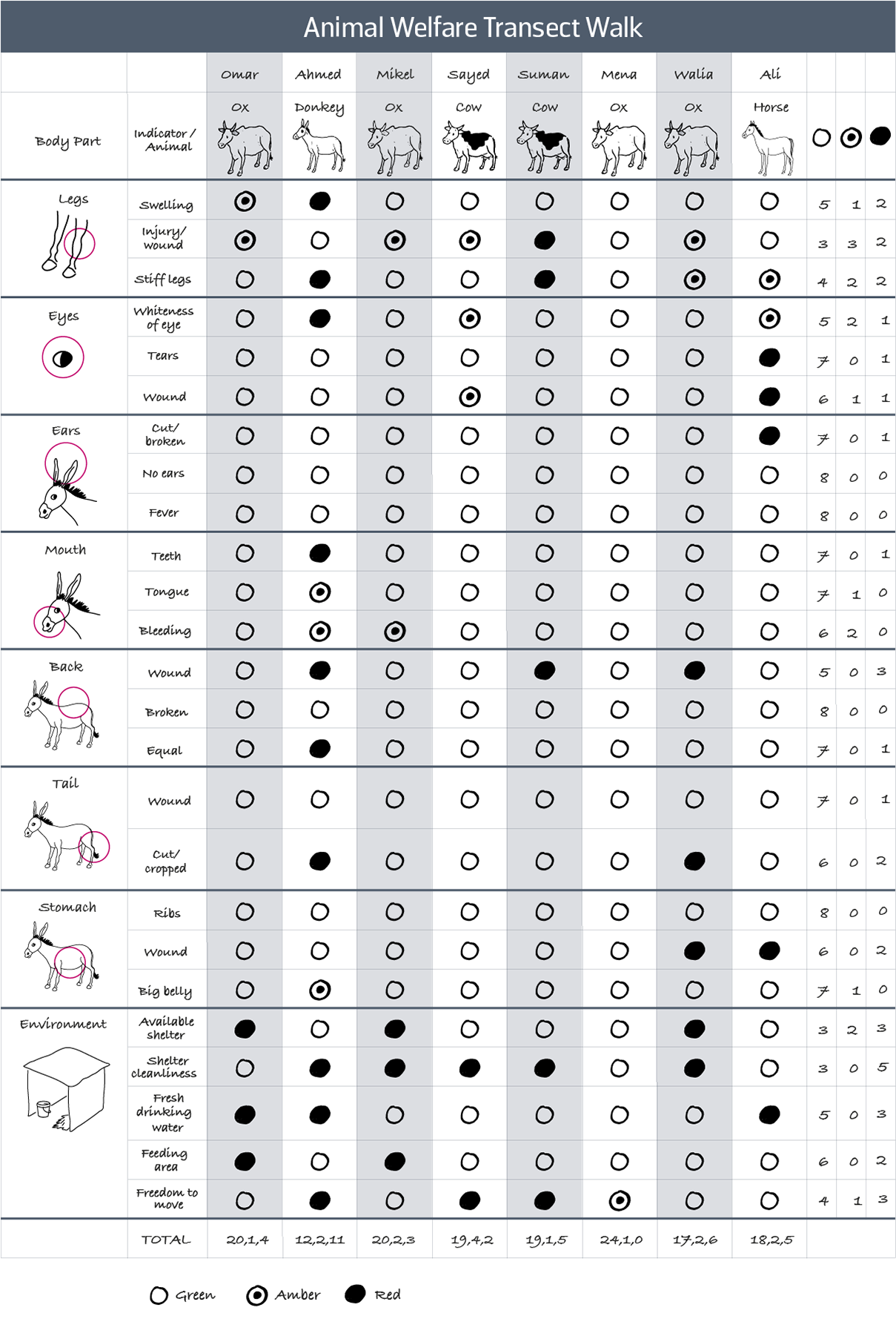
As a first step, the facilitator should prepare a list of the observable indicators derived from identified expectations and effects which reflect animal-based indicators (body and behavioural related indicators), resources, and management practices. In addition, animal-based welfare indicators identified through T19 ‘Animal feeling analysis’, and/or T20 ‘Animal body mapping’ exercises can be used to inform indicator selection for the transect walk. This list of indicators can then be presented back to the community to agree on the criteria which defines each in terms of good, moderate, bad condition/state (green, yellow, red).
Consider using the ‘effects on humans’ identified in step six to inform human indicator selection if part of the project.
Address any identified gaps in knowledge through sensitization or training sessions. It is recommended to conduct this prior to undertaking any community-based action planning.
Any identified gaps can be examined in more detail using the following tools, especially prior to undertaking any community-based action planning:
T21 Animal welfare practice gap analysisto promote understanding of the drivers of gaps in animal welfare practices, such as lack of motivation, resources, or knowledge that can be used to develop targeted behavioural change strategies.
T25 Problem animal to identify the root causes of the different animal welfare issues observed on the body of the animal and inform action planning to address them.
T26 Animal welfare cause effect analysis to explore the root causes of specific animal welfare issues and promote understanding of the effects of the issue on animals and people as a means to generate improved motivation to take action and inform action planning.
This tool encourages people to think about how their animal(s) feels based on their experience. By mapping animals’ experiences and associated feelings over time, it allows community members to see the cumulative positive and/or negative impact of these experiences. In this way, the tool can provide insights into how communities perceive their animals’ experiences and understand their feelings and needs.
Tool purpose:
Time needed:
• Generate communities’ understanding of how daily activities affect animals’ feelings contribute to animals’ positive or negative welfare states and impact their quality of life. • Improve communities’ compassion for their animals. • Support communities to identify opportunities for providing positive life experiences of their animals. • Motivate communities to increase the provision and frequency of positive life experiences of their animals, as well as other people in their lives. • Help identify gaps in communities’ understanding of animal welfare and animal sentience which can help inform project activity planning
2-2.5 hours
Materials needed:
Facilitator prompt sheets/visual aids including Balance of Life Experiences scale (refer to the animal welfare learning module for example), Five Domains of animal welfare, pens, and paper (not limited to paper, the facilitator can explore different ways the different communities want to document their information)
Stages of Behaviour Change: Pre-contemplation Stage
Project Support: Participatory Learning and Action Tools, Training
Specific Topics: Animal Husbandry and Management; Animal Handling; Animal Welfare, Feelings and Needs; Animal Health and Services; Compassion/Empathy; Community Change Agents
T18a: A day in the Life of an Animal
“A day in a life of an animal”
Step 1
Form 2-3 small groups of 3-5 people depending on the number of participants. The more groups the longer the activity may take.
Step 2
Ask the groups to think about the animals in their community, and to choose an individual animal that they will explore together. Ask the group for a summary of the individual animal, for example age, name, whether they work. If using pens and paper this animal can be drawn in the middle, or if reporting verbally then the participants can give a quick overview in the introduction to the group in Step 5.
Be prepared to ensure the group focuses on one example (e.g., a horse working in a brick kiln, a chicken providing eggs).
Step 3
Ask each group to draw a clock with 24hrs and briefly describe what the animal is doing over the course of the day (e.g., waking up, eating/drinking, being prepared for work, working, resting) and map these on the 24 clocks. Check to ensure all key periods and activities have been included, asking probing questions if you think anything may be missing.
Step 4
Then ask each group to pick at least 3 time points throughout the day (recommended to choose at least as many time points as people in their group), and consider in more detail what the animal is experiencing at each of these time points including: • What activities are/ is the animal doing/engaged in (e.g., feeding)?
Prompt the group to think in terms of the five domains. Often people will focus on tangible things like food and water. Try to also ensure that other activities are also covered, for example free time, rest, social contact. Refer to the five domains of animal welfare visual aid if available to support their discussion.
• What are the frequency and duration of these activities/experiences? • How does each activity/experience make the animal feel (e.g., experiencing pleasurable tastes) and influence the animal’s mental state?
Some people find it easier to reflect on how they would feel in that situation. So, for example discussing quality rest – you could ask, “how do you feel when you don’t sleep well? Can you sleep when it is very noisy around? Has anyone ever been prevented from sleeping because they were worried about something (that was going to happen to them the next day)?”
Step 5
Next, bring the groups together and ask them to give a short introduction to their chosen animal’s day to the whole group. Each person in the group can present at least one time point so that between them they cover the full day.
Next, facilitate a discussion using the points below as a discussion guide: • Probe for more details on their animals’ daily experiences/activities where appropriate and needed to encourage them to think about and identify the nature of these experiences in terms of whether they may be positive or negative where this may not yet be clear.
For example, with rest, can the animals move freely? Are they restrained up next to someone or something they don’t like or fear? Are they restrained so that they cannot relax properly and achieve good quality rest? Is the environment noisy, preventing them from sleeping? How do their rest patterns align with their natural needs?
• Discuss whether an activity and/or experience is truly positive or whether it reflects an alleviation of a negative experience. For example, providing water to a dehydrated animal is alleviating a negative experience, whereas play is (most likely) a positive experience. - As negative and positive experiences are not always the direct opposite of each other, it is important to discuss them separately e.g., is the experience negative or not; is the experience positive or not.
• Encourage discussion of how the frequency, duration, and intensity of experiences differ, and how this can impact an animal’s quality of life.
For example, if an animal is wounded in an accident, this may be a very intense experience and painful at the time. However, if the animal is in a secure environment and receives prompt and effective treatment, then the negative experience will be lasting. However, if the animal does not receive treatment, then the negative experience will last longer. Even if the injury is minor and the pain experienced is not initially intense, if left untreated the pain will increase, and the animal may need to be active or work with the painful injury or be unable to rest properly if in pain. These experiences will accumulate, making the overall balance of these experiences will be negative, and lower the animals’ resilience to other negative experiences. In this example, a short but high intensity experience may have less impact on the balance of experiences than a less intense but longer lasting experience.
• Ask what opportunities are provided for their animal to experience comfort, pleasure, interest, confidence, and the ability to make choices and feel a sense of being in control? - For example, if they are provided with shelter, do they have the choice about when to enter the shelter and when to remain outside, allowing them to adjust for their thermal comfort and security (e.g., some animals, such as horses, may feel very trapped in a shelter, whereas other animals, such as dogs, may feel a lot safer within a shelter than outside).
• Based on this discussion, where do you believe your animal sits on the balance of life experiences scale and why? (Refer to the balance of life experience visual aid if available)
Once concluded, summarize their discussion in terms of the following points: • Key points in the animal’s day (e.g., rest, work, eat, drink, are tied up (movement restricted), roam freely). • The range of their animals’ experiences and feelings. • How animals’ feelings would change if experiences were very frequent or very prolonged. • Highlight where the animal sits on the balance of life experiences scale and why.
Step 6
Next use the following questions to encourage participants to reflect and learn from the activity:
• Was there anything that surprised you? • What did you learn from this activity? • How representative do you think this is of your other animals/animal in the community? • Is there anything that you think you could do differently in the future to improve your animal’s quality of life based on your learnings from this activity?
Encourage them to identify and/or draw attention to the positive aspects of what they already do as a means to promote reflection and learning and motivation to do more of what is already feasible for them, rather than focusing on what they can’t.
Step 7
Finally, draw the activity to a conclusion using the following points: • Reflect on the original aims and purpose of the activity and draw conclusions relevant to these • Highlight key reflections about what participants learned doing this activity. • Summarize what the group concluded they could do to minimise negative experiences and/or increase positive experiences in their animals’ lives.
T18b: The Life of an Animal
The life of an animal
Step 1
If doing this exercise in a separate session from the day in a life activity, begin with Step 1 and 2 from the “A day in the Life of an Animal” activity above first.
If conducting this activity in the same session following completion of the day in the life activity, skip to step 2 below.
Step 2
Explain they will be mapping their animal’s experiences over the course of the animal’s lifetime and ask them to decide how they wish to represent the lifetime of their animal’s life cycle visually e.g., table, circle, list, timeline.
Then ask each group to identify the major life cycles/stages/time points of their animal, and plot these in accordance with how they decided to represent the animal’s lifetime. Encourage them to identify at least as many life events as people in their group, ensuring they include consideration of the animal’s life cycle from birth, growth, reproduction, working up to end of life as well.
Step 3
Once the life stages/time points of their animal are identified in step 2, ask each group to explore in more detail what the animal is experiencing at each stage, you can use the following to guide the discussions:
• What activities are some of the activities the animal is doing/engaged in at each stage (e.g., working, breeding)?
Prompt the group to think in terms of the five domains for the life cycle/stage of the animal they have picked to focus on. Often people will focus on tangible things like food and water. Try to also ensure that other activities are also covered, for example free time, rest, social contact. Refer to the five domains of animal welfare visual aid if available to support their discussion. • What are the frequency and duration of these activities/experiences? • How does each activity/experience make the animal feel (e.g., experiencing pleasurable tastes, experiencing positive human-animal interactions, experiencing and exhibiting positive natural behaviours, etc.) and influence the animal’s mental state?
Some people find it easier to reflect on how they would feel in that situation. So, for example discussing quality rest – you could ask, “how do you feel when you don’t sleep well? Can you sleep when it is very noisy around? Has anyone ever been prevented from sleeping because they were worried about something (that was going to happen to them the next day)?”
Explore the different life stages in more detail considering what the animal is experiencing at each stage. Details to be discussed should consider both the activity (e.g., weaning) and the associated mental state (e.g., distress/fear/panic if forcibly weaned and put in isolation). • What are the frequency and duration of these life experiences? • How does each experience make the animal feel (e.g., experiencing pleasurable tastes, experiencing positive human-animal interactions, experiencing and exhibiting positive natural behaviours, etc.) and influence the animal’s mental state?
Some people find it easier to reflect on how they would feel in that situation. So, for example discussing being separated from other animals and kept alone – you could ask, “how do you feel when you are isolated from friends and family? Has anyone ever been prevented from socializing with your network of support?”
Step 4
After discussion, bring the groups together and ask them to present the lifetime of their animals to the whole group. Each person in the groups should present at least one time point/life stage, which between them covers the entire lifespan. Encourage discussion of how the animal’s welfare changes over their lifetime using the guiding questions below, and encourage a process of reflecting on the exercise, generalising, and application. Conclude where this animal sits on the Balance of Life Experiences chart.
Step 5
Once finished, summarize key reflections and learnings from discussions including:
• Key points in the animal’s life (e.g., birth, early life, weaning, working/productive life, ownership changes, end of life). • The range of experiences and feelings, and how these change over time. • How quality of life is impacted by experiences that are very frequent or very long. key reflections and what people discovered by participating in this exercise. • What the group concluded they could do to minimise negative and add more positive experiences, including any immediate actions vs longer term changes needed.
Conclude by reflecting on the original aims and purpose of the exercise and draw conclusions relevant to these, and ensure concluding reflections highlight where the animal sits on the balance of life experiences scale and why.
Facilitator's Notes
Preparatory work (things to consider before the exercise):
It is important that participants have been socialized in the concepts of the five domains of animal welfare and balance of quality life experiences prior to beginning this activity. If they have not yet had an introduction to these concepts, you will need to build in more time to introduce these concepts in advance.
Consider your target audience (community, community facilitators) for this exercise.
Establish your motivations and goals for doing this exercise with that group of participants.
Based on this, decide whether you will run both activities and only run one of the activities.
Establish what species/animals are you are likely to, or need to, discuss and why (consider whether there is benefit of having same species groups e.g., equid owners).
Do you feel confident with the application of this task to those species? Do you feel confident discussing the range of positive and negative experiences for the different animal species that you may be discussing during the exercise? Do you need to seek some further support or clarification?
Consider a manageable group size (too small may produce too little discussion, too big may result in too much variation, debate, or not enabling everyone to participate fully).
Be prepared with information to respond to how a community views the animal experiences. We suggest that in advance of the session you have a list of ‘red flags’ – practices that are very dangerous to welfare and need an immediate response – and an idea of what the ideal situation would look like, so that you are clear on what you can praise/want to see.
Consider how you may capture these results with literate and illiterate groups (use photo to capture if they have used different symbols to represent the life of an animal)
In this tool it is important to focus on increasing opportunities for positive experiences, and not only opportunities for reducing negative experiences.
for “The life of an animal” activity, the following suggestions also apply:
Consider how the community/culture would most likely break down the life of an animal e.g., by age, by life event, and work with them to establish the best way of doing this. Ensure that all the critical stages/life cycles from birth to end of life are captured in the discussion even though the classification might vary.
Be prepared to challenge or fill in gaps of key life stages that may be missed.
Next Steps
This exercise may be used to improve communities understanding of how experiences can impact on an animal, promote understanding of the concept of animal welfare generally, and/or as a precursor to community action planning by helping to generate discussion and ideas about how community members can provide more opportunities for their animals to have more positive life experiences and a greater sense of control choice and feeling of control. Next steps will therefore vary depending on your intended objectives of use of this tool, and in what project phase you are implementing it. Think about how the information or outcomes generated from this activity may be used or help inform your next steps. You may also wish to consider whether they can serve as an indicator of change which you may wish to assess again later. (Although if this uncovers incidents of welfare practices that are unacceptable then the facilitators should explore using the available resources within this guide how to address them).
The animal feelings analysis examines an animal’s experience of its own life. This tool has been developed specifically to help participants understand that their animals are sentient beings, whose emotions can be positively or negatively impacted by their state of health, environment, nutrition, ability to express natural behaviours and through people’s interactions with them. By helping people recognize that animals, like people, are sensitive and have feelings about what is happening to them, this exercise can improve people’s motivation to care more about the effect of their own actions on their animals’ overall welfare. In addition, this tool helps participants to assess whether their animals are experiencing a positive emotional state e.g. high and low energy, such as excitement, pleasure, sociability, choice over environment, comfort, satiety (fullness) and/or calm. This tool can be used either on its own as a sensitization exercise, or incorporated into the T22 Animal Welfare Transect Walk/Participatory Welfare Needs Assessment.
Tool purpose:
Time needed:
• To sensitize animal owners, users and carers to the fact that animals have feelings, which are expressed through their behaviour or ‘body language’. • To raise awareness of the observable signs and symptoms that people can use to assess how their animals are feeling. • To generate discussion around positive and negative factors influencing the feelings and behaviour of animals, and ways animals’ positive emotional state can be improved, and increase people’s motivation to improve it.
2 - 3 hours
Materials needed:
Sticks, coloured powder or chart paper, post-it notes, cards, markers. Animal jigsaw puzzle if available and/or or other visual aides to illustrate positive and negative welfare states.
Stages of Behaviour Change: Pre-Contemplation Stage
Project Support: Participatory Learning and Action Tools
Specific Topics: Animal Welfare, Feelings and Needs; Compassion / Empathy, Community Change Agents
Animal feeling analysis
Figure T19 Animal feelings analysis by an animal-owning community
As a first step in participatory welfare needs assessment, a group of animal owners identified 15 indicators that they could use to assess happiness and unhappiness in their animals. All animals were scored collectively based on these indicators, with three pebbles for ‘happy’, two pebbles for ‘medium’ and one pebble for ‘sad’. Only one animal scored three pebbles for all the signs assessed. The animal owners discussed why this animal was found to be so happy and most of the other animals were not. Based on the discussion the group agreed on several action points to make the other animals happier.
Animal Feeling Analysis
Step 1
Ask participants “what do their animals expect of their owners to be happy and healthy?” and ask a community helper to list these expectations on a sheet of paper using words or drawings”. Probe participants to think about what animals expect in terms of the following components which contribute to a positive welfare state (Five Domains)
• To be healthy? (prevention & timely treatment of disease, pain) • For good nutrition? (feeding & watering) • For their environment? (Comfort, rest, temperature, shelter) • To express their natural behaviours? (Freedom of movement, social interaction w other animals, positive human-animal interactions)
Please note: If participants are struggling to identify animals’ needs and expectations, ask them what they require for their own (human) wellbeing. How would you feel without regular access to water or time to socialise with your friends or ability to go wherever you want?
Step 2
Next, ask the community helper to draw a matrix with four columns and write ‘happy, ‘neutral’ and ‘unhappy in the 2nd, 3rd, and 4th top columns (see figure T19). If you feel the community will struggle to identify neutral states, make only the columns, with happy and unhappy in the 2nd and 3rd column.
While the community helper is creating the matrix, ask participants how they observe/know whether their animal is happy or sad. Where do they look or what do they observe to know this? List the general body parts, expressions, or behaviours they identify using words or drawings in the first column of matrix.
For example: several communities advised that their animals use the position and movement of their ears, eyes, head, and neck to show if they are in their ‘best’, ‘better’ or ‘bad’ emotional state.
Step 3
Next ask participants to detail the combination of behaviours or expressions that indicate an animal that is feeling happy, those that indicate that the animal is feeling unhappy, and those that indicate a neutral state for each of the identified signs in the first column.
Step 4
Once the matrix is complete, facilitate the group to reflect on what they learned from this activity. Encourage them to think about the importance of observing these signs and indicators and how this can help them to understand what their animals are feeling and enable them to better respond and meet their animal’s needs. Summarize the exercise by reflecting that animal have feelings like people, and they can use these signs and indicators to help them be sensitive to their animals’ feelings and understand what is happening to them at any moment and reflect on how their own actions have an impact on what they are observing in their animals.
Step 5
Summarize the results of the activity and have the community helper add any actions and activities to the community action plan. Agree on a date and time for the next session.
The matrix should be left with the community. Make a copy or take a photograph for your reference for future discussions and further action planning. Add a copy to your project action tracker. If they have not already performed one, agree a time when they will assess their animals by doing an animal welfare transect walk (T22) together.
If part of T22 Transect Walk
Step 6
If this exercise is part of the transect walk, first carry out steps 1-4 above. Then, develop a matrix with the agreed behavioural signs written along the top and the names of owners and their animals written down the side. You can use either numerical scoring (2 = happy; 1 = neutral; 0 = sad) or traffic lights to indicate best (green), better (orange) and bad (red). Go with the group on a transect walk to visit individual animals and assess their behaviour and surroundings. Discuss the body language of each animal in detail and associated factors that contribute to a positive mental state to build consensus among all the participants about how each animal truly feels.n tracker.
Step 7
At the end of the transect walk, sit together, and discuss which factors cause or influence the feelings of animals, both positively and negatively and reasons for this. Summarize the results of the activity and agree on action points that individuals and/or the group can take to make their animals feel happier. Have the community helper add any actions and activities to the community action plan. Agree on a date to repeat the exercise and monitor changes in animal feelings.
Facilitator's Notes: Animal Feelings Analysis
The animal feelings analysis is best carried out in small or medium-sized groups, as crowding around an animal may change its behaviour.
Participants should have a general understanding of animal welfare prior to conducting this exercise.
Behavioural expressions or body language may be different for different species of animal. There may be more than one type of behavioural expression for the same feeling. Encourage participants to discuss this.
It may be helpful to prepare visual aides of examples of positive and negative expressions of animals’ feelings to enable participants to understand the signs and symptoms of positive and negative emotional states.
Next Steps
Follow up with the T22 Animal welfare transect walkto support the assessment and monitoring of animals’ welfare and identification of common welfare problems to inform action planning.
As a first step, the facilitator should prepare a list of the observable indicators derived from identified expectations and effects which reflect animal-based indicators (body and behavioural related indicators), resources, and management practices. In addition, animal-based welfare indicators identified through T17 ‘If I were an animal’ and/or T20 ‘Animal body mapping’ exercises can be used to inform indicator selection for the transect walk. This list of indicators can then be presented back to the community to agree on the criteria which defines each in terms of good, moderate, bad condition/state (green, yellow, red).
Consider using other tools such as T17‘If I were an animal’ and T21‘Practice gap analysis’to look at the physical aspects of welfare such as food, water, shelter, disease and injury and their effects on the animal’s behaviour.
Animal body parts map, animal body issues map and animal-based welfare indicators map
A body map is a picture an animal showing the parts of its body, their functions, and the body areas affected by wounds or diseases. The map depicts either the whole body, or part of the body, as it is perceived by individuals or a community group. This tool can be used to map animal body parts and wounds or disease symptoms on the body, which can be useful in the concept of a project to gain an understanding of how people understand their animals’ bodies, and their perception of common welfare issues on animals’ bodies. It can also be used in the planning phase to map animal-based indictors of good and bad welfare status, which can help inform indicators used in participatory welfare assessments.
Tool purpose:
Time needed:
Body part mapping • To identify local names for parts of an animal’s body. • To uncover and discuss traditional beliefs about animal body parts. • To explore the different perceptions that people have about their animals’ body parts and their associated roles and functions. • To act as an educational tool that introduces participants to the roles and importance of different body parts.
Animal body issues map • To identify problems on animals’ bodies which they perceive as issues and their believed causes.
Animal-based welfare indicators map • To understand what people perceive to be good and bad indicators of welfare.
2 - 3 hours
Materials needed:
Sticks, coloured powder, chart paper, markers. Broken horse or donkey puzzle if available.
Keyword Search Tags
Project Phase: Initiation Phase, Planning Phase
Approaches for Working With Communities: Community Development Approach, Community Engagement Approach
Behavioural Drivers (COM-B): Capability
Project Support: Participatory Learning and Action Tools
Specific Topics: Animal Welfare, Feelings and Needs
T20a: Animal Body Parts Map
This basic animal body parts map allows participants to identify their animals’ body parts, providing an indication of how participants perceive their animals’ bodies.
Figure T20a Simple animal body parts map of a working horse
Ten members of working animal owning households produced the simple animal body map above. The animal owners named all known parts of the animal and provided the local names for each part.
T20b: Animal Body Issues Map
The animal body issues map is a natural follow-up activity to the body part and is useful for understanding what participants perceive as normal versus unhealthy. For example, in places where animals have similar welfare problems, such as being thin, owners often perceive thinness to be normal and do not identify it as a problem. In the example below, participants were encouraged to describe the issues - or problems - that affect each body part. The group drew the identified issues on the animal body map (T20b). They indicated their believed causes (when known) and added them to the map next to the associated issue.
Figure T20b Animal body issue map, indicating body issues and causes on a working horse
Through this exercise, the group identified the following wounds:
Nose due to nostrils being slit
Mouth due to where the bit rests
Eyes due to uncleanliness and dirt
Ears due to cutting
Back due to saddle wounds
Barrel due to friction from cart rope
Pastern/fetlock (above hoof) due to hobbling
Knee due to fall
Dock (tail area) due to cart ties
Rump from use of whip
T20c: Animal-based welfare indicators Map
The animal-based welfare indicators map is a useful follow up activity to the animal body parts map. This activity identifies what the animal-owning households perceive to be good and bad indicators of welfare on an animal’s body.
Figure T20C Animal body indicators map of a working horse
Figure T20C is an example of an animal-based welfare indicator map that was created by members of a working animal-owning community. Participants identified characteristics of what they believed a normal, healthy working animal should look like and wrote the identified healthy indicators next to the associated body parts identified in the first animal body mapping activity. They were then asked to identify unhealthy indicators of the same characteristics, and included those on the map. When participants initially completed the map, they only identified a few indicators associated with poor welfare. At this early phase of community engagement, participants had not yet been introduced to concepts of animal welfare, and the activity identified gaps in their knowledge; for example, they incorrectly identified the presence of frog in their working donkeys’ hoof as a poor indicator of health.
This exercise can be repeated and Figure 20c updated and revised to correct any inaccurate indicators after participants’ complete their first participatory animal welfare needs assessment (PWNA) (see recommended next steps T22 Animal Welfare Transect Walk), where they will learn how to identify good and bad animal welfare states related indicators. Once updated and accurate, this animal body map of welfare issues and indicators can then be used to inform action planning.
Animal Body Parts
Step 1
If the animal parts puzzle is available use this and ask participants to put it together, or alternatively ask them to sketch the body of their animal on the ground or on paper, and to identify the different body parts and the local names used for each body part.
Step 2
Once participants have identified all body parts, initiate a discussion on their perceptions of the role and function of each part. This discussion often creates an opportunity for facilitators to sensitize participants about which body parts are important to animals’ function, which is particularly relevant in relation to working animals.
Animal body issue map
Step 3
Follow step one above, then ask the group to identify issues they commonly perceive on the body of their animals. This may include wounds, symptoms of disease, or other problems with animal health or function which they observe. It is important to allow participants to identify what they perceive to be issues, rather than identify issues you as the facilitator perceive. Encourage participants to draw these issues on the body map or represent those using symbols next to the appropriate body part.
Animal-based welfare indicators map
Step 4
Using the animal body parts map (steps 1 and 2), ask participants how a normal, healthy animal should look. Starting the discussion with the question ‘What parts of the body do you look at when purchasing/adopting an animal?’ can be useful. Through this question, participants will typically start to identify what they perceive as indicators of good animal health or welfare as observed on an animal’s body. Ask them to write or draw symbols representing the indicator next to the associated body part on the map.
As a follow up question, ask participants what poor animal health or welfare would look like, or what they consider to be an indication of poor health or condition when purchasing an animal.
Through the discussion, differences in ideas about indicators will emerge and they will sensitize one another to reach agreement. At this stage, it is common for only a few indicators to be identified, especially related to poor animal welfare conditions. Some identified animal-based indicators may be incorrect, highlighting gaps in knowledge, perception about the animal body part and misguided beliefs of welfare. This is gives rise to opportunities for future sensitization on good and bad welfare states.
Step 5
The animal-based welfare indicators mapping activity may be revisited after conducting an initial participatory animal welfare needs assessment (PWNA) in the initiation/planning phase of the community project cycle (T22 Animal Transect Walk). Through the PWNA exercise, participants gain greater understanding of good and bad welfare states and associated animal-based indicators, which they can use to update, add to, and/or correct the indicators on their initial animal-based welfare indicators map (see figure T20c above).
At this time, the facilitator may ask probing questions about different body parts related to what was observed and learned through the transect walk in terms of indicators of problems and good welfare states. Encourage participants to create a comprehensive body map of animal-based parameters for assessing animal welfare relevant to their local context. These can then later be used to inform indicator selection for future transect walks to support monitor community-based action plans/for individual personal action plan and monitoring.
Facilitator's Notes
This tool has been adapted into a ‘Broken Horse’ jigsaw puzzle, where animal body parts are discussed by reconstructing a wooden jigsaw of an animal. This puzzle version of the exercise is good for starting discussions about animal welfare with children.
Next Steps
Issues and related causes identified through this exercise can provide a preliminary indication of perceived animal welfare issues during the initiation phase. Deeper analysis of root causes can be explored during the community action planning using T25 Problem animal and/or T26 Cause and effect analysis.
Ground truth animal welfare issues identified by participants during the mapping exercise, with animals’ actual observed body condition, which can highlight potential gaps in participants’ understanding of welfare issues.
Sensitize participants on good and bad welfare states and associated animal-based indicators.
Identify the most commonly observed animal welfare issues including animal-based indicators, resource related issues and environmental issues.
The animal welfare practice gap analysis is designed to explore current animal management practices and activities which contribute to animal welfare. This tool identifies gaps and reasons for the gaps in terms of the main drivers of behaviour change: capability, opportunity and motivation. It has been adapted from other tools specifically to put the animal at the centre of the analysis. The first steps are very similar to those in ‘If I were an animal’ (T17). Consider conducting this activity separately with owners, users and carers, including both men and women, or other relevant groups that are likely to have different priorities.
Tool purpose:
Time needed:
• To identify the gaps and causal factors contributing to people not meeting the welfare needs of their animals. • To identify actions people can take either individually or collectively to address gaps in animal husbandry and management practices to improve animal welfare. • To support gender analysis if conducted separately between men and women by identifying differences in factors contributing to gaps in practice. • To inform identification of community actions and/or behaviour change strategies to address the causes of people’s poor animal husbandry and management practices related to lack of capacity, resources and/or motivation. • When used repeatedly, results can inform monitoring by enabling assessment of perceived changes in participants’ animal welfare practices and underlying causal factors which constrain their adoption.
2 hours
Materials needed:
Chart paper, index cards or sticky notes, pens/markers, chalk, stones, pebbles, local materials (leaves, seeds, etc.)
Approaches for Working With Communities: Community Development Approach, Community Engagement Approach
Behavioural Drivers (COM-B): Behaviour Change Diagnosis and Planning, Motivation
Stages of Behaviour Change: Preparation Stage
Project Support: Participatory Learning and Action Tools, Needs Assessment, Gender Analysis, Monitoring and Evaluation
Specific Topics: Animal Husbandry and Management, Community Change Agents
Animal welfare practice gap analysis
Figure T21a Animal welfare practice gap analysis carried out by animal owners
A group of animal owners analysed their current animal management practices. They identified 10 practices that their animal would expect from them and scored the extent to which they currently carry out these practices. The highest ‘in practice’ scores were for timely veterinary treatment and free access to water. The group discussed the most common reasons for seeking veterinary treatment and how changes in current practices could reduce or eliminate the need for the treatment altogether. The lowest scores were for ‘shelter from the elements’ and ‘time to interact and play with other animals’. After a discussion, the group identified quick wins and collectively:
Purchased more nutritious and balanced feed by buying food in small groups instead of individually. This means spending less money, but also having better quality feed.
Identified a location to make a rolling-pit for the animals to use after work that was cleared so it was safe for the animals; it was also near a place where the users could have tea and socialise together.
Identified 5 new water points and cleaned abandoned tyres to use as water troughs.
The group agreed to make these good practices a daily habit and to monitor each other’s progress against their individual action plans.
Start by encouraging participants to see the world from their animals’ point of view. Ask what expectations their animals have of them to have a happy and healthy life and experience a positive mental state. If they are struggling with this concept, ask them what they need as humans to be happy and healthy, then extend the question to their animals. At this point, the group should start identifying expectations animals have of their owners. Ask the community helper to write the expectations on cards for everyone to see or use representative drawings.
When participants have finished identifying their animals’ expectations of them, it is the facilitator’s responsibility to ensure that all welfare components have been considered. Use the following guiding questions as needed to facilitate participants to identify their animals’ expectations of them in terms of any of the following domains of welfare [Five Domains] which they have not yet considered:
• Health - What do animals need/expect of owners to be healthy? (Disease prevention, timely treatment, proper fitting equipment) • Nutrition - What do animals need/expect of owners for good nutrition? (feeding & watering) • Environment - What do animals need/expect of owners in their environment? (Comfort, rest, temperature, shelter) • Behaviour - What do animals need/expect of owners to express their natural behaviours? (Freedom of movement, social interaction with other animals)
Please note: The facilitator should group/organise similar expectations into one category and explain the reason for the grouping (only if the anticipated effects of the expectation not being met are the same). For example, if the community identified ‘free access to water’ and ‘clean water’, consider consolidating the two examples into one ‘free access to clean water’ category.
Once the list is complete, ask the community helper to record the group-identified expectations on cards using words, symbols, or local materials.
Step 2
Next, ask the helper to draw a grid or matrix on the ground using coloured powder, chalk, or a stick, with at least 5 columns in the matrix to start. Place the group-identified practices (cards in step 1b) along the first column.
Label the second column ‘in practice’ (like the matrix in step 1a).
Step 3
Facilitate the group to fill in the second column of the matrix labelled ‘in practice’, by asking participants to what extent their animals’ expectations are fulfilled by each of the identified practices. Scoring from 0 to 10 (0 = not in practice, 10 = completely in practice).
Any remaining stones (out of ten) can be kept aside or in the first column, next to the identified practice.
Step 4
Ask the group to identify at least 4 of the most important factors contributing to gaps in their animals’ expectations and current practices. Have the helper write the factors on a card using words or symbols.
They may identify factors (causes) such as:
Place the cards with the factors as column headers along top of the matrix, adding more columns to the matrix if necessary.
Step 5
Ask participants to use the remaining stones (out of ten) to score the gap factors (causes). For example, if one of the expectations was ‘timely veterinary treatment’, five stones out of ten may have been used for ‘in practice’. The remaining five stones would need to be divided amongst the different causes of gaps in practice e.g. two stones for ‘lack of knowledge’ and three stones for ‘not a priority’.
Please note: Coming to an agreement on how the factors (causes) should be scored will raise a debate amongst the group. These discussions create shared learning opportunities, as participants learn from one another as they discuss and agree on final scores. As a facilitator, you should allow and encourage this discussion without inserting your ideas.
Step 6
Once all the causes of gaps in practice have been scored and the matrix is complete, ask a community member to help summarize the results with the group.
Use the following guiding questions to facilitate a discussion amongst participants:
• Where gaps in practices exist, what are the specific skills, knowledge and/or resources preventing participants from meeting their animals’ needs?
• What are the effects of the animal husbandry and management practice gaps on both animals and animal-owning households? If the group has already completed T17 ‘If I were an animal’, ask them to come up with some of the effects that they identified in this activity.
• Which practices do you perceive as most important to ensuring the welfare of your animals? Please note: This question can provide an opportunity to raise awareness of how practices often considered less important can still have significant impacts on animal’s welfare.
• What actions can participants take, either individually or collectively, to address these gaps and mitigate the negative effects on animals and animal-owning households?
• What technical support is required to support participants in acting?
Step 7
If participants have identified specific actions to address gaps, have the helper record the actions and specific activities in the community action plan. Make sure to include who will monitor it and a realistic timeline. Add any opportunities to capacity build or project plan into your project action tracker.
Facilitator’s notes: Animal welfare practice gap analysis
It is helpful for participants to have a general understanding of animal welfare and related animal husbandry and management best practices when undertaking this activity. Consider conducting one or more of the following activities as time permits to raise awareness of animal welfare needs prior to conducting this exercise:
T17 ‘If I were an animal’: raises awareness of what animals’ need and how they depend on people experience positive welfare states
T18 Thriving not surviving: promotes understanding of the five domains of animal welfare and how people can promote positive welfare states
T19: Animal feelings analysis: helps promote understanding of animal feelings and related physical expressions and behaviours indicative of those feelings.
T20 Animal body mapping: helps identify animal-based indicators of welfare status which can be used in the transect walk, and can serve as a useful sensitization exercise improve understanding of indicators of good and bad animal welfare.
If individual participants come up with a below standard practice (e.g. watering 2 x per day when free access is best practice), the facilitator can use this as an opportunity for them sensitize each other by reaching consensus.
This exercise can take considerable time, so discuss this in advance with the group. If the activity takes more than two hours, consider action planning in the next session.
Encourage everyone to express their own views and avoid bringing in your own examples while the matrix is being populated. Do not allow it to become a facilitator-driven exercise.
Consider having a designated note taker to document the insights (e.g. info on knowledge, skills, beliefs, resources) that emerge from participants’ discussions during this activity.
It is common for participants to identify only a few main effects on animals (step 6), especially when animals are not viewed as sentient beings. It is the facilitator’s role to use this as an opportunity to promote understanding of animals’ experience of these gaps.
T15 Cost benefit analysis when motivational factors have been identified as reasons for participants’ not meeting the expectations of their animals or when no consequences have been agreed by the community to address gaps
The facilitating organization may consider one or both of the following actions to address the identified gaps:
Capacity building trainings to promote knowledge and skills related to implementing animal husbandry and management practices that promote animal welfare:
Humane handling techniques
Proper feeding methods
Basic wound management
Benefits of grooming
Benefits of stable care
In-depth assessment or care practice research to identify:
Who needs to practice and who influences the desired behaviour
To identify main barriers to adoption of the promoted behaviour
Sustainable livelihood and/or community development-related projects to improve access and availability of resources important to animal welfare
An adaptation of a traditional transect walk [48], this animal welfare transect walk can be used as part of a participatory animal welfare needs assessment of the welfare status of animals. It encourages participants to make direct observations of the animals themselves by looking at the animals, the resources in their environment and the owner’s, user’s, carer’s handling and management practices. This is a useful tool for exploring animal welfare conditions and the realities of resources available to animals within a community.
The findings from this exercise, coupled with analysis from the contributing root causes for any welfare problems (T21, T25and/or T26) can be used to prepare animal welfare improvement plans for individual or groups of animals. It can also be used to monitor changes in animal welfare over time if conducted at different points in time, and recorded observations compared to assess change.
Tool purpose:
Time needed:
• To identify which animals are in the best/worst condition and have the best/worst welfare. • To identify the most common animal welfare problems within the community • To understand which welfare issues owners, users, carers prioritize. • To inform community action planning and target capacity building activities to address community-identified priority welfare issues. • To identify which owners, users, carers may be good candidates to target as animal welfare champions in the community, when used in conjunction with the results from T1. Using these two tools together should identify individuals with the highest potential to be exemplary champions and potential mentors to others.
5-10 minutes for each animal in the walk + 1 hour for discussion
Materials needed:
Sheets of paper, pen, coloured markers (red, yellow, green)
Project Support: Participatory Learning and Action Tools, Needs Assessment, Monitoring and Evaluation
Specific Topics: Animal Welfare, Feelings, and Needs, Animal Husbandry and Management; Community Change Agentsnts / Resilience
Animal welfare transect walk
The animal welfare transect walk gives a more complete and detailed view of animal welfare because the animals are present for the group to examine, whereas the previousanimal welfare mapping exercise (T1) or body mapping exercise (T20), only gives an overall ‘bird’s-eye’ view of the animal conditions in a community, as described by their owners without the animals present. In this way, the transect walk can strengthen or triangulate the information from these mapping exercises.
An animal-owning community carried out an animal welfare transect walk using a green, yellow, red traffic light system to score 25 animal welfare indicators that they had identified during their previous discussions and exercises, including 5 that directly relate to owner and carer behaviour (environmental factors). In this example, environmental factors were included because participants’ had a good understanding of animal welfare issues at the activity was carried out. However, it is also possible to modify this tool by using only animal condition indicators, which may be helpful in when participants have not yet gained a good understanding of factors contributing to good animal welfare.
Figure T22a Animal welfare transect walk recording sheet using traffic light signals
After the walk, the owners sat down together and analysed the score for each individual animal by summarizing the vertical columns on their recording sheet. In this example, Ahmad’s animal was found to be in the worst condition, with 11 red (‘bad’) and 2 amber (‘medium’) marks, followed by Walia’s animal which had 6 red and 2 amber welfare issues. After looking at all the individual animals, the group then summarized the horizontal rows to find out which welfare issues were most common in their village. Shelter cleanliness was the biggest issue in the community, with five of eight animals marked red. The group followed this exercise with a root cause analysis (consider using T25andT26) and inserted the results in the community action plan for action by individual owners and collectively.
Animal Welfare Transect Walk Using Traffic Light Signals
Step 1
Explain the purpose of the animal welfare transect walk to the group and involve all participants in the process of decision-making about which indicators of good and poor animal welfare are going to be observed. Create a safe learning environment at the start of this activity if this tool is being used as entry at Initiation phase to nurture positive motivation for further engagement.
To facilitate discussion and identification of observable animal welfare indicators, consider referring to the outputs of one or more of the following tools if already conducted:
Depending on participants’ understanding of animal welfare issues at the time this activity is carried out, it may be appropriate to focus only on indicators of animal body condition and consider adding indicators related to environmental/owner practices as the tool is used repeatedly and community participants’ understanding of animal welfare improves.
Alternatively, as the facilitator, you have an important role here: to check that the list represents all aspects of animal welfare as sometimes we find that the owners’ checklist only contains signs of physical welfare. If you notice this, it may be helpful to ask probing questions to encourage them to think about observable indicators of their animals’ welfare in terms of the five domains of animal welfare (e.g. nutrition, health, environment, behaviour, and mental state). After the group has finalized their list, sit together with them and check whether all aspects of welfare are covered.
Discuss the agreed animal welfare indicators thoroughly with all members of the group as well as the animal owners and carers from each household visited and agree a score for each one.
Step 2
Once the group has decided which observations to make, agree how the observations and discussions will be captured or recorded and who will take responsibility for this. Ask the community to decide what symbols will be used to record the result of each observation.
Examples include:
• Traffic light signals: good/best animal condition shown with green dot, moderate issues with animal condition with amber/yellow dot, worst condition with a red dot. Sometimes just red and green are used. • A tick/check mark might be used for good and a cross for bad. • Instead of a traffic light system, numerical scores might be assigned. For example: Red/cross = 0, Yellow/amber = 1, Green/tick/check = 2. If only red/green are used, then Red = 0 and Green = 1.
Step 3
Decide whose animals will be visited and the route of the transect walk. Fix a time when the group will go on the walk. It is essential that the owner and family of each animal visited are present when the group is visiting his or her animal and the surroundings.
Step 4
The community group should walk the route together, visiting all the households where animals are kept and the surrounding areas to look at each animal carefully. The group will often wish to make additions and alterations to the agreed observations. Any animal welfare issues which have emerged from other tools and exercises may also be discussed with the group during the walk.
Step 5
After returning from the walk, ask the group to summarize and analyse their record sheets:
• Have the participants add up the scores or numbers of red, yellow/amber, and green dots vertically to give a summary of the welfare problems of the animals. This can be used by the group to formulate individual action plans for owners. • Adding up the scores or dots horizontally will give a score for the whole community or group for that welfare parameter and add identified welfare issues to the “issues” column of the Community Action Plan. • Come to a consensus on the animal welfare successes and problems and discuss possible contributing factors. Discussion questions might include: - What welfare indicators are most in need of improvement and which are best performing? What are the reasons? - Why did some participants score higher than others? What are they doing differently than others who had lower scores? - What are the implications of these welfare issues on their animals’ physical and mental state, and on the lives of different household members? For example, do these welfare issues impact women, men, boys, or girls differently? - What could feasibly be done to improve their animals’ current welfare situation and replicate successes?
Record any identified ‘actions to be taken’ in the relevant column of the community action plan and have participants agree on a frequency to animal welfare transect walk activity to monitor progress (monthly, quarterly, etc.).
Facilitation Notes
If there are large numbers of animals, carry out the same exercise over several days so that all animals or a representative number of animals and households are covered.
This exercise can take considerable time, so discuss this in advance with the group and agree a suitable time to set aside for doing it.
If this exercise is planned to be undertaken in the project initiation phase or to support rapport building, it is imperative to create a safe and learning environment and build understanding about why scoring is part of the exercise.
It is helpful for participants to have a general understanding of animal welfare and related animal husbandry and management best practices prior to conducting this exercise. Consider conducting the following activities to raise awareness of animal welfare, feelings and needs, and help inform the identification of animal welfare related indicators to use during the transect walk:
T17 ‘If I were an animal’: raises awareness of what animals’ need and how they depend on people experience positive welfare states
T19 Animal feelings analysis: helps promote understanding of animal feelings and related physical expressions and behaviours indicative of those feelings.
T20 Animal body mapping: helps identify animal-based indicators of welfare status which can be used in the transect walk, and can serve as a useful sensitization exercise improve understanding of indicators of good and bad animal welfare.
Decide with the community in advance whose animals will be visited and the route of the transect walk. Fix a time when the group will go on the walk. It is essential that the owner and family of each animal visited are present when the group is visiting his or her animal and surroundings.
Animal welfare transect walks may be repeated at regular intervals and the results compared with previous walks. This enables participants to monitor and evaluate changes in the welfare status of individual animals, and changes management practices and availability of animal-related resources.
Next Steps
Once the participatory animal welfare needs assessment is complete, you can prioritize issues to address using one of the following tools:
Alternatively or in addition, you can explore the causes and effects of welfare issues by following the transect walk up with one of the following activities
Three pile sorting, use cards to enable a member of an animal owning community to sort and discuss animal management and work practices according to whether they are seen as good, bad, or neutral for animal welfare.
Tool purpose:
Time needed:
• To explore participants’ understanding and perspectives on any animal welfare issue, care and management practices (including harmful practices) and to provide a starting point for problem analysis and action. • To analyse perceptions about animal diseases and their symptoms, causes and prevention.
1 hour 30 minutes
Materials needed:
Chart paper, note cards, markers or other locally available resources, and a set of cards showing animal welfare.
Approaches for Working With Communities: Community Development Approach, Community Engagement Approach, Societal Outreach and Campaigns Approach
Stages of Change: Pre-contemplation Stage, contemplation
Project Support: Participatory Learning and Action Tools, Needs Assessment
Specific Topics: Animal Husbandry and Management, Animal Handling
Three pile sorting
Step 1
For this exercise you need to prepare beforehand.
Make a set of cards showing animal welfare or management practices which can be interpreted as good, bad, or in-between (neutral). These should be based on problems previously identified by the community during exercises such as ‘If I were an animal’ (T17), Animal body mapping (T20) or Animal welfare practice gap analysis (T21). Common negative practices which could be illustrated on the cards include beating animals, overloading, not offering water, incorrect feeding, and lack of care for wounds
Step 2
Organize participants into groups of no more than seven and ask each group to form a circle. Give a set of cards to each circle and ask for two or three volunteers to sit in the centre of the circle and sort the cards together. They should place each card in one of three piles: representing good welfare or management practices, bad welfare, or management practices, and in-between or neutral practices (or practices where there is uncertainty or disagreement).
Step 3
After the cards have been sorted, ask the volunteers to arrange them so that each card is visible to the whole group (see figure T23 below- Place holder). Encourage debate between participants to challenge their choices and analyse all aspects of their decision. Enable participants to understand why a particular practice may be better or worse for animal welfare.
Step 4
Ask the group to identify which of the animal welfare issues or management practices are occurring in their own village, especially the ones they have identified as bad. This discussion can be used to enable participants to identify priority welfare problems and to propose potential solutions or action to be taken.
Step 5
Document the discussions and share back with the community.
Record the community’s analysis and responses in your project action tracker and follow up with the community later if/when you start action planning together.
Figure T23 a sample pile sorting process
Facilitation Notes
It is important that you enable the group to bring their own perceptions and use their local terms for management practices, diseases, pain, and animal suffering.
The game can also be played using photographs representing the existing situations in the village. This needs advance preparation.
Notice and document why certain practices are said to be harmful or are perceived as positive or neutral while they affect animal welfare. It is important to also note their misconceptions about the practices, diseases, etc. and their stages of change (pre-contemplation – being unaware or contemplation stages – struggling with their decisional balance to determine them as good, bad or neutral) with regard to the different care and management and animal diseases.
Another variation is to ask participants to sort cards according to different types of animal welfare issue they have experienced, such as i) issues directly related to animals ii) issues related to service providers and other stakeholders and iii) issues related to animal owners, users, and carers.
Storytelling and guided testimonials can be used to connect with communities and encourage individuals to act. Stories are entertaining, are easy to remember, and allow people to identify with the characters. Stories can move people to action by inspiring and showing solutions to a problem. For the purposes of this guide, this tool has been adapted to animal welfare related stories.
T24a: Closed-Ended Story
A closed-Ended Story is an account of an event (true or imaginary) that is intended to promote a specific animal welfare behaviour to solve a particular animal welfare problem.
Tool purpose:
Time needed:
• To support communities to act on animal welfare issues, by promoting a specific behaviour. • Provide communities with solutions to different animal welfare issues they face in the community.
1.5 - 2 hours.
Materials needed:
pre-preparation of a closed ended story, handouts of the story, flip chart paper
Stages of Behaviour Change: Contemplation Stage, Preparation
Project Support: Participatory Learning and Action Tools
Specific Topics: Community Change Agents
The following are examples of closed ended stories which were created to encourage donkey owners to adopt the desired behaviours of cleaning and drying their animals’ pack saddles before using them with animals (Example 1) and cleaning their donkey’s hooves after work (Example 2). Refer to steps below for instructions on crafting closed ended stories relevant to your own context, using these example stories for reference.
Closed Ended Story Example 1: Caring for animal equipment before use
Bibek was the owner of a donkey who carried bricks by pack in the brick kilns in Nepal. Each day, Bibek would prepare the animal for work. First offering some food and water. Next, looking over his animal and brushing off the excess dust from its body. One day Bibek noticed his donkey flinching in response to the brushing. When Bibek looked more closely at his animal, he noticed a few red, raw wounds. The hairs around those wounds were dirty and matted. It took a few attempts to get the pack saddle on his donkey. Bibek could tell his donkey did not want to wear the saddle, it kept moving away. But they had to go now or risk losing money!
Bibek felt pressure and forced the saddle on. He wished it were not so hard! During a tea break, Bibek asked other workers whether their animals had wounds. They all said yes. The wounds were hard to see during work because they were hidden by the pack saddles. At the end of the day, Bibek took off the sweaty pack saddle and dropped it to the dusty earth. The donkey was left to wander, flies swarming around the sweat and open wounds.
Bibek went to the local shop. Other men were having tea outside the shop, with their donkeys tied up nearby. Bibek noticed these donkeys did not have any wounds. Yet, everyone in this area of Nepal must work in the brick kilns. How did their donkeys not have wounds, when all the donkeys in his village did? He greeted the men and said, 'your donkeys look very good, they have no wounds.' The men explained that there was a time when all their animals had wounds. One day, Hari, a man in their village, made changes to the pack saddles they all used. Hari was also trained in first aid and because of this he understood the importance of keeping the pack saddle clean and dry each day and keeping the donkey's coat clean too. This kept away the flies and reduced any infection.
Because of this, Bibek said 'wow, I would like to meet Hari!' And so, they arranged to meet. After their meeting, Hari supported Bibek's community to make changes to the pack saddles. And why it is important to keep clean the sweaty saddles and animals. Slowly the wounds reduced and went from all the donkeys. Ever since seeing that change, Bibek felt so happy to realise he had helped his whole community and their animals all because he started a discussion about why other donkeys did not have wounds.
Closed Ended Story Example 2: Hoof Cleaning
Amina lives in rural Kenya. She is married and has two daughters. Amina recently began working as a water vendor in the nearby market and entirely relies on her two donkeys for her livelihood. Amina is part of a women's group. Everyone in the group uses donkeys to make an income. Amina looks forward to their meetings. It is so nice to talk about life with others! Her daughters, Neema and Zawadi are responsible for the donkeys before and after the market trips. Neema did not like the donkeys. To her, they are big and strong. Neema had seen the donkeys together. Sometimes the donkeys were calm but sometimes they look to be fighting! It made Lela afraid. Neema is happy to clean the stable, fetch food and water when the donkeys are away but because she is scared, she does not want to go near the donkeys.
Amina had learned at her recent group meeting the importance of picking the dirt and debris out of her donkey’s hooves 1-2 times per day, especially after journeys. Excited with her new knowledge, she told Neema to clean out their donkey’s hooves twice a day, especially after journeys. This made Neema feel very bad. She thought ‘how can I do this when I am afraid of our donkeys?’ Neema told her mother how she felt. Amina then realised she was not sure how to do this new task either and it made her nervous too. Amina knew a man, Baraka who always talked about his donkeys. He values them, they look in great condition and are easy to work with. Shani wondered what his secret was. She asked Baraka to join one of her woman’s group meetings and demonstrate how to clean out her donkey’s hooves so that everyone was able, and nobody was afraid. She brought Neema and Zawadi to the meeting.
Baraka demonstrated how to safely approach the donkey and how to gently ask the donkey to lift its leg. ‘Who would like to try now?’ Baraka asked. He knew from Amina that Neema was afraid. Baraka wanted to show Neema how to work with a donkey gently, safely, and confidently. Baraka said, ‘how about you Neema? I can help you learn that donkeys are very nice and can be easy to work with – you just need to learn how.’ Neema thought to herself that Baraka had made cleaning out the hooves look so easy! Maybe he was a magician! She found the courage to try. Baraka explained how donkeys like to be approached and how to restrain them safely for husbandry tasks. He shows Neema how to ask the animal to lift its leg. Then he showed her how to clean out the hooves. First the front legs, then the back. Baraka explained to Neema that it was perfectly normal to be nervous around donkeys. Once you learn how to move around them and ask them gently to do things, working with a donkey can be very nice.
Baraka checked in on Amina’s family a few weeks later. Ever since his demonstration and mentoring, everyone in the family can gently, safely, and confidently lift the legs and clean out the hooves of the family’s donkeys twice a day. However, Neema always wants to be the one to clean the hooves. She is not afraid anymore and feels proud doing the task and of her donkeys.
Closed-Ended Story
Step 1
You need to prepare a story beforehand. Refer to the closed ended story examples provided above for ideas when adapting your own to suit the context and issues relevant to the community. Consider the following guidelines in developing their own context specific story:
• A closed ended story should aim to identify animal welfare issue and associated problem behaviour. • Highlight the impacts on the animal and its feelings because of the problem, consider including elements about societal perceptions of the problem (and these could be framed positively to encourage desired behaviour (e.g., neighbours’ frown on the poor condition of animal and judge owner), or be reflective of the reflect reality even if negative and a barrier to change), • The Story should link to the consequences for people/owners/target actors whenever feasible, and include the subject identifying problem/developing awareness, reflecting on problem and their role in it, weighing pros and cons of change which should reflect local perceptions. • The story could be crafted in a way that it is used to raise doubts about current beliefs/practices which are hindering willingness to act, and then contemplating potential solutions, deciding, and preparing a course of action, and reflecting on benefits of having made the change. • The story should have a final verdict at the end where all the details are wrapped up and leave the reader knowing how it ends.
Step 2
Ask participants how many of them have recently heard or told a story. What kinds of stories? Where did they hear or tell them? Then explain that in this session, they will talk about one type of story, the closed-ended story, sharing the definition of a closed-ended story with community participants so they are clear on what it is.
Explain to the participants that you will now read a closed-ended story. You may wish to distribute handouts of the story if helpful.
Step 3
Discuss the story in small groups or in plenary by posing questions that promote reflection, learning and action in relation to the story you read. The following questions are provided for general guidance; however, you are encouraged to adapt them and create your own to ensure relevance to your story:
• What was the main problem in the story? • What happened to animal in this story? What symptoms did the animal have? • What did the subject(s) think cause the problem/symptoms? • What did others in the story think about the issue and/or express about tissue? • What was the solution to the problem? • What did we learn from this story? • Do you know anyone who has ever had a similar problem? And how did they solve it? • How could this issue be prevented or resolved in your context? • Could the problem be addressed by doing something like what was done in this story? • What would you do in this scenario? • What commitments to action can you make from the lessons gathered from this story?
Step 4
Record any key insights from the community’s analysis and responses in your project action trackerwhich may be relevant to your project planning and implementation (e.g., community members’ stages of change and identified to support their progress, potential barriers, and motivators to change etc.), and consider adding any key actions communities identify to take within theircommunity action plan as appropriate.
Facilitation Notes
You are encouraged to craft a story that is relevant to your context and which community members can easily relate with and refer to the example stories provided for ideas on how to design a story that promotes reflection, learning and action.
It is recommended to review the example reflection and learning questions provided within the steps and adapt them as needed to ensure they reflect your own story prior to undertaking this activity to save time and ensure the activity runs smoothly and generates effective discussion when implemented.
Consider asking both men and women, and other relevant social or marginalized groups to provide their reflections on stories separately. Different participants may draw different conclusions from the same story that is ok as this reflects their different views and lived experiences of the topic discussed. This is important as it will provide insights on different groups perspectives which can help you better understand these groups and how best to work different groups and tailor your interventions to support them in improving their animals’ welfare.
Next Steps
The tool can be supplemented with T24b. Animal Welfare Before and After Story, to support with determining the next steps to take in addressing the animal welfare situation.
T24b: Animal Welfare Before and After Story
This tool uses a ‘before and after’ story to stimulate discussion about how to change from a situation of poor animal welfare to a situation where welfare is improved.
The Animal welfare story with a gap uses a pair of pictures, to show a ‘before’ situation relating to a working animal and the other showing an ‘after’ scenario where the animal’s welfare has improved.
Tool purpose:
Time needed:
• To elicit discussions on animal welfare issues; showing the situation as it was and how it has improved. • To Understand the Steps to a Desired Change • To help the community come up with strategies for improving animal welfare issues by identifying the steps that would need to be taken to achieve what is represented in the improved picture.
2 hours.
Materials needed:
large paper, note cards, markers, and pre-prepared pictures of animals before and after welfare issue has been resolved.
Stages of Behaviour Change: Contemplation Stage, Preparation
Project Support: Participatory Learning and Action Tools
Specific Topics: Animal Welfare, Feelings and Needs; Animal Husbandry and Management; Animal Handling; Community Change Agents
The illustration below shows a community engaging using the animal welfare before and after story. The discussions include comparison of two different set of welfare situations presented in pictures. The participants are discussing both drawings and filling in the gap in the story by identifying the steps that would need to be taken to achieve what is represented in the improved picture.
Figure T24b Community members discussing welfare.
Animal Welfare Before and After Story
Step 1
For this exercise you need to prepare the pictures beforehand: use drawings or photographs of existing animal management situations or practices in the community.
Step 2
Divide the participants into several small groups and give each group the same set of ‘before’ and ‘after’ pictures. Ask each group to begin by considering the ‘before’ picture, such as a picture of a animal with wounds, and to discuss why the situation has occurred. Next, ask each group to discuss the ‘after’ scene of the improved situation, such as an animal with fewer or no wounds. Then ask the groups what steps they think they might take to get from the ‘before’ to the ‘after’ scenario (in other words how they would fill the gap in the story), what obstacles they might have in their way, and what resources they would need to do this.
Step 3
Bring the different groups together and ask each group to tell the stories they have created. Encourage the groups to weigh the benefits of each suggestion for improving animal welfare and discuss more ways to overcome the obstacles. Use the following questions provided as a general guide during the discussions, however you are encouraged to adapt them and create your own to ensure relevance to your story:
• What steps would you need to act and make this change a reality in your context? • What resources or support exist to support you in taking these steps? If necessary, resources or support are lacking, what alternatives exist or how could you investigate or learn more about how others have overcome this issue or go about securing these resources/support?
Step 4
Record the community’s analysis and responses in your project action tracker and follow up with the community later if/when you start action planning together.
Facilitation Notes
You are encouraged to consider asking both men and women, and other relevant social or marginalized groups to provide their reflections separately.
Facilitate the discussion of ‘before’ and ‘after’ scenarios by ensuring that the animal welfare context is clearly shown.
More interpretations and suggestions can be gathered by dividing the participants into several small focus groups (for example of women and men, young and old people, or other categories) and giving each the same set of pictures. After analysing the drawings, the focus groups can come together to report on their discussions and compare their views.
Ensure to document the experiences of different community groups views as it may be unique to their intersecting identities and lived experiences.
T24c: Open-Ended Story Telling
Open-Ended Story is an account of an event (true or imaginary) that talks about a problem but does not explain what to do about it. In an open-ended story, listeners are asked to generate as many as possible solutions to a complex problem. In the context of animal welfare, the community may be asked to suggest as many as possible solutions to an animal welfare related story.
Tool purpose:
Time needed:
• To promote discussion and support identification of ideas for solution to a complex issue or problem for which no clear strategy has been identified.
1.5 -2 hours.
Materials needed:
pre-preparation of an open-ended story, handouts of the story, large paper, note cards, markers.
The following are example of an open-ended story were created to help communities identify solutions for addressing heat stress in their animals. Refer to steps below for instructions on crafting an open-ended story relevant to your own context, using this example for reference.
Open-ended Story Example: Providing water to animals
Heat stressed animals — all species [behaviour — immediate: cool the animal down; longer-term: provide animals with free access to water without interruption, disturbance, or distraction]
Temperatures are starting to rise. Nobody looked forward to this time of year when temperatures would reach 40 Celsius / 100 Fahrenheit in the day. It is not comfortable for people and animals alike — especially when there are market trips to do. Abha and his wife Kanti set out in the early morning to reach the market by 6am. The trip would take 3 hours in each direction. They travelled by cart, pulled by their horse, who had recently given birth. Her foal either ran alongside or joined the family on the cart.
The marketplace was very busy. There were many families, with livestock and things to sell. The goods for sale were organised in different sections. Abha was selling grain. The marketplace was hot, open without any natural shade. Some families were clever! They brought poles and material to create their own shade. Water was available at a few locations around the market. When Abha and Kanti arrived at the market and began preparations to sell their grain, Kanti noticed their horse breathing very heavy. Her nostrils were flaring/widening, her head was held very low, and her stomach was moving in and out very fast. Kanti also noticed her foal was trying to nurse and struggling. Kanti got distracted by an interested buyer.
An hour later, Kanti noticed their horse was still breathing very heavy. Kanti then remembered seeing bullocks in the village doing the same thing and the local healer insisted the animals were cooled down. It was dangerous the animals were so hot that they were no longer sweating. They needed to recover from the heat outside and heat generated from working. Abha and Kanti wondered what options they had to cool down their horse. They worried they would not be able to travel home if their horse was sick.
Open-Ended Story
Step 1
You need to prepare a story beforehand. Refer to the open ended story example provided above for ideas when adapting your own. An open-ended story should include: • A story should aim to identify animal welfare issue and associated problem behaviour. • Highlight the impacts on the animal and its feelings because of the problem, consider including elements about societal perceptions of the problem (and these could be framed positively to encourage desired behaviour (e.g., neighbours’ frown on the poor condition of animal and judge owner), or be reflective of the reality even if negative and a barrier to change), • The Story should link to the consequences for people/owners/target actors whenever feasible, and include the subject identifying problem/developing awareness, reflecting on problem and their role in it, weighing pros and cons of change which should reflect local perceptions. • The story should not have a final verdict at the end, and allow the listeners to provide what the imagine should be the end of the story and well as opportunity to suggest what needs to be done Once you have the story ready, ask participants how many of them have recently heard or told a story. What kinds of stories? Where did they hear or tell them? Then explain that in this session, they will talk about one type of story, the open-ended story. Then share with the community the definition you prepared in advance of what an open-ended story is and explain the definition. An Open-Ended Story is an account of an event (true or imaginary) that talks about a problem but does not explain what to do about it.
Step 2
Explain to the participants that you will now read an open-ended story. See an example of the story in figure T24c below. Distribute the story Handout: Open-Ended Story. Read the story with the participants. Discuss the story in small groups or in plenary by posing the questions for the story you read:
Step 3
The discussions can be guided by the following questions. • What were the main problems in the story? What went wrong? • How could these problems have been prevented? • Have people in your community ever had these kinds of problems? • How can we prevent this problem?
Step 4
Ask participants when they might want to use a closed-ended story and when might they want to use an open-ended story. Allow participants time to answer. Summarize the discussion in your project action tracker and follow up with the community later if/when you start action planning together.
Facilitation Notes
The stories provided are examples, and you are encouraged to craft a story that is relevant to your context and which community members can easily relate with. You may refer to the example stories provided for ideas on how to design a story that promotes reflection, learning and action.
It is recommended to review the example reflection and learning questions provided within the steps and adapt them as needed to ensure they reflect your own story prior to undertaking this activity to save time and ensure the activity runs smoothly and generates effective discussion when implemented.
Consider asking both men and women, and other relevant social or marginalized groups to provide their reflections on stories separately. Different participants may draw different conclusions from the same story that is ok as this reflects their different views and lived experiences of the topic discussed. This is important as it will provide insights on different groups perspectives which can help you better understand these groups and how best to work different groups and tailor your interventions to support them in improving their animals’ welfare.
The problem animal tool supports identifying and exploring the underlying causes of perceived animal welfare issues through an in depth root cause analysis. This activity can be revisited when planned actions have resulted in desired welfare improvements to promote evaluation and reflection on unidentified or unaddressed root causes. Please note that the first step in this exercise is the same as that ofAnimal welfare body mapping (T20).
Tool purpose:
Time needed:
• To raise awareness of the root causes of welfare issues affecting different parts of an animal’s body and possible actions to be taken to address them, either collectively or individually • To inform organisational planning based on root cause analysis of animal welfare issues
2-3 hours
Materials needed:
Chart paper, cards, sticky notes, coloured markers, tape, and scissors
Keyword Search Tags
Project Phase: Planning Phase
Approaches for Working With Communities: Community Development Approach, Community Engagement Approach, Societal Outreach and Campaigns Approach
Behavioural Drivers (COM-B): Behaviour Change Diagnosis and Planning, Capability
Stages of Behaviour Change: Preparation Stage
Project Support: Participatory Learning and Action Tools, Needs Assessment
Specific Topics: Animal Welfare, Feelings and Needs
Problem Animal
Figure T25a Problem animal diagram
Exploring the complexities of need and demand for farriery service.
This diagram was made by a group of animal owners. First, the group discussed the problems affecting each part of the animal’s body, then they analysed the problems in depth to find their root causes. The group found that wounds on different parts of the body have different causes, but there are also causal factors (sub causes) which are common to more than one body area, such as bad road conditions and the way that ropes are tied. Wounds on the belly, breast and tail base were found to be inter-related. The group created a community action plan to address some of the root causes identified during this exercise.
Figure T25b Problem animal – causes of identified animal welfare problems
Animal body mapping PLEASE NOTE: Steps 1-3 are the same as in T20 Animal body mapping and should be completed prior to carrying out T25 Problem animal.
Animal body parts map
Step 1
If the broken animal jigsaw puzzle is available, start by playing the game. Then, ask participants to sketch the body of their animal on the ground or on paper and to identify the different body parts and the local names used for each body part.
Step 2
Once participants have identified all body parts, initiate a discussion on their perceptions of the role and function of each part. This discussion often creates an opportunity for facilitators to sensitize participants about which body parts are important to animals’ function, which is particularly relevant in relation to working animals.
Animal body issue map
Step 3
Follow step one above, then ask the group to identify issues they commonly perceive on the body of their animals. This may include wounds, symptoms of disease, or other problems with animal health or function which they observe. It is important to allow participants to identify what they perceive to be issues, rather than identify issues you as the facilitator perceive. Encourage participants to draw these issues on the body map or represent those using symbols next to the appropriate body part.
Problem animal
Step 4
Then, ask the community which 2 or 3 of the issues identified in step 3 are the biggest problems and focus on those for the rest of the activity. Start with those most common to everyone.
Have participants discuss the causes of the problems and draw or write the causes near the relevant part of the animal’s body. Analyse each welfare issue in depth by repeatedly asking ‘why?’ questions.
For example:
‘Why does the animal get that wound?’ – ‘Because of the leather belt on the harness’
‘Why does the leather belt cause the wound?’ – ‘Because it is not cleaned and oiled’
‘Why is the belt not cleaned and oiled?’ – ‘Because we don’t have the time’
‘Why don’t you have the time?’
…and so on, until the group reaches the deepest root causes of the welfare problem and cannot go any further.
When one welfare problem is complete, take up the next one and repeat the questions until root causes are drawn or written next to all the problems shown on the body of the animal. If time permits, add additional issues, and repeat the same process with participants.
Step 5
As the discussion progresses and all the causes are identified, analyse any links or relationships between different causes and show these using lines or arrows (see Figure T25).
Please note: It is common for participants to discuss, and debate causes. These discussions often create shared learning opportunities, whereby participants learn from one another as they discuss and seek agreement on the true causal factors. As a facilitator, you should allow and encourage this discussion without inserting your ideas. However, you may need to ask probing questions or take the time to guide participants to the real causal factors if they get stuck or their lack of understanding prevents them from identifying true root causes. You may also need to intervene if they struggle to resolve their differences in beliefs themselves.
Step 6
Ask participants to reflect on what they have discussed and mapped.
Discussion questions may include:
• What have they realized or learned because of doing this activity? • What are possible solutions for addressing the root causes of priority animal welfare issues? • Are there opportunities to take collective action to address the root causes the issues? • Referring to the identified root causes, what are the implications or consequences for owners or animal-owning households if not addressed?
Support the community to identify possible solutions if needed, either in this session or in a follow up session as time and resources permit.
Step 7
Have the community helper record the root causes and any specific actions and activities in the community action plan, including who will monitor, a realistic timeline and any help needed from external stakeholders. Record the root causes and actions to be taken by the team to your project action tracker and support the community by linking them to any necessary stakeholders
Facilitator’s notes: Problem animal
The facilitator should have a good knowledge of animal welfare and be able to recommend solutions to address issues, including community-based collective action ideas.
Men, women, owners, users and carers all have different roles and responsibilities related to their animals and may have different knowledge to contribute to understanding the root causes of welfare issues. Decide who best to include in this activity and whether to carry it out with men and women (or other subgroups) separately or in a mixed group. This will depend on group dynamics, your rapport with the community and the local context.
The in-depth problem analysis explores socially and traditionally induced inequality related issues as root causes from different people’s lived experiences depending on their position within a society e.g. gender inequality, caste systems, migratory status, race, etc. might uniquely affect owners/users/carers understanding in living within and dealing with root causes. Therefore, the importance of creating safe and enabling environment during such discussion is a high priority as part of a ground rule when leading such sensitive areas. It is also important to acknowledge people’s realties/lived experiences; rather than being dismissive.
This exercise needs a lot of patience and questioning in order to enable the deepest causal factors to come out of the discussion. Keep asking “why” until all root causes are identified.
Consider using cards or sticky notes to document the causes and sub-causes, as participants may change their mind about the causes and either move or remove them.
It is important for the facilitator to end such meetings on a positive note by doing Step 6 and 7 focusing on the potential solutions. Doing this helps with reflective motivation for people to be more motivated to continue to engage and work with us (rather than leaving them pondering about all the magnitude of the problems they have to tackle).
If the animal body mapping (T20)exercise was performed by the group in the recent past, it should not be necessary to repeat steps 1-3. In this case, review and summarize the issues identified with the group, then move to root cause identification in step 4.
T26 Animal welfare cause and effect analysis to explore the root causes of an individual welfare issue identified during this Problem Animal activity in greater depth along with the related effects on animals and people. This tool is great for fostering motivation to improve animal welfare, as it explores the consequences of inaction for both animal and humans.
T15 Cost benefit analysis to explore the risks and opportunities of action and inaction on both animals and humans, including potential solutions for reducing costs and increasing benefits to both. This tool is useful if previously agreed community actions are not being adopted due to lack of motivation or high perceived costs.
Undertaking the root causes analysis using T25 tool paves the way to do COM-B behavioural diagnosisto further support the kind of substantive intervention needed to address the desired behaviour change.