This PLA may be conducted to assess change in a variety of contexts, and this tool includes guidance for two different versions, including: a) changing trends analysis, and b) before and now change analysis.
T11a: Changing Trend Analysis
A changing trend analysis helps the community to identify changing trends over time, for example over generations. Here, a ‘generation’ refers to people born and living around the same time e.g. ‘grandparents generation’, ‘parents generation’, ‘present generation’ etc. Through discussion of present and past situations, this tool enables participants to identify the significant changes that have occurred over time, promoting a greater understanding of the current situation.
Tool purpose:
Time needed:
• To reflect on changes to the lives of animals and animal-owning households within a community over time: - animal populations - reliance and use of animals - animal husbandry and management practices - disease patterns - availability and use of health services and resources - climate or other environmental factors • To generate discussion about significant changes over time and reasons for any perceived negative changes that have occurred
2 - 3 hours
Materials needed:
Cards, pens, markers, coloured powder, chalk, sticks, tree leaves, coloured cards or other locally available materials.
Keyword Search Tags
Project Phase: Initiation Phase
Approaches for Working With Communities: Community Development Approach, Community Engagement Approach
Project Support: Participatory Learning and Action Tools
Specific Topics: Animal Husbandry and Management; Animal Welfare, Feelings and Needs; Animal Health and Services; Livelihoods; Vulnerability / Resilience
Changing trend analysis
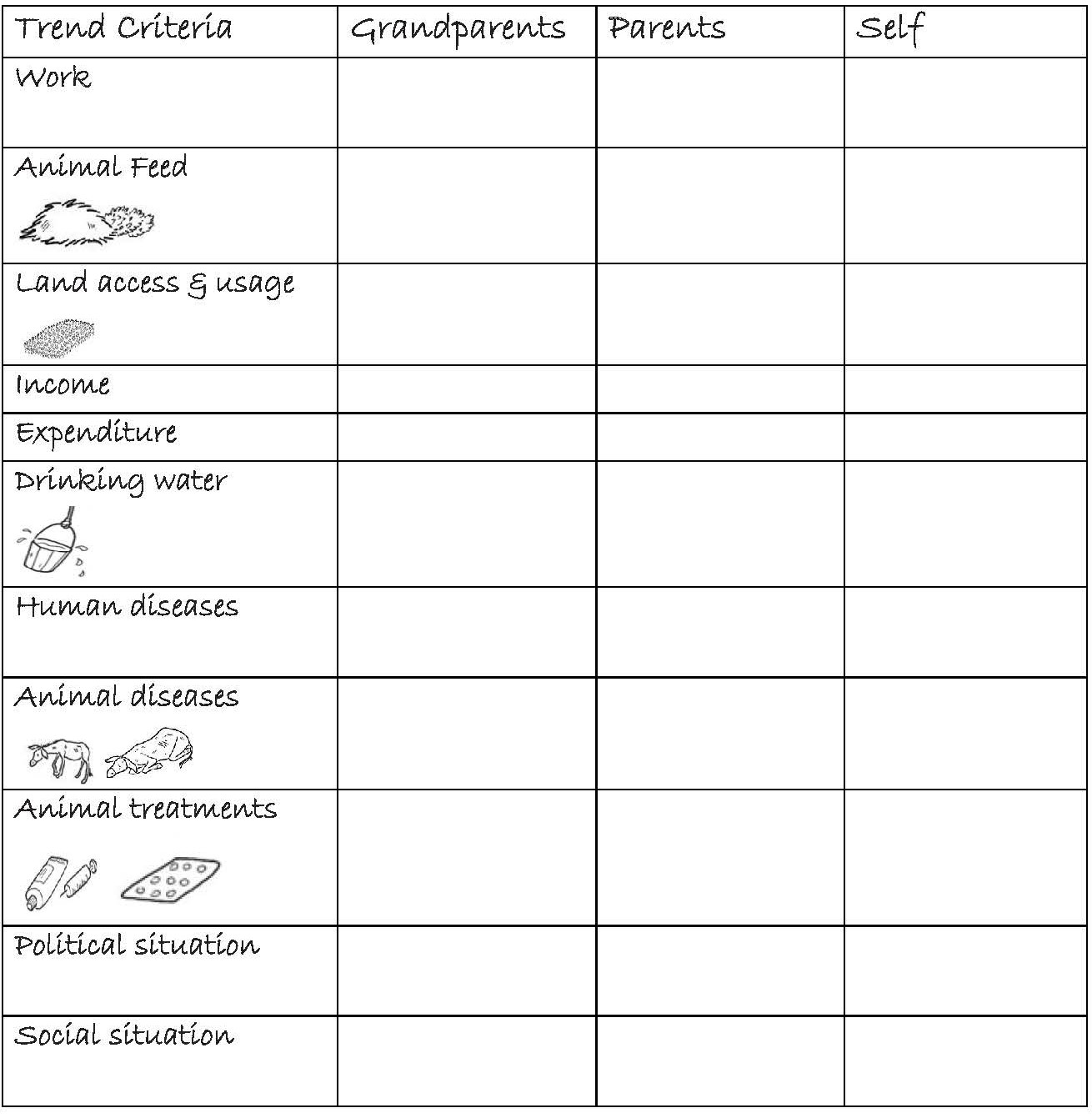
Figure T11A-1 Changing trend analysis matrix (analysis criteria on vertical axis, generations on horizontal axis)
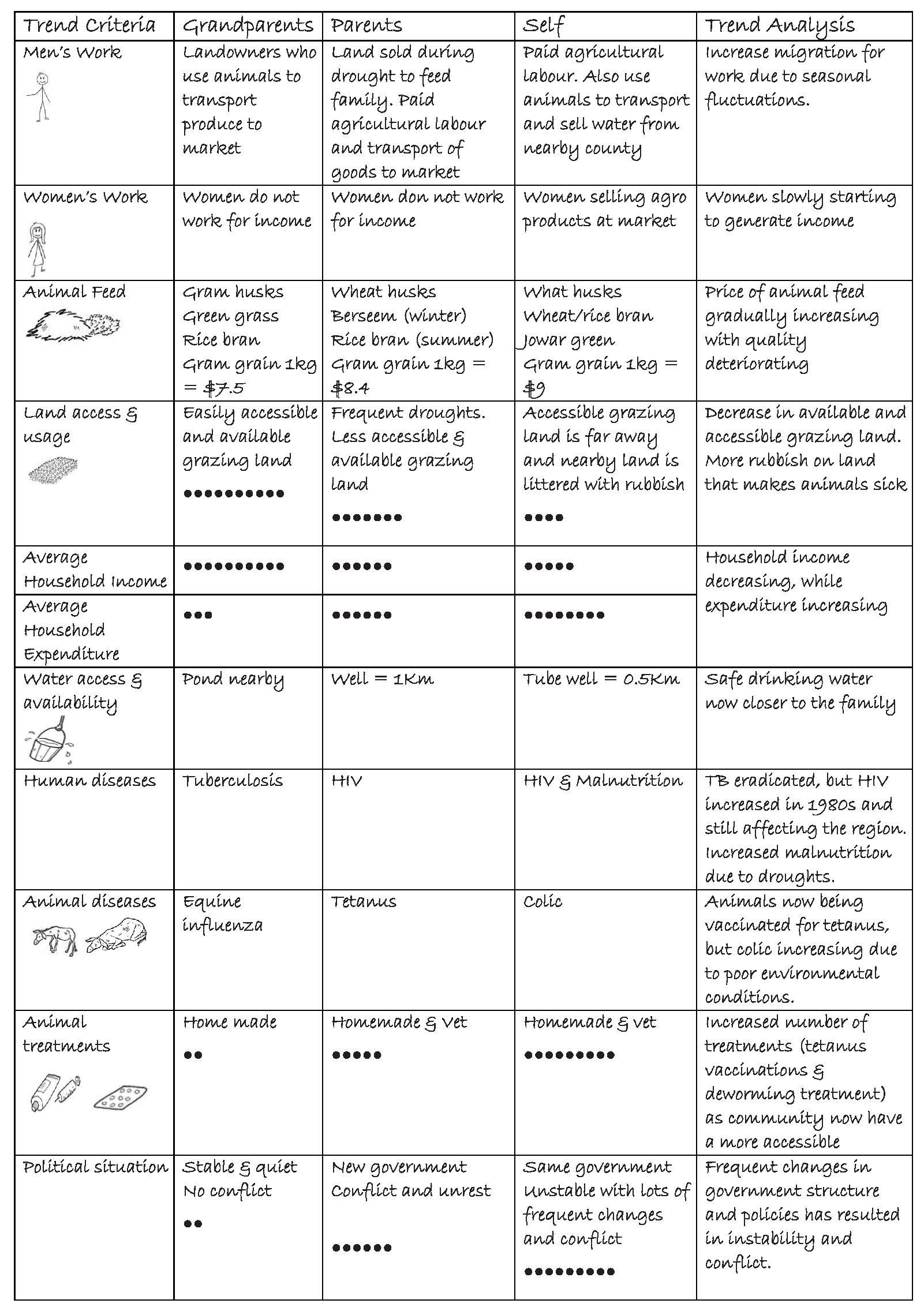
Figure T11A-2 Changing trend analysis of changes affecting potters and their working animals over four generations
The completed matrix above is the result of a changing trend analysis carried out with a group of animal-owning farmers. It was used as part of a community needs assessment and shared vision. It shows changes in work type and land ownership, quantity, type and cost of animal feed and fodder, grazing land accessibility and availability, average household income and expenditure, availability of and distance to travel for water, human and animal disease prevalence and treatment options, and changing political situation. As a result of this exercise, farmers were able to identify opportunities to mitigate the trends they identified as negatively impacting their lives and the related welfare of their animals.
Changing Trend Analysis
Step 1
Start by explaining that the purpose of the exercise is to understand how the situation in the community has changed over time, and that the group will start with the present and then look at the past. Then ask the group what changes they have experienced in their lives as compared to the past?
Examples:
• Income-generating activities for men and women (separately) • Household income • Household expenditure
Other human aspects, such as food consumption, health and illness, education, and social groups, such as religious groups, self-help & savings/loaning groups, women’s groups. Access & availability of natural resources, such as water, wood, soil, land, etc.
Then ask about changes they have experienced related to their animals.
Examples include:
• Types of animals • Animal work types • Feed practices • Health/illness • Treatment
Ask the community helper to write all identified changes on cards using words or drawings. Make sure that each criterion is specific, for example if participants say ‘water’ clarity if they mean ‘access and availability of water’. Once all changes have been identified, ask participants to select the cards representing the changes which are most important to them. It is the facilitator’s job to ensure that the ones most important to the project are included.
Step 2
Then ask participants to define a timescale for their analysis. It may be based on generations, such as ‘in our grandparents’ time’, ‘in our parents’ time’ and ‘in our time’, or other important activities, events, or years.
Ask the community helper to draw a matrix on the ground and show the chosen time scale on the horizontal axis along the top of the matrix and place the cards with the trend criteria identified in step 1 down the vertical axis (figure T11A-1).
Step 3
Next, explain to the group that they will complete the matrix and decide with the group how they wish to display the situation for each trend criteria. For example, by scoring criteria that can be measured using seeds or stones (0 to 10 for income/expenditure), and/or drawings, symbols, or words for lists of objects etc. As the group defines the scenario for each trend criteria, ask the helper to represent the situation on cards using the chosen means of display.
Step 4
Once the matrix is complete, record the trend analysis by adding a column labelled ‘analyses to the matrix.
Use the following guiding questions to facilitate a discussion about changes over time:
• What are the significant trends or changes that have occurred over time? • Are these trends/changes positive or negative? • What caused these trends/changes to occur?
In the ‘analysis’ column, write whether the change has been positive or negative and have participants expand on the negative changes. Explore the possibility and interest in taking action to address the identified negative changes.
Step 5
The matrix produced should be left with the community. Take a picture or copy and add it to your project action tracker for future reference and to assist with intervention planning.
Facilitator’s Notes: Changing trend analysis
Include a broad cross-section of animal-owning household members of all ages. Invite 10-20 people to participate in this exercise (e.g. youth, adults, elders).
If it is not possible or locally appropriate to do the exercise collectively with both sexes, conduct the exercise separately with men and women. Each may recall different events and changes due to the impacts that resulted in their lives.
Do not lead participants into identifying changes that are not important to them. While asking probing questions, emphasize identifying changes that they perceive to be important. Events or perceived changes should not be included simply because the facilitator inquiries about them.
Clarify any doubts to understand people’s perceptions about changes over time by reaching consensus amongst participants.
Next Steps
As part of a community needs assessment and shared vision, this activity might accompany one or more of the following tools to get a full picture of community dynamics and needs for project planning:
T1 Mapping to understand which resources and services are important to the community.
T2 Mobility Map to understand where people spend most of their time and how long it takes to get places.
T3 Venn Diagram(T3b Social Networking Venn diagram) to identify key individuals, groups and actors perceived to be most important to people and their animals.
T12 Dependency Analysisto understand animal-owning households’ level of dependency on external actors and their implications on resources and services important to ensuring animals’ welfare.
T11b: Before and Now Analysis Changing Trend
The before and now analysis helps the community to identify changes from the beginning to the end of an animal welfare improvement project. This tool may be used to analyse many different aspects of peoples’ lives and the lives of their animals, including changes in people’s reliance/use of animals, animal care practices, animal disease patterns and related impacts on people, availability and use of animal-related health services and resources, climate or other environmental factors affecting animals and people.
Tool purpose:
Time needed:
• To reflect on perceived changes in the lives of animals and animal owning households within the project period • As a learning and reflection tool to assess perceived changes in animal welfare and people’s behaviours as a result of community/project activities • To determine if there are remaining areas of improvement that can be addressed
2 hours
Materials needed:
Cards, pens, markers, coloured powder, chalk, sticks, tree leaves, coloured cards or other locally available materials.
Keyword Search Tags
Project Phase: Exit & Evaluation Phase
Approaches for Working With Communities: Community Development Approach, Community Engagement Approach, Societal Outreach and Campaigns Approach
Behavioural Drivers (COM-B): Motivation
Stages of Behaviour Change: Maintenance Stage
Project Support: Participatory Learning and Action Tools, Monitoring and Evaluation
Specific Topics: Animal Husbandry and Management; Livelihoods; Vulnerability/Resilience
Owners know what to look for when animals being treated by LSP
7
LSP access
Previously free services
Availability better – now have LSP phone numbers
7
Beating
Everyone used to beat their animals
No more beating
6
Figure T11B Before and now results from a group of animal owners in Faisalabad, Pakistan
The matrix in figure 11B was produced by a group of animal-owners at the end of a five year project as part of the community’s self-evaluation. They wanted to determine whether the human and animal welfare changes within their community could be sustained over time without the intervention team. The group compared the situation before the intervention to the present state, analysed what the differences meant and whether they thought that they had the skills, knowledge and tools needed to continue to improve on their own.
The group identified six key areas where change has been observed since the beginning of the animal welfare improvement project: food provision (dietary diversity), water provision (daily increase), local service providers’ skills (improvement), owners’ knowledge of good animal welfare, access to local service providers (LSPs) and beating of animals. After scoring the extent to which the majority of the community had made positive change, the group determined that more work was needed to improve LSP skills, owners’ knowledge of animal welfare, access to LSPs and beating of animals. They added the actions that they would take to the community action plan and set a date for the next meeting to focus on beating, which scored the lowest amongst the positive changes.
Before and Now Analysis
Step 1
Start by explaining to the group that they will be reflecting on changes in the lives of animals and their own community members within the project period, comparing how things were before the project to now.
Step 2
Ask the group about the present situation relating to animals’ care, use and their own livelihood status. Have the group compare the present situation to the past.
Ask:
• What are some of the changes that have resulted since project/community action plan activities were implemented? • How have things changed since the beginning of the project?
As the community comes up with the present situation, have the community helper write the changes with words or symbols on cards.
Examples of change categories might include:
• Men’s/women’s work types • Animals’ usage • Household income, expenditure, credit (group formation) • Land access & usage • Animal and human diseases and treatments • Community dynamics (more cohesion amongst group) • Climate change situation (water/feed storage) • Political situation (changes to laws, by-laws) • Environmental change (infrastructure improvements, increased availability of resources)
Please note: If the community comes up with more than 10 changes, ask participants to select the cards representing the 8-10 changes which are most important to them.
Step 3
Ask the community helper to draw a matrix on the ground or large sheet of chart paper. Label three columns ‘change in project’, ‘before’ and ‘now’. Have the helper place the cards representing the most important changes down the first column under ‘change in project’.
Then, facilitate a discussion on how the present situation has changed since the project started. The past and present situations will be defined by the community through this discussion. As each situation is defined for each of the changes, have the community helper write the results on cards and place the past scenario in the ‘before’ column and the present situation in the ‘now’ column.
Step 4
Have the community helper add a fourth column and label it ‘score’. Ask the community to score out of 10 the proportion of the community who meets the ‘now’ criteria. For example, a score of 10 = everyone has changed; 0 = no change.
Step 5
Once the matrix is complete, discuss the results of the activity with the group.
Follow the discussion by asking:
• Does everyone agree with the results? If yes, why? If no, why not? • What needs to change for everyone to achieve the desired result? - Can you achieve the desired results without our intervention? - If yes, do you feel that you have skills, knowledge, and resources to continue without the intervention team?
If the group determines that not all the project objectives have been met and wish to continue with the project, have the community helper add any identified priorities to the community action plan for later discussion and further planning.
Step 6
The matrix should be documented through photos or recreated on paper. Copies should be made and distributed to the group for their records, future reference and/or action planning. Add a copy to your project action tracker.
Facilitator’s Notes: Before and now analysis
If possible, invite 10-15 people to participate in this exercise.
If it is not possible or locally appropriate to do the exercise collectively with both sexes, consider conducting the exercise separately with men and women. Each may recall different change criteria due to the impacts that resulted in their lives.
Do not lead participants into identifying changes that are not important to them. While asking probing questions, emphasize identifying changes that they perceive to be important. Perceived changes should not be included simply because the facilitator inquiries about them.
Have the community’s original shared vision available for reference during the final discussion.
Next Steps
If the community determines it is satisfied with the changes it has achieved:
Consider using T28 Group Sustainability Mapping tool to help participants in planning to sustain their welfare improvements independently once support from the facilitating organization has ceased.
The facilitating organization may use the qualitative before and now findings of project successes to support project reporting or future funding proposals.
If participants indicate the project activities have not achieved the desired changes, update the community action plan and project action tracker with any new agreed actions. Re-evaluate persistent issues using any or all of the following tools:
T21 Animal Welfare Practice Gap Analysis to identify actions people can take, either individually or collectively, to address gaps in animal husbandry and management to improve animal welfare
This tool analyses the household’s dependency on internal actors e.g., household or community, and external actors for resources and services, such as water, feed and/or grazing land, shelter, financial resources, equipment for working animals (e.g., harnesses, carts), grooming supplies, and services, such as animal health service providers. This exercise may also be adapted to assess dependency in contexts where key stakeholders are comprised of only a single group (e.g., women only).
Tool purpose:
Time needed:
• To increase community awareness of their dependencies on external resources and service provision actors and potential implications for promoting animal welfare. • To motivate participants to take action to reduce unnecessary dependency on external actors and improve their self-sufficiency. Activity discussions can motivate collective action and group formation. • To identify project support required to support animal-owning communities in reducing their dependency on external actors. • To monitor changes in reduced dependency on external actors and improvements in self-reliance, which can serve as a proxy indicator of improved resilience/reducing community vulnerability to vulnerable
2-3 hours
Materials needed:
Chalk, coloured dust, stick, stones, pebbles, cards or paper, pens and any other locally available resources to represent service or resources.
Approaches for Working With Communities: Community Development Approach
Behavioural Drivers (COM-B): Behaviour Change Diagnosis and Planning, Opportunity, Motivation
Project Support: Participatory Learning and Action Tools, Needs Assessment, Monitoring and Evaluation
Specific Topics: Animal Health and Services, Vulnerability / Resilience, Group Formation / Strengthening
Dependency Analysis
An animal-owning community used this activity to explore their dependency on external actors.
Figure T12a Dependency analysis – blank template
Figure T12b Dependency analysis produced by an animal-owning community
The group identified twelve resource and service providers on whom they felt they had an external dependency. After scoring their level of dependency, they discussed the reasons for the dependencies:
Figure T12c Dependency analysis – reasons for external dependencies and challenges
The group identified opportunities for action to improve animal welfare:
The community requested support to learn how to make first aid kits for their animals, so they could stock basic medicines for treatment in their own village.
Women decided to use their collective savings from their self-help group to purchase a grinder to begin making their own grain and thereby decreasing their cost of animal feed.
Through these actions, the group was able to reduce their vulnerability and improve their self-sufficiency.
Dependency Analysis
Planning phase – Community action planning
Step 1
Start by asking the group to think of all the resources and services they use to care for their animals and have the helper write them down.
Step 2
Ask the community helper to draw a large table, either on the ground or on chart paper. There should be three main columns: ‘Resources & services’, ‘external dependency’ and ‘household/internal’ (See figure T12a).
Step 3
Start analysing external dependency versus household/internal control, by asking the question: do you depend on an outside source to be able to provide this resource or service to your animal? Provide examples as necessary, such as shopkeepers to buy equipment and materials, feed/fodder sellers to buy feed/fodder, farriers to trim hooves. Have the group score the listed resources and services using seeds or pebbles out of a total score of 10.
Please note: If a household needed veterinary treatment for an injured animal, the external control might be scored as 6/10, as they are dependent on the veterinarian to provide treatment. If they do not rely on anyone externally (e.g. they produce all the feed & fodder themselves), the external score is 0 and the household/internal score is 10.
Step 4
Ask participants to analyse their dependency on external actors based on the chart they have produced. Ask the community helper to record the responses or note them yourself. The following questions may be used to guide the discussion:
• Why do you depend on external actors for certain resources or services? (If not already identified through the exercise) - If externally dependent actors have not already been identified through discussions, ask participants to identify them. • How can you improve animal welfare by reducing your dependency on external actors? • Are there collective actions that the community could take to reduce external dependency?
Step 5
After this discussion, ask participants what actions they can take towards making these changes. Help the group to qualify short-term (~3 months) versus long-term actions (more than a year). If there is a long list of issues and associated actions, have the group prioritise just one or two to focus on before the next meeting.
Have the helper record the actions and linked activities in the community action plan. Make sure to include who will monitor it and a realistic timeline. Support the community by linking them to any necessary stakeholders.
Implementation phase - Participatory monitoring
Step 6
Repeat steps 1-3 (above) to assess the changes agreed by the community in step 4 within the community action plan, by comparing with the previous activity outputs (step 5).
Initiate a final discussion using the following questions as guidance:
• Why have changes occurred or not? What are the reasons for changes? • How have changes impacted on animal welfare and their own lives?
Comparing the past results to present situation can generate useful discussion about perceived improvements in animal welfare and related benefits to people’s livelihoods and well-being that have resulted from changes.
Facilitation Notes
Decide the group dynamics ahead of time and whether it would be best carried out with men and women (or other subgroups) separately or in a mixed group. This will depend on your rapport with the community, culture and local gender dynamics.
If conducted separately between men and women, consider bringing the two groups back together at the end of the activity to review the results of each chart and resolve any discrepancies if time allows.
An in-depth analysis of dependency on external actors (step 4) can take considerable time, so discuss this in advance with the group in preparation.
Next Steps
Record the community’s short and long-term actions and related activities to your project action tracker. Revisit the activities in the next meeting to monitor their progress and what further support is required.
T10 Gender Control Analysisis a useful tool for exploring the differences in internal control (within the household) between men and women.
T13 Income, Expenditure and Credit Analysis is a useful follow-up tool for analyzing dependency on external actors for financial resources and motivating participants to take collective action to reduce expenditures or increase access to savings and credit through the formation of self-help groups.
This activity provides a visual representation of a savings and loaning groups’ overall status, including the reasons for lending or borrowing money between members of a savings and loaning group. The group’s savings fund or common contributions are lent (inter-loaned) for various purposes, such as buying animal feed, paying for service provision, equipment repair and maintenance, purchase of additional animals and other household needs. Reasons for taking loans may have been identified previously through tools such as T13 income, expenditure and credit analysis and may be reviewed in their community action plan if necessary.
Tool purpose:
Time needed:
• To support a community savings group to understand their financial strength, status and potential for long-term sustainability of group savings and loaning activities. • To assess and/or monitor how group savings and loans are being used to improve animal welfare and the lives of animal-owning households. • To give an indication of loan repayments and promote accountability amongst members. • To identify opportunities for additional and/or collective income-generating activities. • To compare changes in how loans are being used (base line to end line).
2 hours
Materials needed:
Materials needed: Chart paper and markers, post-its, cards or any other local materials
Project Support: Participatory Learning and Action Tools, Monitoring and Evaluation
Specific Topics: Vulnerability / Resilience, Livelihoods, Group Formation / Strengthening
Group inter-loaning analysis
This exercise is used to assess the present status of group members’ loan repayments, thereby providing a social accountability mechanism which encourages group members to repay their loans to the group fund as originally agreed between group members.
Information gained from this activity can help participants decide where collective spending might save them money and therefore reduce their need to borrow from the fund. For example, if many group members are borrowing money to buy animal feed, a common fund could be used to buy animal feed in bulk. The group may wish to arrange vaccinations for all community animals at the same time for a reduced fee or buy resources together in bulk.
Figure T14a Group inter-loaning analysis (template)
Figure T14b Group inter-loaning analysis (sectioned)
Figure T14c Group inter-loaning analysis completed by a community
A savings group analysed the use of money lent from their common savings fund. All members of the group had taken a loan at some point. The circle rings represents:
Name of group members: Individual names of people who have an outstanding loan
Purpose of loan: The reason for taking the loan
Loan amount: Original loan amount and the repayment terms (months to repay)
Status: the amount still owing and number of months left to repay
In this savings group, most loans were taken by group members to buy animal feed. This exercise helped the group discuss where they could take action collectively for their animals, such as buying feed in bulk at a discounted price.
Group Inter-Loaning Analysis
Step 1
Take time at the beginning of the exercise to have an in-depth discussion on the group’s general activities and different projects that they work on together. This will act like an icebreaker and help participants feel more comfortable and willing to share freely before beginning any type of discussion on money or finances.
Slowly transition the discussion to focus on financial activities and on inter-loaning.
Step 2
Ask the community helper to draw a small centre in the middle of a piece of chart paper that will represent the group and label it with the group name. Then, have the helper draw four big circles around the centre circle (see figure T14a).
Ask the group generally for what purpose they take loans from the savings group.
Please note: From here, the conversation will move to the individual level, so ask the group if they feel comfortable with this and give consent to sharing individually. Assure them that the discussion will be kept confidential and that it is for the purpose group learning. Also, advise them that they are not obligated to participate if they do not feel comfortable. You can also mention that this tool has potential to be used to monitor individual progress over time, or to improve or strengthen group loaning activities.
Ask members with active loans who would like to volunteer to participate in the activity. Try to have between 6-10 participants. Remind them that this is not an individual analysis, but a group analysis. The facilitator should try to ensure that there is diversity amongst the loan purposes.
Step 3
Ask participants to write their names on separate cards or to identify themselves using different symbols. Put a card on the outside circle labelled ‘name’. Arrange the cards representing each person who has taken a loan around the outside edge of the circle. Then, have the community helper divide the circle into segments according to how many participant names are along the outer circle (e.g. 11 segments for 11 participants) (see figure T14b).
Ask participants about the purpose of their loan and have the helper write the purpose on a card. Put a card on the second outer ring labelled ‘purpose’. Add the card representing the purpose in line with the person’s name.
Ask participants about the loan amounts taken and repayment periods. Have participants write the amount and period (e.g. 2,000 / 24 months) on a card. Have the community helper put a post-it on the third outer circle labelled ‘amount & period’. Add the cards representing the amount & period in line with each participant’s segment.
Finally, ask participants about the loan balances and remaining repayment periods. Have participants write the loan balance and remaining repayment period (e.g. 500 / 2 months) on a card. Have the community helper place the card on the remaining circle labelled ‘loan statuses. Add the cards representing the loan status in line with each participant’s segment.
Step 4
Once the chart is complete, ask the group about their general observations of the final chart.
Depending on their responses, you might probe further into the terms and conditions or rules and regulations of the savings group.
Guiding questions might include:
• What are the criteria for a group member qualifying for loans? (rules & regulations governing group loans) • If defaulting has been identified, ask: what are the reasons for defaulting on loan payments? Ask for a few personal examples. • If defaulting has not been identified, ask participants whether any members have ever defaulted and why? • Are they comfortable with the rules and the terms? If no, what changes are possible? • Has there been a time when a group member needed a loan, and the group was unable to provide it? If yes, why? - What did they do about it individually or as a group? • What strategies are the group currently undertaking to increase their savings and loaning capacity? - What could they do to increase the amounts available for loaning as a group?
Step 5
At the end of the exercise, ask the group to summarise their findings:
• Highlight how animals have benefited from the group’s inter-loaning activities. For example, loans taken for: - Animal treatments and health care - Purchasing feed and fodder - Seeking health or welfare service - Materials to build a shelter
• How animals could benefit from inter-loaning activities. • How members have benefited from initiating income-generating activities individually or as a group.
After this discussion, ask participants what actions they can take from the analysis. Have the community helper record the actions and any specific activities in the community action plan. Make sure to include who will monitor it and a realistic timeline. Support the community by linking them to any necessary stakeholders. Add the outputs of this activity to your project action tracker and any action points to follow up on.
Facilitation Notes
This exercise is ideal for a community-based group of animal owners that has been operating for at least one year, with members making regular contributions to a common savings fund and accessing group loans.
Consider removing the individual names from the outside of the circle and replacing them with symbols or numbers to make those who volunteered feel more comfortable and willing to share during the analysis.
It is best to do this exercise without referring to the group’s register or ledger of savings and loans. If any queries arise, look at the register together at the end of the exercise and make changes to the chart then if needed.
Encourage each group member to tell you about their loan amounts themselves. Discourage one particular member or group leader from leading the exercise and talking about or for the other members.
Next Steps
Revisit the actions and activities in your project action tracker in the next meeting to monitor their progress and what further support is required.
Repeat the inter-loaning analysis annually to assess changes and promote accountability amongst members.
If conducted in the exit and evaluation phase and results of the activity have shown that the savings and loaning group is well-functioning, consider carrying out a sustainability mapping exercise to help the group determine whether they can continue without help from the facilitating organization.
‘If I were an animal’ is a tool specifically designed to put the animal and its welfare at the centre of community analysis and discussion and is very popular in animal-owning communities. It enables people to experience the point of view of the working animal by asking them to reflect on the question: ‘If I were an animal, what would I expect from my owner or carer?’ This tool is a good follow up to animal body mapping (T20) and animal feeling analysis (T19).
Tool purpose:
Time needed:
• To raise awareness of animals’ needs and promoting positive welfare states • To understand the effects on animals and humans when animals’ needs are not met • To identify the perceived extent animals’ needs are being met within the community • Can support identification of indicators related to animals’ body and behaviours, husbandry and management practices, and effects of animal’s welfare on people’s lives • To identify perceived animal welfare issues and gaps in knowledge to support intervention planning
1.5 - 2 hours
Materials needed:
Sticks, coloured powder or chart paper, cards, markers, stones, beans, seeds or other locally available materials. Picture of an animal if one is available.
Approaches for Working With Communities: Community Development Approach, Community Engagement Approach, Societal Outreach and Campaigns Approach
Behavioural Drivers (COM-B): Behaviour Change Diagnosis and Planning, Capability, Motivation
Stages of Behaviour Change: Pre-contemplation Stage, Contemplation Stage
Project Support: Participatory Learning and Action Tools, Needs Assessment, Monitoring and Evaluation
Specific Topics: Animal Husbandry and Management; Animal Handling; Animal Welfare, Feelings and Needs; Livelihoods; Compassion / Empathy, Community Change Agents / Resilience
If I were an animal…’
Figure T17 shows the completed ’If I were an animal’ diagram developed by a group of animal owners as one of the first steps in a participatory welfare needs assessment. They identified five expectations that their animals have of them as owners in order to survive and thrive: humane handling (no beating), no over-loading, timely treatment, sufficient feed/fodder and sufficient water. In the second circle they scored their present practices out of ten: they scored lowest on humane handling (no beating) and highest on sufficient food/fodder. Through discussion, the group identified the effects of not meeting their animals’ expectations on the animal, including fear, lameness, weakness and wounds, including where they would look for the specific behavioural and physical signs resulting from not meeting their animals’ expectation. Finally, they identified the effects on the human owners, including loss of income and aggressive/scared animals that are more difficult to handle. These effects were recorded and used by the group to assess their animals during an Animal welfare transect walk (T22).
'If I were an animal'
Step 1
Start by encouraging participants to see the world from their animals’ point of view. Ask what expectations their animals have of them to have a happy and healthy life. If they are struggling with this concept, ask them what they need as humans to be happy and healthy, then extend the question to their animals. At this point, the group should start identifying expectations animals have of their owners. Ask the community helper to write the expectations on cards for everyone to see or use representative drawings.
When participants have finished identifying their animals’ expectations of them, it is the facilitator’s responsibility to ensure that all welfare components have been considered. Use the following guiding questions as needed to facilitate participants to identify their animals’ expectations of them in terms of any of the following domains of welfare which they have not yet considered:
• Health - What do animals need/expect of owners to be healthy? (Disease prevention, timely treatment, proper fitting equipment) • Nutrition - What do animals need/expect of owners for good nutrition? (feeding & watering) • Environment - What do animals need/expect of owners in their environment? (Comfort, rest, temperature, shelter) • Behaviour - What do animals need/expect of owners to express their natural behaviours? (Freedom of movement, social interaction with other animals)
Please note: The facilitator should group/organise similar expectations into one category and explain the reason for the grouping (only if the anticipated effects of the expectation not being met are the same). For example, if the community identified ‘free access to water’ and ‘clean water’, consider consolidating the two examples into one ‘free access to clean water’ category.
Once the list is complete, ask the community helper to record the group-identified expectations on cards using words, symbols, or local materials.
Step 2
Next, ask the community helper to draw a big circle on the ground or on paper and place an animal in the centre. If you carry drawings or models of animals with you, such as the one used for animal body mapping (T20), put one of these in the centre of the circle to represent the animal instead.
Step 3
Once all cards have been placed, ask participants which of the actors support their animals specifically. Mark the card with coloured dot or sticker representative of the animal. The more the dots or sticker representing the animal are placed on an actor, the more support the actor provides.
Step 4
Ask participants to identify which relationships are accessible by men, women, or both, by placing a different indicative mark on the card (either using pens or stickers, or bean types). If the relationship is accessible to both men and women, ask whether accessibility is equal for both sexes. You may wish to place a > / = / < in between the representative marks or objects to indicate which sex has greater access. If it is just one group (e.g. only men) then this step is not necessary.
Step 5
Once the social Venn diagram is complete, encourage participants to discuss what it shows (if not already identified through previous discussions).
Consider using the following questions as a guide:
• Why are some relationships perceived to be more or less important? • Why are certain actors more important for men or women? (If identified) • Are there differences between men, women and/or children within the household? • Why are some actors positively or negatively affecting people and their animals? • What changes in this network could improve yours and/or your animals’ lives? • What can you as an individual or group do to improve your relationships with these actors? • What have you learned because of participating in this activity?
Initiation Phase:
Step 6
The diagram should be documented through photos or recreated on paper. Copies should be made and distributed to the group for their records, future reference and/or action planning. Add a copy to your project action tracker.
Planning Phase:
Step 7
Have the community helper record any actions the group agrees to the community action plan. Record the community’s agreed actions and activities in your project action tracker and support the community by following up with any identified key stakeholders.
Facilitator’s Notes: ‘If I were an animal’
Consider conducting an animal feeling analysis (T19) in a prior session to assess the positive and negative factors that influence how animals feel and behave.
Ideally, this exercise should be carried out with 15-20 participants in order have everyone input into the discussion. If the group is large, consider having a second facilitator and break the group into two.
Encourage everyone to express their own views and avoid using only one person’s examples or contributions for the diagram. Allow enough time to discuss participants’ own beliefs and traditional animal management practices.
It can be helpful to have pictures/diagrams on hand that represent the possible effects on animals when their expectations are not met, which may be used instead of hand writing. This can support sensitization and be used in situations where literacy is low.
Next Steps
Follow up with the T22 Animal welfare transect walk to support the assessment and monitoring of animals’ welfare and identification of common welfare problems to inform action planning.
As a first step, the facilitator should prepare a list of the observable indicators derived from identified expectations and effects which reflect animal-based indicators (body and behavioural related indicators), resources, and management practices. In addition, animal-based welfare indicators identified through T19 ‘Animal feeling analysis’, and/or T20 ‘Animal body mapping’ exercises can be used to inform indicator selection for the transect walk. This list of indicators can then be presented back to the community to agree on the criteria which defines each in terms of good, moderate, bad condition/state (green, yellow, red).
Consider using the ‘effects on humans’ identified in step six to inform human indicator selection if part of the project.
Address any identified gaps in knowledge through sensitization or training sessions. It is recommended to conduct this prior to undertaking any community-based action planning.
Any identified gaps can be examined in more detail using the following tools, especially prior to undertaking any community-based action planning:
T21 Animal welfare practice gap analysisto promote understanding of the drivers of gaps in animal welfare practices, such as lack of motivation, resources, or knowledge that can be used to develop targeted behavioural change strategies.
T25 Problem animal to identify the root causes of the different animal welfare issues observed on the body of the animal and inform action planning to address them.
T26 Animal welfare cause effect analysis to explore the root causes of specific animal welfare issues and promote understanding of the effects of the issue on animals and people as a means to generate improved motivation to take action and inform action planning.
The animal welfare practice gap analysis is designed to explore current animal management practices and activities which contribute to animal welfare. This tool identifies gaps and reasons for the gaps in terms of the main drivers of behaviour change: capability, opportunity and motivation. It has been adapted from other tools specifically to put the animal at the centre of the analysis. The first steps are very similar to those in ‘If I were an animal’ (T17). Consider conducting this activity separately with owners, users and carers, including both men and women, or other relevant groups that are likely to have different priorities.
Tool purpose:
Time needed:
• To identify the gaps and causal factors contributing to people not meeting the welfare needs of their animals. • To identify actions people can take either individually or collectively to address gaps in animal husbandry and management practices to improve animal welfare. • To support gender analysis if conducted separately between men and women by identifying differences in factors contributing to gaps in practice. • To inform identification of community actions and/or behaviour change strategies to address the causes of people’s poor animal husbandry and management practices related to lack of capacity, resources and/or motivation. • When used repeatedly, results can inform monitoring by enabling assessment of perceived changes in participants’ animal welfare practices and underlying causal factors which constrain their adoption.
2 hours
Materials needed:
Chart paper, index cards or sticky notes, pens/markers, chalk, stones, pebbles, local materials (leaves, seeds, etc.)
Approaches for Working With Communities: Community Development Approach, Community Engagement Approach
Behavioural Drivers (COM-B): Behaviour Change Diagnosis and Planning, Motivation
Stages of Behaviour Change: Preparation Stage
Project Support: Participatory Learning and Action Tools, Needs Assessment, Gender Analysis, Monitoring and Evaluation
Specific Topics: Animal Husbandry and Management, Community Change Agents
Animal welfare practice gap analysis
Figure T21a Animal welfare practice gap analysis carried out by animal owners
A group of animal owners analysed their current animal management practices. They identified 10 practices that their animal would expect from them and scored the extent to which they currently carry out these practices. The highest ‘in practice’ scores were for timely veterinary treatment and free access to water. The group discussed the most common reasons for seeking veterinary treatment and how changes in current practices could reduce or eliminate the need for the treatment altogether. The lowest scores were for ‘shelter from the elements’ and ‘time to interact and play with other animals’. After a discussion, the group identified quick wins and collectively:
Purchased more nutritious and balanced feed by buying food in small groups instead of individually. This means spending less money, but also having better quality feed.
Identified a location to make a rolling-pit for the animals to use after work that was cleared so it was safe for the animals; it was also near a place where the users could have tea and socialise together.
Identified 5 new water points and cleaned abandoned tyres to use as water troughs.
The group agreed to make these good practices a daily habit and to monitor each other’s progress against their individual action plans.
Start by encouraging participants to see the world from their animals’ point of view. Ask what expectations their animals have of them to have a happy and healthy life and experience a positive mental state. If they are struggling with this concept, ask them what they need as humans to be happy and healthy, then extend the question to their animals. At this point, the group should start identifying expectations animals have of their owners. Ask the community helper to write the expectations on cards for everyone to see or use representative drawings.
When participants have finished identifying their animals’ expectations of them, it is the facilitator’s responsibility to ensure that all welfare components have been considered. Use the following guiding questions as needed to facilitate participants to identify their animals’ expectations of them in terms of any of the following domains of welfare [Five Domains] which they have not yet considered:
• Health - What do animals need/expect of owners to be healthy? (Disease prevention, timely treatment, proper fitting equipment) • Nutrition - What do animals need/expect of owners for good nutrition? (feeding & watering) • Environment - What do animals need/expect of owners in their environment? (Comfort, rest, temperature, shelter) • Behaviour - What do animals need/expect of owners to express their natural behaviours? (Freedom of movement, social interaction with other animals)
Please note: The facilitator should group/organise similar expectations into one category and explain the reason for the grouping (only if the anticipated effects of the expectation not being met are the same). For example, if the community identified ‘free access to water’ and ‘clean water’, consider consolidating the two examples into one ‘free access to clean water’ category.
Once the list is complete, ask the community helper to record the group-identified expectations on cards using words, symbols, or local materials.
Step 2
Next, ask the helper to draw a grid or matrix on the ground using coloured powder, chalk, or a stick, with at least 5 columns in the matrix to start. Place the group-identified practices (cards in step 1b) along the first column.
Label the second column ‘in practice’ (like the matrix in step 1a).
Step 3
Facilitate the group to fill in the second column of the matrix labelled ‘in practice’, by asking participants to what extent their animals’ expectations are fulfilled by each of the identified practices. Scoring from 0 to 10 (0 = not in practice, 10 = completely in practice).
Any remaining stones (out of ten) can be kept aside or in the first column, next to the identified practice.
Step 4
Ask the group to identify at least 4 of the most important factors contributing to gaps in their animals’ expectations and current practices. Have the helper write the factors on a card using words or symbols.
They may identify factors (causes) such as:
Place the cards with the factors as column headers along top of the matrix, adding more columns to the matrix if necessary.
Step 5
Ask participants to use the remaining stones (out of ten) to score the gap factors (causes). For example, if one of the expectations was ‘timely veterinary treatment’, five stones out of ten may have been used for ‘in practice’. The remaining five stones would need to be divided amongst the different causes of gaps in practice e.g. two stones for ‘lack of knowledge’ and three stones for ‘not a priority’.
Please note: Coming to an agreement on how the factors (causes) should be scored will raise a debate amongst the group. These discussions create shared learning opportunities, as participants learn from one another as they discuss and agree on final scores. As a facilitator, you should allow and encourage this discussion without inserting your ideas.
Step 6
Once all the causes of gaps in practice have been scored and the matrix is complete, ask a community member to help summarize the results with the group.
Use the following guiding questions to facilitate a discussion amongst participants:
• Where gaps in practices exist, what are the specific skills, knowledge and/or resources preventing participants from meeting their animals’ needs?
• What are the effects of the animal husbandry and management practice gaps on both animals and animal-owning households? If the group has already completed T17 ‘If I were an animal’, ask them to come up with some of the effects that they identified in this activity.
• Which practices do you perceive as most important to ensuring the welfare of your animals? Please note: This question can provide an opportunity to raise awareness of how practices often considered less important can still have significant impacts on animal’s welfare.
• What actions can participants take, either individually or collectively, to address these gaps and mitigate the negative effects on animals and animal-owning households?
• What technical support is required to support participants in acting?
Step 7
If participants have identified specific actions to address gaps, have the helper record the actions and specific activities in the community action plan. Make sure to include who will monitor it and a realistic timeline. Add any opportunities to capacity build or project plan into your project action tracker.
Facilitator’s notes: Animal welfare practice gap analysis
It is helpful for participants to have a general understanding of animal welfare and related animal husbandry and management best practices when undertaking this activity. Consider conducting one or more of the following activities as time permits to raise awareness of animal welfare needs prior to conducting this exercise:
T17 ‘If I were an animal’: raises awareness of what animals’ need and how they depend on people experience positive welfare states
T18 Thriving not surviving: promotes understanding of the five domains of animal welfare and how people can promote positive welfare states
T19: Animal feelings analysis: helps promote understanding of animal feelings and related physical expressions and behaviours indicative of those feelings.
T20 Animal body mapping: helps identify animal-based indicators of welfare status which can be used in the transect walk, and can serve as a useful sensitization exercise improve understanding of indicators of good and bad animal welfare.
If individual participants come up with a below standard practice (e.g. watering 2 x per day when free access is best practice), the facilitator can use this as an opportunity for them sensitize each other by reaching consensus.
This exercise can take considerable time, so discuss this in advance with the group. If the activity takes more than two hours, consider action planning in the next session.
Encourage everyone to express their own views and avoid bringing in your own examples while the matrix is being populated. Do not allow it to become a facilitator-driven exercise.
Consider having a designated note taker to document the insights (e.g. info on knowledge, skills, beliefs, resources) that emerge from participants’ discussions during this activity.
It is common for participants to identify only a few main effects on animals (step 6), especially when animals are not viewed as sentient beings. It is the facilitator’s role to use this as an opportunity to promote understanding of animals’ experience of these gaps.
T15 Cost benefit analysis when motivational factors have been identified as reasons for participants’ not meeting the expectations of their animals or when no consequences have been agreed by the community to address gaps
The facilitating organization may consider one or both of the following actions to address the identified gaps:
Capacity building trainings to promote knowledge and skills related to implementing animal husbandry and management practices that promote animal welfare:
Humane handling techniques
Proper feeding methods
Basic wound management
Benefits of grooming
Benefits of stable care
In-depth assessment or care practice research to identify:
Who needs to practice and who influences the desired behaviour
To identify main barriers to adoption of the promoted behaviour
Sustainable livelihood and/or community development-related projects to improve access and availability of resources important to animal welfare
An adaptation of a traditional transect walk [48], this animal welfare transect walk can be used as part of a participatory animal welfare needs assessment of the welfare status of animals. It encourages participants to make direct observations of the animals themselves by looking at the animals, the resources in their environment and the owner’s, user’s, carer’s handling and management practices. This is a useful tool for exploring animal welfare conditions and the realities of resources available to animals within a community.
The findings from this exercise, coupled with analysis from the contributing root causes for any welfare problems (T21, T25and/or T26) can be used to prepare animal welfare improvement plans for individual or groups of animals. It can also be used to monitor changes in animal welfare over time if conducted at different points in time, and recorded observations compared to assess change.
Tool purpose:
Time needed:
• To identify which animals are in the best/worst condition and have the best/worst welfare. • To identify the most common animal welfare problems within the community • To understand which welfare issues owners, users, carers prioritize. • To inform community action planning and target capacity building activities to address community-identified priority welfare issues. • To identify which owners, users, carers may be good candidates to target as animal welfare champions in the community, when used in conjunction with the results from T1. Using these two tools together should identify individuals with the highest potential to be exemplary champions and potential mentors to others.
5-10 minutes for each animal in the walk + 1 hour for discussion
Materials needed:
Sheets of paper, pen, coloured markers (red, yellow, green)
Project Support: Participatory Learning and Action Tools, Needs Assessment, Monitoring and Evaluation
Specific Topics: Animal Welfare, Feelings, and Needs, Animal Husbandry and Management; Community Change Agentsnts / Resilience
Animal welfare transect walk
The animal welfare transect walk gives a more complete and detailed view of animal welfare because the animals are present for the group to examine, whereas the previousanimal welfare mapping exercise (T1) or body mapping exercise (T20), only gives an overall ‘bird’s-eye’ view of the animal conditions in a community, as described by their owners without the animals present. In this way, the transect walk can strengthen or triangulate the information from these mapping exercises.
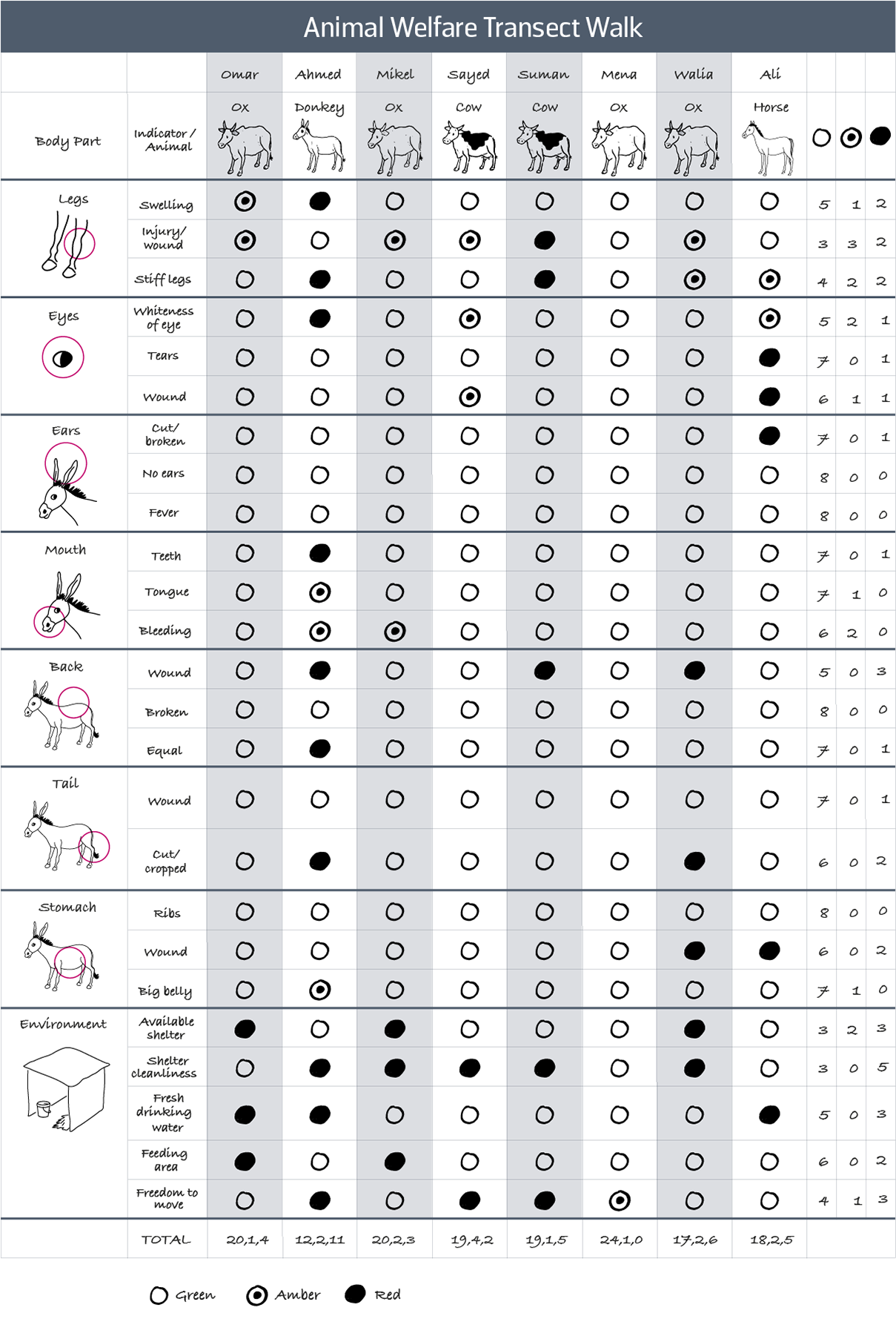
An animal-owning community carried out an animal welfare transect walk using a green, yellow, red traffic light system to score 25 animal welfare indicators that they had identified during their previous discussions and exercises, including 5 that directly relate to owner and carer behaviour (environmental factors). In this example, environmental factors were included because participants’ had a good understanding of animal welfare issues at the activity was carried out. However, it is also possible to modify this tool by using only animal condition indicators, which may be helpful in when participants have not yet gained a good understanding of factors contributing to good animal welfare.
Figure T22a Animal welfare transect walk recording sheet using traffic light signals
After the walk, the owners sat down together and analysed the score for each individual animal by summarizing the vertical columns on their recording sheet. In this example, Ahmad’s animal was found to be in the worst condition, with 11 red (‘bad’) and 2 amber (‘medium’) marks, followed by Walia’s animal which had 6 red and 2 amber welfare issues. After looking at all the individual animals, the group then summarized the horizontal rows to find out which welfare issues were most common in their village. Shelter cleanliness was the biggest issue in the community, with five of eight animals marked red. The group followed this exercise with a root cause analysis (consider using T25andT26) and inserted the results in the community action plan for action by individual owners and collectively.
Animal Welfare Transect Walk Using Traffic Light Signals
Step 1
Explain the purpose of the animal welfare transect walk to the group and involve all participants in the process of decision-making about which indicators of good and poor animal welfare are going to be observed. Create a safe learning environment at the start of this activity if this tool is being used as entry at Initiation phase to nurture positive motivation for further engagement.
To facilitate discussion and identification of observable animal welfare indicators, consider referring to the outputs of one or more of the following tools if already conducted:
Depending on participants’ understanding of animal welfare issues at the time this activity is carried out, it may be appropriate to focus only on indicators of animal body condition and consider adding indicators related to environmental/owner practices as the tool is used repeatedly and community participants’ understanding of animal welfare improves.
Alternatively, as the facilitator, you have an important role here: to check that the list represents all aspects of animal welfare as sometimes we find that the owners’ checklist only contains signs of physical welfare. If you notice this, it may be helpful to ask probing questions to encourage them to think about observable indicators of their animals’ welfare in terms of the five domains of animal welfare (e.g. nutrition, health, environment, behaviour, and mental state). After the group has finalized their list, sit together with them and check whether all aspects of welfare are covered.
Discuss the agreed animal welfare indicators thoroughly with all members of the group as well as the animal owners and carers from each household visited and agree a score for each one.
Step 2
Once the group has decided which observations to make, agree how the observations and discussions will be captured or recorded and who will take responsibility for this. Ask the community to decide what symbols will be used to record the result of each observation.
Examples include:
• Traffic light signals: good/best animal condition shown with green dot, moderate issues with animal condition with amber/yellow dot, worst condition with a red dot. Sometimes just red and green are used. • A tick/check mark might be used for good and a cross for bad. • Instead of a traffic light system, numerical scores might be assigned. For example: Red/cross = 0, Yellow/amber = 1, Green/tick/check = 2. If only red/green are used, then Red = 0 and Green = 1.
Step 3
Decide whose animals will be visited and the route of the transect walk. Fix a time when the group will go on the walk. It is essential that the owner and family of each animal visited are present when the group is visiting his or her animal and the surroundings.
Step 4
The community group should walk the route together, visiting all the households where animals are kept and the surrounding areas to look at each animal carefully. The group will often wish to make additions and alterations to the agreed observations. Any animal welfare issues which have emerged from other tools and exercises may also be discussed with the group during the walk.
Step 5
After returning from the walk, ask the group to summarize and analyse their record sheets:
• Have the participants add up the scores or numbers of red, yellow/amber, and green dots vertically to give a summary of the welfare problems of the animals. This can be used by the group to formulate individual action plans for owners. • Adding up the scores or dots horizontally will give a score for the whole community or group for that welfare parameter and add identified welfare issues to the “issues” column of the Community Action Plan. • Come to a consensus on the animal welfare successes and problems and discuss possible contributing factors. Discussion questions might include: - What welfare indicators are most in need of improvement and which are best performing? What are the reasons? - Why did some participants score higher than others? What are they doing differently than others who had lower scores? - What are the implications of these welfare issues on their animals’ physical and mental state, and on the lives of different household members? For example, do these welfare issues impact women, men, boys, or girls differently? - What could feasibly be done to improve their animals’ current welfare situation and replicate successes?
Record any identified ‘actions to be taken’ in the relevant column of the community action plan and have participants agree on a frequency to animal welfare transect walk activity to monitor progress (monthly, quarterly, etc.).
Facilitation Notes
If there are large numbers of animals, carry out the same exercise over several days so that all animals or a representative number of animals and households are covered.
This exercise can take considerable time, so discuss this in advance with the group and agree a suitable time to set aside for doing it.
If this exercise is planned to be undertaken in the project initiation phase or to support rapport building, it is imperative to create a safe and learning environment and build understanding about why scoring is part of the exercise.
It is helpful for participants to have a general understanding of animal welfare and related animal husbandry and management best practices prior to conducting this exercise. Consider conducting the following activities to raise awareness of animal welfare, feelings and needs, and help inform the identification of animal welfare related indicators to use during the transect walk:
T17 ‘If I were an animal’: raises awareness of what animals’ need and how they depend on people experience positive welfare states
T19 Animal feelings analysis: helps promote understanding of animal feelings and related physical expressions and behaviours indicative of those feelings.
T20 Animal body mapping: helps identify animal-based indicators of welfare status which can be used in the transect walk, and can serve as a useful sensitization exercise improve understanding of indicators of good and bad animal welfare.
Decide with the community in advance whose animals will be visited and the route of the transect walk. Fix a time when the group will go on the walk. It is essential that the owner and family of each animal visited are present when the group is visiting his or her animal and surroundings.
Animal welfare transect walks may be repeated at regular intervals and the results compared with previous walks. This enables participants to monitor and evaluate changes in the welfare status of individual animals, and changes management practices and availability of animal-related resources.
Next Steps
Once the participatory animal welfare needs assessment is complete, you can prioritize issues to address using one of the following tools:
Alternatively or in addition, you can explore the causes and effects of welfare issues by following the transect walk up with one of the following activities
Below is an overview of the community action planning process covered by steps within the planning phase of the community development approach:
Figure 37: Overview of the Community Action Planning Process
Beginning with a participatory welfare needs assessment (PWNA) helps put the animal itself to the centre of the group’s analysis by looking at the present welfare status of their animal/s. This process sensitizes owners to their animals’ needs and feelings and the ways in which these are expressed through an animal’s behaviour or body language.
Use the methods in this section to conduct and record data for a baseline assessment to determine:
The percentage of people who (do not) practice the promoted behaviours.
The existing pre-conditions (identified barriers/motivators) for practicing the desired behaviour (e.g. people’s knowledge, availability of resources).
Animal welfare indicators if an animal welfare assessment was not conducted at the start of the project initiation phase.
Having recorded a baseline of where animal welfare and associated husbandry and management practices are before any intervention enables assessment of the extent of behaviour change during monitoring and evaluation.
2.1.1 Analyse animal welfare needs and identify indicators for assessing the extent their needs are being met
The focus of this step is to support the group in building a common understanding of welfare based on the five domains. It will also enable them to recognize how aspects of good welfare and poor welfare are expressed by animals’ appearance and behaviour by facilitating the group’s analysis of how animals feel and what they need for their well-being.
In this section you will facilitate the group to:
Identify the needs of animals.
Analyse how far the animals’ needs are being met by everyone involved with their care regime.
Analyse the effects on animals when their basic needs are not fulfilled.
Identify the physical and behavioural signs of each need.
Organize a group meeting and facilitate the group to identify animal welfare needs and what it looks like when these needs are not met. To start the process of discussing animal needs, consider using Animal body mapping (T20) where the group identify welfare issues and their perceived causes on a drawing of their animals’ bodies and discuss what they perceive to be good and bad indicators of welfare. The Thriving not surviving (T18), and Animal feeling analysis (T19) tools can help to examine how the animal may experience life and how people can influence those emotions both positively and negatively. ‘If I were an animal’ (T17) may then help the community to determine to what extent animal needs are being met within the community and can support identification of welfare issues, indicators they can use and any knowledge gaps.
A list of an animal’s welfare needs will be developed by the group during these exercises and information to assist this process can also be found in the Animal Welfare and Communities Learning Module Part 1: Understanding animal welfare. These tools help to move people from looking at solely animal-related resources and services to observing the animal directly and seeing what animals can tell them about their own needs. They put the animal at the centre of analysis. Support group members in coming to common agreement on what they perceive to be good animal welfare and animal husbandry and management practices within their local context.
To support this process, consider populating a five domains framework with their animals’ needs and the equivalent human behaviours that would support meeting them, like the example provided in the facilitator resource 9. Example of Five Domains of Animal Welfare for Donkeys Linked with Human Behaviours. It is important to support the group in defining a list that represents all aspects of animal welfare not just those signs of physical welfare. Ask probing questions to encourage them to think about observable indicators of their animals’ welfare in terms of the five domains of animal welfare (e.g. nutrition, health, environment, behaviour, and mental state).
Next the group need to agree on how these animal- and resource or behaviour-based indicators will be scored to enable assessment of animal welfare and monitoring of changes. Participants write or draw the indicators as a list that can be used for assessing their own animals. The group then comes to a consensus on how each indicator will be scored and decide the exact definition for each score. Refer to the Animal Welfare Transect Walk (T22) instructions for determining scoring. The simplest scoring uses a traffic light system, over time communities will often shift to a more complex numerical system as the group builds experience and confidence assessing their animals’ welfare.
2.1.2 Conduct participatory welfare needs assessment to understand the welfare status of animals within the community
Facilitate the group to assess the welfare status of an animal, by looking at the physical condition of its body and observation of its behaviour. The Animal feeling analysis (T19) and Animal body mapping (T20) tools are helpful here. Identify things that may directly or indirectly affect the welfare of their animals (also refer to previous community needs assessment section 1.2). These include management practices, owner behaviour, resources, stakeholders and the environment, the Animal welfare practice gap analysis (T21) will assist here.
With the group, assess the level or severity of various welfare problems and their contributing factors. Conduct another Animal welfare transect walk (T22) now the community has greater awareness of how to assess animal welfare. This transect can be undertaken by men, women or both together, this process allows exploration of animal welfare conditions and assesses the realities of resources available within the community. The process of joint analysis leads to individual as well as collective action and increases understanding of the need for change and helps support people’s progress through the stages of change from pre-contemplation to the preparation stage.
Once completed, convene the group to sit together and summarise the findings on a chart to draw conclusions. If the walk has been carried out on more than one day, it is useful to hold a group discussion at the end of each day, with a final meeting on the last day of the exercise. The group summarizes the findings for each individual animal and for all the animals together. In particular, the group draws out the indicators that scored red (bad condition), for individual animals and for the village all together. This will generate a list of welfare issues for prioritizing during the next step of community action planning. As community members score themselves during the participatory welfare needs assessment, community facilitators can probe and listen for change talk to gauge different individual’s stages of change.
Tools and resources helpful to supporting this step include:
The resource is intended to support community facilitators design evaluation questions to track the implementation, progress and outcomes of the animal welfare improvement project/behaviour change processes. The resource can be used when developing community project participant’s individual interview or focus group discussion guide. The sample questions explore community vis-a-vis individual level household changes; group sustainability; and tracking behaviour change from the stages of change perspective. Note these are not exhaustive and need to be adapted to fit to your programme/project/context needs.
Keyword Search Tags
Project Phase: Exit & Evaluation Phase
Approaches for Working With Communities: Community Development Approach, Community Engagement Approach, Societal Outreach and Campaigns Approach
Project Support: Facilitator Resources, Monitoring and Evaluation
It could be helpful to start with questions which encourage the respondent to easily respond to e.g.
Why did you get involved in this project? What did you find the most interesting about this project?
What was the most difficult part for you? What could be done differently to make this project more successful in the future?
You can ask them to recall and explain what things were like before – and then ask them to explain how they are now. Eg) How were animals in your community before this project started? Probe: Were they happy? Why? Did they look healthy? Why? Did they have the things they need? What did/didn’t they have?
Then provide a follow on question, Eg) How are things for animals in your community now? Why? Probe: Do they have what they need? Do they look healthy? If yes, why? If no, why not?
Do people do anything differently with their animals now? Can you give some animal welfare related actions being carried by the community?
Are change agents (if being utilized) playing an active role in supporting your community? In what ways? What do you think they could do differently?
Is there a collective understanding amongst community members of the major animal welfare issues and how to address them?
What are the animal health service providers available in your area? Do these local service providers provide quality services to the satisfaction of community members? Probe: Are group members seeking the help of animal health services?Are local service providers responsive to community requests? Does the responsiveness differ based on people’s gender or socio-economic status? Can you provide examples?
Are community/group members seeking animal welfare related services proactively and in a timely manner? Can you give examples?
Are men, women and children in families who own animals all aware of their animals’ welfare issues and participate in activities that are important to improve and maintain good welfare?
What kind of actions have been taken in your community to ensure better animal welfare improvement is achieved? (Probing questions depending on your focus issue: What examples of community-led animal disease prevention measures are being carried out on appropriate timelines e.g., vaccines and boosters? Are appropriate measures to ensure clean and comfortable environments for animals in place? Are community members engaged in the project have a good knowledge of appropriate and welfare friendly gear? And use them on their animals? e.g., harnessing, saddle-fitting, cart balance and loading, are animals handled in ways that are safe? (Which doesn’t not prevent their development or creates risk of injury. What are the animal – owner/handler interactions? What are the wound prevention or/and management practices in your area? Have you seen changes on that?).
What changes in access to and availability of resources do communities perceive have resulted from their involvement in the project?
Have there been any benefits to the community from this work? Probe: Can you give specific examples?
Have there been any negative consequences on the community from this work? Probe: Can you give specific examples?
Sample questions to ask when assessing group sustainability (if the project included Equine Welfare Group Formation)
Is your community different after forming a group? If yes, in what ways? If no, why do you think this is?
Is the group registered? Is your group functioning well with regular documented meetings? Have there been changes in leadership of your group? Are men and women part of the leadership and membership?
Is conflict resolution mechanism in place, has been used and the outcome recorded in village registers?
Are there examples of collective actions that have been undertaken by the group to meet their animals’ needs and are these recorded in the records of the community group e.g., collective feed purchases, vaccine campaigns, advocacy with government agencies to address their animal needs?
What are the successful animal welfare improvements that were achieved through your collective/group actions? What were your group’s actions to encourage your members to change their behaviour to improve animal welfare? Were there mechanisms that your group established to change your members' behaviour to improve animal welfare? Can you give us examples? Can you tell us more about this?
Sample Questions for Assessing Changes/impact at the individual level
Are all members of your family aware of your animal’s welfare issues? Probe: Your wife/husband? What about your children? Probe: What do they each do for your animal’s welfare?
Have you learnt anything new since being part of this group/work?
What are the changes you have seen in your animals, give examples/specify
What are the practices you have adopted at home that has are helping you improve the welfare of your animals? Give examples.
What kind of support have you received from Brooke/partners or change agents?
Do you do anything differently with your animals now, after being part of this project: Probe: Can you give some examples? Why didn’t you do the things that you do now with your animal, beforehand? What stopped you from doing things with your animal the way you do now, before this project started? What helped you to change your practice or what is a challenge for your not to change your practice? What do you want to know more or practice more to improve your animals’ welfare?
How would you rate your rate of motivation to continue to practice the new targeted behaviour? Do you intend to keep caring for your animal in the ways you do now? If yes, why? What could make it difficult to do this? If no, why not?
What are the prompts and triggers to adopt the new behaviour you identified? [learning questions for reflection and for future programme/project intervention design]
Were you able to identify something that would help you to sustain the desired targeted behaviour? And what is it?
Have you faced unforeseen challenges? If so, what are the unforeseen challenges have you faced?
Is there any resource/time implication of adopting the desired new targeted behaviour when compared to the old practice? Probe: Do you think this will impact whether you continue to do this?
Vulnerable groups’ targeted question: Have you encountered any specific challenges to your gender/situation or position as a result practising this desired behaviour? e.g., making decisions to take the animal to be treated, deciding to pay to a service?
Has it been difficult to continue/maintain the new ways of treating and working with your animal? If yes, why? If no, why not? What or who made it easier for you to keep up these ways of working? What or who made it difficult to maintain the new changes? What kind of support do you still require to maintain/continue with practicing the desired targeted behaviour?
Have you started experiencing the benefits of animal welfare to your livelihood and the associated desired behaviour change?
Tracking Behaviour change using Stages of Change Model
As part of working towards behaviour change, it is important to track progress towards the realization of the desired behaviour. You can use the below questions to monitor progress or as part of overall project evaluation. The below points/questions can help you to check whether you were successful to introduce change within each stage of change. These suggested indicative questions (not prescriptive and exhaustive) can be used for FGD, KII, and within surveys/interviews, or can be included as a follow up of various participatory tools that can be used for evaluation phase. You can also ask these questions retrospectively once the groups/individual project participants progress to the next stage of change to understand the change progress as part of your learning.
Pre-contemplation and contemplation (following Conception phase):
Have community/individual’s knowledge and understanding about animal welfare improved? Do they identify the gap in practice on animal welfare now? You can probe this by asking:- Can you explain what animal welfare means to you? Follow on: What was the standard of animal welfare in your community before this work started/your group formed? Probe: Why was this the case?
Have they become aware of what animal welfare concerns are there in their locality/individual homestead? Probe: Can you provide examples?
Are community/individual’s’ able to link their/o/u/c problem behaviour with the animal welfare gap.
Has the capability (physical and psychological) and motivation (Reflective motivation) of o/u/c changed after the intervention?
What is the belief system of the community/individual about the possibility of change? What is their change talks?
Did their value system change because of the intervention [during conception /planning phase] and/or your organization contribution or that of the CCA?
How would they rate (individual or collective depending on your availability of resource and relevance) their motivation for change? This will be asked retrospectively as part of overall evaluation, or as a question at the end of the first phase? If asked at the end, this could be clearer: “How would you have described your motivation for change at the beginning of this process?”
What kind of steps/actions they are willing to take or have taken so far?
Preparation
How would they rate their motivation to adopt the new desired targeted behaviour?
What is your current understanding about the relationship between the problem behaviour and animal welfare practice gap; and how can you change this?
Did their value system change because of the intervention [during conception /planning phase interactions] and/or your organization contribution or that of the CCA?
What kind of steps/actions they are willing to take or have taken so far?
What kind of support has they received? e.g. Action plan development trainings, etc.
Have they (group and/or individual) developed action plan to act?
What were their barriers to develop action plans before the start of this programme/project? Have these barriers changed? How would they link your programme/project/CCA helped/contributed to reducing the barriers?
What were their barriers to develop action plans before the start of this programme/project? Have these barriers changed? How would they link your programme/project/CCA helped/contributed to reducing the barriers?
Action
Did they find their action plans relevant to their reality when trying to implement them? (This shows doing good COM-B analysis helps in identifying potential barriers and adaptive programming with SI can further help the community/individual to get the relevant/appropriate intervention to help the shift to take concrete actions to perform the desired behaviour change).
What are the prompts and triggers to adopt the new behaviour you identified? [learning questions for reflection and for future programme/project intervention design]
Were you able to reinforce the supporting behaviours that will help you to sustain the desired targeted behaviour? Probe: Can you provide specific examples?
Have you faced unforeseen challenges? If so, what are the unforeseen challenges have you faced?
Is there any resource/time implication of adopting the desired new targeted behaviour when compared to the old practice?
How would you rate your rate of motivation to continue to practice the new targeted behaviour? [for survey or FGD or KII]
Vulnerable groups’ targeted question: what kind of actions were you to take? Have you encountered specific to your gender/situation or position? E.g. making decisions to take the animal to be treated, deciding to pay to a service?
Have you faced any safeguarding issues when practicing this new targeted behaviour [This is particularly relevant when part of the socio-economic and COM-B analysis/gender analysis has shown that it is a hindrance for animal welfare or a prompt/favourable social norm for animal welfare practice without being exploitative of individuals/undermining their dignity and rights]
Who helped you to continue to continue overcome your challenges/distractions to go back to the old way? Did you have supporting relationships or mechanisms?
Maintenance
How long were you able to hold of the maintenance of performing the desired targeted behaviour?
Have you seen the benefit in practicing the new desired targeted behaviour?
Who helped you to continue to overcome your challenges/distractions to go back to the old way? Did you have supporting relationships or mechanisms?
What kind of support do you still require maintaining the desired targeted behaviour?
Termination
How long were you able to maintain/sustain performing the desired targeted behaviour?
Did you have supporting relationships or mechanisms or incentives to perform the desired behaviour and to improve your animal welfare practice? What or who helped you to continue to continue overcome your challenges/distractions not to fall back to the old ways of handling/managing/using your animal?
Have you started communicating the benefits of animal welfare to your livelihood and the associated desired behaviour change to your friends, family, etc.?
Facilitation Notes
Facilitator needs to create an enabling safe space for people/groups who are marginalized to express their lived experiences regarding the different barriers they faced and how they have found the project to help them maintain human behaviour change that benefits their animals’ welfare improvement and also theirs and their family/community lives. Meeting invites to such meetings need to ensure both genders be able to meaningfully participate and for their views to be heard to determine the next steps.
It is important to note that such discussions with communities should be voluntary and use ethical standards which includes informing the participants why they are selected, the purpose of the discussion/interview, that their views won’t affect their involvement in the project and how the interview/the discussion will be take and the purpose of the meeting should be clearly communicated to them. The following tools may also be used to support the evaluation of project success:
3.2.1 Participatory monitoring of animal welfare and human behaviour change
Getting communities to monitor their progress is important to show tangible results for their efforts which in turn will encourage further support and effort for future improvements. This process helps indicate whether a community has all the resources it needs, how effectively the group/s are working together and whether they have something important they should share with other communities to disseminate information learned.
It is important to understand all the stages of change, anticipating that groups may be in pre-contemplation regarding some issues, and are likely to be in contemplation and preparation stages of change early on, developing into action and maintenance at the later stages of this process. Be aware though that behaviour can relapse backwards at any stage so refer to the facilitator resource 6. Techniques for Supporting Progress through the Stages of Change for support with this.
Participatory monitoring of animal welfare and behaviour change enables group members to feel proud and good about themselves, therefore more likely to maintain the changes they’ve adopted. Repeating the Animal welfare transect walk (T22), at intervals of one, two or three months, enables the group to monitor changes in the welfare of their animals. Their scores for each animal welfare issue are recorded on the same monitoring chart each time.
Group members then sit together again to reflect on their findings, both positive and negative. Improvement in scores shows the effect of the actions they have taken to improve management of their animals and to prevent welfare problems from occurring. If there is no improvement, or if scores decrease, possible reasons for this need to be discussed. They may identify gaps in their current practices, decide if further actions or closer monitoring are needed and record all relevant details to refer to as they progress.
3.2.2 Participatory review and reflection on monitoring results, community action plans, and lessons learned, adapting as needed
It is essential for the group to critically appraise the performance of both the individual members and the group collectively, for the animal welfare interventions to succeed. These positive, constructive appraisals translate action into learning which in turn translates into further action. The depth of reflection has a major effect on the quality of the action that follows.
Periodic tracking of progress can help group members to:
Build their interest in the intervention and their commitment to making it work.
Assess the roles of different stakeholders.
Understand the changing dynamics in their environment.
Generate increasing knowledge about actions that work or that are not effective in their community action plan, leading to corrective action or improvement.
Share responsibility for dealing with challenges.
Bring peer pressure and peer motivation to influence individual actions.
Trigger greater understanding, sensitivity, and care for their animals.
This will also enable you and your project to understand their situations and constraints more clearly. Two types of participatory monitoring are essential for the success of the action and reflection process:
Monitoring of group activities to check that group members and other stakeholders are doing what they agreed to do in their action plan. It is recommended this be a regular activity conducted every group meeting.
Monitoring of changes in animal welfare and related husbandry and management practices, which can be achieved by repeating the Animal welfare transect walk (T22).
During this process:
Organize regular group meetings to review individual and collective efforts towards welfare improvement.
Check and record the activities agreed in the community action plan to ensure that they are carried out.
Generate resources needed for implementation of the plan, through collective contribution and by forming links with other resource providers.
Initiate support for implementation of those activities that need external support.
Analyse the results of the Animal welfare transect walk recording chart.
Take corrective action to keep the plan on track and/ or to develop new action points.
We have found when refinement of community action plans occurs, it commonly occurs in two ways. First, as the group increases its sensitivity towards its animals, the members choose to use a longer list of welfare changes that they want to measure, and they create more detailed scoring systems for these. They will do these themselves in time. If they do not, you should not introduce more complexity because it is important that the community decides what they feel is useful to measure. Both the animal-based indicators and those relating to resources or management practices increase in number and complexity. Second, group members start to come up with more root causes and the associated welfare-promoting actions that need to be encouraged, and they include these in their community action plan and recording system.
Holding meetings for reflection and learning, lead the group in collectively looking at their activities, to find out whether they were carried out as agreed and whether they led to the desired change in a welfare issue. Have group members sit together to reflect on findings from their participatory monitoring, both positive and negative. The group will find that some issues can be resolved quickly (e.g. within three months), while others take longer, and some will not change despite the group’s action. This stimulates further discussion, which can be further supported through root cause analysis on these specific issues, using the Problem animal tool (T25) or Animal welfare cause and effect analysis (T26). This second level of root cause analysis is an essential step in the process of solving the more difficult or long-term welfare problems facing animals. In addition, the Animal Welfare Practice Gap Analysis (T21) may be useful to use here as it can enable the group to assess its’ progress against initial results of activity if previously conducted, explore the extent to which they have been able to change their animal care practices to meet their animals’ needs, and highlight potential constraints they may be facing in adopting these new practices.
If improving the quality of animal health service providers was an issue the group prioritized to address, implementing the Community Score Card (T35) activity anew and comparing results can help inform the group’s reflection and learning as it will enable them to evaluate changes from initial results. To aid reflection and learning and development of collective actions the following facilitator resources are useful: Dependency Analysis (T12), Income, expenditure, and credit analysis (T13), Group inter-loaning analysis (T14). In addition, the Cost Benefit analysis (T15) can generate motivation to act by enabling communities to weigh the costs and benefits of action vs inaction for both animals and people.
In addition, it can also be useful to the group’s reflection and learning to ask the group to look back further, comparing the situation before they started to implement their community action plan with the situation now. Using the Before and Now Analysis (T11b) tool can support this process. The group analyses which actions have been most effective and which less effective and the reasons why. This helps participants to learn, to change their interventions if necessary and to plan for continuing action. Matrix ranking (T9) can be used to compare the relative success of the activities taken up. During this part of the analysis, it is also useful to discuss the achievements and difficulties faced while working together as a group, with reasons for these, and how any difficulties were overcome. The resource 14. Overview of Community Group Formation Process, Challenges, and Factors Influencing Group Success has a section on Common Challenges and Solutions Related to Community-based Organizations/ Governance which can support this process. When groups are faced with complex problems, they have yet to be able to solution, consider using Open Ended Story Telling (T24c) to help them to brainstorm possible solutions to the complex issue they are facing.
Community groups will go through an iterative planning process adapting their action plans throughout the course of the project. Upon achievement of desired results, encourage the group to decide whether to initiate community action planning to address new priorities or issues. In this case, support the group to identify new priorities and enable all participants to progress through the stages of change for any new behaviours they decide they wish to adopt to improve welfare issues. This is one of the key measures that can show that a group has become successful in institutionalizing behaviour change and taking collective and individual actions to see improvement in animal welfare in their communities/members. When groups add new issues and behaviours to their plan this is also an indicator of a successful group.
You are likely to find that in the early stages the animal-owning group needs a lot of support and capacity-building, which relies heavily on your skill as a facilitator. As the group becomes more familiar with animal welfare issues and confident in solving them, they will drive this action-reflection-action cycle themselves. This is a sure sign of the success of your work. This is also the stage where you start to discuss how long they will need your support as a facilitator and over what period you should withdraw from the group. Planning for your eventual withdrawal is essential to support the growth of a self-reliant group and not increase its dependency on you. In our experience it takes the group 12 months to reach this stage, and a further 12 to 18 months of strengthening until you finally withdraw.
Throughout these discussions, record any key insights in your Project Action Tracker for use in reflecting and adapting your own project plans and strategies as needed to support the group’s continued progress. Update your Behaviour Change Planning Table and refer to Guidance on Identifying Effective Behaviour Change Strategies as appropriate to supporting your adaptive management process based on lessons learned from these monitoring, learning and reflection processes.
4.1.1 Project end line monitoring to assess achievement of project
An overview of the exit and evaluation phase supported by the steps that follow are outlined in Figure 44 below:
Figure 44: Overview of Process for Assessing Whether to Exit Project
To help inform determination of whether to exit and withdraw support, final end-line monitoring of indicators in accordance with the monitoring plan is an essential first step. It is also important to assess where the community are in terms of the stages of change and facilitate whether they feel they can maintain the behavioural changes to sustain their animal welfare improvements. It is also useful for you as the facilitator to listen for change talk, and assess their progression, or the progression of others they sought to influence (e.g. animal health service providers), into the maintenance phase for the behaviours they sought to promote.
Once collected, analyse data, and compare end line results with results from the baseline assessment to determine the extent to which project objectives were achieved and preconditions for adopting and maintaining the desired behaviours have been addressed (e.g. barriers and motivators to desired behaviours). Identify successes as well as underperforming outcomes, for further follow-up discussion, reflection and learning with communities. Providing opportunities for such collective reflection and experience sharing can be powerful tools for learning and change, help inform adaptive management, and can foster motivation and a sense of self-efficacy and ownership of change amongst the community.
In addition, it is helpful to share the lessons learned more widely. They may be shared with the whole community to which the animal owners’ group belongs, and through workshops where different CBOs or communities come together from across a wider geographic area. This can generate motivation amongst others to support or take part in similar activities and helps to increase the reach and effectiveness of your programme.
4.1.2 Community Self-evaluation
The purpose of this step is to assess the longer-term impact of the group’s efforts to improve the welfare of their animals, to enable community group members to understand the positive changing trends in animal welfare and reflect on any issues that might need further action and identify potential needs for external support. Your job is to determine whether the group can stand on its own feet before the project withdraws support and exits.
For this step you will need to gather community members together to perform end-line monitoring to review the effectiveness of their community action plan and decide future objectives. You will need to plan this meeting in advance because it will take longer than a regular group meeting. Some groups decide to hold a two-day meeting, whereas others plan to spend two hours every day for three to four days on the self-evaluation process. It is very useful to involve local stakeholders and service providers identified during the initiation and planning phases. Their involvement will help to strengthen the community action plan by encouraging them to continue working closely with the group on improving service provision for animals.
During these discussions, two main areas will be evaluated:
1. Success and failures of the community action plan
Facilitate the group to look together at their activities to investigate how well they were carried out and whether they led to the desired change in the welfare issue and refer to any monitoring results collected from their Animal Welfare transect Walks and results available from the project’s monitoring. The group analyses which actions have been most effective and which less effective and the reasons why. This helps participants to learn, to change their interventions if necessary and to plan for continuing action.
Start by asking the group to remember what happened right at the beginning when their interventions started. Conduct a Before and Now Analysis (T11b) and/or compile a Historical timeline (T7) of the events and challenges that occurred throughout the period since they began to work together. If changes in the quality of animal health service providers was an aim of the group, reviewing any recent results from the Community Score Card (T35) activity, or conducting the activity anew to evaluate changes from initial results can be helpful. Such activities will set the climate for in-depth discussion. During this part of the analysis, it is also useful to discuss the achievements and difficulties faced while working together as a group, with reasons for these, and how any difficulties were overcome.
2. Evaluating sustainability
Once the community action plan and resultant changes in animal welfare and related impacts have been evaluated, it is important to evaluate whether improvements in animal welfare can be sustained, both in terms of the group’s functioning and members’ maintenance of new behaviours.
Facilitate the community group to reflect on whether their plan has achieved the desired results and agree on any areas that may still require continued action and/or support. If the community finds that at least most of them can sustain their changes in behaviour without any support (are at the at maintenance stage of change) and, if possible, that performing these new behaviours have become part of their norms/values or habits, then it can be said that these changes have become sustainable.
In addition, conduct or revisit results from the Group sustainability mapping (T27), along with the Group Governance Self-Assessment (T31), and Group Inter-loaning Analysis (T14), for CBOs with savings and loaning function, as appropriate. Review results with the CBO and support them to self-evaluate the sustainable functioning of the group and/or association if this has been feasible to organize in terms of the extent to which the necessary elements are in place to enable them to maintain their results and continue functioning without support from the project.
4.1.3 Project Process Evaluation
In addition to end line monitoring, it is recommended the project conduct an evaluation of the project using internal or external evaluators, with preference for using impartial third-party evaluators whenever feasible. These process evaluations are particularly essential if desired changes in animal welfare were not achieved as it will enable you to assess opportunities for the project to improve its implementation strategy or processes to improve outcomes, as well as help inform the determination of whether to continue the project using a different strategy. Evaluations should seek to assess the following in consultation with relevant stakeholders:
The appropriateness and effectiveness of the processes employed to: - improve and sustain animal welfare and the adoption of desired behaviour change, - promote participatory engagement and empowerment of communities, and - promote gender equality and safeguarding of vulnerable groups.
Stakeholder satisfaction with the project: - assess stakeholder perceptions related to the benefits and value of the plan both in terms of animals and people, - satisfaction with the project/implementing organization - recommendations for improvement
Tools and resources helpful to supporting this step include:
A group sustainability map is a tool for visually representing the cornerstones for successfully achieving sustainable animal welfare improvements. It enables a community group to visualise the key ‘results areas’ that need to be in place to achieve a long-lasting improvement in their animals’ welfare. It is recommended this activity be conducted in the planning or implementation phase of the project, and then its outcomes referred to during monitoring and reflection and learning processes throughout the project, as well as the exit and evaluation phase. In this way, the tool supports assessment of the extent to which the group can sustain its animal welfare improvements independently and help inform the determination of the group’s readiness for withdrawal of external support.
Sustainability mapping is slightly different from vision or dream mapping which involved visualizing broad goals, with vision statements often drawn by participants in the form of pictures [79]. Sustainability mapping on the other hand, focuses on identifying specific results areas needed to achieve sustainability, then breaking down each results area into the specific activities to deliver them, thereby enabling participants to formulate a concrete action plan for achieving lasting change.
Tool purpose:
Time needed:
• Enable community group members to identify specific results areas that will support their achievement of lasting animal welfare improvements without external support. • Support community action planning by identifying activities community groups need to undertake to deliver each result area and achieve lasting animal welfare improvements. • Support evaluation of group readiness for withdraw of project support.
2 hours
Materials needed:
Chart paper, coloured cards, markers, or other locally available resources, like sticks, stones, straw, beans, seeds, coloured powders or saw dust, etc.
Keyword Search Tags
Project Phase: Planning Phase, Implementation, Exit and Evaluation Phase
Approaches for Working With Communities: Community Development Approach
Behavioural Drivers (COM-B): Opportunity
Stages of Behaviour Change: Preparation Stage
Project Support: Participatory Learning and Action Tools
Specific Topics: Group formation/strengthening
Group Sustainability Map
An example group sustainability map is provided in figure T28 below. The map illustrates the results areas identified as needing to be in place for a community group to achieve lasting animal welfare improvements.
Figure T28 Group Sustainability map
The following activities were then identified to support achievement of each results area, followed by discussions about opportunities for carrying them out:
Animal owners, carers, and users with the motivation, knowledge, and skills to meet their animals’ welfare needs
Advocate for and secure training for group members on animal husbandry and management best practices from extension service providers
Raise awareness of animal husbandry and management best practices to others in the community
Provide guidance to those who need it on preventing/addressing animal welfare issues as needed
Model best practices in animal husbandry and management and share experiences with other community members to encourage their uptake
Effective and functioning community group governance structures andsavings and loansystem
Group develops and approves constitution with clear vision and purpose to improve animal welfare
Group elects governing body members regularly as per the governance constitution including ensuring women’s and other vulnerable groups genuine participation and leadership
Group has financial system (e.g. records, audit reports, minutes of decisions, etc.) and strong management to ensure efficiency, financial stability and sustainability
All members contribute to group savings as per constitutionally agreed requirements
Group action plan is regularly revisited and adapted as needed based on monitoring results
Secure training for group members in community group governance from extension service providers
Mechanisms for monitoring animals’ welfare needs within the community
Agree on observable indicators of animal welfare within their group and the community at large that the group can monitor
Conduct animal welfare transect walks at regularly agreed intervals
Securing access/availability to/of quality and affordable resources and services necessary to sustaining their animal’s welfare
Establish good working relationships with key animal resource and health service providers to support the community in meeting animals’ welfare needs through quality service provision.
Facilitate collective bargaining and purchases from animal resource and service providers at reduced cost to support group members and others in the community in meeting their animals’ welfare needs
Advocate for and secure water point maintenance training for group members from extension service providers
Establish, maintain or provide support to a water point management committee to maintain water points or other community-led natural resource management important to the community and their animals
Group Sustainability Mapping
Step 1
Invite community group members to identify what they need to put/have in place (sometimes called results areas) in order to maintain good working animal welfare on their own to sustain lasting improvements in their animal’s welfare without external support. Give the participants coloured cards and ask them to draw or write down their thoughts. Some areas to consider are suggested under Step 2.
It is important to ensure that different community members are invited and have a safe enabling space for them to share their views on what sustainability looks like from their point of view.
Step 2
Next, ask participants to analyse what is on each card and sort them into categories, facilitating their debate until they come to a consensus on the ‘results areas’ which they believe need to be in place for them to achieve a long-lasting improvement in their/their community’s animals’ welfare. Once results areas are agreed and paste the cards comprising each area onto a big piece of chart paper and ask participants to develop a results statement on each area.
Some examples of possible results are provided below for reference: • Animal owners, carers, and users with the motivation, knowledge, and skills to meet their animals’ welfare needs • Effective and functioning community group governance structures and savings and loan system • Mechanisms for monitoring animals’ welfare needs within the community • Securing access/availability to/of key resources and services necessary to sustaining their animal’s welfare
Step 3
Once results statements have been created, ask group members to identify activities which they would need to undertake to achieve each result statement. Ask them to draw or write each activity on the chart under the result area which it contributes to, and discuss the opportunities for carrying out these activities. Once completed, encourage the group to incorporate their identified activities within their community action plan.
Step 4
Document results by either transferring it to a piece of paper or by taking a photo of the completed outputs. Ensure a copy of the sustainability map produced is retained by the community. Record any relevant insights from the community’s analysis in your project action tracker. Follow up with the community to further support their action planning and implementation of identified activities as needed.
Facilitation Notes
Note what different sustainability aspects are identified as priorities by different community members considering their lived experiences.
It is also important to identify what form of group formation and structure is relevant for the intended group sustainability.
Based on results of monitoring and evaluation and community self-assessment, and related discussions sharing results, determine which of the following options is most appropriate and feasible. It is important that any decision to exit the project and withdraw support should be based, as far as possible, on the CBO members’ assessment of their own self-reliance, readiness for withdrawal, and desire to continue to act on improving animal welfare.
Withdrawal Support and Exit - this option is recommended when: a. The desired behavioural change and related animal welfare improvements have been achieved, or b. When the desired behavioural change and related animal welfare improvements have not been achieved/seem unlikely to be sustained and feasibility of achieving them is unlikely.
Continue Support and Do Not Exit: this option is recommended when desired behavioural change and related animal welfare improvements have not been achieved or are unlikely to be sustained due to issues with strategy, community capacity, or unexpected circumstances, and your project has the necessary resources to continue supporting the project. In such cases, it is recommended you build the necessary capacity and/or adapt the community development strategy and re-plan in collaboration with the community to continue working to achieve desired results.
Any determination to exit and gradually withdraw support, and the projects’ ability and desire to continue support should be shared and discussed with the animal owning community and other relevant stakeholders for full transparency and accountability.
4.2.2 Gradual phase out of project support and exit
The aim of this period is for the community to become gradually independent of regular facilitation while maintaining animal welfare improvements and reacting rapidly and effectively to any threats or downturns in welfare.
Develop plan for withdrawal of regular support with the group. During this stage you should come to an agreement with the group about how much of your support that they will need in the future. The group needs to agree on a transition from your facilitation to a situation where they continue to meet and take action to improve animal welfare without your regular support. This will involve careful planning. Long-term support may include holding an annual meeting, helping to overcome specific problems or crises, and/or linking the group with other relevant agencies and federating local community groups.
Get the community to discuss how they will plan, who will be the representative for the group, whether this will change over time and how new representatives will be decided. Encourage the group to reach out to other resource or service providers for collaboration, find out what further support they might need from the project, agree a timeframe, establish criteria of how group will measure self-reliance and enable identification of their own self-reliance based on criteria.
Prepare an action plan to continue welfare improvement based on the self-evaluation analysis:
Discuss the process of continuing improvement in animal welfare with the group when they develop their new action plan.
Agree what support is needed from you and the project to implement their action plan.
Agree a time frame for giving this support and implementing the plan.
Get the group to decide who their representative will be, whether this will change over time and if so, what will guide decisions about employing new representatives in the future.
Establish criteria with the group for measuring their self-reliance and enable them to identify their current level of self-reliance based on these criteria.
Encourage the group to reach out to other resource- and service- providers
Withdraw your regular facilitation from the group according to the agreed time frame. Provide active support only in response to the group members’ request and only in a crisis, which they cannot resolve on their own.
Gradually withdrawing support will enable you to extend your facilitation into other communities where animals are in need and enable you to support improving the lives of more animals over a larger area in the long term than would be possible if you stayed closely involved with one group or community.
4.2.3 Conduct follow-up monitoring to assess sustainability of change and consider follow up action as needed
Animal welfare improvements are only truly a success if the desired behaviours continue to be practiced by the community and the related improvements in animal welfare are sustained over the long term. As such, it is essential to conduct follow-up monitoring for a period after all support has been withdrawn. This will enable the project to use learnings from results to adapt its implementation strategies as needed, and potentially re-engage the community to support maintenance of desired change. Consider continuing monitoring activities on a yearly basis for up to two to three years before determining the extent to which the project has been a success.
It is recommended you develop post-exit re-entry criteria for providing spot interventions to address underperforming indicators identified through monitoring. For example, you may consider providing additional project support if results show two or three indicators are not being maintained, or if any indicator falls below a certain limit of acceptance. Continue periodic monitoring to assess improvement in underperforming indicators due to any re-entry activities.