The table below provides a summary of general guidance for community facilitators to support working with community members to progress through the different stages of change. It includes definitions of each stage of change with examples in the context of animal welfare, along with the process for community facilitators to focus on when individuals are in each stage, as well as recommended tools and techniques helpful to harnessing people’s own motivations and rationales for change, and building their confidence and commitment to take action and sustain change.
Approaches for Working With Communities: Community Development Approach, Community Engagement Approach, Societal Outreach and Campaigns Approach
Behavioural Drivers (COM-B): Motivation
Stages of Change: Stages of Change, Pre-contemplation Stage, Contemplation Stage, Preparation Stage, Action Stage, Maintenance Stage
Project Support: Facilitator Resources, Training
Specific Topics: Outreach and Communication, Community Change Agents
Stage of Change
Processes for Change / What to Focus On
Recommended Tools / Techniques to Use in Each Stage of Change
Pre-contemplation:
Individuals do not recognize the need for change or are not actively considering change.
Consequences/cons of change are felt to outweigh the benefits/positives.
For example, a person doesn’t think it is a problem if they do not provide their animals with access to water to drink throughout the day.
• Build Rapport – show respect and empathy by recognizing individuals’ expertise in their own lives/situations, their intentions for acting informed by their expertise and lived experiences, support their autonomy in decision making rather imposing your expertise.
• Evoke individuals’ reasons for change by connecting behaviour change to the things the individual cares about.
• Elicit change talk/their rationales for change by bringing their attention to their rationales for change and minimize attention and discussion focused on exploring rationales for sustaining their current practices.
• Consciousness Raising: Support individuals to seek out new information to gain understanding and feedback about the problem behaviour to help improve their awareness of the problem (e.g. facts, leaflets). You may wish to consider undertaking a Societal Outreach and Campaigns Approach as a first step.
• Dramatic relief: Support individuals experience and express feelings about the problem behaviour and potential solutions, encourage self-evaluative process that enables individuals to assess/understand the negative impacts of the current behaviour and potential benefits of change.
• Environmental Re-evaluation: help raise doubt and increase the person’s perception of the risks and problems with their current behaviour e.g. guided discussions with others, testimonies, storytelling that promote learning and reflection about how their actions affect their animals/themselves/others.
If individuals continue not to recognize or accept there is a problem, focus on continuing to build rapport through active listening, asking open ended questions, using reflections and summaries about what they community and show empathy so they feel understood. Ensure they understand change is ultimately up to them and not being pushed on them. Consider asking to schedule a time when the discussion can be revisited, perhaps after they take time to reflect or seek out additional information.
Recommended Tools/Techniques:
Use OARS to elicit change talk, build rapport, show empathy, and:
• Open ended questions to invite individuals to tell their story in their own words, and provides an opportunity to learn more about what the person cares about e.g. their values and goals.
• Affirmations: Can take the form of compliments or statements of appreciation and understanding that recognize a person’s strengths and acknowledge behaviours / qualities / characteristics that encourage the direction of desired positive change, helps build rapport and their confidence in their ability to change.
• Reflective listening: Involves rephrasing a statement to capture the implicit meaning and feeling of a person’s statement, encourages and helps people understand their motivations more, and helps amplify or reinforce individuals desire for change.
• Summarize what you have heard individuals, highlighting in particular any recognition of the problem, their concerns about the issue, their intent to change, or their optimism about their ability or outcome of making change.
Provide Feedback using Ask – Offer – Ask approach:
• Ask permission to discuss behaviour to show respect, Ask what they already know before offering feedback / advice / information about the issue, Ask permission to offer information they may not know.
• Offer information or feedback if granted to permission to do so.
• Ask them to reflect on the feedback/information you have provided.
Individuals recognize the problem related to their behaviour and are considering change.
They are weighing the pros and cons of change but are ambivalent and/or uncertain, and may feel the negatives of change still outweigh the positives.
For example, a person doesn’t take preventative measures against animal disease despite being concerned about the health risks diseases pose.
• Guide their internal motivation by continuing to elicit change talk / their rationales for change to strengthen their commitment to change.
• Self re-evaluation/Re-evaluating self-image: work to facilitate changing their beliefs and attitudes by (Davis Jr. 2010): - helping them recognise the difference between their values and behaviour/creating cognitive dissonance, - values clarification activities or discussions, - contact and discussions with role models, - guided imagery (where people imagine themselves in the new situation [e.g., animal experiences good welfare and they feel good about practicing desired behaviour]
• Support individuals to choose change through weighing up the pros and cons of change to resolve their ambivalence/tip the balance between the pros and cons by: - exploring ambivalence and alternatives, - identifying reasons for change/risks of not changing, - increasing the persons confidence in their ability to change.
Highlight/promote awareness of success stories/those who have made and sustained similar change to encourage others to follow their example and improve their confidence in their ability to change.
Recommended Tools/Techniques:
Strengthen commitment to change through use of OARS (see above):
• Elicit change talk by asking open-ended questions related to: disadvantages of the status quo advantages of change optimism for change their intention to change.
• Use reflections to amplify or reinforce individuals desire for change.
• Use affirmations to help build individuals confidence in their ability to change.
• Use summaries to point out discrepancies between the person’s current situation and future goals.
Individuals are motivated to change their behaviour/see the benefits of change, and are intent upon taking action.
They believe the positives/benefits of change outweigh the costs, however are considering what to do.
For example, a person is convinced of the benefits of addressing a particular welfare issue, but lack the understanding of what to do about it.
• Goal Setting - support individuals to identify a specific target for change / goal.
• Making a commitment to change.
• Support them to explore options for making the change and select appropriate strategies for taking action e.g. identify time to act, who/what will help.
• Recognize/reiterate individuals’ choice and control over any decisions or change they make.
• Develop a realistic plan for taking action.
• Discuss potential problems/challenges and solutions to help reduce their perceived/real barriers that may make the behaviour more difficult to adopt e.g. how to acquire the necessary knowledge or skills, or ideas for reducing costs.
• Create social conditions to support individuals in making the change as needed (Davis Jr. 2010): - work to change community norms to favour change - draw attention to those who have made a change - organize events or create opportunities for individuals to make their commitment to change publicly or in front of others for greater accountability
Recommended Tools/Techniques:
• Continue elicit change talk to strengthen individuals commitment to change. • Write down individuals goals for change and change plan.
Individuals have initiated change and start practicing the new behaviour, experiencing its benefits as well as costs, such as time, effort, money, opinions of They are taking steps towards change, however haven’t fully stabilized in the process.
For example, a person has begun sheltering their animals at night, however may find that this now requires extra effort to regularly keep it clean.
• Support individuals to implement action plans and take steps toward change based on the plan they developed and revise as needed.
• Work to
• Recognize/reward successes: provide encouragement and feedback on positive steps taken towards desired behaviours, praise and recognize individuals efforts.
• Support individuals to overcome challenges e.g. skill building, assisting with solving problems, identifying and removing/avoiding problem behaviour triggers.
• Consider mechanisms for supporting accountability to help maintain individuals motivation and commitment e.g. self-monitoring, public sharing of achievements/proud moments, give praise and recognition of efforts, facilitate peer-peer support networks.
Recommended Tools/Techniques:
Affirmations can be used to recognize individuals’ strengths and efforts in taking action to change.
Individuals are practicing the new behaviour and making necessary adjustments to sustain the change. The benefits or positives of change are clearly outweigh the costs/negatives. new behaviour is sustained for at least 6 months.
For example, despite efforts to require to learn how to train their animals using positive reinforcement rather than harmful punishments, a person continued guiding their horses without whipping for at least 6 months.
Ensure preconditions for sustainability of change.
Support individuals to develop processes and skills for maintaining change.
Support individuals to identify and use strategies to prevent return to prior behaviour.
Continue to promote individuals’ motivation and confidence in abilities to sustain change through:
• Regular discussions and reflection, and sharing of success stories by those who have made and sustained change, and recognize people’s efforts to change and encourage others to follow their example.
• Continue positive reinforcement and establish mechanisms of rewards and recognition for maintaining behaviours e.g. acknowledge individuals efforts, commitment, and achievements, encourage individuals to be role models for others, public sharing of their successes, continued self-monitoring and reflection on their positive efforts and achievements, as well as benefits of change.
• Encouraged utilization of support systems e.g. peer support networks, linkages with local organizations/extension agents etc.
Establish accountability mechanisms that encourage individuals to sustain change e.g. self-monitoring and sharing of results, peer-peer support and sharing of progress.
Recommended Tools/Techniques:
Affirmations can be used to recognize individuals’ strengths and efforts in maintaining change.
Effective outreach messaging is key to delivering sustainable changes to improve animal welfare. This resource will outline how to develop your messaging strategy; the psychological and societal drivers to consider that will influence the content and design of the messaging; and how to design and deliver messaging in the most effective way to be heard, accepted, and ultimately change behaviour. Follow the steps outlined in the Community Development, Community Engagement, and Societal Outreach and Campaigns Approaches to gather the information you need to generate a greater understanding of your target audience, including barriers that might prevent behaviour change, and what messaging and communication mediums may work best for the specific audience you aim to target.
Stages of Change: Pre-Contemplation Stage, Contemplation Stage
Project Support: Facilitator Resources, Training
Specific Topics: Outreach and Communication,Community Change Agents
ATTENTION!
Communication is a two-way process; it is as important to listen as it is to speak. Listen to feedback given by your target audience, ask for their guidance and then actively listen to their response, and avoid imposing your own ideas without giving full credence to theirs. Your target audience will teach you about their community, so listen and observe carefully.
1.1 Developing your messaging strategy
No community is homogenous, so it is critical to consider the following as you develop ideas (adapted from [32]):
Who do you want to communicate with?
Are there potential supporters or barriers to communication? You need to ascertain who the allies and gatekeepers are to the information you want to communicate i.e. those who may support or regulate the way messaging can be designed and disseminated? You will need to need to anticipate reactions when developing/framing the messages so ensure you work with these allies and gatekeepers to facilitate the effectiveness of the communication.
Do you need to tailor messages for different target audiences? Are you trying to change the behaviour of animal owners, or perhaps people who offer resource provision for animal owners, or those at a higher level of leadership within a community?
Why should your message matter to your audience?
What are the differences within your target audience you need to consider, such as values, social norms, beliefs, religions, traditions, power dynamics and varied experiences because of intersecting issues in their lives?
Does everyone in your target audience have a similar capacity and motivation for change? For example, are there differences in literacy levels, knowledge, and access to resources or wide socio-economic divides? Does everyone have the same need or want to change?
What is the main overarching narrative any messaging needs to convey?
What are your communication goals? Key messages need to support these goals. Try to keep specific goals to only one or two; distribution of resources over too many goals will dilute messaging and reduce the likelihood of behaviour change.
What are your messaging needs - are they needed to support a long term or short-term subject?
How does your messaging create a sustainable vision for the future – do you know what that might look like?
How widely do you want to disseminate information? (this may also depend on your organisation’s targets, which will influence how accessible it needs to be to a wider audience) A small, more personalised approach can be more effective but is more resource heavy, than a larger scale approach, which is less resource intensive, reaches a greater audience but may cause less degree of change [88].
How do the audience share information between themselves, and how do they most readily receive information?
Your message is the core information you wish to communicate, through whichever media you have decided will be most effective within your target audience (refer to Societal and Campaigns Approach for more information about types of communication media). Your messaging needs to persuade people that they need to change, though of course behaviour change is not as simple as telling someone they need to change. People need to be supported and given opportunities to explore the problems and generate ideas for possible solutions - giving them ownership of the changes they need to create ( [89]). Bear in mind you will never attain 100% uptake of any behaviour change target, people are individuals with differing priorities and pressures.
1.2 Psychological and societal drivers your messaging strategy needs to consider
Behaviour is incredibly complex so effective messaging to create sustainable behaviour change needs to consider how all the following drivers’ interplay and influence each other, for example, knowledge can influence attitudes but then changing attitudes can lead to a person seeking out more knowledge; internal and external drivers can be interdependent [90]. Also refer to the facilitator resource 2. Essential communication skills for promoting behaviour change.
1.2.1 Internal and External Drivers
Internal and external drivers must be considered when designing messaging for human behaviour change. The following section outlines different internal and external drivers influencing people’s behaviours.
Social norms are the informal rules and understandings everyone abides by [91] and are an important driver in behaviour change; what people see others doing may be more likely to encourage them to adopt the behaviour [90]. However, social norms can also create barriers to positive behaviours by the persistence of negative behaviours that are perceived as acceptable within that community [91]. Social norms as drivers of behaviour make perfect sense; if we see others performing a behaviour, we can see that it works, and we can also observe the method. People are drawn towards those who behave the same way and avoid those who deviate (generally!). Using messaging that harnesses social and descriptive norms may increase the effectiveness of the information you are trying to convey, particularly when the information is included as part of guided group discussion [90]. For example, highlighting how a target behaviour has benefitted or been adopted by a proportion of people already within their community, is more likely to influence uptake, than communicating about social responsibility towards animal welfare improvement. Be careful when developing messaging, as highlighting the frequency people engage in undesirable behaviours can also increase the likelihood of other people adopting these behaviours for the same reasons as previously mentioned. People are highly social, so if they believe an undesirable behaviour is common within their community your message could have the opposite impact to the one you are expecting [90, 89].
Introducing this concept in your messaging is important to overcome barriers such as those mentioned previously, in the maintenance of negative behaviours due to social norms. Introducing shared values, a value-based approach, or thinking about the values needed to grow within the community to move towards positive behaviour change, can create useful dialogue about the similarities we share with the audience and enables diverging behaviour to be reframed within a more acceptable vision [91]. Values determine a person’s willingness to change, their openness to new information and their concern for ‘others’. Although changing people’s values is incredibly difficult, targeting these values when developing messaging can be a very effective method to encourage behaviour change [90].
Attitudes are strong predictors of behaviour when “based on personal experience, specific to the behaviour, and salient”. The most effective messaging considers the credibility of its source (your key influencers), the format your messaging takes and its content. Make messaging applicable and salient for your target audience, something the audience can believe is replicable and beneficial to them in their current environment [90].
In addition, an individual’s beliefs will influence their interpretation and processing of messaging; beliefs are an individual’s assertion that something exists or is true developed from their direct personal exposure to information. People are more likely to accept messaging that is framed in a way that is consistent with their beliefs; if messaging does not challenge their world view, they are less likely to reject it. When people are exposed to messaging that is inconsistent with their beliefs, they are likely to show resistance to the new information and more firmly fix onto their original view; this also has implications when developing messaging as people will most strongly believe the first messaging that is delivered so ensuring it is accurate is essential. Be aware of your own beliefs when developing messaging, incorrect assumptions may cause offence and alienate your audience.
Personal norms will play a part in how willing someone is to take responsibility and change their behaviour. It is difficult to increase someone’s sense of personal responsibility but asking for a level of commitment through your communications can increase the likelihood a person will try to act. This is even more effective when people verbalise or write their commitments publicly rather than in private, but these commitments should always be a voluntary action [90]. When an agreed commitment is written and displayed publicly within a community, those who have joined in with the agreement will have a greater feeling that the behaviour change is being internally driven by their own choices. For behaviour change to be truly sustainable, a person needs to be able to attribute that change to themselves, rather than some external forces. However, there will be differences on how much value is placed on individuals expressing their own individual behaviour, depending on whether communities have interdependent or independent cultures [90].
Emotions are a useful route to encourage sustainable behaviour [90]. Increasing empathy, such as encouraging your target audience to ‘imagine how an animal feels’ or by appreciating some elements of shared experiences with their animals, may promote willingness to try methods of husbandry that are known to be more humane.
Self efficacy or a person’s belief in their ability to perform an action, increases motivation to perform a behaviour [90]. Some members of your target audience, such as those more marginalised or discriminated against, may have less confidence in their ability to create change or make a difference [92, 93]. Using messaging that increases knowledge about the behavioural options available to improve animal welfare, particularly when broken down into smaller manageable steps with regular positive feedback, can support peoples’ perceptions of their ability to change their practices [90]. Messaging may need to be developed that helps support the challenging or broadening of perceptions within the wider public e.g. promoting women as key decision makers in seeking services when this is not typical within their community or how an individual woman perceives themselves.
Encouraging the collaboration of groups of individuals, either as formed memberships or peer to peer, can increase the effectiveness of messaging. Groups of individuals working together may provide a link between individual action attempts and a wider societal reach; working together provides social support and encourages sustaining behaviour change to form habitual patterns. Social capital or the shared bonds, reciprocity and trust encouraged by working together increases obligations and cooperation and is a useful concept to embrace. However, it will not work in isolation if a community does not have the capacity for change (such as a lack of resources, knowledge, power and so on) but embedding messages within social groups is known to increase their effectiveness. Ensuring messaging and communications are participatory in their development increases the chances the behaviour change will be adopted by heightening the sense of group or social identity and empowerment within the target audience [90].
Correct framing will influence how well received and understood your messaging is, and ultimately influence whether people are likely to change their behaviour and/ or attitudes. Incorrectly framed messages may move people into cognitive dissonance and denial, creating a barrier towards any further change [94]; but harnessing dissonance may also motivate behaviour change in a direction more consistent with a person’s attitudes and as the behaviour changes the attitude may change to be more consistent with the behaviour [90].
1.3 How to design and deliver effective messages
Messaging as a journey (adapted from [124])
To provide a good, solid foundation, messaging needs to capture attention and be relevant to your audience:
Where possible, use media or communications that utilise all the senses – people learn and remember in different ways so try to capture the imagination of as many of your audience as possible. Embed messages within the physical environment your target audience frequent and the media sources they tend to utilise [125].
Applicable
Applicable: to real life - tangible, believable, achievable
Make the idea you are trying to convey tangible to that audience – if a concept is tricky to understand make it clearer by relating it to something where they do have experience.
Personalised
Personalised: to your target audience – beliefs, social norms, attitudes etc.,
Use images as close to the target audiences’ experience as possible – it needs to be believable, and people need to feel they too could achieve what is being shown. Use local landmarks, recognisable clothing, types of building, and so on.
(Adapted from [32])
1.3.1 Development of messaging
An effective communication strategy must include well-conceived content, but the delivery, dissemination and execution of the information is key to drawing the audience in whilst also motivating and empowering them to change [97].
Keep messaging simple, avoid jargon or the use of unfamiliar terminology as this will turn a receptive audience into an ambivalent one very quickly.
Use audience guidance to develop messages
Target audiences may adhere to very different values and behaviours in terms of communication styles. Develop relationships and be creative, respect, listen and respond to these differences. It is important to generate messaging that is meaningful to your audience and allow them to be instrumental in supporting that process of change. Prescriptive communications and provision of solutions can create reliance and disempower your audience, and this process can encourage psychological reactance, which creates barriers to change [91, 98]. See Societal Outreach and Campaigns Approach for the practical ways to encourage target audience discussion.
Frame your message
Evaluation of ways that make the behaviour easy or difficult, and whether solutions are simple or require more involved interventions, all impact how messaging is framed and how it will be received. People cannot change their behaviour if the resource required to support that change is not available within their environment or is inaccessible due to its cost or complexity of use [90]. Most messages highlight positive outcomes but sometimes highlighting the losses that may be incurred if a behaviour change is not adopted can be more effective. Emphasising the local and immediate impacts of the issue can encourage your audience to relate to the issue and increase effectiveness of communications [32, 97].
Debunking
Correcting misinformation or myths can backfire, so it is recommended to avoid using this technique in your messaging. Mentioning misinformation can serve to increase familiarity and reinforce the maintenance or adoption of negative undesirable behaviours. If you have no option and this technique must be used, any misinformation debunking should always follow clear evidence containing the correct information [97].
Make messaging specific
Describe actions clearly, in easy steps to improve clarity and comprehension and increase a person’s self-efficacy (see section 1.2.1).
Avoid fear based, threatening or authoritarian/ prescriptive messaging
People react to these types of messages with either problem-focused coping or emotion-focused coping, and responses are heavily reliant on the degree of self-efficacy (see section 1.2.1) and the control people have of their situation. Reactions are likely to lead to avoidance, particularly when dealing with marginalised communities, so this method of messaging should be avoided [32].
Encourage commitment
By getting people to sign up to the project, perhaps those who have signed up or pledged to work at targeted changes get some visible marker that they have joined – such as a badge or other signal that increases the chance of them sticking to the project (people do not like to be inconsistent), which can then encourage peers to want to sign up. Refer to personal norms and social norms in section 1.2.1. for more information. Public commitment to change tends to be effective at sustained behaviour change by transferring motivation from an external source (pleasing others) to an internal one (self-fulfilment) [90, 89].
Provide goals
Encouraging the target audience either individually or together to work towards certain target behaviours can increase the perception of social norms (see section 1.2.1.) and encourage peer-to peer pressure to engage in them.
Make messages memorable
Develop specific prompts to help people remember the behaviour changes when you are clear which behaviour you are targeting, these prompts can also be linked to parts of an established routine to increase the chances of habit formation [91]. If there are barriers to people adopting some behaviours, for instance being unsure about how to treat certain wounds, you could create a card that your audience can use that takes them through the steps (either visually or written depending on literacy) or create a vivid reminder to water their animals that they can attach to somewhere prominent [32, 89].
1.3.2 Delivery of messages
Use a credible source
Pick your spokesperson/s carefully; trust and rapport is an important element of behaviour change [97]. To disseminate some of your messaging you may want to use existing social networks and so enlisting people considered influential within their community is key – refer to Societal Outreach and Campaigns Approach for guidance on how to identify these key influencers. Do not immediately assume the key influencers to be the official leaders within a community. Do your research; key influencers are those who the target audience look up to as valuable sources of credible information and are also those who encounter the greatest number of people [90]. Avoid the use of groups or channels that could increase social divisions, such as strongly political or those from a very different socio-economic background [90].
Avoid solely providing information
This is known to be less effective at promoting behaviour change, although knowledge does matter. Giving people information to enable them to understand their behavioural options and the impact of these options on welfare is important, particularly at low levels of knowledge [90].
Narratives
The use of narratives with compelling storylines and characters that relate to the target audiences’ beliefs and values can emotionally engage audiences and motivate change with greater effectiveness than arguments and information [97].
Behaviour change is dynamic
Not all information will be relevant or most effective at the same time or in the same way [96] – adapt your messaging, accordingly, listen to feedback and for change talk, different messaging will work effectively depending on the Stage of Change of your target audience.
Showcase
Use early adopters of the targeted behaviour change to showcase the benefits in your messaging. Showcasing examples from early adopters serves two purposes, it not only shows the target audience that behaviour change is achievable, which creates social norms and overcomes barriers, but also it increases the commitment the adopter has and in doing so increases the chance the behaviour change will be sustained [89]. These early adopters could also assist by disseminating messaging; encouraging peer to peer or community contact is a major influence on adoption of behaviour changes via social diffusion [32].
Feedback
Effective messaging involves receiving feedback from your target audience, which can help guide and adapt your messaging to make it more effective, but you also have a responsibility to feedback to your target audience. Where target behaviours have been adopted feeding back to your community about, for instance, how many people have reduced the wounds in their animals, or have adopted free access to water provision, can serve to increase the likelihood of the behaviour change being sustained in the longer term.
This PLA may be conducted to assess change in a variety of contexts, and this tool includes guidance for two different versions, including: a) changing trends analysis, and b) before and now change analysis.
T11a: Changing Trend Analysis
A changing trend analysis helps the community to identify changing trends over time, for example over generations. Here, a ‘generation’ refers to people born and living around the same time e.g. ‘grandparents generation’, ‘parents generation’, ‘present generation’ etc. Through discussion of present and past situations, this tool enables participants to identify the significant changes that have occurred over time, promoting a greater understanding of the current situation.
Tool purpose:
Time needed:
• To reflect on changes to the lives of animals and animal-owning households within a community over time: - animal populations - reliance and use of animals - animal husbandry and management practices - disease patterns - availability and use of health services and resources - climate or other environmental factors • To generate discussion about significant changes over time and reasons for any perceived negative changes that have occurred
2 - 3 hours
Materials needed:
Cards, pens, markers, coloured powder, chalk, sticks, tree leaves, coloured cards or other locally available materials.
Keyword Search Tags
Project Phase: Initiation Phase
Approaches for Working With Communities: Community Development Approach, Community Engagement Approach
Project Support: Participatory Learning and Action Tools
Specific Topics: Animal Husbandry and Management; Animal Welfare, Feelings and Needs; Animal Health and Services; Livelihoods; Vulnerability / Resilience
Changing trend analysis
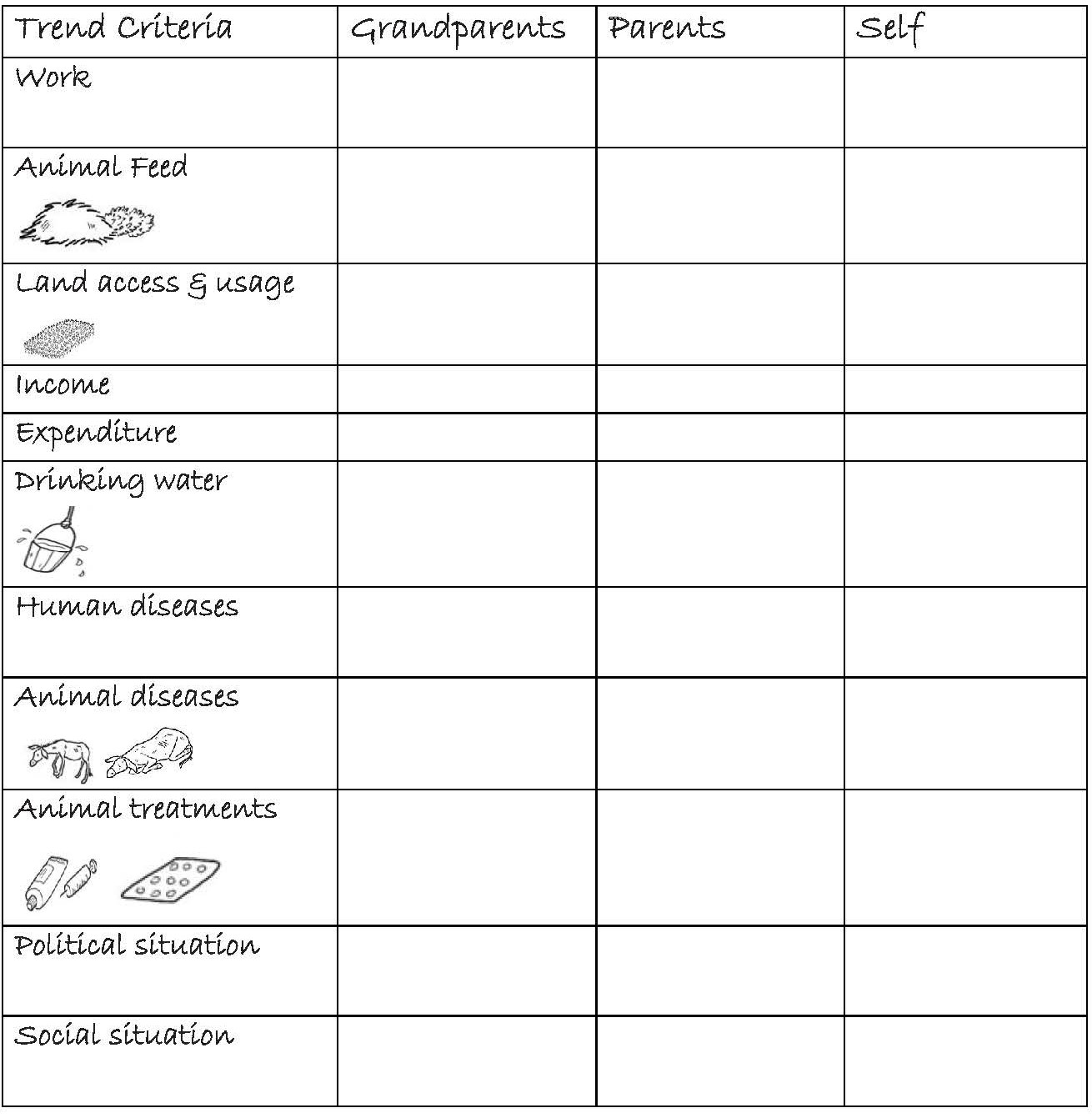
Figure T11A-1 Changing trend analysis matrix (analysis criteria on vertical axis, generations on horizontal axis)
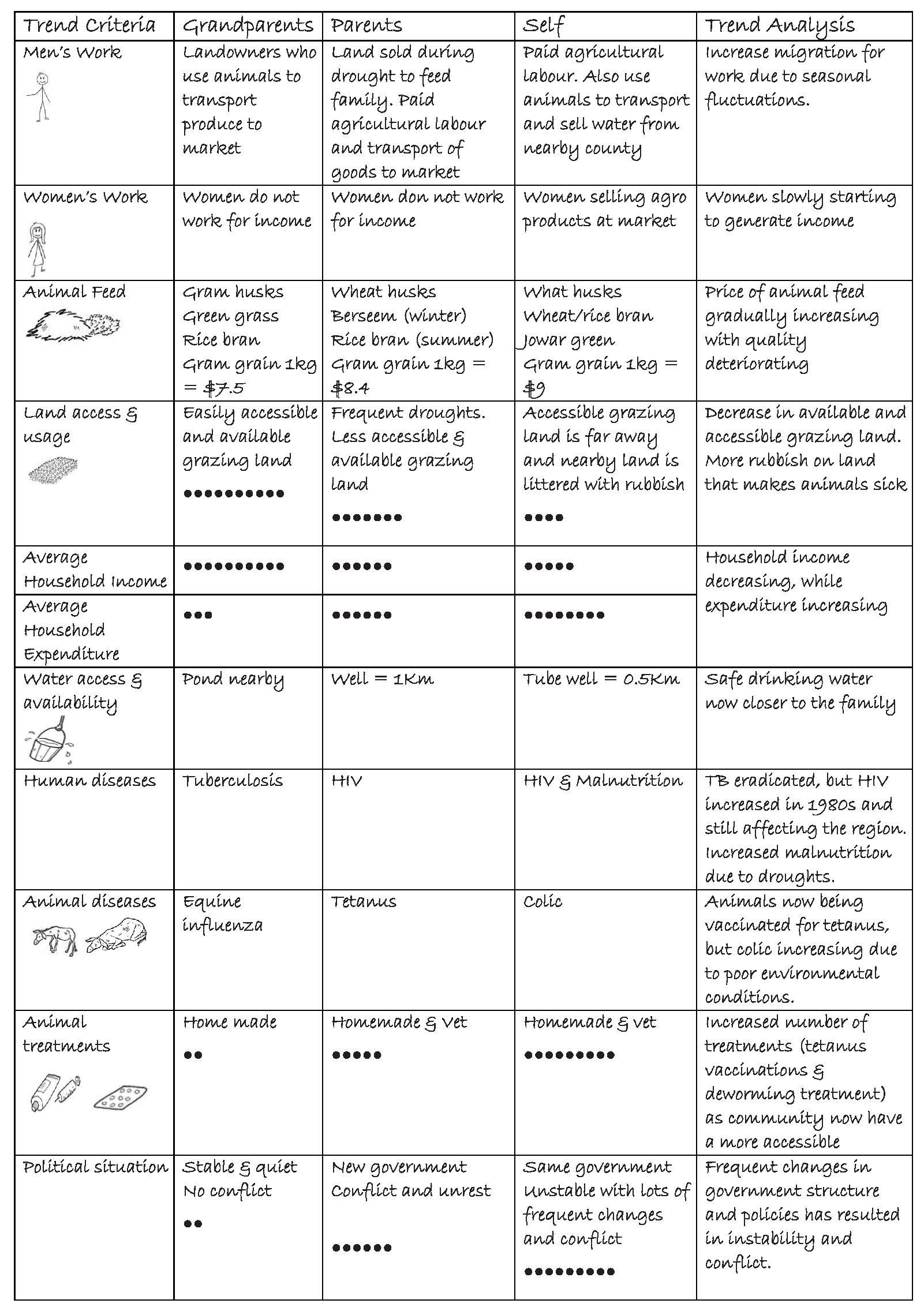
Figure T11A-2 Changing trend analysis of changes affecting potters and their working animals over four generations
The completed matrix above is the result of a changing trend analysis carried out with a group of animal-owning farmers. It was used as part of a community needs assessment and shared vision. It shows changes in work type and land ownership, quantity, type and cost of animal feed and fodder, grazing land accessibility and availability, average household income and expenditure, availability of and distance to travel for water, human and animal disease prevalence and treatment options, and changing political situation. As a result of this exercise, farmers were able to identify opportunities to mitigate the trends they identified as negatively impacting their lives and the related welfare of their animals.
Changing Trend Analysis
Step 1
Start by explaining that the purpose of the exercise is to understand how the situation in the community has changed over time, and that the group will start with the present and then look at the past. Then ask the group what changes they have experienced in their lives as compared to the past?
Examples:
• Income-generating activities for men and women (separately) • Household income • Household expenditure
Other human aspects, such as food consumption, health and illness, education, and social groups, such as religious groups, self-help & savings/loaning groups, women’s groups. Access & availability of natural resources, such as water, wood, soil, land, etc.
Then ask about changes they have experienced related to their animals.
Examples include:
• Types of animals • Animal work types • Feed practices • Health/illness • Treatment
Ask the community helper to write all identified changes on cards using words or drawings. Make sure that each criterion is specific, for example if participants say ‘water’ clarity if they mean ‘access and availability of water’. Once all changes have been identified, ask participants to select the cards representing the changes which are most important to them. It is the facilitator’s job to ensure that the ones most important to the project are included.
Step 2
Then ask participants to define a timescale for their analysis. It may be based on generations, such as ‘in our grandparents’ time’, ‘in our parents’ time’ and ‘in our time’, or other important activities, events, or years.
Ask the community helper to draw a matrix on the ground and show the chosen time scale on the horizontal axis along the top of the matrix and place the cards with the trend criteria identified in step 1 down the vertical axis (figure T11A-1).
Step 3
Next, explain to the group that they will complete the matrix and decide with the group how they wish to display the situation for each trend criteria. For example, by scoring criteria that can be measured using seeds or stones (0 to 10 for income/expenditure), and/or drawings, symbols, or words for lists of objects etc. As the group defines the scenario for each trend criteria, ask the helper to represent the situation on cards using the chosen means of display.
Step 4
Once the matrix is complete, record the trend analysis by adding a column labelled ‘analyses to the matrix.
Use the following guiding questions to facilitate a discussion about changes over time:
• What are the significant trends or changes that have occurred over time? • Are these trends/changes positive or negative? • What caused these trends/changes to occur?
In the ‘analysis’ column, write whether the change has been positive or negative and have participants expand on the negative changes. Explore the possibility and interest in taking action to address the identified negative changes.
Step 5
The matrix produced should be left with the community. Take a picture or copy and add it to your project action tracker for future reference and to assist with intervention planning.
Facilitator’s Notes: Changing trend analysis
Include a broad cross-section of animal-owning household members of all ages. Invite 10-20 people to participate in this exercise (e.g. youth, adults, elders).
If it is not possible or locally appropriate to do the exercise collectively with both sexes, conduct the exercise separately with men and women. Each may recall different events and changes due to the impacts that resulted in their lives.
Do not lead participants into identifying changes that are not important to them. While asking probing questions, emphasize identifying changes that they perceive to be important. Events or perceived changes should not be included simply because the facilitator inquiries about them.
Clarify any doubts to understand people’s perceptions about changes over time by reaching consensus amongst participants.
Next Steps
As part of a community needs assessment and shared vision, this activity might accompany one or more of the following tools to get a full picture of community dynamics and needs for project planning:
T1 Mapping to understand which resources and services are important to the community.
T2 Mobility Map to understand where people spend most of their time and how long it takes to get places.
T3 Venn Diagram(T3b Social Networking Venn diagram) to identify key individuals, groups and actors perceived to be most important to people and their animals.
T12 Dependency Analysisto understand animal-owning households’ level of dependency on external actors and their implications on resources and services important to ensuring animals’ welfare.
T11b: Before and Now Analysis Changing Trend
The before and now analysis helps the community to identify changes from the beginning to the end of an animal welfare improvement project. This tool may be used to analyse many different aspects of peoples’ lives and the lives of their animals, including changes in people’s reliance/use of animals, animal care practices, animal disease patterns and related impacts on people, availability and use of animal-related health services and resources, climate or other environmental factors affecting animals and people.
Tool purpose:
Time needed:
• To reflect on perceived changes in the lives of animals and animal owning households within the project period • As a learning and reflection tool to assess perceived changes in animal welfare and people’s behaviours as a result of community/project activities • To determine if there are remaining areas of improvement that can be addressed
2 hours
Materials needed:
Cards, pens, markers, coloured powder, chalk, sticks, tree leaves, coloured cards or other locally available materials.
Keyword Search Tags
Project Phase: Exit & Evaluation Phase
Approaches for Working With Communities: Community Development Approach, Community Engagement Approach, Societal Outreach and Campaigns Approach
Behavioural Drivers (COM-B): Motivation
Stages of Behaviour Change: Maintenance Stage
Project Support: Participatory Learning and Action Tools, Monitoring and Evaluation
Specific Topics: Animal Husbandry and Management; Livelihoods; Vulnerability/Resilience
Owners know what to look for when animals being treated by LSP
7
LSP access
Previously free services
Availability better – now have LSP phone numbers
7
Beating
Everyone used to beat their animals
No more beating
6
Figure T11B Before and now results from a group of animal owners in Faisalabad, Pakistan
The matrix in figure 11B was produced by a group of animal-owners at the end of a five year project as part of the community’s self-evaluation. They wanted to determine whether the human and animal welfare changes within their community could be sustained over time without the intervention team. The group compared the situation before the intervention to the present state, analysed what the differences meant and whether they thought that they had the skills, knowledge and tools needed to continue to improve on their own.
The group identified six key areas where change has been observed since the beginning of the animal welfare improvement project: food provision (dietary diversity), water provision (daily increase), local service providers’ skills (improvement), owners’ knowledge of good animal welfare, access to local service providers (LSPs) and beating of animals. After scoring the extent to which the majority of the community had made positive change, the group determined that more work was needed to improve LSP skills, owners’ knowledge of animal welfare, access to LSPs and beating of animals. They added the actions that they would take to the community action plan and set a date for the next meeting to focus on beating, which scored the lowest amongst the positive changes.
Before and Now Analysis
Step 1
Start by explaining to the group that they will be reflecting on changes in the lives of animals and their own community members within the project period, comparing how things were before the project to now.
Step 2
Ask the group about the present situation relating to animals’ care, use and their own livelihood status. Have the group compare the present situation to the past.
Ask:
• What are some of the changes that have resulted since project/community action plan activities were implemented? • How have things changed since the beginning of the project?
As the community comes up with the present situation, have the community helper write the changes with words or symbols on cards.
Examples of change categories might include:
• Men’s/women’s work types • Animals’ usage • Household income, expenditure, credit (group formation) • Land access & usage • Animal and human diseases and treatments • Community dynamics (more cohesion amongst group) • Climate change situation (water/feed storage) • Political situation (changes to laws, by-laws) • Environmental change (infrastructure improvements, increased availability of resources)
Please note: If the community comes up with more than 10 changes, ask participants to select the cards representing the 8-10 changes which are most important to them.
Step 3
Ask the community helper to draw a matrix on the ground or large sheet of chart paper. Label three columns ‘change in project’, ‘before’ and ‘now’. Have the helper place the cards representing the most important changes down the first column under ‘change in project’.
Then, facilitate a discussion on how the present situation has changed since the project started. The past and present situations will be defined by the community through this discussion. As each situation is defined for each of the changes, have the community helper write the results on cards and place the past scenario in the ‘before’ column and the present situation in the ‘now’ column.
Step 4
Have the community helper add a fourth column and label it ‘score’. Ask the community to score out of 10 the proportion of the community who meets the ‘now’ criteria. For example, a score of 10 = everyone has changed; 0 = no change.
Step 5
Once the matrix is complete, discuss the results of the activity with the group.
Follow the discussion by asking:
• Does everyone agree with the results? If yes, why? If no, why not? • What needs to change for everyone to achieve the desired result? - Can you achieve the desired results without our intervention? - If yes, do you feel that you have skills, knowledge, and resources to continue without the intervention team?
If the group determines that not all the project objectives have been met and wish to continue with the project, have the community helper add any identified priorities to the community action plan for later discussion and further planning.
Step 6
The matrix should be documented through photos or recreated on paper. Copies should be made and distributed to the group for their records, future reference and/or action planning. Add a copy to your project action tracker.
Facilitator’s Notes: Before and now analysis
If possible, invite 10-15 people to participate in this exercise.
If it is not possible or locally appropriate to do the exercise collectively with both sexes, consider conducting the exercise separately with men and women. Each may recall different change criteria due to the impacts that resulted in their lives.
Do not lead participants into identifying changes that are not important to them. While asking probing questions, emphasize identifying changes that they perceive to be important. Perceived changes should not be included simply because the facilitator inquiries about them.
Have the community’s original shared vision available for reference during the final discussion.
Next Steps
If the community determines it is satisfied with the changes it has achieved:
Consider using T28 Group Sustainability Mapping tool to help participants in planning to sustain their welfare improvements independently once support from the facilitating organization has ceased.
The facilitating organization may use the qualitative before and now findings of project successes to support project reporting or future funding proposals.
If participants indicate the project activities have not achieved the desired changes, update the community action plan and project action tracker with any new agreed actions. Re-evaluate persistent issues using any or all of the following tools:
T21 Animal Welfare Practice Gap Analysis to identify actions people can take, either individually or collectively, to address gaps in animal husbandry and management to improve animal welfare
3.1 Overview of Communities for Animals Approaches for Working with Communities
The communities for animals’ resource provides step by step guidance for three different intensity approaches for working with communities to improve their animals’ welfare based on recommended best practices for promoting behaviour change and the highest level of community participation for lasting change.
The three approaches are further explained below:
Approach 1
INTENSIVE COMMUNITY DEVELOPMENT APPROACH
The community development (CD) approach is the most participatory, empowering and intensive approach involving.
The core of this approach is to build the capacity of the animal-owning community to act as a collective for sustainable improvement in the welfare of their animals. It requires time, effort and commitment from you and the community. This approach relies heavily on participatory learning and action (PLA) methods to facilitate an inquiry process whereby group members come to identify, understand, and prioritize their animal welfare issues, and discuss and agree on actions to take to address them. With your support, members of the group can work together to:
Improve their understanding of animal welfare and their own animal husbandry and management practices
Improve the quality, accessibility and availability of existing service providers in their area
Make and/or negotiate collective purchases of animal related resources for improved cost savings
Advocate for their needs with a unified voice
Improve access and availability of financial resources if group savings and loan initiatives are undertaken
The existence of a strong, cohesive group is essential to achieving the motivation, knowledge and monitoring mechanisms for mutual learning and peer support for improving the lives of animals. These groups could be newly established or existing groups that can mainstream animal welfare issues and work on animal welfare needs improvement. Co-operation between owners also allows the group to do things that its members could not achieve as individuals, such as buying animal feed in bulk, and advocating for their needs, such as holding service-providers to account for the quality of service they provide. Collective action undertaken by groups is not only beneficial to group members but can potentially benefit individuals within the broader community e.g. promoting quality health services, and securing low cost feed. The CD approach relies on participatory learning and action processes and tools, which are well-aligned with supporting community groups’ progress through the stages of change to achieve and sustain animal welfare improvements on their own.
The CD approach can be used to complement the CE approach when:
Community groups engaged through the CD approach are utilized to provide cross learning opportunities for CE approach sites e.g. Village-to-village visits, competitions.
CE or SOC communities are linked with service providers linked with community groups in CD projects.
Group members are encouraged to continue to act as change agents and agenda setters upon project exit, and model and encourage animal welfare improvements to peers.
In addition, this approach can support the societal outreach and campaigns approach, for example when community-based organizations formed through this approach are consulted to inform campaign development, pilot or communicate outreach messaging.
Approach 2
SEMI-INTENSIVE COMMUNITY ENGAGEMENT APPROACH
The community engagement (CE) approach is an intermediate approach, which requires you the community engagement facilitator or a trained community change agent to directly engage with individuals or groups to facilitate behaviour change to improve animal welfare, albeit visits may be less frequent than the CD approach.
This approach does not require advanced facilitation skills and can be delivered through trained community change agents and therefore can support broader reach than the community development approach.
This approach relies heavily on using recommended tools and techniques in effective communication for behaviour change and adult learning theory. This involves consulting communities and listening to understand why they practice behaviours contributing to poor animal welfare and facilitating a process to support building their self-efficacy, knowledge, skills, and motivation to change their behaviours. Ideally, this approach seeks to improve the animal welfare issues and related animal husbandry and management practices prioritized for change by communities, who supports community members’ progress through the stages of change.
On the spectrum of participation, this approach promotes consultation, involvement, and collaboration with communities to support behaviour change for animal welfare improvements. To the extent this approach relies on organized events to raise awareness and build community capacity to improve animal welfare, communities are ideally involved to greatest extent feasible, regardless of whether issues and solutions were collaboratively identified e.g. involving community members in role plays, competitions, or other organized events such as theatre performances etc.
The semi-intensive approach can also be used to make maximum use of the intensive community development initiatives you may be doing, by extending some of benefits of the community development approach to groups in the communities where animals are experiencing poor welfare in areas located nearby groups formed through the community development approach. The aim here would be to create opportunities for cross-site learning between animal owners in intensive and semi-intensive groups, and linking with service providers with whom you are already working in the nearby intensive communities. This is particularly useful when you find you are unable to work intensively with all of the high-risk animals at the same time, either because your organization does not have the capacity or the animal owners are too scattered to initiate group formation for collective action. In particular, the CE approach can be used to complement the CD approach by:
Supporting rapport building and sensitization during initiation phase. For example, working through change agents to permit greater understanding of the local context and community dynamics.
Support sustainability of behaviour change upon withdrawal of project support by the facilitating organization, for example if community change agents continue to provide light touch support to peers to motivate and sustain animal welfare improvements.
Tools and techniques common to this approach can be used by facilitators to support group members through the stages of change.
Approach 3
EXTENSIVE SOCIETAL OUTREACH AND CAMPAIGNS APPROACH
The social outreach and campaigns (SOC) approach is the least intensive approach and involves using persuasive communication techniques and/or demonstrations to provide information and raise awareness of animal welfare issues and best practices amongst the target population.
The extensive approach is best used where there are limits or constraints on the ability of you or your organization to work intensively with communities. This approach reaches target populations using broadcast media (TV, radio), outdoor media (billboards, posters), print media (leaflets/other written materials, newspapers), digital media (internet, mobile phone application) [21], or outreach campaigns and organized events e.g. community fairs, competitions, theatre performances, puppet shows. This approach can also be used to influence target groups indirectly by incorporating animal welfare improvement messages into the work of existing organizations in the area such as schools, religious groups, cooperatives, unions. The extensive approach may be used in areas with high or low animal density. However, welfare messaging is less effective than group formation in changing people’s behaviour towards their animals, so it is most suitable for situations where the risks to animal welfare and the livelihood vulnerability of owners are lower. While this approach typically falls at the lower end of the spectrum of participation with a goal of consulting to involving, participation can be improved by ensuring the animal owning community is involved beyond simply informing them, and ensuring they are consulted or collaborated with when designing and/or implementing such initiatives.
The SOC approach can also be used to complement the CE and CD approaches to:
Rapport building and sensitization during the initiation phase.
Promoting social norms to support desired behaviour change.
The aim when working with communities to improve animal welfare is to do so using the most participatory and empowering approach feasible, in recognition that the promotion of self-efficacy is essential to behaviour change and achieving and sustaining animal welfare improvements. As such, whenever feasible, the general recommendation for making the maximum welfare improvement to the animals in most need (or at highest risk of poor welfare), is to adopt a community development approach as it more participatory, empowering, and likely to result in lasting behavioural change and animal welfare improvements. While our recommendations are based on our experience across several countries and in many environments and livelihoods contexts, there will always be exceptions. For example, a change in local government policy or its implementation following a mass media campaign may have a significant impact on the welfare of animals in high-risk groups. In this case, it is possible for an extensive, indirect societal campaign to lead to improvement in the welfare of high-risk animals.
It should also be noted that in one geographical area, you can work with different groups of animals and their owners using different approaches. In addition, the approaches are not mutually exclusive, and can be used together to complement each other to enhance behaviour change and related animal welfare improvements. The decision on whether and how to work with a group of animal owners should be based on your best judgement and the strategic direction and capacity of your organization. Each approach varies in terms of level of intensity of investment, level of community participation and potential for empowerment, as well as in their ability to successfully address the different drivers of behaviour. It is therefore important to carefully consider which approach is most appropriate for a given context, given the level of risk for poor welfare and potential livelihood vulnerability of the animal owning communities where applicable.
The following table provides an overview of the 3 approaches:
General Characteristics
Extensive Societal Outreach and Campaigns
Semi-Intensive Community Engagement
Intensive Community Development
Potential Reach
Supports broader reach at societal level
Targets individuals at community level, reach dependent on project resources
Targets groups of individuals at reach dependent on project resources
Agenda Setting
Agenda may be set by implementing organization, ideally informed through consultation
Best practice is to focus on animal welfare issues/ behaviour changes most relevant to the community. Tools and techniques common to this approach may however also be used to facilitate improvements in welfare issues identified by the implementing organization
Most participatory and empowering approach that enables the community itself to dictate the agenda, identify their priority issues and solutions, and work together to address them.
Potential likelihood of lasting behaviour change and welfare improvements
Low: typically works best when target communities already have the pre-existing motivation to voluntarily adopt desired behavioural change/improve animal welfare
Moderate-High: typically works best when:
• Communities inform decision making and drive desired changes. • seeks to strengthen the self-reliance and problem-solving capacity of animal owners, carers and/or users • Makes positive use of existing local knowledge, practices and locally available resources • Works through and strengthens existing local service providers as appropriate • Social opportunity and/or physical opportunity constraints do not hinder the adoption of desired behaviours (these are not explicitly addressed by this approach).
High: typically works best when the following cornerstones are put in place:
• strong cohesive group structures • community-based welfare monitoring mechanisms • work through and strengthen existing local service and resource providers to ensure availability of quality, affordable local services and resources • motivated and knowledgeable animal owners, carers, and/or users
• Pre-contemplation: to raise awareness of welfare issues • Contemplation: raise awareness and influence social norms/pressure • Preparation: provide information about how to change • Maintenance: provide reminders to practice already existing changes needed
Pre-contemplation: through awareness raising about welfare issues • Contemplation: raise awareness of benefits of desired behaviours, increase social pressure • Preparation: model desired behaviours, and provide information and skills training • Action: support people to solution their own problems, provide feedback on results, facilitate social support and networking • Maintenance: provide positive reinforcement and reminders
Group members naturally progress through the stages of behavioural change as a result of the facilitated participatory learning and action (PLA) activities • Formation of groups provide opportunity for peer to peer support, and in monitoring of behaviours by others thus contribute to behaviour maintenance.
General Competency Level for Implementing Agents
Skilled community educators and communicators
Skilled trainers and influential communicators
Community facilitators skilled in participatory learning and action methods
Level of Investment (time, resources & capacity)
Low (average: 1 year)
Moderate – High (average: 2-3 years)
High (average: 3-5 years)
COM-B Drivers of Behaviour Typically Addressed by Approach
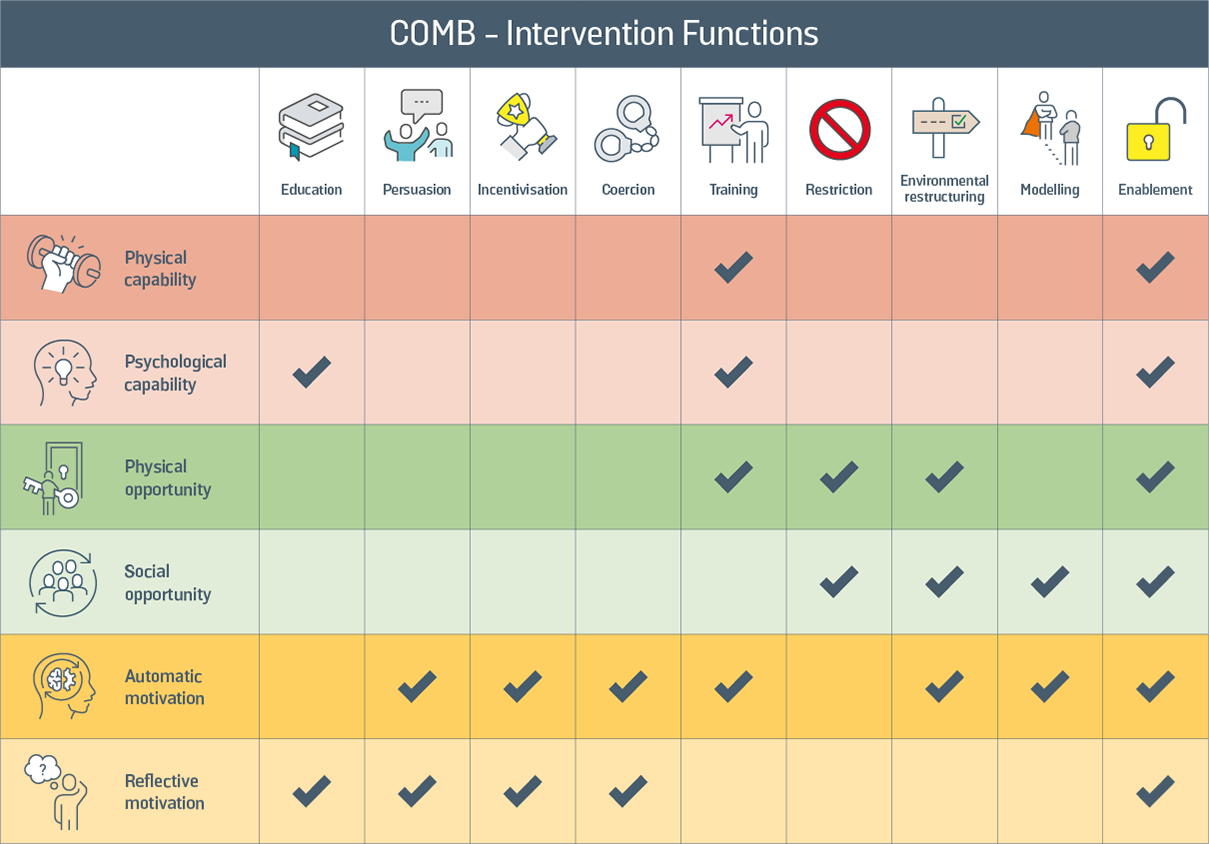
Capability: psychological (knowledge) and physical (skills) • Motivation: Automatic and reflective • Opportunity: Social opportunity (norms at community level and peer support)
Capability: psychological (knowledge) and physical (skills) • Motivation: automatic and reflective • Opportunity: social opportunity and physical opportunity
Community participation goals most likely to be supported
Table 4: Overview of Community-Based Welfare Intervention Approaches
3.2 Considerations for Selecting an Approach for Working with Communities
Once you have identified the animal populations and areas you wish to target, it is useful to understand the local context when how intensively you are able to engage with communities. The following table provides a sample of key considerations to consider in choosing the appropriate approach. If you’re unsure of which approach is right for you, this resource also includes a quiz to help you decide.
KEY CONSIDERATIONS FOR CHOOSING YOUR APPROACH
Extensive Societal Outreach and Campaigns
Semi-Intensive Community Engagement
Intensive Community Development
• Communities can be reached either directly or only remotely e.g. communities may be geographically spread, there may be organization constraints to reach communities/work intensively. • Low willingness or ability of community to meet regularly. • Insufficient social cohesion/trust to work together for collective action. • Does not require a high level of facilitation skills. • Requires lowest estimated time investment to implement (1 year) • Recommended approach for animals at low risk of poor welfare and amongst populations whose livelihoods are not highly vulnerable. • Targets large amounts of people/broad reach.
• Communities can be reached to meet with them directly. • Moderate-High willingness or ability of community members to meet regularly. • Insufficient social cohesion/trust to work together for collective action. • Requires moderately skilled facilitators and/or trained community change agents. • Requires moderately low time investment to implement (2-3 years) • Recommended approach for animals at low -moderate risk of poor welfare and amongst populations whose livelihoods are not highly vulnerable. • Permits somewhat broad reach through targeted engagement with specific groups/individuals (reach dependent on capacity and resources available)
• Communities can be reached to meet with them directly. • Community members are willing and able to meet regularly, and there is sufficient social cohesion/trust to work together for collective action (e.g. not geographically spread, non-migratory) • Requires a high level of facilitation skills to support the participatory learning and action process. • Requires highest investment of support/time to implement (3-5 years) • Recommended approach when working with highly vulnerable people and animals (animal at high risk of poor welfare) • Due to higher support investment, and targeted engagement of groups - may not permit broad reach (depends on capacity of resources of implementing organization)
Table 5: Overview of Key Considerations for Choosing an Approach for Working with Communities
This checklist reflects the key skills and observable behaviours for effectively facilitating community participation and empowerment. While these skills may not all be observed or needed for all activities or contexts in which communities’ are engaged, they represent the core competencies desirable in community facilitators. By harnessing these skills, community facilitators can enable community participants to freely express their opinions, ideas, and concerns, feel valued and respected, and help foster their sense of self-efficacy and ownership over change. This resource can be used as a self or peer assessment tool to help identify capacity strengthening needs and areas of improvement, inform training delivery, and support effective delivery of community development or engagement projects.
Approaches for Working With Communities: Community Development Approach, Community Engagement Approach
Project Support: Facilitator Resources, Training
Community Facilitation Skills Checklist
Did the facilitator come prepared to ensure activity/discussion ran smoothly and didn’t waste unnecessary time of participants? e.g. appropriate materials, understanding of the activity
Did the facilitator sit/position themselves same level with participants?
Did the facilitator explain the purpose of the discussion/activity before it started, and give an indication of how long it would last?
Did the facilitator ask if participants had any questions before the session/exercise began?
Did the facilitator their unsolicited opinions/information/answers rather than facilitate participants to discuss, reflect, learn, and identify their own ideas?
Did the facilitator use open ended questions to help participants reflect and identify key learnings for themselves?
Did the facilitator prevent domination of the activity/discussion by one or a few people, and encourage participation/input from others?
Did the facilitator encourage equal participation from men and women and/or people who are marginalized or vulnerable?
Did the facilitator encourage even shy/timid participants to speak/participate?
Did the facilitator summarize the discussion and key learnings at the end?
Did the facilitator ask participants for feedback on their experience of the discussion/activity at the end? This is important to understand the perspective of participants and whether they felt time spent was valuable to them, to enable them to make any improvements in the future.
Did the facilitator make plans for follow up with the participants and/or ensure clear understanding of next steps?
Did the facilitator record the outcome/result of the activity to ensure the community has a copy, and relevant information could be used to inform project planning?
Was the facilitator engaging and respectful from the beginning to end of the visit?
For effective facilitation, the community facilitator must process the following skills: -
Actively listen: Listening is the bedrock of good facilitation skills. Effective listening before and during a session/meeting is necessary to create a tailored and relevant learning process.
Ask questions: Ask questions often during the session/meeting. This is a critical facilitation skill to move individual and group sharing and learning forward. Questions can be framed to accomplish different types of responses, such as to gain or focus attention, solicit information, give information, direct the thoughts of others, and close discussions.
Be comfortable with silence: Often, questions are met with silence. Participants may need time to process the question, formulate a response, or think of other questions. However, silence can also mean that participants are confused or frustrated. With more experience, you can read nonverbal cues and know how best to address silence.
Be flexible: You never know exactly how a session/meeting will go, who will be there, and what unexpected events will arise. Be flexible and willing to shorten an activity, add important language to a definition, or adapt an exercise.
Stay focused on objectives: Select just one or two practices to focus on during a session/meeting, so that you can discuss them in more detail. If participant discussions get off-topic, refocus the group by using phrases such as “this is interesting to explore further at another time, but let’s return to the topic.” It is your responsibility to find the appropriate time to intervene, thank participants, and bring the conversation back to the objective.
Use verbal and nonverbal encouragement: By using verbal and nonverbal cues, you can make participants feel more comfortable with sharing their thoughts and ideas. By nodding your head or agreeing with the participants as they are speaking, they will feel encouraged to continue sharing. It is also helpful to foster participation of shy or modest participants.
Foster respect among participants: Mutual respect and trust between you and the participants and among the participants nurtures the learning process. Effective learning is supported through the constructive and supportive feedback of respected peers.
Use participatory activities: When participants actively engage with others, they build capacities that are more effective, memorable, and easy to apply. Mix activity types so that there are opportunities to work alone, in small groups, and in one large group. Everyone in the room is a student and a facilitator.
Build in time for reflection: The most effective learning takes place through “real world” experiences, including the opportunity to reflect, identify patterns, draw conclusions, and derive principles that will apply to similar experiences in the future. Allow time for participants to share their experiences and/or to respectfully share others’ experiences.
Build in time for forward planning: Participants need time to practice their new skills, but also to consider ways in which to change their practices going forward. When talking about behaviour change, always include time to discuss barriers and enablers.
Seek feedback: This will ensure that participants can freely express how they found the process, and what needs to be improved. A sample feedback form that can be adapted is presented below.
Generate discussion and awareness amongst community members about their animals’ welfare needs and the animal husbandry and management practices that can meet them (refer to Part 1 below).
Support the identification of behaviours that are feasible for communities to adopt to improve their animals' welfare (refer to Part 2 below).
Identify actions communities can take to improve their animals welfare even when they are unable to address identified welfare issues due to barriers they/the project faces in resolving these issues’ root causes (refer to Part 3 below).
This resource demonstrates how the five domains of animal welfare framework can be linked with human behaviours using donkeys as an example. It illustrates its use as a discussion tool in promoting understanding of donkey’s welfare needs, and for identifying behaviours feasible for community members to adopt to improve their donkeys’ welfare. Refer to this illustrative example to support your development of a five domains framework linked with human behaviours that is relevant to the context of your work. The Animals and Communities Learning Module is also a recommended foundational reading for understanding animal welfare and the five domains of animal welfare discussed in this resource.
PART 1: Developing a Five Domains of Welfare Linked to Human Behaviours Discussion Tool
Table 9a provides an illustrative example of a five domains of welfare framework for donkeys, linked with identified potential human behaviours for meeting donkeys’ welfare needs. It is recommended to populate the five domains framework with animal welfare experts knowledgeable in the target species, and then brainstorm a list of human behaviours in consultation with representative members of the animal owning community to ensure they reflect locally appropriate and acceptable behaviours. In addition, animal welfare experts must work hand in hand with community development/engagement teams for these discussions to ensure any potential behaviours identified for meeting animals’ welfare needs support positive life experiences and do not adversely cause harm to animals. Developing a species specific five domains framework linked to the potential human behaviours for meeting an animals’ welfare needs within the domains of nutrition, health, environment and behaviour can support community discussions and awareness raising about animals’ welfare needs and the animal husbandry and management practices recommended to meet them.
Donkey Welfare Needs Associated with Domains of Welfare
Human Behaviours Associated with Meeting Donkey’s Welfare Needs (Ideal Best Practices Appropriate within Local Context)
NUTRITION DOMAIN
a.Food Quantity and Quality · Donkey’s nutritional requirements are met by eating a sufficient quantity and variety of nutritional feeds (e.g. fibre based feeds) for taste and pleasure. · Donkeys feed on small potions and very often. This is essential for health. In a natural situation donkeys eat for 12-16 hours a day to maintain health. With work they likely need additional energy (e.g. feed during rest breaks during work). b.Water Quantity and Quality: · Donkeys have access to and drink sufficient quantity of water while working and at home
a.Human Behaviours Related to Food Quantity and Quality · Provide sufficient quantities of predominantly fibre based feeds (grass/hay) and other suitable locally available forages including straw (e.g. from oat, barley, wheat), and/or soya meal as local availability permits based on recommended proportions for their animals’ size and workload, at intervals throughout their working day (every 3 hours or /2-3 times/day). · Provide donkeys with opportunities to graze on natural forage when they are not working as often as possible when locally available and provide forage (e.g. straw/hay) when they are not working if there is no or limited natural vegetation available to graze. b.Human Behaviours Related to Water Quantity and Quality · Provide freely available clean water to donkeys whenever they are at home not working. · Provide clean water to donkeys throughout their working day (every 3 hours or /2-3 times/day). · Provide more clean water during hot seasons/conditions and adjust working hours to avoid strong heat time
HEALTH DOMAIN
a.Absence of Disease b.Absence of Lameness c.Absence of Preventable Injuries e.g. wounds d.Provide Timely Treatment and Pain Management
a.Human Behaviours Promoting Absence of Disease · Seek yearly health checks from qualified animal health service providers. · Check donkey’s general health and well-being on daily basis. · Take preventative measures against preventable diseases at recommended treatment intervals (e.g. yearly vaccines, parasite control). · Clean manure from donkey resting areas at home on a daily basis to mitigate parasitic diseases spread by flies, and hoof health issues. b.Human Behaviours Promoting Absence of Lameness · Load donkey carts in a balanced way within the reasonable maximum load to prevent lameness · Pick/clean donkey’s hooves daily before and after working to maintain hoof health and comfort during working. · Seek qualified farriery service providers to trim donkey’s hooves at the regularly recommended frequency to promote hoof health and mitigate lameness. · Clean donkey resting areas on a daily basis to ensure substrate is clean and doesn’t accumulate pools of water/urine to mitigate hoof health issues. · Allow the donkey to go more slowly and choose their route if the ground surface is uneven. If an alternative less uneven route is available, select this route. · Allow the donkey to go more slowly and choose their route if the ground surface is uneven. If an alternative less uneven route is available, select this route. c.Human Behaviours Promoting Absence of Preventable Injuries e.g. wounds · Clean equipment which comes into direct contact with donkey’s skin to remove accumulation of dust and prevent painful rubbing and wounds (e.g. pads and harnesses). · Load donkey carts in a balanced way to prevent equipment rubbing from causing wounds. · Use body and verbal communication to guide donkeys instead of whipping to prevent wounds and stress. · Groom animals to remove dust from skin before they work to prevent equipment rubbing and causing wounds. · Use properly fitting, quality equipment purchased from welfare friendly equipment suppliers (e.g. cart, harness, bit makers), and/or made from locally available materials in accordance with recommendations for promoting welfare (e.g. padding made with straw). · Clean donkey’s eyes daily to remove discharge and debris and check for abnormalities to help mitigate eye problems. · Load donkeys with no more than the recommended weight appropriate for the animals’ size to prevent injury. d.Human Behaviours Promoting Timely Treatment and Pain Management · Clean any skin wounds in accordance with recommended guidance as soon as wounds are observed. · Provide rest for donkey to recover from the injury or until wound recovers · Seek timely treatment from qualified animal health service providers when animal is sick or injured. · Donkeys pain and suffering is managed as needed when injuries or illnesses occur through administration of pain medications prescribed and administered as needed by a qualified animal health service professional
ENVIRONMENT DOMAIN
a.Thermal Comfort/Weather Protection · Prevention of adverse physiological reactions from sun/heat and adverse weather conditions b.Safe Environment · Environment where donkey lives/works is safe and does not pose a risk of injury/harm e.g. traffic, edible rubbish, sharp objects, pooling water where animal stands etc. · Environment permits escape/safety from predation c.Space for Exhibiting Natural Behaviours · Sufficient available space for donkeys to freely socialize with others within shelter or outside the shelter, and also to allow them to move away from other animals as needed e.g. to avoid conflict · Donkeys have space to roam and carry out normal grazing/foraging behaviours without competition · Donkeys have space to roll in the dirt and scratch when not working. d.Substrate/Floor Comfort · Substrate where animals rest and stand is free from excrement and/or pooling water
a.Human Behaviours Related to Thermal Comfort/Weather Protection · Provide donkeys with shelter during hot and wet/rainy weather. · Rest donkeys in shade or shelter with appropriate ventilation while on breaks during working hours to protect them from the heat of the sun and other adverse weather conditions. · Provide shelter large enough to accommodate all animals made of locally available and appropriate materials to remain at optimal temperatures that protect their animals from the heat and other adverse weather conditions (e.g. physical building, wall or other man made or natural structure that is appropriately ventilated.) b.Human Behaviours Promoting a Safe Environment for Donkeys · Remove harmful items/hazards from locations where donkeys are left to rest, graze, and in their shelter areas (e.g. edible plastics, sharp objects etc.) to prevent risk of harm. · Use shelter materials which are safe and do not pose a risk to donkey’s safety · When allowing donkeys to freely graze iv. Keep an eye on their movements and ensure they do not wander to rubbish heaps and ingest plastics and/or v. Tether donkeys using recommended welfare promoting methods and equipment to ensure their safety and prevent their ingestion of harmful materials, and change their location frequently so as not to limit the quantity of feed they are able to graze. · Keep to sides of roads to mitigate potential traffic collisions while transporting goods/people. · Equip donkey carts with reflectors to ensure they are visible to traffic while working. · Equip donkey carts with breaking systems to help manoeuvre effectively in traffic while working. · Ensure donkeys are safe from potential theft, predation and road traffic at night by keeping them in their shelters or other designated safe space close to home where they can be heard if distressed. · Ensure donkeys are safe from road traffic accidents at night by using carts with reflectors. c.Human Behaviours Promoting Space for Donkeys to Exhibit Natural Behaviours · Provide daily opportunities for donkeys to freely roam/carry out normal grazing/foraging behaviours without competition whenever safe to do so. · Allocate adequate space as available and daily opportunities while donkeys are not working to: 1) to freely move their limbs in a natural state, 2) rest, access feed, and avoid excrement, 3) socialize with other donkeys if present/feasible, and 4) move away from other animals as needed for their safety/mitigate conflict/competition and/or predation, 5) Roll and scratch without hindrance of equipment. d.Human Behaviours Promoting Substrate/Floor Comfort · Clean donkey shelters/rest area’s at home daily of excrement and any and excess pooling water · Provide deep, soft substrate for comfort and effective rest/sleep.
BEHAVIOUR DOMAIN
a.Ability/agency to interact with other animals · Donkeys can choose to interact and socialize with other donkeys or other species animals (e.g. touch/mutual grooming, play) or remove themselves from the presence of others. b.Ability/agency to Interact with Environment/Exhibit Natural Behaviours · Donkeys carry out normal behaviours such as rolling, lying down/resting, and resting during non-work periods without restriction. · Donkeys choose and carry out to graze, scratch, shelter, roll or explore their physical environment. c.Donkeys Respond Positively to Interactions with Humans e.g. alertness, interest, engagement with people, calm, no fear or stress response, or remove themselves from interacting with humans
a.Human Behaviours Promoting Donkey Agency · Provide donkeys with an ability to choose to move around freely without restriction/restraint while at rest at home. · Allow donkeys to interact with other animals (touch/mutual grooming), and move away from other donkeys if they choose too, including during their work day whenever feasible without hindering their work. · Use a halter when it is necessary to restrict a donkey’s movement. b.Human Behaviours Promoting Donkeys Exhibition of Natural Behaviours · Use recommended welfare friendly methods of restricting donkey’s movement when it necessary to so as to enable them to maintain as much natural movement as possible (e.g. use of harness and rope rather than hobbling) · Allow donkey foals stay with their mothers as much as possible, and provide them with opportunities to socialize and play with other foals if feasible. · Provide donkeys with intervals of rest throughout the day when they are working, and a day of rest at home without working them after lengthy work days to enable them to recuperate. · Provide donkeys with daily opportunities to freely carry out normal behaviours such as rolling, scratching, grazing, and interacting/playing with other donkeys if available while at home and not working. c.Human Behaviours Supporting Positive Interactions with Donkeys · Calmly approach and speak with donkeys to keep them calm and prevent stressful human interactions which cause them to exhibit fear or aggression. · Use body language communication or sound cues and/or as a ‘firefighting’ immediate option only, the presence of soft sticks which are unable to inflict pain can be used as a visual encouragement or light tap to inspire Donkeys to move as needed rather than whipping them which can cause them fear and stress. · Provide information to a handler or any third party how their donkeys are trained and respond to cues · Owners seek to develop owns skill to train and communicate with their donkeys in a compassionate way or ask for support from animal welfare organizations to build their own skills.
¯ DONKEY’S MENTAL STATE WHEN NEEDS MET/HUMAN BEHAVIOURS ADOPTED ¯
Free from fear, distress, anxiety Feels comfortable Expresses happiness and enjoys pleasure Feels Secure, Protected and Confident
Table 9a. Example Five Domains of Welfare Framework for Donkeys Linked with Human Behaviours
PART 2: Using Root Cause Analysis and Five Domains Framework linked with Human Behaviours to Identify Feasible Animal Welfare Issues and Actions for Addressing Them
The steps below outline a process which can be used or adapted to support the identification of behaviours that are feasible for communities to adopt to improve their animals welfare through use of a root cause analysis and species specific five domains of welfare linked with human behaviours.
First identify the animal welfare issues prevalent in the community. Consider using a participatory animal welfare assessment process, ideally involves members of the animal owning community whenever feasible to do so. The T22 Animal Welfare Transect Walk tool can be used to support this process.
Next, seek to understand the root causes of identified animal welfare issues in collaboration with community members or representative key informants from the animal owning community. Consider using the T25 Problem Animaltool to support undertaking a participatory root cause analysis of identified animal welfare issues. An example of root cause analysis for animal welfare issues identified through a participatory animal welfare assessment are illustrated in Figure 9a below.
Once a root cause analysis of welfare issues has been conducted, facilitate a discussion with community members or representative key informants from the animal owning community to the animal welfare issues which may be feasible and of interest for community members and the project to work together to address based on an understanding of their root causes. Seek agreement on the welfare issues which will be prioritized for improvement, and use a species specific five domains framework linked with potential human behaviours (refer to example in Table 9A above) to further discuss and identify the behaviours feasible for community members to adopt to address these welfare issues. Consider inviting animal welfare experts to the discussion to ensure any behaviours identified do not adversely harm animals and are likely to result in desired animal welfare improvements. Refer to the following considerations to help the selection of target behaviours:
How likely it is the behaviour can be changed (when considering the likelihood of change being achieved, think about the barriers and motivators to change in terms of capability, opportunity, and motivation to change of those who perform the behaviour)
How much of an impact adopting the behaviour would have on improving the overall welfare state of the animal in terms of the five domains.
How likely it is that the behaviour (or group of behaviours) will have a positive or negative impact on other, related behaviours.
How easy it will be to measure the behaviour.
Can the project support communities in adopting this behaviour given its available resources and implementation capacity e.g. if the project is being implemented through trained community change agents, can they effectively support communities in adopting this behaviour as needed?
Figure 9a. Example Root Cause Analysis of Donkey Welfare Issues
Table 9b below is an example of the target donkey welfare issues and behaviours identified as feasible for a community and project to address based on the results of the root cause analysis in Figure 9a. These discussions included representative community key informants and change agents, as well as animal welfare experts who helped ensure any behaviours identified support animal welfare improvements and do no harm.
Identified Donkey Welfare Issues Feasible to Address Based on Root Cause Analysis
Identified Behaviour Change Priorities for Addressing Priority Donkey Welfare Issues (Feasible and Appropriate within Local Context)
NUTRITION DOMAIN
a. Donkey is malnourished/skinny due to insufficient provision of quality and quantity of feed - Not feasible to address based on root cause analysis
Not feasible to address at this stage.
HEALTH DOMAIN
a. Excessive eye discharge b. Back Wounds c. Hindquarter wounds d. Overgrown hooves - Not feasible to address based on root cause analysis
a.Human Behaviours for Addressing Eye Discharge · Clean donkey’s eyes daily to remove discharge and debris and check for abnormalities to help mitigate eye problems. · Avoid as far as possible environments with air contamination e.g. during rest if it is not possible to avoid during work · Contact animal health practitioner if one eye is being different to the other eye, swelling, closed eye, thick and have coloured discharge and there is obvious change to the colour of the eye. · Avoid using blinkers and decorative items that dangle around the eyes b.Human Behaviours for Addressing Back Wounds · Wipe down and/or shake out any equipment to remove any accumulated mud or dirt before or after each use to prevent excess accumulation of dirt causing rubbing. · Groom animals carefully to remove dirt and dust from skin before they work to prevent equipment rubbing and causing wounds. · Use back padding under any loads whenever donkeys are using packs or to prevent carts from rubbing, in accordance with welfare promoting instructions for making such back pads using locally available materials (instructions to be provided by project). · Gentle cleaning with clean cloth to clean the wound. · Give the donkey to rest to recover from the wound c.Human Behaviours for Addressing Hindquarter Wounds · Rest animals from work to enable wounds to heal. · Use body and verbal communication or sound cues and/or as a ‘firefighting’ immediate option only and once wounds are healed use soft sticks which are unable to inflict pain as a visual encouragement or a light tap to inspire donkey’s to move as needed rather than whipping them which can cause them fear and stress (Request for a Compassionate Handling training to be provided by an animal welfare organization).
ENVIRONMENT DOMAIN
n/a – no issues identified from transect walk
n/a – no issues identified from transect walk
BEHAVIOUR DOMAIN
n/a – no issues identified from transect walk
· n/a
Table 9b: Priority Animal Welfare Issues and Actions for Addressing Them
PART 3: Using a Five Domains of Animal Welfare Framework Linked with Human Behaviours to Improve Animal Welfare When Unable to Address Root Causes of Animal Welfare Issues
While identifying existing animal welfare issues is a recommended step in community animal welfare improvement projects, it is not uncommon for community members or a project to be constrained in their ability to address the root causes of such issues. For example, it may not be feasible to resolve animal welfare issues whose root cause is communities’ lack of access or availability of financial resources using a Community Engagement Approach where trained community change agents are the primary implementing agents tasked with supporting community behaviour change at the individual household level. When resolving identified animal welfare issues is not feasible, opportunities to increase animals’ positive life experiences nevertheless exist.
Using a species specific five domains framework linked with associated human behaviours, you can facilitate discussions with community members and encourage them to identify and adopt other feasible actions/behaviours to improve the overall net gain in animals’ welfare even when identified welfare issues cannot be addressed. Using this resource can support flexible, solution oriented discussions with communities for improving animal welfare which are cognizant of contextual constraints, and mitigate promotion of unobtainable welfare standards that are not feasible to achieve. Improving animal welfare is more about creating positive change in animals’ welfare status through increasing animals’ positive life experiences so as to tip the balance between negative and positive life experiences. While addressing identified animal welfare issues is always a goal, you can still achieve an overall net gain in animal welfare even when such issues remain unaddressed. Figure 9b below illustrates the concept of this balance of life experiences.
Figure 9b: Balance of Life Experiences (adapted from [2])
To improve animal welfare it is important to seek to understand and assess animals both positive AND negative experiences within each domain and consider how an animal’s experiences within each of the four domains may be contributing to its mental state AND influencing its overall welfare. Thus, in addition to the identified donkey welfare issues (negative experiences) and associated human behaviours that can be adopted to address them which were identified in Table 9b above, Table 9c below provides examples of additional feasible actions identified in discussion with community members to improve their donkeys’ overall positive life experiences identified by using table 9a to generate awareness and discussion amongst community members. This demonstrates how this facilitator resource can be used to promote animal welfare improvements through focusing on ways to promote positive life experience rather than solely focus on addressing welfare issues. Without it, these opportunities for improving donkeys welfare through enhancing positive life experiences would not have been identified through the transect walk alone, which focussed more on assessing animals’ welfare to identify issues. It is recommended to prioritize elements within each of the domains instead of focussing on all efforts for improving an animals’ welfare within fewer domains to the extent feasible. As such, for this exercise, communities were encouraged to identify ways they could improve their animals’ positive life experiences within the domains of environment, behaviour and nutrition since all of their previously identified issues and behaviours were associated within the one domain of health.
Donkey Welfare Needs/Positive Life Experiences
Identified Potential Behaviour Change Priorities to Improve Donkey’s Welfare (Feasible and Appropriate within Local Context)
NUTRITION DOMAIN
a. Donkeys feed on small portions and often
Human Behaviours Promoting Improved Donkey Feeding a. Provide donkeys with feed and water 2-3 times a day throughout their working day (every 3 hours or 2-3 times/day).
HEALTH DOMAIN
N/A – priority donkey welfare issues already identified for health domain (refer to table 9b)
N/A - human behaviours to address priority donkey health issues already identified (refer to table 9b)
ENVIRONMENT DOMAIN
a.Thermal Comfort/Weather Protection · Prevention of adverse physiological reactions from sun/heat and adverse weather conditions b.Space for Exhibiting Natural Behaviours · Donkeys have space to roll in the dirt and scratch when not working.
a.Human Behaviours Related to Thermal Comfort/Weather Protection · Rest donkeys in shade or shelter while on breaks during working hours to protect them from the heat of the sun and other adverse weather conditions. b.Human Behaviours Promoting Space for Donkeys to Exhibit Natural Behaviours · Provide adequate accessible space for donkeys to roll, scratch, and lay down without hindrance of equipment when not working.
BEHAVIOUR DOMAIN
a.Ability/agency to exhibit natural behaviours/interact with other animals · Donkeys can choose to interact with other animals of their species (e.g. touch/mutual grooming, play) or remove themselves from the presence of other animals. · Donkeys can choose to carry out normal behaviours such as rolling, lying down/resting, and resting during non-work periods. b.Donkeys Respond Positively to Interactions with Humans
a.Human Behaviours Supporting Donkeys Exhibition of Natural Behaviours · Provide donkeys with daily opportunities to freely carry out normal behaviours such as rolling, scratching, grazing, and interacting/playing with other donkeys (if present) while at home and not working. b.Human Behaviours Supporting Positive Interactions with Donkeys · Use communication or sound cues and/or the presence of soft tipped sticks which can be used as a visual encouragement or light tap to inspire Donkey’s to move as needed rather than whipping them which can cause them fear and stress (also supports addressing whipping wounds under health domain).
Table 9c: Additional Actions for Increasing Positive Life Experiences of Donkeys to Improve their Overall Welfare Status
The initiation phase is about building rapport within the target community, understanding the local context, animal welfare issues and community interests and dynamics, as well as gauging interest and motivation in engaging with your animal welfare intervention project.
Purpose:
The purpose of this to provide the practitioners with the direction in terms of the information needed for the initiation phase; and where to collect the information. Including the tools that can assist with collecting the information.
Keyword Search Tags
Project Phase: Initiation Phase
Approaches for Working With Communities: Community Development Approach, Community Engagement Approach, Societal Outreach and Campaigns Approach
Behavioural Drivers (COM-B): Behaviour Change Diagnosis and Planning
10a. Overview of Useful Information to Collect During Initiation Phase
The initiation phase is about building rapport within the target community, understanding the local context, animal welfare issues and community interests and dynamics, as well as gauging interest and motivation in engaging with your animal welfare intervention project. The following table provides an overview of key understandings you should seek through activities implemented during the initiation phase, as well as potential sources for obtaining relevant information.
Useful Information
Why Important
Sources of Information
Demographic Features: gender, age, literacy, income, social status, religion, population density
People’s circumstances can shape their behaviours, as well as inform which strategies may be most effective for engaging them.
Information collected during initial scoping phase
Daily Routines: where and when most animal owners, carers, and users (of working animals) spend their time during the days
How people spend their time can provide insights on what influences their behaviour and the welfare of their animals, as well as indicate their availability for engagement.
Observations, key Informant interviews, focus group discussions (FGD), survey
Common Desires/Priority Motivations: What are men and women’s common desires for their lives and the lives of their animals/what motivates them? Are there key concerns or issues which preoccupy their thinking? e.g. good income, health, having good community status, been seen as good according to their religion, or ensuring children’s education, having productive animals? And what benefits do they feel their animals contribute to their lives?
This can help us understand people's value, or issues they face, as these are likely to influence people’s motivations and behaviours [72]. Understanding this is useful to framing communications in ways that motivate and support behavioural change to improve animal welfare.
Existing Behaviour: What are men and women’s existing animal use, care, and management practices and what do they like/dislike about them? What animal related resources and services do men and women rely on? What are their priority challenges or concerns related to their animals, and animal related services and resources?
Understanding people’s current animal related practices/behaviours can help us understand what may be leading to observed animal welfare issues and who may be responsible. It is also helpful to understand what people appreciate and don’t about their current practices, so we can gauge perceived benefits and potential barriers to change. This is helpful to understanding whether and how the desired behaviours the project may promote could be perceived as more beneficial and worth practicing by target groups and enable communications to be framed accordingly where possible. In addition, understanding their priority animal welfare concerns, can help you gauge issues people may be more highly motivated to address and indicate potential useful starting points.
Observations, key Informant interviews, in depth focus group discussions, surveys
Animal Related Resources and Service Providers: What animal related resource and services providers exist within the community and what are the available resources and services they can provide?
Understanding what animal related resource and service providers exist within the community can be useful to understanding who you can potentially work with, what resources and services are available, and enable you to understand which may be underutilized based on insights from communities about those which they rely on. Understanding what animal related resources and services are available may be helpful to understanding possible solutions to animal welfare issues
Observations, key Informant interviews, in depth focus group discussions, survey
Influential People/Groups: what people influence men and women’s animal husbandry and management practices? Whose opinions and knowledge do they value and are likely to listen to generally, as well as in relation to their animals?
Helpful to identifying potential partners, groups, and individuals influential within the community who the project can engage as respected leaders or messengers or modellers of change, and/or whose support can be harnessed to promote change. May also help you to understand whose opinions or influence may pose a challenge to people’s adoption of desired changes.
Community Dynamics: what aredifferent members of the animal owning community’s expected social roles, how do they interact and collaborate or don’t amongst and between groups, who is perceived to hold power, and which individual or groups experience discrimination and/or greater opportunities or hardships because of their social status or other demographic characteristics,
Communities are not homogeneous, and it’s important to understand different members of the animal owning community in terms of their expected social roles, how they interact and collaborate, or don’t, amongst and between groups, who is perceived to hold power, and which individual or groups experience discrimination and greater opportunities or hardships because of their social status or other demographic characteristics. This will enable you to better understandintersectionality, and plan and design your project in ways that seeks to promote equality and mitigate the potential of your project to engage in exploitative practices which reinforce discrimination, as well as which may elicit mistrust in the project. This will also help your project allocate appropriate resources (human, financial, etc.) for your project in a strategic way.
Observations, key Informant interviews with organizations operating in the area or other knowledgeable stakeholders/potential change agents.
10b. Example Focus Group Discussion Questions Supporting Initiation Phase Assessments
A focus group discussion (or FGD) is a qualitative research method in the social sciences that employs the use of semi-structured interview led by a skilled moderator to elicit responses and generate discussion among the participants about a subject of interest within a given time.
Focus group discussions should be used when you need to understand an issue at a deeper level than you can access with a survey. They are helpful for adding meaning and understanding to existing knowledge or getting at the “why” and “how” of a topic.
Important guide to follow when designing your FGD questions.
Keep the number of questions reasonable (under 10, if possible). This prevents the participants from getting confused or worn out by a long discussion.
Keep the questions simple and short. FGD participants won’t get the chance to see the questions like in a survey.
Ensure that the wording on questions is clear. Otherwise, participants will end up discussing the question itself, rather than what the question was trying to ask.
Be careful that questions about sensitive issues or topics are asked carefully. Otherwise, the FGD will stop just because people are too embarrassed to answer.
Make sure that questions are worded in a way that cannot be answered with a simple “Yes” or “No” answer. Using words like “Why” and “How” will help elicit better responses from participants.
Question Types
There should be three types of questions in a focus group discussion:
Probe questions: these introduce participants to the discussion topic and make them feel more comfortable sharing their opinion with the group.
Follow-up questions: delve further into the discussion topic and the participants’ opinions.
Exit question: check to ensure that you didn’t miss anything.
Example
Say that you run two different animal welfare programs and you’d like to know why programme A sees better attendance than Program B. You could use the following questions to explore this issue:
Probe Questions:
How familiar are you with our programs?
How often do you attend our programs?
What is your favourite program?
Follow-Up Questions:
What is your favourite and least favourite aspects of Program A?
What is your favourite and least favourite aspects of Program B?
What influences whether you attend a program?
What influences whether your friends attend a program?
If we were to close a program, which one should we close and why?
Exit Question:
Is there anything else you’d like to say about our programs?
This Behaviour Change/Com-B Diagnosis Community Question Guide is recommended to be used as a framework to understand the COM-B components sufficiently to enable community facilitators rely on their own critical thinking and effective facilitation skills to identify what community members need in order to enact a target behaviour in terms of capability,motivation, and opportunities (COM-B). Overly adhering to these examples questions is not recommended. Facilitators are encouraged create their own contextually appropriate questions to ask to diagnose what needs to change when conducting a COM-B diagnosis in discussion with community members. Select or adapt example questions from this resource only as needed to support your exploration of barriers to change in consultation with communities.
The example questions relevant to the six subcomponents of COM-B outlined in the table below reflect the different Theoretical Domains associated with each COM-B subcomponent. These are just example questions and are not all necessary to ask during a COM-B analysis, as this would prove too time consuming. Rather, they reflect examples of questions that may be helpful to determining what someone may need in order to enact a desired target behaviour (in terms of COM-B). They are not prescriptive or exhaustive, but rather are intended to provide community facilitators with a sense of what each COM-B component means.
When conducting a COM-B diagnosis with communities, it is common for responses to questions to be relevant to more than one COM-B subcomponent. It is therefore helpful to take some time to carefully review responses after discussions are held, and organize or code them in terms of their relevance to the different COM-B subcomponents. Responses can not only help identify the COM-B barriers to behaviour change, they can also identify factors that could potentially enable or motivate desired behaviour change which may useful for projects to consider in their behaviour change planning.
The COM-B diagnosis of what needs to change for a desired behaviour to be adopted can then be used to identify the type of interventions and behaviour change techniques most likely to be effective in addressing the identified COM-B barriers to behaviour change. Using the Behaviour Change Wheel is recommended to support this process as it provides an evidence-based framework for identifying the types of interventions and behaviour change techniques evidenced within behaviour change science to be most effective in addressing different COM-B barriers to change [21]. Refer to the facilitator resource 13. Guidance on Identifying Effective Behaviour Change Strategies Based on COM-B Diagnosis for further guidance.
Table of Example Questions Supporting COM-B Diagnosis
COM-B Drivers
Example Questions Supporting COM-B Diagnosis Associated with the Theoretical Domains
Capability: Physical
Physical Skills: (Domain Definition: an ability or proficiency acquired through practice; skills, skills development, ability, interpersonal skills, practice, skills assessment)
• What skills do you think are required to be able to do [specify desired behaviour]? • Do you know how to [specify desired behaviour]? • How competent do you feel in doing [specify target behaviour]? • Have you practiced the [specify the desired behaviour]? • Can you think of any ways in which your own skills for doing [specify desired behaviour] could be improved? • Given your existing skills and (physical) strength, how easy or difficult would you find doing [specify desired behaviour]? • How/where can you receive training learn how to [specify the desired behaviour]? (responses may relate to psychological capability, and/or physical or social opportunity) • Do you have the skills to work with others as needed to undertake [specify target behaviour]?
Capability: Psychological
Knowledge (Domain Definition: an awareness of the existence of something; including knowledge of condition/scientific rationale, procedural knowledge, knowledge of task environment):
• How do you know/are you able recognize when [specify targeted animal welfare issue] is distressing the animal/needs to be addressed? • Can you tell me about what causes [specify targeted animal welfare issue]? • What does your animal need for [specify targeted animal welfare issue] to be improved/resolved? • What do you think about [specify desired behaviour] being recommended to address [specify targeted animal welfare issue]/Do you know why [specify desired behaviour] is recommended? • What do you know about/ How familiar are you with [specify desired behaviour required]? Do you feel you need any more knowledge in order to be able to address [specify animal welfare issue] or to adopt/practice [specify desired behaviour]? PROBE: what has prevented you from becoming knowledgeable in the ways you feel would be needed? Are there adequate opportunities to practice [specify desired behaviour] so you feel confident and competent in doing it?
Memory, Attention, and Decision Processes (Domain Definition: ability to retain information, focus selectively on aspects of the environment and choose between two or more alternatives, memory, attention, attention control, decision making, cognitive overload/tiredness):
• Is doing [specify desired behaviour] in the [specify context and desired timing/frequency of desired behaviour as applicable] something you would normally do? If no, why not? If yes, what helped you decide to do it? • Is doing [specify target behaviour] something you think you would likely often forget? • If you are likely to forget doing [specify target behaviour], what do you think would help you to remember? • What do you think will help you to stop doing [specify undesired behaviour]? (responses may be relevant to other domains) • What would stop you from doing [specify desired behaviour] in the [specify context and desired timing/frequency of desired behaviour as applicable]? (responses may be relevant to other domains) • How much attention do you think you will need invest/pay to do [specify target behaviour]? /How much cognitive power is needed to do [specify target behaviour]…is it affected by tiredness or other factors (please explain)? • What could influence your decision to do [specify target behaviour]? If no, why not? (responses may be related to other domains)
Behavioural Regulation (Domain Definition: anything aimed at managing or changing behaviour e.g. self-monitoring; breaking habit; action planning):
• Will doing [specify target behaviour] require breaking any well-formed habits? Please explain any existing habits by telling me more about what triggers you to initiate the current habitual behaviour (e.g. internal or external cues), and what you do in response to those cues (e.g. physical, mental and/or emotional responses to cues), and what reward or benefit you experience as a result which keeps you doing this habitual practice (e.g. why this habit/way of doing things is worth it)? • Are there things that would help to prompt you to do [specify desired behaviour]? • What would need to happen for you to do this [specify desired behaviour] as recommended to address the [specify targeted animal welfare issue]? • Are there particular groups of people for whom doing [specify desired behaviour] is more difficult? Please explain your response, what makes it more difficult for these groups in comparison to others? • To what extent do you feel that self-monitoring of your behaviours would be needed to do [specify target behaviour]?
Opportunity: Physical
Environmental Context and Resources (Domain Definition: Any circumstance of a person’s situation or environment that discourages or encourages a behaviour; includes: environmental stressors, resources, enabling culture/climate, salient events/critical incidents, interaction between person and their environment, barriers and facilitators):
• What materials or services are needed for you to be able to practice [specify desired behaviour] in [specify context behaviour occurs] [specify desired timing/frequency of behaviour]? • What things make it easy for you to practice [specify desired behaviour] in [specify context behaviour occurs] [specify desired timing/frequency of behaviour]? • What things make it difficult for you to practice [specify desired behaviour] in [specify context behaviour occurs] [specify desired timing/frequency of behaviour]? Prompt as needed e.g. access and availability of resources, finances, time? • How difficult is it to get/obtain [list any known resources/services/support needed for practicing the desired behaviour]? • Are there competing tasks and time constraints which may affect your ability to do [specify target behaviour]? Please specify. • To what extent does access or availability of any resources/services affect your ability to [specify target behaviour]? • Is doing or not doing [specify target behaviour] associated with or interrupted by critical incidences or events? • Are there accessibility factors or environmental influences that change the likelihood of [specify target behaviour]? • Are there other barriers and facilitators to doing [specify target behaviour]? (responses may be related to other domains)
Opportunity: Social
Social Influences(Domain Definition: interpersonal processes that can cause individuals to change their thoughts, feelings, or behaviours; includes: social pressure; social/cultural norms; group conformity, social comparisons, social support; power; intergroup conflict; group identity, and/or modelling):
• What pressures do you face from others to do or not do [specify target behaviour]? • Is there anyone that would disapprove of you or make it challenging for you to do [specify target behaviour]? Please describe how they, or your relationship with them, would make it difficult? • How important/not important do the people important to you think it is to do [specify desired behaviour]/address [specify target animal welfare issue]? Please explain why they may think this. • How would the people that you live and socialise with help you do [specify desired behaviour] in [specify context behaviour occurs] [specify desired timing/frequency of behaviour]? Prompt as needed: family, peers, social groups. • How do the people that you live and socialise with make it difficult for you to do [specify desired behaviour]? Prompt as needed: family, peers, social groups • Who do you see people around you doing [specify desired behaviour]; and if yes, how does this influence you? • Are there any cultural, traditional, or community beliefs or values which would make [specify target behaviour] less socially acceptable or challenging to adopt? • Are there any power dynamics or social norms within your community or household which would affect whether you can do [specify target behaviour]?
Motivation: Automatic
Reinforcement (Domain Definition: Increasing the probability of a response by arranging a dependent relationship, or contingency between the response and a given stimulus; includes: rewards, incentives; punishment, consequences, reinforcement, contingents, sanctions etc. which increase the probability of a particular behaviour):
• How easy or difficult do you think it would be to remember to [specify target behaviour] in [specify context behaviour occurs] every time you need to do it/ [specify desired timing/frequency of behaviour]? e.g., very difficult, somewhat difficult, or not difficult at all? Please explain your answer/why you feel this way. • What are the incentives for you to change from current practice to [specify desired behaviour], and how likely do you feel these benefits rewards are? • What evidence do you have that doing [specify target behaviour] would be a good thing? • What are the costs or consequences of not doing [specify target behaviour]? (Responses may also be relevant to Reflective Motivation/Beliefs about Consequences Domain) • What punishments or sanctions may be experienced/imposed for doing [specify target behaviour]?
Emotion(Domain Definition: positive or negative feelings which can encourage or discourage a particular behaviour; includes: fear, anxiety, stress, depression, positive/negative affect):
• When you can care for your animal and meet its needs, how does it make you feel? • When thinking about changing your practices to [specify target behaviour], how does this make you feel? Is this likely to cause you any anxiety, stress, burn out, or other any other positive or negative emotions? Please explain why you would feel this way?
Motivation: Reflective
Social/Professional Role and Identity (Domain Definition: coherent set of behaviours and displayed personal qualities of an individual in a social or work setting; includes: personal, social and group identify, professional identify, roles boundaries, and confidence, leadership/management/business clients):
• Is doing [specify desired behaviour] compatible or in conflict with [specify professional identity/standard]? • What do you feel about the credibility of the source of the recommendation/guidance about doing [specify target behaviour] to improve [specify animal welfare issue]? • Do you feel [specify target behaviour] is aligned with what others in their social or professional group/network are going (e.g. other households, animal owners/carers, animal breeders/producers, animal cart drivers etc.)? • To what extent do leaders/managers/clientele facilitate people’s adoption of [specify desired behaviour]? • To what extent are leaders/managers/clients willing to listen problems associated with [specify animal welfare issue] and [specify target behaviour] recommended to address it? (select the subject of question as appropriate to context of behaviour)
Belief About Capabilities(Domain Definition: self-confidence; perceived competence or ability which can; includes: perceived competence, self-efficacy, perceived behavioural control, beliefs, self-esteem, empowerment, confidence)
• How confident do you feel in your ability to [specify desired action] in [specify context behaviour occurs] and [specify desired timing/frequency of behaviour]? PROBE: - if confidence low: what would make you feel more confident? Is there anything that would increase your confidence? - if not doing it: how confident are you that you could change to doing [specify desired behaviour]? - if already doing it: how confident are you in maintaining or enhancing your existing practice? • How well equipped are you to do make this change and do [specify desired behaviour]? • Have you had (or do you envision) any problems/experienced any challenges trying do [specify desired behaviour]? / What makes it/would make it difficult for you to [specify target behaviour]? Why does this/do these make it difficult? What would make it easier? • Do you think you could carry on doing the [specify desired behaviour] in [specify context behaviour occurs] [specify timing/frequency of behaviour] if you started? Why or why not?
Optimism (Domain Definition: confidence things will happen for the best or that desired goals will be attained; includes; optimism, pessimism, unrealistic optimism, identify)
• Are you optimistic or pessimistic about the outcome of [specify target behaviour]/resolving {specify welfare issue]? Please explain your rationale.
Intentions (Domain Definition: conscious decision to perform a behaviour/resolve to act; includes: stability/strength of intentions, stages of change)
• How much do you want to take action to resolve [specify targeted animal welfare issue] by adopting [specify desired behaviour]? • Do you intend to do {specify target behaviour] consistently over time? Please explain your rationale.
Goals(Domain Definition: Mental representations of outcomes an individual wants to achieve; includes: goals (distal/proximal), goal priority, goal/target setting. goals (autonomous/controlled), action planning implementation intention) • Are there goals set in the immediate or distant future related addressing [specify targeted animal welfare issue]? • How important are achieving goals associated with doing [specify target behaviour]/improving [specify target animal welfare issue]? • Are there other things that you want to achieve that could interfere with, or that you think are more important than doing the [specify desired behaviour]? • How much do you feel you need to do [specify target behaviour]? • Has a plan been put in action to do [specify target behaviour] to address [specify target animal welfare issue]?
Beliefs about Consequences (Domain Definition: beliefs; outcome expectancies; characteristics of outcome expectancies; anticipated regret; consequents; includes: beliefs, outcome expectancies, characteristics of outcome expectancies, anticipate regret, consequents)
• What do you think will happen if you do [specify desired behaviour] to address [specify targeted animal welfare issue]? • Do you believe doing [specify target behaviour] is useful? Please explain why or why not? (responses may be relevant to Automatic Motivation/Reinforcement Domain) • What do you think are the advantages or benefits of [specify desired behaviour] for a) you? and b) your animal? (responses may be relevant to Automatic Motivation/Reinforcement Domain) • What do you think are the costs or consequences of adopting [specify desired behaviour] for a) you and b) your animal? (responses may be relevant to Automatic Motivation/Reinforcement Domain) • In your opinion, do the benefits of adopting [specify target behaviour] outweigh the costs/consequences? (responses may be relevant to Automatic Motivation/Reinforcement Domain) Do you feel you may regret doing [specify target behaviour]? Please explain your rationale.
General
• Is there anything else that you would like to add about what may encourage or discourage someone from being able to do [specify desired behaviour]? • Are there any other factors that you think might be important to consider about [specify desired behaviour] or [specify animal welfare issue] that we haven’t covered?
Questions Examples Adapted from [108, 21, 109, 110]
Facilitation Notes
When developing/asking COM-B diagnosis questions, ensure you:
Frame questions to be open-ended (e.g. not yes/no)
Focus questions on the target behaviour;
Ask additional probing questions as needed to elicit details; and
Include questions on only the TDF domains that may be relevant to your target behaviour and project context.
It will be important to first ensure there is sufficient rapport with respondents before initiating in-depth questioning about the specific target behaviour. Discussions should begin with some general greetings and introduction, and/or initial engaging background questions rather than starting with the COM-B diagnosis questions.
The order/layout of the questions in the table above DO NOT represent the most logical order they should be asked but rather simply lay out examples of the types of questions which may be appropriate to ask to assess barriers and motivators to practicing the desired behaviour. It is the role of the facilitator to ensure questioning does not feel like an interrogation and gauge the order in which they should be asked which create a natural, and logical flow to the conversation. Facilitators are encouraged to lay out their selected questions in an order which they feel would be most natural and logical, and should remain flexible to adapting the order as responses when it makes sense to do so e.g. if certain questions would seem to be logical follow up questions to maintain the natural progression of the discussion.
It is essential facilitators do not solely follow a prescriptive line of pre-prepared questions, and are properly skilled to facilitate these discussions and ask follow up questions as needed to more deeply probe community members’ responses to gain clarity on the true nature of the barriers and motivators to the adoption of the desired target behaviour.
Not all domains and questions may be relevant to the target behaviour and context in which you are working. Adapt and create additional questions as needed to explore the general behavioural domains above as needed for the specific target behaviour. The questions you decide to ask/determine to be relevant to understanding what needs to change to support adoption of the target behaviour, and how you ask them, will depend on the desired target behaviour, who is being targeted to adopt it, your understanding of the local context and what is appropriate to ask and how best to frame the questions, as well as the nature of the welfare issue and characteristics of the target animal (e.g. species, age, size, use, activity level, and reproductive and health status)..
As there may be many identified domains of behaviour and associated questions to explore to understand barriers and motivators to behaviour change, you may need to schedule more than one session with targeted respondents before fully understanding the COM-B barriers and motivators to change.
While these questions are organized in terms of COM-B drivers and their associated theoretical domains, responses to questions associated with a particular driver/domain will often provide information relevant to other or multiple COM-B sub-components. It is the responsibility of the facilitator to assess the nature of responses and their intended meaning within a given context, and categorize it in accordance with the appropriate COM-B driver to them as you feel appropriate. For this reason,
It is recommended to use an audio recording device to record responses with the consent of participants, or to take detailed notes of discussions to enable you to refer to them for better understanding of participants’ insights.
Recording conversations enables you to focus on asking open ended questions, listening, and exploring different topics without having capture detailed responses in writing. Listening back to recordings helps ensure critical information is not missed from interviews and allows you take your time when organizing/coding responses in terms of their relevance to different COM-B subcomponents.
Consider creating a table or document template to help organize responses in terms of the six COM-B drivers pertinent barriers and motivators to change related to which can be used to identify what needs to change, and related intervention functions and behaviour change techniques using the Behaviour Change Wheel during behaviour change project planning.
When time and resources are constrained for conducting a COM-B diagnosis with communities, consider conducting the COM-B diagnosis with a few representative key informants or focus groups representative of target groups. Project teams can also use these questions to help ensure they have thought through the potential barriers to change when planning behaviour change interventions; however it always recommended that their assumptions be checked and any gaps in their knowledge explored in discussion with communities.
It is recommended to explore barriers and motivators to adoption of a desired behaviour through discussion with community members/groups targeted to adopt the desired behaviour, as well as with other key stakeholders with knowledge and experience of community members and their potential barriers and motivators to change e.g. service providers, change agents, spouses etc. This triangulation of data can be helpful to gaining a full understanding of the barriers to change, which may not necessarily become apparent from responses of only one group of people/perspective.
Depending on who is targeted to adopt a desired behaviour, consider conducting a COM-B diagnosis separately with different representative groups to ensure you understand potential differences in their perceived barriers to change e.g. men, women, urban vs. rural community members, marginalized groups. This is important because barriers to change may differ depending on the intersecting social characteristics and realities different groups face, and may require different interventions and behaviour change techniques be used to support different groups in adopting the same target behaviour.
While the example questions provided in this guide can be used to conduct a COM-B diagnosis, barriers and motivators to change informing COM-B diagnosis can also be identified through insights gathered through use of other participatory tools or community engagement activities.
This PLA may be conducted to explore the potential benefits, risks and affordability of different practices to enable participants to thoroughly examine the implications of their choices for more informed decision-making. This tool includes step-by-step guidance for three different versions, including:
This tool explores the potential benefits, risks, and affordability of adopting different animal welfare-related practices to both people and their animals, thereby enabling participants to thoroughly examine the implications of their choices for more informed decision making. By promoting understanding of the benefits of changing their behaviours or practices to improve animal welfare, along with the costs and effects of existing practices, this exercise promotes animal welfare improvements by generating motivation and commitment to change, and identifies opportunities for reducing costs through collective action.
Tool purpose:
Time needed:
• To promote understanding of the potential effects/costs and benefits of improving animal welfare practices for both animals and people. • To motivate participants to adopt new practices, either independently or collectively, to improve the welfare of their animals. • To identify ways to reduce costs of adopting new practices to improve animal welfare through collective group action.
2 hours
Materials needed:
Chart paper, index cards or sticky notes, pens/markers, chalk and/or locally available materials
Project Support: Participatory Learning and Action Tools
Specific Topics: Animal Husbandry and Management Practices, Livelihoods, Group Formation / Strengthening
Cost-benefit analysis of animal welfare practices
This exercise facilitates assessment of the costs and benefits of adopting different animal husbandry and management practices such as: feeding and watering, sheltering, humane handling, freedom of movement/no hobbling, allowing animals to socialize together, grooming, using welfare friendly equipment etc.
In the example below, animal-owning participants assessed the costs and benefits of adopting animal welfare practices that were previously identified as gaps during the T21 Animal Welfare Practice Gap Analysis.
T15a Cost-benefit analysis of improved animal welfare practices
The above example was produced by a group of animal-owners in a brick kiln community in Pakistan who identified lack of provision of balanced feed as an animal welfare practice gap.
Through discussions, the group identified the following as key learnings:
A balanced ration can be purchased by spending only Rs 50 more per day individually
Keeping the animal healthy is not only important for the health and wellbeing of the animal, but also for the family
Through discussions, the group identified the following possible solutions:
A few people decided that they would add maize to their regular feed ration
The group agreed to explore purchasing feed in bulk because it will save time and they can purchase it collectively at a reduced cost
Cost-benefit Analysis of Animal Welfare Practices
Step 1
Before undertaking this activity, identify key behaviours necessary for improving animal welfare that have been difficult to change amongst the community. For this exercise, have the community select only one hard to change behaviour for analysis at a time, where low motivation and/or high costs have been identified as hindering adoption.
Step 2
Start by drawing a matrix and write the difficult behaviour selected in step 1 in the top row. Ask a community helper to assist in creating the matrix if time and capacity permits.
Step 3
Start the discussion by asking the group to identify the perceived costs of adopting the practice, in terms of money, time and labour. Allow the community to identify the costs important to them without leading them and have the community helper write the costs on cards using words or symbols and place them in the matrix.
Step 4
Once the costs of adopting the new practice is identified, ask participants to specify the benefits to the animal. After the benefits to the animal are identified, ask participants to identify the benefits to the household and have the community helper write the benefits on cards using words or symbols and place them in the matrix.
Step 5
Once the matrix is complete for adopting the new practice, ask participants to identify the effects/costs on the animal if the new practice is not adopted. After these effects/costs to the animal are identified, ask them to identify any effects/costs on the household. Have the community helper write the effects/costs on cards using words or symbols and place them in the matrix.
Step 6
Once the matrix is complete, review it with participants to assess the costs and benefits of adopting the new practice. The following guiding questions may be used to facilitate the discussion:
• What have you learned from this exercise? • What are possible solutions to reduce the negative impacts to animal welfare and your household, while also mitigating the potential costs to your household of adopting the new practice? (Either at household or group level) • Who needs to do what differently and how often?
Have the community helper document the key learnings and possible solutions from the discussions. Based on the discussion, prompt the group to decide on what actions they wish to take, any support needed and who will monitor. Add them to the community action plan.
Step 7
The matrix should be left with the community. A copy should be made for reference for future discussions and action planning. Add a copy to your project action tracker along with any identified needs for support or actions that need to be taken by the project. Make sure to add identified gaps in knowledge or understanding to your action tracker, as well as any plans to further sensitize animal-owning households in these areas.
Facilitator’s notes: Cost-benefit analysis of animal welfare practices
This tool is best conducted with participants who have already been introduced to concepts of animal welfare, understand animals’ needs and best practices. Consider using any or all of the following tools before undertaking a cost-benefit analysis. T19, T21, and T22 are particularly recommended, as reviewing their findings prior to this activity can help to identify the hard to change behaviours.
Make sure that participants consider more than just the financial costs when deciding whether to adopt any new practices.
It may be useful for professionals, such as vets or community animal health workers, to be present for this activity to advise on the animal welfare implications of any identified solutions. This will promote understanding of costs and benefits to animals and resolve any misconceptions about animal welfare issues and best practices.
Consider using any combination of writing, drawings, symbols or number scoring and/or locally available materials to represent costs and benefits identified to enable participants to understand and discuss the matrix once finalized.
When participants’ are considering the effects on the animal, encourage them to think about the physical, behavioural, mental/emotional state of the animal.
In contexts where male and female household members have different animal-related roles and responsibilities (e.g. ownership, care, use, financial decision making), conduct this activity with all household members who have key roles and responsibilities associated with the specific animal welfare practices being assessed and for which change is desired.
When new practices or behaviours are relatively easy to adopt with little risk or cost (e.g. grooming), it may be possible to assess more than a few behaviours in one session without overwhelming participants.
As changes in existing practices are achieved, and/or new priorities emerge, consider conducting this activity again to generate motivation for change in other animal welfare and management practices.
Next Steps
The following tools are recommended for use as a reflective learning exercise to understand whether any of the originally perceived costs and benefits were realized as a result of changes adopted to practices:
Participants may monitor animal-based welfare indicators to assess changes in animal welfare resulting from their changes in practice. Consider using animal-based welfare indicators developed in the following exercises:
T15b: Cost-Benefit Analysis - Prevention and Treatment of Animal Health Issues
This tool explores the potential benefits, risks, and affordability of preventing and treating animal health issues to both the animal and their owners, users and carers thereby enabling participants to thoroughly examine the implications of their choices for more informed decision making. By promoting understanding of the benefits of changing their behaviours or practices to improve animal welfare, along with the costs of inaction, this exercise can support animal welfare improvements by generating motivation and commitment to change, and identify opportunities for reducing costs through collective action.
Tool purpose:
Time needed:
• Promote understanding of the potential costs and benefits of preventing and/or treating animal health issues and effects of inaction for both animals and people. • To motivate participants to take action, either independently or collectively, to improve the health their animals. • Identify ways to reduce costs of adopting new practices to improve animal health through collective group action.
2-3 hours
Materials needed:
Chart paper, index cards or sticky notes, pens/markers, chalk, stones, pebbles, local materials (leaves, seeds, etc.)
Stages of Behaviour Change: Contemplation, Preparation Stage
Project Support: Participatory Learning and Action Tools
Specific Topics: Animal Health and Services, Livelihoods, Group Formation / Strengthening
Cost-benefit analysis of prevention and treatment of animal health issues
This version of the cost-benefit analysis promotes prevention and treatment of animal diseases or illnesses by assessing the costs and benefits of each to humans and animals, and potential effects if no action is taken. This activity can identify opportunities for collective action to reduce the costs associated with preventing and treating some animal health issues e.g. reduced rate group vaccinations.
In the example below, a cost-benefit analysis was conducted with an animal-owning group when prevention and treatment of animal illnesses were identified as a gaps in their welfare practices using the T21 animal welfare practice gap analysisexercise. The costs and benefits of prevention and treatment were assessed for the two highest priority illnesses previously identified by the community using the T8 pairwise ranking and scoring.
T15b Cost-benefit analysis of preventing and treating tetanus and colic
Cost-benefit analysis of prevention and treatment of animal health issues
Step 1
Before undertaking this activity, identify a priority disease or illness which has been difficult to encourage the community to adopt prevention or treatment measure. Consider reviewing findings from T1c Mapping - disease, T8 pairwise ranking and scoring or T9 matrix ranking and scoring to identify priority illnesses or diseases to analyse with the group. For this exercise, select only one disease to analyse at a time.
Step 2
Start by asking the community helper to draw a matrix and list ‘prevention’ and ‘treatment’ along top of the matrix.
Step 3
Ask participants about the main factors they consider when weighing the costs and benefits of preventing or treating the animal disease/illness being assessed. The group may add as many factors as they feel necessary.
The facilitator may probe the participants to consider the following factors if not initially identified, however factors should only be included which the participants use to inform their decision making:
• Cost of treatment/prevention • Disease/illness frequency • Severity • Prevention/treatment cost • Effectiveness • Loss of work/income due to animal illness (for working animals)
Ask the community helper to list identified factors in the first column of the matrix.
As a facilitator, ensure that the benefits to both animals and people are well represented by adding ‘benefits/effects on animal’ and ‘benefits/effects on household’ to the matrix once participants have identified the factors they consider when deciding whether to take preventative measures for illness/disease being assessed. Facilitate the group to fill in the matrix.
Step 4
Once the matrix is complete, review with participants.
Use the following guiding questions to facilitate the discussion:
• What have you learned from this exercise? • What are the benefits to both animal and household of taking preventative measures rather than seeking treatment? • What are possible solutions for reducing this disease/illness that reduce the costs for households? • Are there opportunities to take collective action to reduce the costs? • What steps would you take to put these solutions into practice?
Based on the discussion, prompt the group to decide on what actions they wish to take, any support needed, responsible parties and add them to the community action plan.
Step 5
The matrix should be documented, either through photos or recreated on paper. Copies should be made and distributed to the group for their records and for reference for future discussions and action planning. Add a copy to your project action tracker along with any identified needs for support or actions that need to be taken by the project.
Facilitator’s Notes: Cost-benefit analysis
As this exercise may take some time to complete, limit the number of assessed diseases/illnesses to the main 2-3 priorities. More can be added as time permits or the activity can be conducted again in the future to assess other illnesses/diseases. This is important to reducing the likelihood that participants’ become overwhelmed and/or demotivated to change as a result of the number of changes they are being asked to consider.
As changes in existing practices are achieved and/or new priorities emerge, consider conducting this activity again to generate motivation for change in other animal welfare and management practices.
This tool is best conducted with participants’ who have already been introduced to concepts of animal welfare, understand animals’ needs and best practices. Consider using any or all of the following tools before undertaking a cost benefit analysis:
In contexts where male and female household members have different animal-related roles and responsibilities (e.g. ownership, care, use, financial decision making), conduct this activity with all household members who have key roles and responsibilities associated with the specific animal welfare practices being assessed, and for which change is desired.
If literacy amongst participants is low, consider filling in the matrix using symbols, drawings, or number scoring rather than written text to represent general concepts (e.g. +/-, ?/?/☹). The facilitator is responsible for asking questions and facilitating discussions about representations in the matrix to promote understanding and engagement of all participants. See example in animal feed cost-benefit analysis.
It is common for participants to start by analysing the financial costs and benefits of alternative animal welfare practices and naturally seek out the cheapest options. Your role as a facilitator is to ensure that animal welfare costs and benefits are included in the discussions, along with their related implications on animal-owning households.
Next Steps
Address any misconceptions or gaps in knowledge or understanding that were added to your project action tracker (plans for additional outreach, trainings, or experiential learning activities to further sensitize animal-owning households within their own action plan).
The following tools are recommended for use as a reflective learning exercise to understand whether any of the originally perceived costs and benefits of action were realized as a result of changes adopted to practices.
Participants may monitor animal-based welfare indicators to assess changes in animal welfare resulting from their changes in practice. Consider using animal-based welfare indicators developed in the following exercises:
This tool explores the potential benefits, risks and affordability of adopting different animal feeding practices to both the animal and their owners, users and carers thereby enabling participants to thoroughly examine the implications of their choices for more informed decision making. By promoting understanding of the benefits of changing their current feeding practices to improve animal welfare, along with the costs of maintaining the current situation, this exercise can support animal welfare improvements by generating motivation and commitment to change, and identify opportunities for reducing costs through collective action.
Tool purpose:
Time needed:
• To promote understanding of the potential costs and benefits of improving animal feeding practices and effects of inaction for both animals and people • To motivate participants to take action, either independently or collectively, to improve the welfare their animals • To identify ways to reduce costs of adopting new feeding practices to improve animal welfare through collective group action.
2-3 hours
Materials needed:
Chart paper, index cards or sticky notes, pens/markers, chalk, stones, pebbles, local materials (leaves, seeds, etc.)
Stages of Behaviour Change: Contemplation, Preparation Stage
Project Support: Participatory Learning and Action Tools
Specific Topics: Animal Husbandry and Management, Group Formation / Strengthening
Feeding practice analysis
In our experience, many working animals are thin and community groups identify feeding as one of their main concerns. Root cause analyses often highlight difficulties in finding enough good quality food of high nutritional value and the high cost is often considered a barrier. The feeding practice analysis explores whether changes in animal feeding practices will lead to better animal welfare outcomes whilst remaining affordable. It can assess current feeding practices, the nutritional content of different feeds and/or general effect on the animal, and the best formulation of feed at low cost. Finally, this tool can identify opportunities to improve the affordability of feeds through collective action.
T15c Cost-benefit analysis of animal feeding practices in Halaba, Ethiopia
Cost-benefit Analysis of Feeding Practices
Step 1
Start by asking participants to discuss different types of feed available throughout the year, not just those which are currently available. Ask the community helper to draw a matrix on the ground or a large piece of chart paper, list the difference types of feed down the first column using words, symbols, pictures, or locally available materials to represent the different feed types.
Step 2
Ask participants to list the factors they consider when weighing the costs and benefits of using the different feeds. The group may add as many factors as they feel necessary.
The facilitator may probe the participants to consider the following factors if not initially identified, however factors should only be included which the participants use to inform their decision making:
• Cost • Availability (seasonal/annual) • Access (ease of obtaining) • Nutritional value for promoting animal health and productivity • Discounts for buying in bulk
Ask the community helper to list identified factors along the top row of the matrix.
Please note: As a facilitator, ensure that the nutritional value for promoting animal health and productivity is included in the matrix if not already identified by participants so that the assessment of costs and benefits of different feed types do not solely consider factors important to households.
Step 3
Facilitate the group to fill in the matrix. Consider using any combination of writing, drawings, symbols, number scoring (e.g. 🙂/😐/☹️, +/-) and/or locally available materials to complete the matrix so participants can understand and discuss it.
Step 4
Review the matrix with participants to assess the costs and benefits associated with changing feeding practices to improve animal welfare.
Use the following guiding questions to facilitate the discussion:
• Which of these feeds do you currently use? • What is the cost of the feed currently being provided (allow participants to specify in terms that are relevant to them e.g. daily/weekly cost)? • Do you think it would be better to use a different formulation of feed than you currently use given each type of feed has a different potential benefit for your animals? • What feeds/formulations would have the highest nutritional content and greatest benefit for animals at lowest cost for households? • Are there opportunities to adopt these improved formulations of feed through collective action/purchase to get a reduced group rate? • What steps would you take to put these solutions into practice?
Based on the discussion, prompt the group to decide on what actions they wish to take, any support needed, and responsible parties, and add them to the community action plan.
Step 5
The matrix should be documented, either through photos or recreated on paper. Copies should be made and distributed to the group for their records and for reference for future discussions and action planning. Add a copy to your project action tracker, along with any identified needs for support or actions that need to be taken by the project.
Step 6
The diagram should be documented through photos or recreated on paper. Copies should be made and distributed to the group for their records, future reference and/or action planning. Add a copy to your project action tracker and note preferred resource and service providers.
Facilitator’s Notes: Cost-benefit analysis
Participants should be sensitized to the nutritional value of different feed types available in their locality and the benefits to promoting animal welfare using easily understood local language. Ideally, this would happen shortly before this activity is conducted.
It is useful for professionals, such as vets or community animal health workers, to be present for this activity to advise on the nutritional content of different feeds to promote understanding and accurate accounting of potential costs and benefits to animals of different feeds and support development of a locally appropriate feeding plan.
Make sure that participants consider more than just the financial costs when deciding whether to change feeding practices. Ensure that planned changes do not reduce household costs at the expense of animal welfare.
This tool is best conducted with participants’ who have already been introduced to concepts of animal welfare, understand animals’ needs and best practices. Consider using any or all of the following tools before undertaking a cost benefit analysis:
In contexts where male and female household members have different animal-related roles and responsibilities (e.g. ownership, care, use, financial decision making), conduct this activity with all household members who have key roles and responsibilities associated with the specific animal welfare practices being assessed, and for which change is desired.
If literacy amongst participants is low, consider filling in the matrix using symbols, drawings, or number scoring rather than written text to represent general concepts (e.g. 🙂/😐/☹️, +/-). The facilitator is responsible for asking questions and facilitating discussions about representations in the matrix to promote understanding and engagement of all participants. See example in animal feed cost-benefit analysis.
It is common for participants to start by analyzing the financial costs and benefits of alternative animal welfare practices and naturally seek out the cheapest options. Your role as a facilitator is to ensure that animal welfare costs and benefits are included in the discussions, along with their related implications on animal-owning households.
Focus on assessing only a few top priority animal welfare practices at a time to reduce the likelihood that participants’ become overwhelmed and/or demotivated to change as a result of the number of changes they are being asked to consider. This is important if the changes are perceived as challenging or high risk to adopt. However, when new practices or behaviours are relatively easy to adopt with little risk or cost (e.g. grooming), it may be possible to assess more than a few without overwhelming participants.
As changes in existing practices are achieved and/or new priorities emerge, consider repeating this activity with other animal welfare and management practices.
Next Steps
Add identified misconceptions or gaps in knowledge/understanding to your project action tracker, along with any of the community’s plans for outreach, trainings or experiential sensitization/learning activities.
Use the following tools as reflective learning exercises to understand whether any of the originally perceived costs and benefits were realized as a result of adopted changes:
Participants may monitor animal-based welfare indicators to assess changes in animal welfare resulting from their changes in practice. Consider using animal-based welfare indicators developed in the following exercises:
The Behaviour Change Planning Table to helps you strategically think through and plot the theory of change for achieving desired behaviour change to inform your community animal welfare improvement project planning.
Approaches for Working With Communities: Community Development Approach, Community Engagement Approach, Societal Outreach and Campaigns Approach
Behavioural Drivers (COM-B): Behaviour Change Diagnosis and Planning
Project Support: Facilitator Resources, Documentation and Reporting
Complete the table by following Steps 1-6 in the table. A completed table is provided as an example, along with a blank template for you to complete for your project. The table reflects information related to one desired behaviour, and it is recommended you complete one for each behaviour, or desired result, the project desires to promote whenever feasible.
Example of Completed Behaviour Change Planning Table
STEP 1
STEP 2
STEP 3 (*see instructions below)
STEP 4
STEP 5
What behaviour/ action is being promoted by the project and what are the animal welfare issue(s) it is expected to address?
Who is the target group (who is expected to adopt this change)?
What needs to change for target groups(s) to be able adopt desired behaviours/improve animal welfare? (e.g. in terms of COM-B/barriers to behaviour change)
What do project activities need to achieve to address what needs to change? (e.g. Increase/ decrease/ improve / reduce…. + …perception …ability (knowledge / skills) …availability of / access to…)
What activities will be undertaken by the project to achieve these desired changes?
EXAMPLE: Feed animals dry feed mixed with small amount of water to reduce dust inhalation to reduce the incidence of colic
EXAMPLE: 1. Women carers 2. Girls and boys who help with feeding
EXAMPLE: 1. Women, girls, and boys are not aware of the causes of colic (C-Ps) 2. Women, girls, and boys do not know how to prevent colic (C-ps) 3. Water is not available in the house to mix with feed in the mornings (only available after midday once retrieved from local water point by women) (O-ph)
EXAMPLE: 1. Increase women, boys, and girls understanding of the causes of colic 2. Increase women, boys, and girls’ ability to prevent colic that results from their husbandry and management practices
EXAMPLE: CCAs conduct home visits where:
STEP 6
EXAMPLE Impact Indicators: # Of incidents of colic reported by animal owning households Improved income generation from reduced number of days animal is unable to work
EXAMPLE Outcome Indicators: % women carers and girls and boys who feed animals dry feed mixed with small amount of water % Of women, girls, and boys aware of the causes of colic and how to prevent it % Of households reporting water is accessible in the house in the morning to mix feed
EXAMPLE Output Indicators: # Of training sessions held on causes and prevention of colic # Of women carers and girls and boys attended training on causes and prevention of colic
Example 1
Example of Completed Behaviour Change Planning Table
STEP 1
STEP 2
STEP 3 (*see instructions below)
STEP 4
STEP 5
What behaviour/ action is being promoted by the project and what are the animal welfare issue(s) it is expected to address?
Who is the target group (who is expected to adopt this change)?
What needs to change for target groups(s) to be able adopt desired behaviours/improve animal welfare? (e.g. in terms of COM-B/barriers to behaviour change)
What do project activities need to achieve to address what needs to change? (e.g. Increase/ decrease/ improve / reduce…. + …perception …ability (knowledge / skills) …availability of / access to…)
What activities will be undertaken by the project to achieve these desired changes?
EXAMPLE: Owners’ guiding donkeys using verbal and body communication whenever donkeys are required to move.
EXAMPLE: Urban donkey cart drivers in Kenya
EXAMPLE: Urban donkey cart drivers not aware of alternative positive methods of communication with donkeys which does not involve a whipping (C-Ps).
Urban donkey cart drivers lack skills to effectively communicate with the donkeys using body language (C Ph).
EXAMPLE: Increase urban donkey owning cart driver’s awareness of alternative methods of communication which do not involve whipping.
Increase urban donkey owning cart driver’s ability to use verbal or body language to communicate with the donkeys and train donkeys to respond with desired behaviours without using a whip.
EXAMPLE: · Conduct awareness sessions for Urban donkey cart drivers · Animal welfare experts conduct alternative guiding methods training sessions · Coach and mentor owners to practice new guiding method skills they are trained on in classroom and in real life setting
STEP 6
EXAMPLE Outcome Indicators:
# Of Urban donkey cart drivers in Kenya reporting that they use alternative guiding (verbal and body communication)
% Donkeys in urban areas in Kenya with improved body score condition.
EXAMPLE Output Indicators:
# Of training/mentoring sessions held on alternative guiding communication with Urban donkey cart drivers
Example 2
* For STEP 3: List what needs to change for desired results of project in terms of the following COM-B components, labelling each need accordingly (e.g. C-ph, M-Au)
Physical capability (C-ph) – physical skills, strength, or stamina
Psychological capability (C-ps) – knowledge, cognitive and interpersonal skills, memory, attention, decision making processes, behavioural regulation
Physical opportunity (O-ph) – physical environment and resources
Social opportunity (O-so) – social influences
Reflective motivation (M-Re) – beliefs (e.g. about capabilities, consequences), optimism, intentions, social/professional roles and identify
Most communities may not know how best to apply the Cost-benefit analysis tool (T15) to motivate groups to improve the welfare of their working animals. The animal welfare snakes, and ladder game provide a fun and entertaining way for the communities to apply the cost benefit analysis tool: The tool is adapted from the traditional ‘snakes and ladders’ game.
Tool purpose:
Time needed:
To engage the interest of participants and increase their collective knowledge about animal management and motivates them to act on poor welfare practices.
2 hours
Materials needed:
Chart paper or a piece of cloth, markers, or other locally available resources, such as cards, photos, bottle tops, leaf’s, stones, etc.
Stages of Behaviour Change: Pre-contemplation Stage, Contemplation Stage
Project Support: Participatory Learning and Action Tools
Specific Topics: Animal Husbandry and Management; Animal Handling; Animal Welfare, Feelings and Needs; Community Change Agents
Figure T16: Illustrated example of original large cloth board of Snakes and ladders game developed by Brooke Egypt, Cairo (2009).
Animal Welfare Snakes and Ladders Game
Step 1
For this game you need to prepare beforehand. The common Snakes and Ladders board game is used for the exercise, either the small size available in the market, or you can make a big version using large sheets of cloth or paper. The game has between 50 and 100 squares in a matrix. Ladders and snakes are drawn or painted on, connecting different squares (see Figure T16b)
To convert the game for animal welfare cost-benefit analysis, two types of information need to be collected before starting:
• Existing animal management or work practices which are positive/good. • Existing animal management or work practices which are negative/bad.
These practices need to be recorded in advance on cards, using words, symbols, or photos. Place one card in the square at the top and bottom of each snake, and one at the top and bottom of each ladder. Snakes are usually associated with cost or loss and ladders with benefit or gain. This cost or loss and benefit or gain can be expressed in both welfare and financial terms. For example, bad hoof care practices can lead to lameness (pain and poor welfare for the animal) as well as three days’ loss of work for the owner, costing them a certain amount of money a day. Alternatively, causes and effects can be put at opposite ends of the snakes and ladders. For example, the card at a snake’s head could show a lame animal, while the one at the tail could show poor hoof care practices (bad quality shoeing or untrimmed feet).
Step 2
Normally six to eight people play the game together using dice. Each participant is represented by a different counter or object (such as a bottle top, leaf, or stone) placed on the first square. Everyone gets a chance to play by rolling the dice in turn. At the beginning somebody must roll a six before the game can start. Then each player moves their counter the same number of squares as he or she rolls on the dice.
Step 3
When a player’s counter lands on a square containing a card or photo, the card is turned and discussed by the players. If a player reaches a square showing the head of a snake, the counter must be moved down to the tail of the snake. When a player reaches a square at the bottom of a ladder, they can climb the ladder to reach the square at the top.
Before moving from a snake’s tail, players must describe a situation that they have experienced which is like the one shown on the card. Encourage the group to discuss this and decide what types of action would turn the cost into a benefit, before moving on to the next player.
Facilitation Notes
Consider using many variations of this game, such as placing question cards about good and bad animal management practices in random squares on the board.
Consider using a large board so that players can walk around it to play.
The game can be used with both adult and children with great success.
Next Steps
The tool can be supplemented with the following tools to determine if there have been any changes in motivation of the community towards improving their animal welfare and the value they place on the animal, as well as their knowledge on how to best take care of the animals:
This resource will walk you through the process of identifying effective behaviour change strategies most likely to be effective in support the adoption of desired behaviours based your identification of what needs to change in terms of COM-B. This resource has three parts that needs to be used step-by-step to identify the appropriate strategy and has been adapted and informed by the Behaviour Change Wheel: A Guide to Designing Interventions Book by Lou Atkins, Robert West, and Susan Michie [21]. The first part explores what you need to do after identifying your COM-B Community level behaviour diagnosis; and how to categorize/map the gathered information in a strategic manner to point you to the appropriate intervention function. Part 2 focuses on identifying the relevant behaviour change techniques to further sharpen the strategy and the activity designing. To use this resource, you will need to have completed steps 1-4 in your Behaviour Change Planning Table.
If the information contained in this facilitator resource is something you have not heard of before, please go to the Human Behaviour Change Learning Module.
Approaches for Working with Communities: Community Development Approach, Community Engagement Approach, Societal Outreach and Campaigns Approach
Behavioural Drivers (COM-B): Behaviour Change Diagnosis and Planning
Project Support: Facilitator Resources, Training, Documentation and Reporting
Part 1: Identifying Effective Behaviour Change Intervention Functions
The behaviours we observe people exhibiting occur because of three, often interacting conditions or drivers: 1) capability, 2) opportunity, 3) motivation, commonly referred to as COM-B. These three components of behaviour are defined below, along with their subcomponents:
Capability: individual’s psychological and physical ability to enact or engage in the behaviour, and includes having the necessary knowledge and skills
1. Physical capability (C-ph) – physical skill, strength, or stamina
2. Psychological capability (C-ps) – knowledge, cognitive and interpersonal skills, memory, attention, and decision processes, behavioural regulation
Opportunity: factors which fall outside the individual which make the behaviour possible or prompt it
3. Physical opportunity (O-ph) – physical environment and resources, opportunities afforded by the environment involving time, resources, locations, cues, physical ‘affordance’
4. Social opportunity (O-so) – social influences, opportunity afforded by interpersonal influences, social cues and cultural norms that influence the way that we think about things
Motivation: reflective and automatic mechanisms/cognitive processes that activate or inhibit the behaviour including habitual processes, emotional responding, as well as analytical decision making
5. Reflective motivation (M-Re) – professional/social role and identity, optimism, goals, processes involving plans (self-conscious intentions) and evaluations (beliefs about what is good and bad, about capabilities)
Through your consultations with communities, ideally through COM-B diagnosis which helps you to identify the barriers and motivators (e.g. Facilitator Resource No. 11 Behaviour Change/COM-B Diagnosis Community Guide Question), you should have some degree of understanding of factors related to the target actors’ capability, motivation, and opportunities causing the undesirable behaviours underlying observed animal welfare issues (Refer to completed Step 3 column of theBehaviour Change Planning Table.
You can then use the table below to identify the most effective type of intervention functions to consider implementing to promote adoption of the desired behaviour based on yourCOM-B Diagnosis of what needs to change for the desired behaviour to be adopted [25]. It is not uncommon for each behaviour to have numerous drivers, and each may therefore require numerous types of interventions be undertaken to effectively change the behaviour, as shown in the figure 13a below.
Each of the types of intervention function are further defined in the table below [25]:
Intervention Functions
Definitions
Examples
Education
Increasing knowledge or understanding
• Providing information to promote better care for equids and create understanding about consequences. • Raise awareness of animal husbandry practices that support positive welfare states
Persuasion
Using communication to induce positive or negative feelings or stimulate action
• Using imagery and/or respected messengers to motivate increase in the feeling of how important your equid is.
Incentivisation
Creating expectation of reward
• Having a system that rewards practising the desired behaviour, such as being celebrated as the owner of the healthiest equid.
Coercion
Creating expectation of punishment or cost
• An animal owning community-based organization adopt bylaws that include financial consequences for members who mistreat their animals • Working with law enforcement officers to punish those who mistreat or do not take good care of their equids.
Training
Impacting skills
• Providing trainings on how to communicate with the equids without whipping. • Provide training on handling or farriery techniques
Restriction
Using rules to reduce the opportunity to engage in the target behaviour (or to increase the target behaviour by reducing the opportunity to engage in competing behaviours)
• Prohibiting using equids to carry loads over a certain weight, in relation to the equid weight to avoid overloading, or not using the equid without equid-friendly harness.
Environmental restructuring
Changing the physical or social context
• Printing posters (even billboard) and pinning them in the environment as a reminder for the need to practice the desired behaviour. • Encouraging equid owners’ associations or local administration to create/facilitate animal shelters at marketplaces to allow animals to rest comfortably after transporting goods to market
Modelling
Providing an example for people to aspire or imitate
• Identifying and using leaders or community change agents, who already practice the desired behaviour for others to copy them.
Enablement
Increasing means/reducing barriers to increase capability or opportunity.
• Providing social support groups, for people to feel part of similar group doing the same action or behaviour. • Supporting animal owning groups to form groups to do bulk purchase of feed for their animals.
Table 13a - Examples: Providing information to promote better care of animals, raise awareness of animal husbandry practices that support positive welfare states
Part 2: Identifying Complementary Policy Categories
Once you have identified the intervention function, the next step will be to explore if there are relevant Policy Categories that you can use to sharpen your strategy to help you embed the desired behaviour. The policy category can be used as part of your asks in the message you will craft when you are using this approach to identify gaps or to anchor your interventions direction even if you are not going to directly engage in policy advocacy work.
[25]
Part 3: Identifying Behaviour Change Techniques Relevant to Selected Intervention Functions
Once you have identified the appropriate intervention functions and policy categories for each behaviour, create a table like the example below, and refer to the table of behaviour change techniques (BCTs) related to each intervention function provided below, and select the behaviour change techniques most likely to be appropriate to the community context in which you are working.
You can download the free Behaviour Change Techniques Taxonomy v1 application (BCTTv1) to support your identification of the most used behaviour change techniques relevant to each intervention function, or refer to the table below which provides definitions and examples behaviour change categories with examples.
S.N.
Intervention Functions Definition
Behaviour Change Techniques* *All BCTs could potentially be considered for any intervention type, however the BCT’s listed here are those which have been most used and evidenced as effective for each type of intervention function within the behaviour change science literature.
Education: Increase knowledge or understanding
· Information about social and environmental consequences · Information about consequences of inaction/not adopting desired behaviour e.g., to animals and/or their owners Feedback on behaviour · Feedback on outcome(s) of behaviour · Prompts/cues · Self-monitoring of behaviour
Persuasion: Use communication to induce positive or negative feelings to stimulate action
· Credible source · Information about social and environmental consequences · Information about consequences of inaction/not adopting desired behaviour e.g., to animals and/or their owners · Feedback on behaviour · Feedback on outcome(s) of behaviour
Incentivization: Create an expectation of reward
· Feedback on behaviour · Feedback on outcome(s) of behaviour. · Monitoring of behaviour by others without feedback. · Monitoring of outcome(s) of behaviour without feedback. · Self-monitoring of behaviour.
Coercion: Create and expectation of punishment or cost
· Feedback on behaviour. · Feedback on outcome(s) of behaviour. · Monitoring of behaviour by others without feedback. · Monitoring of outcome(s) of behaviour without feedback. · Self-monitoring of behaviour.
Training: Impart skills
· Demonstration of the behaviour. · Instruction on how to perform the behaviour. · Feedback on behaviour. · Feedback on outcome(s) of behaviour. · Monitoring of behaviour by others without feedback. · Monitoring of outcome(s) of behaviour without feedback. · Self-monitoring of behaviour. · Behavioural practice and rehearsal · Instructions on how to perform the behaviour
Restrictions: Use of rules to reduce the opportunity to engage in the behavior
There are no BCTs identified as ‘most frequently used’ for Restriction because BCTs are focused on changing the way people think, feel, and react rather than the way external environments limit their behaviour.
Environmental Restructuring: change the physical environment
· Adding objects to the environment. · Prompts/cues. · Restructuring the physical environment.
Modelling: Provide an example for people to aspire to or emulate
· Demonstration of the behaviour
Enablement: Increase means or reduce barriers to increase capability (beyond education or training) or opportunity (beyond environmental restructuring)
· Demonstration of the behaviour. · Social support (unspecified). · Social support (practical). · Goal setting (behaviour). · Goal setting (outcome). · Adding objects to the environment. · Problem solving. · Action planning. · Self-monitoring of behaviour. · Restructuring the physical environment. · Review behaviour goal(s). · Review outcome goal(s).
Table 13b Intervention functions (IFs) and frequently used BCTs
Next, use the APEASE criteria also provided in a table below to help you narrow your selection of behaviour change techniques. Although the APEASE criteria provides a structured way of narrowing appropriate BCTs, it is important to draw on local knowledge and your own expertise when selecting the most appropriate intervention functions and BCTs to be implemented in each context. When narrowing your selection, it is also helpful to consider the BCTs used most frequently before considering those used less frequently [21].
Once you have completed the activity, use the identified BCT’s which meet the APEASE criteria to inform the development of effective community engagement activities to address the barriers and motivators identified as needing to change. List community engagement project activities within the Step 5 column of the Behaviour Change Planning Table provided within the facilitator resources.
Criteria
Description
Affordability
Acceptable in terms of project budget. It does not matter how effective or even cost effective it may be if it cannot be afforded. An intervention is affordable if within an acceptable budget it can be delivered to, or accessed by, all for whom it could be relevant or of benefit.
Practicability
Extent to which it can be delivered and designed through the means intended to the target population and ease of adoption by the community given the means available to them. You know, or have great cause to believe, that the barriers to adoption of behaviours hoped to be addressed by the intervention are not beyond the scope of project to address
Effectiveness and cost effectiveness
Effectiveness refers to the effect size of the intervention in relation to the desired objectives within the local context. It is important when weighing intervention strategy options to the extent to which the intervention will have a direct, significant impact on solving/reducing the severity of observed animal welfare issues and promote the adoption of desired behaviours, and whether it has potential to affect change in many welfare issues/behaviours, and/or have spill over/generalizability to other behaviours and people. Cost Effectiveness refers to the ratio of cost to effect. If two interventions are equally effective it is always recommended to pursue the more cost-efficient strategy. If one option is more effective but less cost effective, then other criteria such as affordability should be considered.
Acceptability
Acceptability refers to the extent to which an intervention strategy will be judged as appropriate by relevant stakeholders. Acceptability may be different for different stakeholders.
Side effects/safety
Side effects/safety refers to the extent a particular intervention may have unwanted side-effects or unintended consequences. Consider whether interventions may cause harm to animals, people, or the environment before deciding whether to proceed.
Equity
An important consideration is the extent to which an intervention strategy may reduce or increase disparities in standard of living, health, or well-being for different sectors of society.
Table 13 c APEASE Criteria - adapted from [21]
The table below provides an example of a completed behaviour change intervention functions and behaviour change techniques identified based on COM-B diagnosis findings for changing whipping behaviour in Kenya. Consider creating a similar table to support your own behaviour change intervention planning using the human behaviour change intervention planning approach outlined in this resource.
Behaviour Change Statement: Guiding donkeys using verbal and body communication whenever donkeys are required to move.
Most Relevant/Recently Used Behaviour Change Techniques (BCT)
Does BCT meet the APEASE Criteria in the context of the desired behaviour?
Education
Psychological capability
Providing information about the consequences of whipping.
Yes, it is affordable, practical, acceptable, with positive side effects on improving and knowing what is needed to improve the health of the donkey
Persuasion
Reflective Motivation
Using dram/skits to highlight the benefits of guiding a donkey without whipping to elicit emotional response.
Acceptable, practical, not so costly and can reach a wide audience of people depending on the delivery mode.
Environmental Restructure
Social Opportunity
Putting cues/leaflets in visible places to remind the donkey users and the community on how to treat their animals
Yes, affordable, acceptable and may lead to other additional benefits such as awareness on donkeys health and how to guide them
Training
Physical Capability
Teaching the owners how to guide without whip, by using body language
Acceptable, practical, socially acceptable but may not be affordable as it requires one on one training of an individual
Table 13d Example of Completed Intervention and Behaviour Change Intervention Selection for Changing Whipping Behaviour in Kenya
Facilitator's Note:
It should be noted that this guidance focuses on identifying intervention functions from the behaviour change wheel, however the behaviour change wheel can also be used to identify policy categories to support the intervention. However, if barriers to the adoption of desired behaviours are identified amongst communities that may require policy level change, you may wish to consider conducting this activity using the behaviour change wheel’s policy categories as well, to identify those which best support delivery of the intervention functions [21].
Consider downloading the BCTTv1app from iTunes or google play to further help you.