
13. Guidance on Identifying Effective Behaviour Change Strategies Based on COM-B Diagnosis

This resource will walk you through the process of identifying effective behaviour change strategies most likely to be effective in support the adoption of desired behaviours based your identification of what needs to change in terms of COM-B. This resource has three parts that needs to be used step-by-step to identify the appropriate strategy and has been adapted and informed by the Behaviour Change Wheel: A Guide to Designing Interventions Book by Lou Atkins, Robert West, and Susan Michie [21]. The first part explores what you need to do after identifying your COM-B Community level behaviour diagnosis; and how to categorize/map the gathered information in a strategic manner to point you to the appropriate intervention function. Part 2 focuses on identifying the relevant behaviour change techniques to further sharpen the strategy and the activity designing. To use this resource, you will need to have completed steps 1-4 in your Behaviour Change Planning Table.

If the information contained in this facilitator resource is something you have not heard of before, please go to the Human Behaviour Change Learning Module.

Keyword Search Tags

Project Phase:
Planning Phase, Implementation Phase

Approaches for Working with Communities: Community Development Approach, Community Engagement Approach, Societal Outreach and Campaigns Approach

Behavioural Drivers (COM-B):
Behaviour Change Diagnosis and Planning

Project Support: Facilitator Resources, Training, Documentation and Reporting

Part 1: Identifying Effective Behaviour Change Intervention Functions

The behaviours we observe people exhibiting occur because of three, often interacting conditions or drivers: 1) capability, 2) opportunity, 3) motivation, commonly referred to as COM-B. These three components of behaviour are defined below, along with their subcomponents:

Capability: individual’s psychological and physical ability to enact or engage in the behaviour, and includes having the necessary knowledge and skills

  • 1.     Physical capability (C-ph) – physical skill, strength, or stamina
  • 2.     Psychological capability (C-ps) – knowledge, cognitive and interpersonal skills, memory, attention, and decision processes, behavioural regulation

Opportunity: factors which fall outside the individual which make the behaviour possible or prompt it

  • 3.     Physical opportunity (O-ph) – physical environment and resources, opportunities afforded by the environment involving time, resources, locations, cues, physical ‘affordance’
  • 4.     Social opportunity (O-so) – social influences, opportunity afforded by interpersonal influences, social cues and cultural norms that influence the way that we think about things
  • Motivation: reflective and automatic mechanisms/cognitive processes that activate or inhibit the behaviour including habitual processes, emotional responding, as well as analytical decision making
  • 5.     Reflective motivation (M-Re) – professional/social role and identity, optimism, goals, processes involving plans (self-conscious intentions) and evaluations (beliefs about what is good and bad, about capabilities)
  • 6.     Automatic motivation (M-Au) – processes involving emotional reactions, desires (wants and needs), impulses, inhibitions, habits, reinforcement, emotion

Through your consultations with communities, ideally through COM-B diagnosis which helps you to identify the  barriers and motivators (e.g. Facilitator Resource No. 11 Behaviour Change/COM-B Diagnosis Community Guide Question), you should have some degree of understanding of factors related to the target actors’ capability, motivation, and opportunities causing the undesirable behaviours underlying observed animal welfare issues (Refer to completed Step 3 column of the Behaviour Change Planning Table.

You can then use the table below to identify the most effective type of intervention functions to consider implementing to promote adoption of the desired behaviour based on your COM-B Diagnosis of what needs to change for the desired behaviour to be adopted [25]. It is not uncommon for each behaviour to have numerous drivers, and each may therefore require numerous types of interventions be undertaken to effectively change the behaviour, as shown in the figure 13a below.
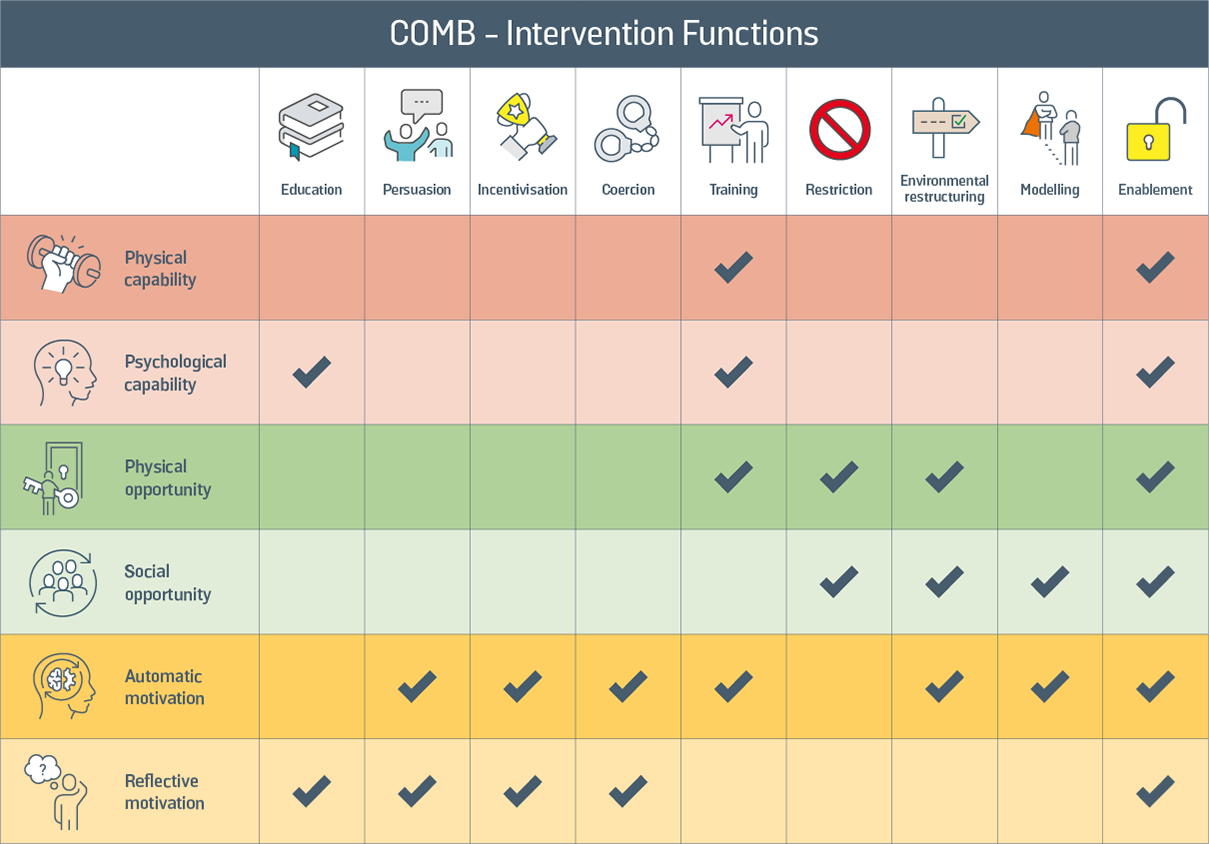
Figure 13a: COM-B Components Linked to Behaviour Change Wheel Intervention Functions (adapted from: [19, 23])

Each of the types of intervention function are further defined in the table below [25]:

Intervention FunctionsDefinitionsExamples
EducationIncreasing knowledge or understandingProviding information to promote better care for equids and create understanding about consequences.
Raise awareness of animal husbandry practices that support positive welfare states
PersuasionUsing communication to induce positive or negative feelings or stimulate actionUsing imagery and/or respected messengers to motivate increase in the feeling of how important your equid is.
IncentivisationCreating expectation of rewardHaving a system that rewards practising the desired behaviour, such as being celebrated as the owner of the healthiest equid.
CoercionCreating expectation of punishment or costAn animal owning community-based organization adopt bylaws that include financial consequences for members who mistreat their animals 
Working with law enforcement officers to punish those who mistreat or do not take good care of their equids.
TrainingImpacting skillsProviding trainings on how to communicate with the equids without whipping.
Provide training on handling or farriery techniques
RestrictionUsing rules to reduce the opportunity to engage in the target behaviour (or to increase the target behaviour by reducing the opportunity to engage in competing behaviours)Prohibiting using equids to carry loads over a certain weight, in relation to the equid weight to avoid overloading, or not using the equid without equid-friendly harness.
Environmental restructuringChanging the physical or social contextPrinting posters (even billboard) and pinning them in the environment as a reminder for the need to practice the desired behaviour. 
Encouraging equid owners’ associations or local administration to create/facilitate animal shelters at marketplaces to allow animals to rest comfortably after transporting goods to market
ModellingProviding an example for people to aspire or imitateIdentifying and using leaders or community change agents, who already practice the desired behaviour for others to copy them.
EnablementIncreasing means/reducing barriers to increase capability or opportunity.Providing social support groups, for people to feel part of similar group doing the same action or behaviour. 
Supporting animal owning groups to form groups to do bulk purchase of feed for their animals.
Table 13a - Examples: Providing information to promote better care of animals, raise awareness of animal husbandry practices that support positive welfare states

Part 2: Identifying Complementary Policy Categories 

Once you have identified the intervention function, the next step will be to explore if there are relevant Policy Categories that you can use to sharpen your strategy to help you embed the desired behaviour. The policy category can be used as part of your asks in the message you will craft when you are using this approach to identify gaps or to anchor your interventions direction even if you are not going to directly engage in policy advocacy work. 

[25]

Part 3: Identifying Behaviour Change Techniques Relevant to Selected Intervention Functions

Once you have identified the appropriate intervention functions and policy categories for each behaviour, create a table like the example below, and refer to the table of behaviour change techniques (BCTs) related to each intervention function provided below, and select the behaviour change techniques most likely to be appropriate to the community context in which you are working.

You can download the free Behaviour Change Techniques Taxonomy v1 application (BCTTv1) to support your identification of the most used behaviour change techniques relevant to each intervention function, or refer to the table below which provides definitions and examples behaviour change categories with examples.

S.N.Intervention Functions DefinitionBehaviour Change Techniques*
 
*All BCTs could potentially be considered for any intervention type, however the BCT’s listed here are those which have been most used and evidenced as effective for each type of intervention function within the behaviour change science literature.
Education: Increase knowledge or understanding·   Information about social and environmental consequences
·   Information about consequences of inaction/not adopting desired behaviour e.g., to animals and/or their owners Feedback on behaviour
 ·   Feedback on outcome(s) of behaviour
 ·   Prompts/cues
 ·   Self-monitoring of behaviour
Persuasion: Use communication to induce positive or negative feelings to stimulate action
 ·   Credible source
 ·   Information about social and environmental consequences
 ·   Information about consequences of inaction/not adopting desired behaviour e.g., to animals and/or their owners
  ·   Feedback on behaviour
  ·   Feedback on outcome(s) of behaviour
Incentivization: Create an expectation of reward ·   Feedback on behaviour
 ·   Feedback on outcome(s) of behaviour.
 ·   Monitoring of behaviour by others without feedback.
 ·   Monitoring of outcome(s) of behaviour without feedback.
 ·   Self-monitoring of behaviour.
Coercion: Create and expectation of punishment or cost ·   Feedback on behaviour.
 ·   Feedback on outcome(s) of behaviour.
 ·   Monitoring of behaviour by others without feedback.
 ·   Monitoring of outcome(s) of behaviour without feedback.
 ·   Self-monitoring of behaviour.

Training: Impart skills
 ·   Demonstration of the behaviour.
 ·   Instruction on how to perform the behaviour.
  ·   Feedback on behaviour.
  ·   Feedback on outcome(s) of behaviour.
 ·   Monitoring of behaviour by others without feedback.
 ·   Monitoring of outcome(s) of behaviour without feedback.
 ·   Self-monitoring of behaviour.
 ·   Behavioural practice and rehearsal
 ·   Instructions on how to perform the behaviour
Restrictions: Use of rules to reduce the opportunity to engage in the behaviorThere are no BCTs identified as ‘most frequently used’ for Restriction because BCTs are focused on changing the way people think, feel, and react rather than the way external environments limit their behaviour.
Environmental Restructuring: change the physical environment
 ·   Adding objects to the environment.
 ·   Prompts/cues.
 ·   Restructuring the physical environment.
Modelling: Provide an example for people to aspire to or emulate ·   Demonstration of the behaviour
Enablement: Increase means or reduce barriers to increase capability (beyond education or training) or opportunity (beyond environmental restructuring)  ·   Demonstration of the behaviour.
  ·   Social support (unspecified).
  ·   Social support (practical).
  ·   Goal setting (behaviour).
  ·   Goal setting (outcome).
  ·   Adding objects to the environment.
  ·   Problem solving.
  ·   Action planning.
  ·   Self-monitoring of behaviour.
  ·   Restructuring the physical environment.
  ·   Review behaviour goal(s).
  ·   Review outcome goal(s).
Table 13b Intervention functions (IFs) and frequently used BCTs

Next, use the APEASE criteria also provided in a table below to help you narrow your selection of behaviour change techniques. Although the APEASE criteria provides a structured way of narrowing appropriate BCTs, it is important to draw on local knowledge and your own expertise when selecting the most appropriate intervention functions and BCTs to be implemented in each context. When narrowing your selection, it is also helpful to consider the BCTs used most frequently before considering those used less frequently [21]. 

Once you have completed the activity, use the identified BCT’s which meet the APEASE criteria to inform the development of effective community engagement activities to address the barriers and motivators identified as needing to change. List community engagement project activities within the Step 5 column of the Behaviour Change Planning Table provided within the facilitator resources.

CriteriaDescription
AffordabilityAcceptable in terms of project budget. It does not matter how effective or even cost effective it may be if it cannot be afforded. An intervention is affordable if within an acceptable budget it can be delivered to, or accessed by, all for whom it could be relevant or of benefit.
PracticabilityExtent to which it can be delivered and designed through the means intended to the target population and ease of adoption by the community given the means available to them. 
You know, or have great cause to believe, that the barriers to adoption of behaviours hoped to be addressed by the intervention are not beyond the scope of project to address
Effectiveness and cost effectivenessEffectiveness refers to the effect size of the intervention in relation to the desired objectives within the local context.  It is important when weighing intervention strategy options to the extent to which the intervention will have a direct, significant impact on solving/reducing the severity of observed animal welfare issues and promote the adoption of desired behaviours, and whether it has potential to affect change in many welfare issues/behaviours, and/or have spill over/generalizability to other behaviours and people.  
Cost Effectiveness refers to the ratio of cost to effect. If two interventions are equally effective it is always recommended to pursue the more cost-efficient strategy. If one option is more effective but less cost effective, then other criteria such as affordability should be considered.
AcceptabilityAcceptability refers to the extent to which an intervention strategy will be judged as appropriate by relevant stakeholders. Acceptability may be different for different stakeholders.
Side effects/safetySide effects/safety refers to the extent a particular intervention may have unwanted side-effects or unintended consequences. Consider whether interventions may cause harm to animals, people, or the environment before deciding whether to proceed.
EquityAn important consideration is the extent to which an intervention strategy may reduce or increase disparities in standard of living, health, or well-being for different sectors of society.
Table 13 c APEASE Criteria - adapted from [21]

The table below provides an example of a completed behaviour change intervention functions and behaviour change techniques identified based on COM-B diagnosis findings for changing whipping behaviour in Kenya. Consider creating a similar table to support your own behaviour change intervention planning using the human behaviour change intervention planning approach outlined in this resource.

Behaviour Change Statement:  Guiding donkeys using verbal and body communication whenever donkeys are required to move.
Intervention FunctionCOM-B Component addressed by Intervention Function
(Refer step 3 column of the  Behaviour Change Planning Table
Most Relevant/Recently Used Behaviour Change Techniques (BCT)Does BCT meet the APEASE Criteria in the context of the desired behaviour?
EducationPsychological capability Providing information about the consequences of whipping.Yes, it is affordable, practical, acceptable, with positive side effects on improving and knowing what is needed to improve the health of the donkey
PersuasionReflective MotivationUsing dram/skits to highlight the benefits of guiding a donkey without whipping to elicit emotional response.Acceptable, practical, not so costly and can reach a wide audience of people depending on the delivery mode.
Environmental RestructureSocial OpportunityPutting cues/leaflets in visible places to remind the donkey users and the community on how to treat their animalsYes, affordable, acceptable and may lead to other additional benefits such as awareness on donkeys health and how to guide them
TrainingPhysical CapabilityTeaching the owners how to guide without whip, by using body languageAcceptable, practical, socially acceptable but may not be affordable as it requires one on one training of an individual
Table 13d Example of Completed Intervention and Behaviour Change Intervention Selection for Changing Whipping Behaviour in Kenya

Facilitator's Note:

It should be noted that this guidance focuses on identifying intervention functions from the behaviour change wheel, however the behaviour change wheel can also be used to identify policy categories to support the intervention. However, if barriers to the adoption of desired behaviours are identified amongst communities that may require policy level change, you may wish to consider conducting this activity using the behaviour change wheel’s policy categories as well, to identify those which best support delivery of the intervention functions [21].  

Consider downloading the BCTTv1app from iTunes or google play to further help you.

Link to References Cited


14. Overview of Community Group Formation Process, and Common Challenges and Factors Influencing Group Success

QUICK LINKS
14a overview of group formation process
14b Factors Influencing Community Group Success
14c Common Challenges in Community-based Organization Governance and Recommendations for Addressing Them

This resource outlines key information for community facilitators to support effective group formation and management including the process of group formation, key characteristics of successful community groups and factors influencing community group success, as well as common challenges and any advice for mitigating them.

Keyword Search Tags

Project Phase:
Planning Phase, Implementation Phase

Approaches for Working With Communities:
Community Development Approach

Project Support:
Facilitator Resources, Training

Specific Topics:
Group Formation/Strengthening

14a. Overview of Group Formation Process

The process of group formation begins with community mobilization. This entails engaging the community to come together to support a common shared interest and achieve a particular goal or objective.

The process of group formation was first outlined by psychologist Bruce Tuckman and describes how teams (or small groups) move through stages which are further defined below and include: forming, storming, norming, and performing, and adjourning (or mourning). The figure below illustrates Tuckman’s team development model, where each of the five stages of team development represent a step on the team-building ladder. As the group members climb the ladder, they move from a random assembly of strangers into a high-performing team or group capable of working towards a common goal.

Fig 14a: Process of Group Formation
(Adapted from [70, 111])

Fig 14a: Process of Group Formation
(Adapted from [70, 111])

The five stages of small group development are further defined below.

  1. Forming: At this stage, the individuals or community group members begin to know each other, understand the purpose of the team or group, and looking for direction from the group leader.
  2. Storming: At this stage, people start to push against the established boundaries. Conflict or friction can also arise between team members as their true characters – and their preferred ways of working surface and clash with other people
  3. Norming: People start to resolve their differences, appreciate one another's strengths, and respect the authority of their leader.
  4. Performing: The group is in flow and performing to its full potential. With hard work and structured processes, the team is likely to achieve its goals efficiently.
  5. Adjourning (or Mourning): Many groups reach this stage naturally. For example, projects come to an end, or permanent groups are disbanded, and people redeployed.

It should be noted this model and stages are not a one-way street. Groups may go back and forth between stages. For example, when a new group member joins a group it can disrupt the group dynamic, or when it decided to undertake a new collective action it may regress and need to re-evaluate the groups’ goals and members’ roles and responsibilities. Thus, when a group arrives at the performing stage, it is important to continue observing the groups progress and assess whether there is any regression which may need to be addressed.

Follow the steps below to support facilitation of a group’s progress through the stages of group formation and strengthening:

  1. Identify the stage that your group is at from the descriptions above.
  2. Consider what you/the group’s members and/or leadership can do to support the group’s progress to the next stage
  3. Schedule regular reviews of group progress and adjust behaviours and leadership approach accordingly.

14b. Factors Influencing Community Group Success

Factors influencing group success are outlined below [88] [112]:

Group Cohesiveness: factors influencing group cohesiveness influencing a group’s success, include:

  1. Similarities of Attitudes and Values: One of the strongest sources of group cohesiveness is the similarity in attitudes and values among group members. This plays a key role when focusing on a particular goal that the whole group believe in. Having a clearly defined group vision is therefore critical to group success.
  2. Size of the Group: Small groups are effective. The larger the size of the group, the less cohesive the group is. The main reasons for this are:
    i. When the group is small, its members have constant face to face contacts. Thus, there will be high degree of interaction and communication with each other. In large groups, the possibility of interaction among members is less.
    ii. As group size increases, it becomes more difficult to get the group to agree on common goals and activities and expression of disagreement and dissatisfaction increases.
    iii. Another problem with large size groups is that there is a likelihood of forming small groups within the large groups. This would result in the dilution of the common group goal thus increasing the extent of power politics play. This tends to decrease the overall cohesiveness.
    iv. Studies have shown that if all the members of the group are of the same sex, then small groups have better cohesion than large ones. But when the groups were made up of both males and females, the large groups have better cohesion.
  3. Time: It is quite natural that the more time people spend with one another, the more they will get to know each other and more tendency there will be to get closer to each other, thus, strengthening the degree of cohesiveness.
  4. Location: Location of the group plays an important role in determining the cohesiveness. Where members of a group are located close together separated from other groups, they will develop greater cohesiveness because of constant face to face interaction. Where there is no dividing line between one group and another, cohesion is more difficult to achieve because a chain of interactions develops.
  5. Difficulty in Entry: The more difficult it is to get in a group, the more cohesive that group becomes. The reasons are that in exclusive and elite groups the members are selected based on certain characteristics and these characteristics being common to all add to the degree of liking and attraction towards each other. The more exclusive the group the more is the closeness among members. As the groups are not easy to join, the selected members feel a sense of pride and accomplishment.
  6. Inter Dependency: When each member of a group has independent activities, the cohesiveness among the members of such group will be less as compared to the group whose members are doing the operations which are dependent upon each other, thus, mutual dependency leads to greater cohesiveness.
  7. Group Leadership Behaviour: The behaviour of the group leadership has a direct influence on the degree of cohesiveness that exists within a group. The leader can make close relations difficult by creating unhealthy competition among members. On the other hand, he can build solidarity by rewarding cooperative behaviour. The cohesive group can help attain the group goals more effectively, if the group members are properly inspired by their leader. A stable and accepted leadership structure. Comprised of honest individuals who demonstrate dedication and sufficient expertise/competency is therefore important to a group’s success.
  8. Member Turnover: To make a group more cohesive, there is need for some degree of stable relationships among members. The higher the degree of member turnover, the less cohesive a group becomes. this is because the more frequently members leave a particular group, the more time it will take for new and old members to get to know each other and re-establish trust and a willingness to cooperate.
  9. Threat: Common threats or challenges are a very powerful force which can unify community members and support group formation, particularly when:
    i. The perceived threat comes from outside the group
    ii. Cooperation can help over-come the threat/challenge, and
    iii. There is little or no change to evade experiencing the threat
    For example, when there is a perceived threat of poor leadership within a community, community members can become motivated to come together as united front to ensure the threatening party has less chance to succeed and take advantage of the community.
  10. Shared Goals and Previous Successes: When a group achieves a meaningful goal, the cohesiveness of the group increases because the success is shared by all the members and each one feels responsible for the achievement. If the group agrees on the purpose and direction of its activities, this serves to bind the group together. Having a common purpose/shared interest and well defined and agreed upon goals objectives is critical for group success. Regular review of vision, mission, and objectives is also helpful to promoting group success.
  11. Cooperation: Sometimes the general atmosphere of group enhances cohesiveness.

    In addition to effective leadership, factors which are important to promoting a positive group atmosphere and group cooperation include:

    • A comprehensive constitution and by-laws agreed by all members, where rules are in use/enforced
    • Having clear mechanisms for the sharing benefits and liabilities amongst members
    • Effective participation of group members, which can be supported by having clearly defined tasks, and membership responsibilities which are shared.
    • Effective participation of group members with equal representation of all members.
    • Strong interpersonal skills for team building
    • Effective and timely internal conflict resolution mechanisms.
    • Members respect each other.
    • Having regular meetings.
    • Having well established and agreed communication channels within the group, as well as for communication with non-members.

Other general group characteristics contributing to group success include [88] [112]:

  • Enhance welfare of other members.
  • Group resources are managed as agreed by group members.
  • Leaders are democratically elected at specified intervals.
  • All members are afforded an equal chance/opportunity of being elected leaders.
  • Group membership is clearly defined.
  • There is proper record keeping and documentation.
  • Transparency and accountability.
  • Continuous acquisition of new skills

In contrast, factors which can contribute to group failure include [88] [112]:

  • Poor leadership
  • Unclear vision/ objectives
  • Poor interpersonal relationship
  • Poor communication
  • Undefined tasks
  • A weak constitution /by laws
  • Non-adherence to constitution
  • Lack of mechanisms on sharing benefits
  • Poor participation
  • Weak conflict resolution and transformation mechanism
  • Unwillingness to acquire new skills
  • Weak interpersonal skills for team building

14c. Common Challenges in Community-based Organization Governance and Recommendations for Addressing Them

Examples of common challenges faced by community-based organizations are outlines below [88]:

  • Ineffective leadership by political, community and/or religious leaders
  • Inadequate political good-will from the leaders who are currently in office and out of office
  • Conflicts, infighting and splinters within groups
  • Conflict of interest by leaders, government officers, donor agencies, development partners and other stakeholders
  • External interference from technical officers, local and political leaders
  • Mismanagement and misappropriation of community project resources
  • Inadequate resources
  • Dependency syndrome
  • Inadequate organizational and management capacity
  • Poor governance
  • Low level of community participation and contributions
  • Poverty
  • Retrogressive culture
  • Hostile natural factors
  • Poor policy framework
  • Clannism/nepotism/tribalism
  • Illiteracy
  • Language barrier
  • Top – down approach to development
  • Differences in socio economic status
  • Dominance by influential community leaders (pioneer syndrome)
  • Differences based on gender and discrimination

In addition, the following challenges have been identified related to facilitating group formation and strengthening [112]:

  • May take long time.
  • If not managed well, might polarise/benefit a specific section of the community.
  • Misrepresentation of the group.
  • Conflicts may delay progress.
  • Might not address individual expectations.
  • Excluded members may sabotage.
  • Some individuals might dominate or have adverse roles.

Guidance for addressing some of these common challenges facing community based organization success are outlined below [88]:

  1. Lack of trust

Trust is crucial to teamwork, and it starts with people knowing each other. Group members need to be acquainted, both professionally and personally, particularly in projects where tensions will run high at some point. Otherwise, members won’t understand each other, they won’t want to engage because they haven’t made that human connection and they won’t fully trust each other.

  1. Conflict and tension

Conflict or a difference of opinion can be healthy and, if carefully managed, can trigger useful debates. It can make people think differently, expanding knowledge and insight; innovation can happen and results flourish. Different opinions within a group should not be seen as a bad thing. The group should put in place a mechanism to handle conflict whenever it arises.

  1. Not sharing information

Knowledge is not power – unless it’s shared. Group members all bring a unique set of skills, knowledge, experience, and wisdom to the table. Effective groups fearlessly share regularly and generously for the benefit of everyone and for the benefit of the project’s success. This makes the capability of the whole group grow and gives the group more power. Leadership should strive to ensure that information is freely shared among members.

  1. Low engagement

Group engagement is crucial to the group success. If engaged, group members will be interested in what they do, committed to the group mission and willing to go the extra mile. They are there in body as well as mentally and emotionally. The key to engagement is involvement – by involving others you make it impossible to stay detached.

  1. Lack of transparency

Without transparency, trust will suffer – both within the group and outside. Transparency is becoming the presumed norm in project and programme management and expectations are growing. It starts at the top: the more senior you are, the more responsibility you must be a role model for this. Group members will follow the leader’s behaviours, good or bad. When this is done well, it can have a positive cascade effect throughout the organisation.

  1. No long-term thinking

Group leaders must get beyond day-to-day urgencies, see the big picture, and consider how all parts fit together. For group members, this means being able to think beyond your own area, about how you fit into the wider group and how you impact the groups’ business. This is about group sustainability and long-term success. Everyone is busy, but just being busy is not enough. Long-term group success requires long-term thinking.

  1. Badly perceived, not delivering

A group has a brand, an image and a reputation created by the actions and behaviours of the group members. A large part of the perception is driven by how well the group delivers on expectations and promises made. Community facilitators and group leaders need to make sure that everyone understands and takes responsibility for their roles in creating the perception of the group. This includes both what is delivered by the group and how it is delivered.

  1. Poor change management

Change is constant and unless carefully managed, it can be detrimental to the group progress and results. Change starts and ends with communication. Whenever you think you’ve communicated enough, you need to communicate some more – and it needs to be interactive: listen, talk, and involve. Be aware of the change curve, or the four predictable stages of change: denial/resistance, emotional, hopeful, commitment. Each stage is needed, but how long someone stays at each stage can be managed and kept to a minimum.

  1. Working in silos

Silo working is a reality for many groups. Group members may sit side by side but not really work together. A great group can be like the three musketeers – all for one and one for all. So, if you are in a group, you may as well really be in it. Working together in earnest is about making the most of the fact that you are a team. Honour your time and efforts by seeing yourself as a full-time member of the group, not just an individual contributor.

  1. Not going in the same direction

To walk in the same direction, a group needs to know where it is going or what it is contributing to (vision) and why (purpose). Spend time on this with your group. This clarity provides a framework and ‘reason to be’ that can rally any given group to work together. Keep in mind that visions need to be compelling and purposes meaningful. People respond to the importance of both.

Link to References Cited


15. Templates Supporting Community-based Organization Governance

QUICK LINKS
15a: Components of Community-based Organization Constitution
15b: Community-based Organization Group Maturation Checklist
15c: Community-based Organization Group Record Keeping Templates

This facilitator resource provides example templates that community-based organisations can adapt to support their governance and promotion of minimum standards required for operating as community organisations.

Keyword Search Tags

Project Phase:
Implementation Phase, Exit & Evaluation Phase

Approaches for Working With Communities: Community Development Approach

Project Support: Facilitator Resources, Documentation and Reporting

 Specific Topics: Group Formation / Strengthening

15a: Components of Community-based Organization Constitution

The components of a community-based organisation (CBO) constitution you may wish to consider including are listed below. If seeking formal recognition of CBO designation my local authorities/governments, it is important to understand the legal requirements for CBO constitutions ensure any constitution developed meets these legal requirements. 

  • Name of Community Based Organisation (CBO)
  • Purpose of the CBO Constitution
  • Objectives of the CBO
  • Area of Operation
  • Applicable Legislation to the CBO Constitution
  • Members of the CBO
  • Composition of the CBO
  • Annual General Meetings
  • General Meetings
  • Resolutions, Voting and Powers at Annual and General Meetings
  • Procedure to be followed at CBO Meetings
  • Finances of the CBO
  • Powers and Authorities of the CBO including the power to
    • Call General Meetings
    • Acquire property and Assets
    • Manage finances and Fundraising
    • Engage in contracts and Partnerships
    • Employ Staff
  • Duties and Obligations of the CBO
  • Indemnity - security or protection against a loss or other financial burden
  • CBO Discretion- Having the freedom to decide how things should be done
  • Signatures- the action of signing a document as a sign of agreement or being bound by what is in the document.
  • Legal Personality- In law, a legal person or 'thing' (less ambiguously, any legal entity) that can do the things a human person is usually able to do in law – such as enter contracts, sue, and be sued, own property, and so on.
  • Amendment of the Constitution and Dissolution of the CBO
  • Dispute Resolution
  • Termination
  • Annex 1: List of Members of the CBO
  • Annex 2: Mandate from the Community (formal agreement from community authorities/members that CBO represents their community interests in the agreed upon area(s) of interest)

15b: Community-based Organization Group Maturation Checklist

The checklist below is an example checklist of common indicators a community-based group has reached maturation and is well-functioning. Community facilitators are encouraged to use or adapt this checklist to their local context and needs.

Group Maturation IndicatorRating out of ten
1Does the group hold regular meetings according to its constitution 
2Attendance of the group meetings (is it 70% and above) 
3Active participation of members in group activities (such as savings) 
4Does the group have a constitution (and is it fully, or partially implemented) Having a constitution (5 points), Full implementation (5 points)  
5Group governance structures are functional   
6The group keeps its records well, (both program-activity and financial records) 
7All decisions made by most group members in accordance with the constitution 
8All members share in the goals and objectives of the group  
9Group members undertake regular development (or skill upgrading programs) 
10Group members composition is sensitive to gender, and other marginalized groups 
Total100

15c: Community-based Organization Group Record Keeping Templates

Group Membership Register

The below is a sample of group memberships register (that can be adapted to accommodate different group’s needs). The template below is for purposes of providing an example only and should not be wholly adopted.

Date of registrationFull NameIdentification document numberAddressRemarks- Paid up membership
     

Community/Group Meeting Minute Template/Content

Meeting Minutes “Minutes are the notes taken whenever a group meets. The Secretary of the group is usually responsible for writing these minutes. The minutes should include:

  • The date of the meeting
  • The place for the meeting (for example, a health centre or school)
  • The title or purpose of the meeting or activities
  • The agenda of the meeting
  • The names of members present, as well as those absent
  • What was talked about
  • What decisions were taken, who will be responsible for carrying out the decision, and by what date
  • What will be done in the future as follow-up

Meeting Attendance Record Template

  • Date of the meeting.
  • Agenda of the meeting
  • List of attendances – as provided in the table below.
NoNameIdentification document numberSignature or thumb print


Meeting discussions.

  • Agenda
  • Deliberations
  • Action points (who, what when) 

Group Financial Record Keeping Template Content

A sample financial record template is provided below; it is not exhaustive as several templates maybe required for group financial record keeping.

Activity DateMoney received (+)Money spent (-)Transaction Description/ Purpose (deposit/expenditure)Cash Account BalanceBank Account Balance  Signatures of Authorizing Parties + Witness  
11/11/2021  Paid for community hall for animal welfare training for 30 group membersUSD 30 Treasurer Signature: Chairperson Signature: Witness Signature:

16. Community Visit Record and Report Template

This is a simple community visit record template for change agents (or staff), to support them with documenting their work. The template captures key insights and observations, progress, challenges, and follow-up actions. The intention is to enable community change agents to easily record and track the projects. These templates are samples and they can be adapted to fit your context.

Keyword Search Tags

Project Phase:
Initiation Phase, Planning Phase, Implementation Phase, Exit & Evaluation Phase

Approaches for Working With Communities: Community Development Approach, Community Engagement Approach, Societal Outreach and Campaigns Approach

Project Support: Facilitator Resources, Documentation and Reporting

Specific Topics: Community Change Agents

Community meeting discussion notes should include the following suggested report structure. This can be further adapted depending on the need. Depending on the literacy level of community change agents, these contents can also be captured in audio or audio visual mechanisms.

  1. Introduction
  • Background
  • Objective of the meeting/visit
  • Name, number and Composition of participants (gender – males/females participants)
  • Name of Community change agent(s) or Staff member who visited
  • Date and venue of the visit
  • Was it a home to home visit or a group visit or event (The place of visit/engagement (for example, a health centre or school, etc.)?)
  1. Process and Approach
  • Methods used to actively engage participants (ensuring men’s and women’s active participation)
  • Participatory/C4A Tools used (if any)
  1. Key Discussion Points and Actions
  • Emerging themes from the conversations
  • What decisions were taken, who will be responsible for carrying out the decision, and by what date?
  • Future as follow-up actions
  • Summary Action points documented by visiting Community Change Agent or Staff member
Key discussion PointsAction points by community membersAction points by the change agent/Brooke (follow up)
  1. Observations and key reflections by visiting Community change agent or staff member(s)
  • Did the place and time work well for the conversations? Why/why not?
  • What went well? What did not go so well? Why? How can this be improved?
  • Any notable story of change that require follow up or documentation by Brooke/Partner

Annex

    • Participant list
    • The community conversation process in pictures

        17. Ideas for Structuring Community Meetings to Promote Reflection and Learning

        This resource is to support project teams in structuring their regular meetings with animal owning community members/change agents so as to promote reflection and learning, generate motivation for change, support community members’ progress through the stages of change, and generate opportunities for peer-peer learning.

        Keyword Search Tags

        Project Phase:
        Implementation Phase

        Approaches for Working With Communities: Community Development Approach, Community Engagement Approach

        Behavioural Drivers (COM-B):
        Capability, Motivation

        Stages of Change:
        Contemplation Stage, Preparation Stage, Action Stage, Maintenance Stage

        Project Support: Facilitator Resources

        Specific Topics: Community Change Agents

        To maximize on the meetings with the community, the community change agents can follow the following ideas and adapt as they go along. 

        For meetings involving community change agents: 

        • Start the meeting with each person having a chance to talk about what is going well – this starts you out with a positive tone.
        • Have people pair up and spend 5 mins each talking about 1) what goal they set for last period and status of achievement, and 2) about their experiences and critical learnings over the past month without being interrupted and without being given advice (This provides people a period to follow their own train of thought from beginning to end). Each person who listened must summarize interesting points to share with group when finished (1 minute summary, use timer for cut off) (good for promoting listening). 
        • Use the following questions to guide group discussion:
          • What have you accomplished in the last month? / What’s happened since we last met regarding…
          • What has worked for you in terms of motivating people to change their practices/adopt new behaviours?
          • What is the status of your target peers? – Stage of change, what are they succeeding with – why?/where are they facing challenges - why?
          • What things have you been asked that you don’t know answer to or have found challenging in carrying out your role? 
        • What support or knowledge/skills would support you in being able to address this? 
        • Where do you experience difficulties affecting change? - greet failure as an opportunity to build understanding, and focus on affirming the effort rather than the result

         “If we consider failure to be unacceptable, then learning is not possible – and then failures will continue.” 

        • Ask for group input on how they have dealt with similar challenges successfully
        • Discuss solutions to trial
        • Negotiated behaviour change – what are things people are resistant to changing despite your/their best efforts? – why do you think this is?
          • If no change is believed possible, discuss potential alternative behaviours that could be promoted/adopted instead to meet their animals’ welfare 
        • Discuss skills/capacity building need requests for next meeting – vote on priority
          • After trainings - make action plan for applying lessons learned. 
          • In follow up meetings, reflect on the experience of applying previous training to address specific issues/challenges discussed, and 
        • Set action plan and goals for next month – can do as group and/or individually if different, ensuring they share back to group if done individuals.

        The figure below provides key areas that the community facilitators can harness to engage the community and promote lasting behaviour change. 

        For meetings involving change agents + their peer groups: 

        • Start by asking for community members to share testimonials about their/others behaviour change experience. Consider focussing on sharing one or more of the following topics:
          • RELATIVE ADVANTAGE: how advantageous/disadvantageous is new behaviour
          • COMPATIBILITY: how is this ask/new behaviour compatible with personal or societal values and beliefs, availability of resources (time/fits w/in routing, money, equipment)
          • COMPLEXITY:  what is the level of real or perceived difficulty - how overcome?
          • TESTABILITY or OBSERVABILITY: provide first-person experiences or first-hand knowledge/experiences have you observed
        • Compare results of Animal welfare transect walk (T22) – highlight most significant change, no change – discuss why successful, why no change, and identify motivation/barriers to adoption if not known (consider brainstorming activity). If this tools is not used by all but other tools have been commonly used, alternatively depending on the specific welfare issues/owner’s behaviour they have been following up, compare results using that.
        • Discuss solutions – what can people change, set new goals as group
          • If no change is believed possible, discuss potential alternative behaviours that could be adopted instead to meet their animals’ welfare needs (refer to the five domains)   
        • Prioritize new indicators for action if some already addressed 
        • Individual changes – changes in level of awareness, attitudes, behaviour
        • Societal level changes – aggregate changes, most significant change, less outbreaks of disease, infrastructure installed/improved/managed, collective actions
        • Understand why successful or not – key questions
          • How was info delivered when adopted/not adopted
          • Which things adopted – where successful and why?
            • Ask why adopted when successful
            • Reflect on how tailored to needs of community

        18. Community Change Agent Personal Action Plan Template

        This is a template for community change agents to use as their personal action plan. 

        Keyword Search Tags

        Project Phase:
        Planning Phase, Implementation Phase

        Approaches for Working With Communities: Community Engagement Approach

        Project Support: Facilitator Resources, Documentation and Reporting

        Specific Topics: Community Change Agents

        It is important for the community change agent to plan beforehand when going to the community. This provides them with the framework to effectively engage the community and document the process, while also indicating the action points for future follow ups.  The table below is an example of a template that the community change agents can prepare beforehand when going to the community.  One of the roles of the community change agents is to organize the community. The process of organizing the community entails. 

        • Step 1: Mobilizing and orienting the community
        • Step 2: Building the relationships, trust, credibility, and a sense of ownership with the community through planning. 
        • Step 3: Inviting the community to fully participate
        • Then, in step 4: Form the community action group (CAG). 

        The table matrix below can be used to plan for community mobilization by the community change agents.

        DateVenueActivity Objectives Resources required Responsible person Indicators

        After community mobilization, the change agents need to plan with the community orientation/engagement process. The table below can provide a guide on how the community change agents can plan for the community engagement/orientation process in advance. 

        Community planning

        The goal of the community planning__________________

        OBJECTIVESBARRIERS/
        OPPORTUNITIES
        STRATEGIESACTIVITIESPEOPLE
        RESPONSIBLE
        RESOURCESTIMELINEINDICATORS OFSUCCESS
        What do we want to achieve specifically related to the animal welfare issueWhat challenge do we think we will face in trying to achieve this result?How are we going to achieve our goal?What are we going to do to achieve the result?(Activities)Who is responsible for each activity (ADD HERE NAMES OF PERSON[S])What resources do we need to achieve the result?When? How long is needed for each activity?(From____ to_____)How will we know when we have achieved the result?(Measurable, observable outcomes)


        At a personal level, the community change agents can use the below template (adopt as necessary) to plan for their activities, either in the community or at the household level.

        Personal Action Planning Worksheet

        The Table is adapted from [127]

        Link to References Cited


        19. Community Action Plan Template

        This resource provides a community action plan template for community groups to document their priorities and identified solutions/actions to achieve the animal welfare improvements and associated actions to change their behaviours based through their collective reflections using participatory learning and action activities. Some of the participatory tools that are relevant prior to using this template are T34 Community Animal Welfare Action Planning, T33 Community Animal Welfare Needs Assessment, T22. Animal Welfare Transect Walk, T8 Pairwise Ranking and Scoring, T9 Matrix Ranking and Scoring.

        Keyword Search Tags

        Project Phase:
        Planning Phase, Implementation Phase, Exit and Evaluation Phase

        Approaches for Working With Communities: Community Development Approach

        Stages of Behaviour Change:
         Preparation Stage, Action Stage, Maintenance Stage

        Project Support: Facilitator Resources, Documentation and Reporting

        Specific Topics: Group Formation/Strengthening

        The community will go through a process of identifying the different animal welfare issues, prioritizing them, and using the template provided below to document the results of their reflections and decisions.

        Facilitation Notes: 

        The table can be filled after 

        ·   After communities identify and ranked them in order of importance, pick the prioritized animal welfare issue. Document the identified major root causes and let them discuss and identify the actions/behaviours or solutions. Such actions need to be owned by the community members to tackle them at community/group level or at each group member’s household level. Ensure appropriate participatory process of exploration, learning and reflection takes place before coming into agreement and developing/populating the community action plan. The developed action plan needs to be monitored, and members should be encouraged to be accountable and also express challenges they encountered.

        It is important to note that some of the proposed actions may have been tried out previously by the equine owners with minimal or no success, hence the facilitator should probe further to ensure participants reflect through any previous actions and what was the gap and settle on the actions with greater chances of realising the changes anticipated.

        ·     This document will serve as a living document to plan action as well as to continue to re-prioritize actions to be taken by the group on their own or in conjunction with other external stakeholders that will support them to execute the actions they have identified. It is thus important for facilitator’s to frequently remind community members to review developed action plans and report back or adapt them based on emerging needs and changes.

        ·       *one prioritized issue can have more than one action; so add rows to identify and each action can be monitored by different stakeholders and have different success indicators

        ·       * Actions – could include a specific behaviour/actions they agreed to take individually and/or collectively.

        ·       *frequency could include community members checking/supporting each other as part of peer support to provide practical or/and emotional support to one another

        ·       Timeline – when the identified action is done and when it needs to be reported

        ·       *who is responsible is taking the action and they need to report back when the group meets again/in the group meetings; this could also be used as a behaviour change technique of monitoring each other’s practice of a desired behaviour

        Resource adapted from [136]

        Link to References Cited


        20. Project Action Tracker

        This resource includes three example trackers you may wish to use to support your work. These are designed for community engagement staff, as a way to record key discussions from community visits, track progress, and capture outcomes. Using trackers will help you to:

        • Be accountable to the communities you work with
        • Provide the support requested by communities during your visits
        • Keep track of actions and ensure that they are completed on time
        • Evidence progress and requests for further support from your organisation or potential partner organisations
        • Report to donors more easily

        Each of these trackers are suggestions only, and should be adapted and used as is appropriate for your team and context. It may not be appropriate or required to use some of these trackers for all projects so you can pick and choose as is helpful for your work.

        Keyword Search Tags

        Project Phase:
        Initiation Phase, Planning Phase, Implementation Phase, Exit & Evaluation Phase

        Approaches for Working With Communities: Community Development Approach, Community Engagement Approach, Societal Outreach and Campaigns Approach

        Project Support: Facilitator Resources, Documentation and Reporting

        1. Team Action Tracker

        The Team Action Tracker keeps a record of actions to be taken by staff/partner staff teams to support identified animal welfare issues. The tracker is informed by PLA activities and directly supports the community action plan.

        The tracker should be populated and updated by community engagement staff. It helps to track which animal welfare issues were identified, using which PLA tools, and captures the follow up actions to be taken by the team to both support the community action plan.

        Animal Welfare IssuePLA Tool UsedProposed team actions / follow upTimeline / DeadlineStatus / UpdatesOutcomes
        Tetanus - interest in group vaccinationsT8 Pairwise ranking
        (Prioritisation exercise)
         
        Date: 
        Follow up in next session to see if the LSP has been contacted and how many animals have received vaccines. Next sessionComplete25 donkeys vaccinated on 12th June 2019
         
        Second visit proposed for 15th August 2019
        Limited water for animals & people – potential water project?T17 ‘If I were an animal’
        (Issue identification)
         
        Date:
        Research water saving projects/programmes within the area to be able to present the community with linkages and/or ideas during the next session.
         
        Find out if/when there are any plans to build a water source closer to the community. If there is no plan, investigate the potential for one.
        Next sessionUnderway but not complete due to staff absence.
        Poor hoof care due to lack of handling and hoof care knowledge/skillsT21 Animal welfare practice gap analysis
        (Root cause identification)
         
        Date:
        Speak with farrier and Animal Health team to arrange sensitization/training session on proper hoof care and humane handle by 30th of June.
        T6 Seasonal calendarDiscuss fodder storage in next session
         
        T4 Daily activity schedule in next session to understand when men and women are available
        Next session, by the end of June.
         (Issue identification)
        Colic
        Flu (nasal discharge)
        Hoof problems
        T9 Matrix scoring & rankingInvite a vet to sensitize on colic (1st priority) during next community meeting.

        2. Project/Regional Action Tracker

        The Project/Regional Action Tracker is designed to collate information from across communities to inform project/regional planning. Information included within the tracker is populated with information taken from PLA activities and community action plans from within the project/regional operational area. The Project/Regional Action Tracker can support with identifying the scale of different issues, tracking different actions/strategies planned, and recording ideas for actions to take/improvement which should be further explored. The goal is to help teams keep track of outcomes of activities with communities for greater strategic coordination and support for planning and development of projects. The utility of this resource will depend on the scale of the project/programme and may not be needed in all project contexts.

        Animal Welfare IssueRegions & communities where issues was identified as priorityKey actions / strategies to takePerson responsibleTimeline / DeadlineAdditional actions / Ideas for improvementStatus / Update
        FeedingHalaba: 17 communitiesRegional training on proper feeding practices scheduled for 30th May 2019


        Drought (water shortage)Dodola: 14 communities ·         Speaking to WaterAid about opportunities to link communities with water savings programmes

        3. Staff Action Tracker

        The Staff Action Tracker is designed to support community engagement staff to document their community visits, activities, and action points for follow up.

        Staff Name:

        Community/site:
        Visit/ Meeting DateNumber of participants and equines targetedCommunity engagement activities
        Key topics/issues discussed (incl. follow up on progress of action points/results identified in previous meeting/visit)
        Identified action points and results expected to be achieved by community
        Persons responsible + expected achievement date
        Identified actions for staff
        Person responsible + expected achievement date
        Status / Update
        06/06/2019# Participants: 
         
        # Equines: 
        T5 Gender roles & responsibilitiesAction point/result expected: 
        1.    Share stable cleaning activities
        Action point: 
        1.    Sensitization on hoof care & possible handling for women 
        2.    Follow up on how sharing of stable cleaning activities are going
        Staff responsible: 
        Expected achievement date:
        07/06/2019# Participants: 10
         
        # Equines: 
         
        T15 Cost-benefit analysis – not over-loading
        ·         Implementation costs
        ·         Cost on animal
        ·         Cost on HH if adopted or not
        ·         Benefits of mixed feed
        Action point/result expected: 
        1.    Reduce from 10 quantal/3 trips to 8 quantal/4 trips
        2.    Buy wheat bran in bulk to reduce cost (10 birr to 8.6 birr / kg)
        3.    Focus on balance loading 
        Person responsible: Fanos & Azamach
        Expected achievement date: Meet to discuss in one week
        Action point: 
        1.    Check with animal welfare team that reduction in amount over more trips is good welfare
        2.    Make plan to collect money for bulk purchase of feed
        3.    Support selection of money managers
        4.    Provide support/training on cart balancing & feed mixing
        5.    Sensitizing shop keeper about over-loading
        6.    Identify feed sellers who are willing to sell in bulk for reduced cost
        7.    Revisit for support planning in 15 days
        Staff responsible: 
        Expected achievement date: 
        07/06/2019# Participants: 
         
        # Equines: 
        T14 Group inter-loaningAction point/result expected: 
        1.    Carry out activity in smaller groups
        Action point:
        1.    Evaluate seed money strategy – focus seed money on direct equine-benefited activities
        07/06/2019# Participants: 10
         
        # Equines?
        T15 Cost-benefit analysis – not over-loading: 
        ·         Implementation costs
        ·         Cost on animal
        ·         Cost on HH if adopted or not
        ·         Benefits of mixed feed
        Action point/result expected: 
        4.    Reduce from 10 quantal/3 trips to 8 quantal/4 trips
        5.            Buy wheat bran in bulk to reduce cost (10 birr to 8.6 birr / kg)
        6.            Focus on balance loading 
         
        Person responsible: Fanos & Azamach
         
        Expected achievement date: Meet to discuss in one week
        Action point: 
        1.    Check with animal welfare technical support staff to evaluate potential welfare implications of community’s proposed action. 
        2.    Revisit for support planning in 15 days
         
        Staff responsible: TBD, consult with AHM and UK AW team 
         
        Expected achievement date: TBD

        21. Example Questions for Evaluating Project Success

        The resource is intended to support community facilitators design evaluation questions to track the implementation, progress and outcomes of the animal welfare improvement project/behaviour change processes. The resource can be used when developing community project participant’s individual interview or focus group discussion guide. The sample questions explore community vis-a-vis individual level household changes; group sustainability; and tracking behaviour change from the stages of change perspective. Note these are not exhaustive and need to be adapted to fit to your programme/project/context needs.

        Keyword Search Tags

        Project Phase:
        Exit & Evaluation Phase

        Approaches for Working With Communities: Community Development Approach, Community Engagement Approach, Societal Outreach and Campaigns Approach

        Project Support: Facilitator Resources, Monitoring and Evaluation

        Sample Questions for assessing animal welfare changes/impact at the community level

        • It could be helpful to start with questions which encourage the respondent to easily respond to e.g.
          • Why did you get involved in this project? What did you find the most interesting about this project?
          • What was the most difficult part for you? What could be done differently to make this project more successful in the future?
        • You can ask them to recall and explain what things were like before – and then ask them to explain how they are now. Eg) How were animals in your community before this project started? Probe: Were they happy? Why? Did they look healthy? Why? Did they have the things they need? What did/didn’t they have?
          • Then provide a follow on question, Eg) How are things for animals in your community now? Why? Probe: Do they have what they need? Do they look healthy? If yes, why? If no, why not?
        • Do people do anything differently with their animals now? Can you give some animal welfare related actions being carried by the community?
        • Are change agents (if being utilized) playing an active role in supporting your community? In what ways? What do you think they could do differently?
        • Is there a collective understanding amongst community members of the major animal welfare issues and how to address them?
        • What are the animal health service providers available in your area? Do these local service providers provide quality services to the satisfaction of community members? Probe: Are group members seeking the help of animal health services? Are local service providers responsive to community requests? Does the responsiveness differ based on people’s gender or socio-economic status? Can you provide examples?
        • Are community/group members seeking animal welfare related services proactively and in a timely manner? Can you give examples?
        • Are men, women and children in families who own animals all aware of their animals’ welfare issues and participate in activities that are important to improve and maintain good welfare?
        • What kind of actions have been taken in your community to ensure better animal welfare improvement is achieved? (Probing questions depending on your focus issue: What examples of community-led animal disease prevention measures are being carried out on appropriate timelines e.g., vaccines and boosters? Are appropriate measures to ensure clean and comfortable environments for animals in place? Are community members engaged in the project have a good knowledge of appropriate and welfare friendly gear? And use them on their animals? e.g., harnessing, saddle-fitting, cart balance and loading, are animals handled in ways that are safe? (Which doesn’t not prevent their development or creates risk of injury. What are the animal – owner/handler interactions? What are the wound prevention or/and management practices in your area? Have you seen changes on that?).
        • What changes in access to and availability of resources do communities perceive have resulted from their involvement in the project?
        • Have there been any benefits to the community from this work? Probe: Can you give specific examples?
        • Have there been any negative consequences on the community from this work? Probe: Can you give specific examples?

          Sample questions to ask when assessing group sustainability (if the project included Equine Welfare Group Formation)

          • Is your community different after forming a group? If yes, in what ways? If no, why do you think this is?
          • Is the group registered? Is your group functioning well with regular documented meetings? Have there been changes in leadership of your group? Are men and women part of the leadership and membership?
          • Is conflict resolution mechanism in place, has been used and the outcome recorded in village registers?
          • Are there examples of collective actions that have been undertaken by the group to meet their animals’ needs and are these recorded in the records of the community group e.g., collective feed purchases, vaccine campaigns, advocacy with government agencies to address their animal needs? 
          • What are the successful animal welfare improvements that were achieved through your collective/group actions? What were your group’s actions to encourage your members to change their behaviour to improve animal welfare? Were there mechanisms that your group established to change your members' behaviour to improve animal welfare? Can you give us examples? Can you tell us more about this? 

            Sample Questions for Assessing Changes/impact at the individual level 

            • Are all members of your family aware of your animal’s welfare issues? Probe: Your wife/husband? What about your children? Probe: What do they each do for your animal’s welfare?
            • Have you learnt anything new since being part of this group/work?
            • What are the changes you have seen in your animals, give examples/specify
            • What are the practices you have adopted at home that has are helping you improve the welfare of your animals? Give examples.
            • What kind of support have you received from Brooke/partners or change agents?
            • Do you do anything differently with your animals now, after being part of this project: Probe: Can you give some examples? Why didn’t you do the things that you do now with your animal, beforehand? What stopped you from doing things with your animal the way you do now, before this project started? What helped you to change your practice or what is a challenge for your not to change your practice? What do you want to know more or practice more to improve your animals’ welfare?
            • How would you rate your rate of motivation to continue to practice the new targeted behaviour?  Do you intend to keep caring for your animal in the ways you do now? If yes, why? What could make it difficult to do this? If no, why not?
            • What are the prompts and triggers to adopt the new behaviour you identified? [learning questions for reflection and for future programme/project intervention design]
            • Were you able to identify something that would help you to sustain the desired targeted behaviour? And what is it?
            • Have you faced unforeseen challenges? If so, what are the unforeseen challenges have you faced?
            • Is there any resource/time implication of adopting the desired new targeted behaviour when compared to the old practice? Probe: Do you think this will impact whether you continue to do this?
            • Vulnerable groups’ targeted question: Have you encountered any specific challenges to your gender/situation or position as a result practising this desired behaviour? e.g., making decisions to take the animal to be treated, deciding to pay to a service?
            • Has it been difficult to continue/maintain the new ways of treating and working with your animal? If yes, why? If no, why not? What or who made it easier for you to keep up these ways of working? What or who made it difficult to maintain the new changes? What kind of support do you still require to maintain/continue with practicing the desired targeted behaviour?
            • Have you started experiencing the benefits of animal welfare to your livelihood and the associated desired behaviour change?

              Tracking Behaviour change using Stages of Change Model

              As part of working towards behaviour change, it is important to track progress towards the realization of the desired behaviour. You can use the below questions to monitor progress or as part of overall project evaluation. The below points/questions can help you to check whether you were successful to introduce change within each stage of change. These suggested indicative questions (not prescriptive and exhaustive) can be used for FGD, KII, and within surveys/interviews, or can be included as a follow up of various participatory tools that can be used for evaluation phase. You can also ask these questions retrospectively once the groups/individual project participants progress to the next stage of change to understand the change progress as part of your learning.

              Pre-contemplation and contemplation (following Conception phase): 

              • Have community/individual’s knowledge and understanding about animal welfare improved? Do they identify the gap in practice on animal welfare now?  You can probe this by asking:- Can you explain what animal welfare means to you? Follow on: What was the standard of animal welfare in your community before this work started/your group formed? Probe: Why was this the case?
              • Have they become aware of what animal welfare concerns are there in their locality/individual homestead? Probe: Can you provide examples?
              • Are community/individual’s’ able to link their/o/u/c problem behaviour with the animal welfare gap.
              • Has the capability (physical and psychological) and motivation (Reflective motivation) of o/u/c changed after the intervention?
              • What is the belief system of the community/individual about the possibility of change? What is their change talks?
              • Did their value system change because of the intervention [during conception /planning phase] and/or your organization contribution or that of the CCA?
              • How would they rate (individual or collective depending on your availability of resource and relevance) their motivation for change? This will be asked retrospectively as part of overall evaluation, or as a question at the end of the first phase? If asked at the end, this could be clearer: “How would you have described your motivation for change at the beginning of this process?”
              • What kind of steps/actions they are willing to take or have taken so far?

                Preparation 

                • How would they rate their motivation to adopt the new desired targeted behaviour? 
                • What is your current understanding about the relationship between the problem behaviour and animal welfare practice gap; and how can you change this?
                • Did their value system change because of the intervention [during conception /planning phase interactions] and/or your organization contribution or that of the CCA?
                • What kind of steps/actions they are willing to take or have taken so far?
                • What kind of support has they received? e.g. Action plan development trainings, etc.
                • Have they (group and/or individual) developed action plan to act?
                • What were their barriers to develop action plans before the start of this programme/project? Have these barriers changed? How would they link your programme/project/CCA helped/contributed to reducing the barriers?

                What were their barriers to develop action plans before the start of this programme/project? Have these barriers changed? How would they link your programme/project/CCA helped/contributed to reducing the barriers?

                  Action 

                  • Did they find their action plans relevant to their reality when trying to implement them? (This shows doing good COM-B analysis helps in identifying potential barriers and adaptive programming with SI can further help the community/individual to get the relevant/appropriate intervention to help the shift to take concrete actions to perform the desired behaviour change).
                  • What are the prompts and triggers to adopt the new behaviour you identified? [learning questions for reflection and for future programme/project intervention design]
                  • Were you able to reinforce the supporting behaviours that will help you to sustain the desired targeted behaviour? Probe: Can you provide specific examples?
                  • Have you faced unforeseen challenges? If so, what are the unforeseen challenges have you faced? 
                  • Is there any resource/time implication of adopting the desired new targeted behaviour when compared to the old practice? 
                  • How would you rate your rate of motivation to continue to practice the new targeted behaviour? [for survey or FGD or KII]
                  • Vulnerable groups’ targeted question: what kind of actions were you to take? Have you encountered specific to your gender/situation or position? E.g. making decisions to take the animal to be treated, deciding to pay to a service? 
                  • Have you faced any safeguarding issues when practicing this new targeted behaviour [This is particularly relevant when part of the socio-economic and COM-B analysis/gender analysis has shown that it is a hindrance for animal welfare or a prompt/favourable social norm for animal welfare practice without being exploitative of individuals/undermining their dignity and rights]
                  • Who helped you to continue to continue overcome your challenges/distractions to go back to the old way? Did you have supporting relationships or mechanisms?

                    Maintenance

                    • How long were you able to hold of the maintenance of performing the desired targeted behaviour?
                    • Have you seen the benefit in practicing the new desired targeted behaviour?
                    • Who helped you to continue to overcome your challenges/distractions to go back to the old way? Did you have supporting relationships or mechanisms?
                    • What kind of support do you still require maintaining the desired targeted behaviour?

                    Termination

                    • How long were you able to maintain/sustain performing the desired targeted behaviour?
                    • Did you have supporting relationships or mechanisms or incentives to perform the desired behaviour and to improve your animal welfare practice? What or who helped you to continue to continue overcome your challenges/distractions not to fall back to the old ways of handling/managing/using your animal? 
                    • Have you started communicating the benefits of animal welfare to your livelihood and the associated desired behaviour change to your friends, family, etc.?

                      Facilitation Notes

                      Facilitator needs to create an enabling safe space for people/groups who are marginalized to express their lived experiences regarding the different barriers they faced and how they have found the project to help them maintain human behaviour change that benefits their animals’ welfare improvement and also theirs and their family/community lives. Meeting invites to such meetings need to ensure both genders be able to meaningfully participate and for their views to be heard to determine the next steps.

                      It is important to note that such discussions with communities should be voluntary and use ethical standards which includes informing the participants why they are selected, the purpose of the discussion/interview, that their views won’t affect their involvement in the project and how the interview/the discussion will be take and the purpose of the meeting should be clearly communicated to them. The following tools may also be used to support the evaluation of project success: